WORLD
WORLD
Otava
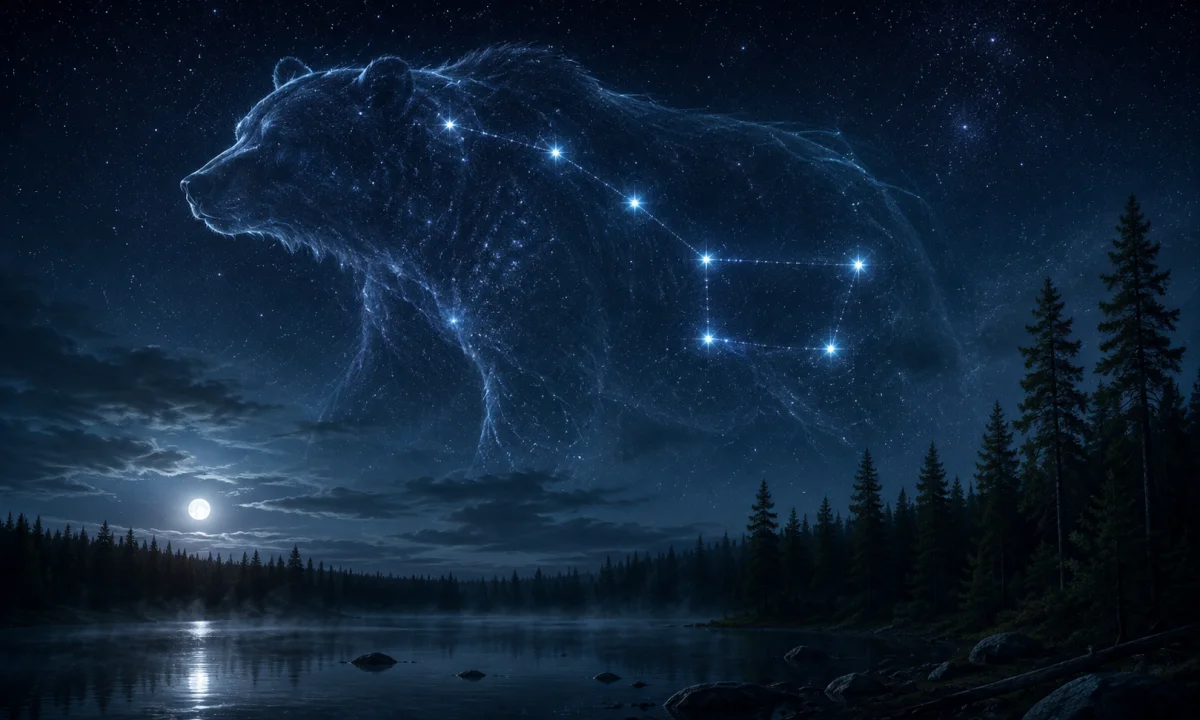
Otava is the Finnish name for the constellation commonly known in English as the Great Bear or, more specifically, the seven prominent stars of the Big Dipper. In Finnish mythology and folklore, Otava belongs to the northern sky rather than to the category of a god, spirit or humanoid hero. Its importance comes from its visibility, its regular movement around the northern heavens and its place within traditional ideas about orientation, seasonal time and the structure of the sky.
What Otava is
In modern Finnish, Otava generally refers to the Great Bear constellation, Ursa Major, while the familiar seven-star pattern is the Big Dipper. In older poetic and folkloric contexts, however, the name may be used less technically for the conspicuous group of stars that forms the most recognisable part of the constellation. The exact boundaries intended by the word can therefore depend on the source and its historical language.
Otava is not consistently described as a personified deity. Finnish traditional material often treats celestial bodies as active, meaningful presences, but that does not mean that each named star or constellation had a fully developed divine personality. The evidence for Otava is strongest as a named celestial sign, a feature of the sky incorporated into poetry, belief and practical knowledge.
The constellation is especially prominent in northern latitudes. Because it circles close to the celestial north pole, it can be seen during much of the year and is useful for locating the direction of north. Its two outer stars, commonly called the Pointers, lead the eye toward Polaris, the North Star. Traditional observers did not need modern astronomical terminology to recognise this relationship. The movement of Otava around the northern sky made it valuable for travel, night-time orientation and the marking of changing hours or seasons.
Origins and cultural setting
Finnish mythology developed within a wider Finnic cultural environment in northern Europe. Its traditions were transmitted chiefly through oral poetry, customary practices, songs, narratives and inherited descriptions of the natural world. They were not preserved in a single ancient religious book. Much of what is now called Finnish mythology was recorded by collectors and scholars from the eighteenth and nineteenth centuries onwards, often from oral performers in Finland and neighbouring Finnic regions.
This history matters when interpreting Otava. A reference to the constellation in a poem does not automatically reveal a single, unchanged prehistoric belief. Oral tradition permits variation in wording, imagery and meaning. A nineteenth-century publication may also combine material from different performers and regions. The name and its associations should therefore be understood as part of a changing tradition rather than as evidence for one universally accepted Finnish doctrine about the stars.
The night sky was nevertheless an important part of life in the northern environment. Long winters, extensive forests, waterways and long distances made knowledge of direction particularly useful. Stars were observed in relation to travel, weather, work and the annual cycle. A constellation that remained visible across much of the year could become a stable point of reference in both practical speech and poetic imagery.
The name Otava
The origin of the name Otava is not entirely certain. In Finnish, the word has also been associated with a large fishing net or net-like implement, and this meaning has often been considered in discussions of the constellation's name. Some interpretations imagine the stars as a net spread across the sky. The precise historical relationship between the ordinary noun and the celestial name, however, is not established beyond dispute.
The name has also attracted comparison with Finnish and other Finnic words connected with the bear. Finnish otso, for example, is a traditional poetic name for the bear. Such comparisons are relevant because the Great Bear has been associated with a bear in many northern and Eurasian traditions. They do not, by themselves, prove that Otava originally meant “bear” or that every Finnish reference to Otava preserves a bear myth.
Variation in the spelling and interpretation of traditional names is common when oral poetry is written down. Forms found in older records may reflect regional pronunciation, the spelling practices of collectors or the conventions of poetic metre. The most familiar modern form is Otava, but individual historical references should be interpreted in their own linguistic and textual context.
Otava in Finnish views of the sky
Finnish cosmological imagery often presents the sky as an ordered but active realm. The sun and moon are prominent celestial powers in traditional poetry, while stars can serve as signs of order, distance and permanence. Otava's repeated circuit around the northern sky made it particularly suitable for ideas about the regular movement of the heavens.
Traditional Finnish poetry does not always explain the mechanisms of the sky in a single consistent system. Some passages use ordinary observation, some use symbolic language, and some belong to elaborate mythic episodes. Otava may appear simply as a visible constellation, as part of a description of the heavens or as a marker in a poetic account of cosmic disturbance. It is safer to speak of a range of associations than of one fixed “Otava myth”.
In practical tradition, the stars could help travellers estimate direction and time. The usefulness of Otava was enhanced by its relation to the northern part of the sky, where the stars appear to turn around a comparatively fixed point. This observation may be expressed in folklore through images of revolving, circling or standing in the heavens. Such imagery reflects direct experience of the night sky, even when later readers interpret it symbolically.
Otava and the bear tradition
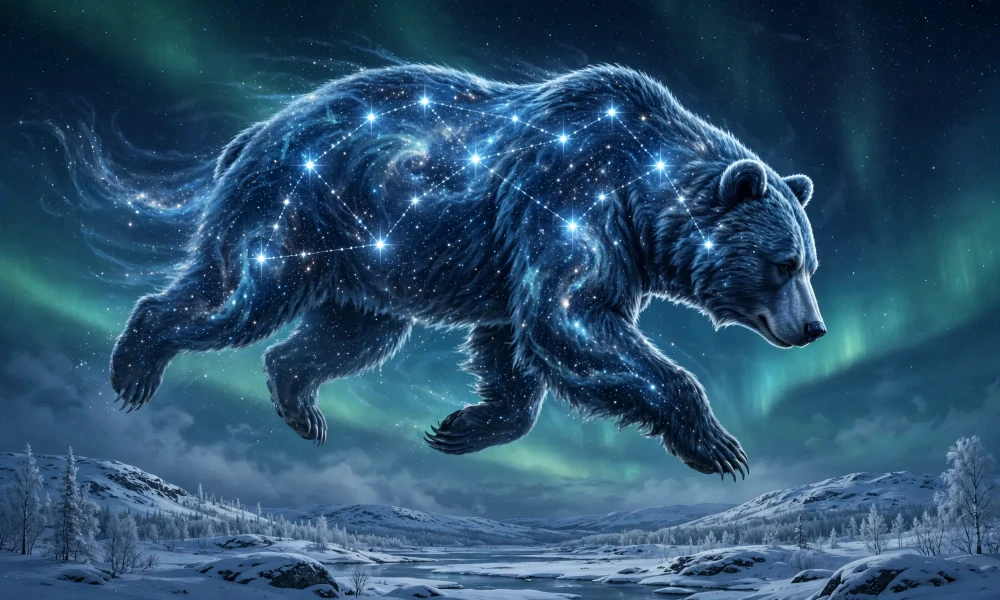
The Great Bear has a particularly strong bear association in many cultures, and Finnish tradition also contains an important bear complex. The bear was treated with respect and surrounded by euphemistic names, ritual language and hunting customs. In older Finnish belief, the bear was not merely an ordinary forest animal. It could be regarded as a powerful, human-like or spiritually significant creature whose death required careful ceremonial treatment.
Because of this background, it is tempting to interpret Otava automatically as a heavenly bear. The connection is plausible as a comparative possibility, but it should not be presented as a settled fact for all Finnish tradition. Finnish sources may refer to the Great Bear or its stars without telling a bear story, and bear-related beliefs about the animal on earth do not necessarily describe the constellation.
Some scholars have considered whether a celestial bear, a bear hunt or a bear's place in the northern sky might lie behind particular northern traditions. Similar motifs occur among several peoples around the Baltic, northern Europe and the Arctic. Yet similarities can arise through shared observation of the same distinctive constellation, cultural contact or independent development. The surviving evidence does not support reducing all Finnish meanings of Otava to one ancient bear cult.
Otava in the Kalevala tradition
The best-known written source for Finnish mythic poetry is the Kalevala, compiled by Elias Lönnrot and first published in a complete form in the nineteenth century. It was assembled from oral songs collected in Finland and Karelia, but it is not a verbatim transcript of one traditional epic. Lönnrot arranged, edited and connected materials to create an extensive poetic work.
Otava appears in the poetic world represented by the Kalevala, alongside the sun, moon and other features of the heavens. The epic's cosmological passages can present the stars as part of a structured universe and can invoke them during moments when the normal order of the world is threatened or restored. The exact significance of a reference depends on the particular runo, translation and manuscript tradition.
In the Kalevala, celestial imagery is especially important in episodes involving the disappearance or concealment of heavenly lights. The sun and moon are not merely decorative objects: their absence affects the world below and becomes part of a crisis requiring action. References to the stars, including Otava in some translations or textual contexts, help establish the wider cosmic setting.
It would be misleading to treat the Kalevala as a direct record of an ancient Finnish pantheon. It is a literary compilation based on older oral materials, and its presentation of the heavens reflects both inherited tradition and nineteenth-century editorial shaping. The epic is nevertheless valuable evidence for how Finnish poetic culture represented Otava and the northern sky at the time its source material was collected.
Symbolism and possible meanings
Otava can symbolise constancy within movement. The stars appear to travel across the night, yet their pattern remains recognisable and returns in a regular cycle. This combination makes the constellation suitable for poetic images of cosmic order, endurance and orientation. It may also represent the relationship between human life and a larger natural rhythm.
The constellation's position in the northern sky gives it a practical and symbolic association with direction. In a landscape where travellers could become lost among forests, lakes and unmarked paths, the ability to identify a reliable celestial sign had real value. A star pattern used to find north could become part of a cultural vocabulary of guidance without requiring a formal religious cult.
Otava may also evoke the separation between the human world and the celestial realm. The stars are visible but unreachable, familiar in shape but distant in substance. Finnish poetry often moves between everyday experience and mythic space, allowing a constellation to function both as an observed object and as a participant in a cosmic image.
Interpretations involving a net, trap or bear remain possibilities rather than universally established meanings. The visual form of the Big Dipper can invite different explanations, and names may preserve several layers of association. A careful reading distinguishes the literal astronomical reference from later attempts to reconstruct an original myth behind it.
Related figures and concepts
Otava should not be confused with Ukko, the prominent Finnish sky and thunder god. Ukko is associated with weather, thunder, lightning and divine authority; Otava is a constellation. A poetic passage may place celestial and divine elements in the same scene, but that does not make Otava an alternative name for Ukko.
It should also be distinguished from the North Star, known in Finnish as Pohjantähti. Polaris is a single star near the north celestial pole, whereas Otava is the Great Bear constellation, or in common usage its seven principal stars. The two are related observationally because the outer stars of the Big Dipper point toward Polaris.
Otava is likewise not the same as Pohjola. Pohjola is a mythic northern land in Finnish poetry, particularly in the Kalevala. The Finnish word for north and the constellation's location in the northern sky can create thematic connections, but a constellation should not be identified with a mythic territory.
Finally, Otava should not be merged with every bear constellation or bear figure found in neighbouring traditions. Northern Eurasian cultures have their own names, stories and ritual contexts. Comparative mythology can illuminate recurring patterns, but it cannot replace the evidence of Finnish language and Finnish source material.
Later reception
In modern Finland, Otava remains an ordinary and familiar astronomical name as well as a word with literary and cultural resonance. It appears in poetry, educational material, descriptions of the night sky and discussions of Finnish tradition. The name is also used in modern institutions and commercial contexts, including the name of a major Finnish publishing company. That modern use should not be confused with a mythological character or an ancient religious title.
Contemporary fantasy, games and popular retellings may turn Otava into a named spirit, goddess, guardian or magical constellation. Such inventions can draw inspiration from Finnish mythology, northern landscapes and the Kalevala, but they are modern adaptations unless supported by older traditional evidence. In the historical material, Otava is best understood as a culturally significant constellation whose meanings arise from observation, language, oral poetry and the wider Finnish relationship with the northern sky.