WORLD
WORLD
Oisín
Oisín is a celebrated hero and poet of Irish mythology, especially the Fenian or Fianna tradition. He is usually described as the son of the warrior Fionn mac Cumhaill and Sadb, and as the father of Oscar. Unlike a god or a supernatural being in the strict sense, Oisín is a heroic figure: a warrior of the Fianna, a keeper of ancestral memory and a singer of poetry. His stories connect the age of the legendary Fianna with the arrival and spread of Christianity in Ireland.
Origins and cultural setting
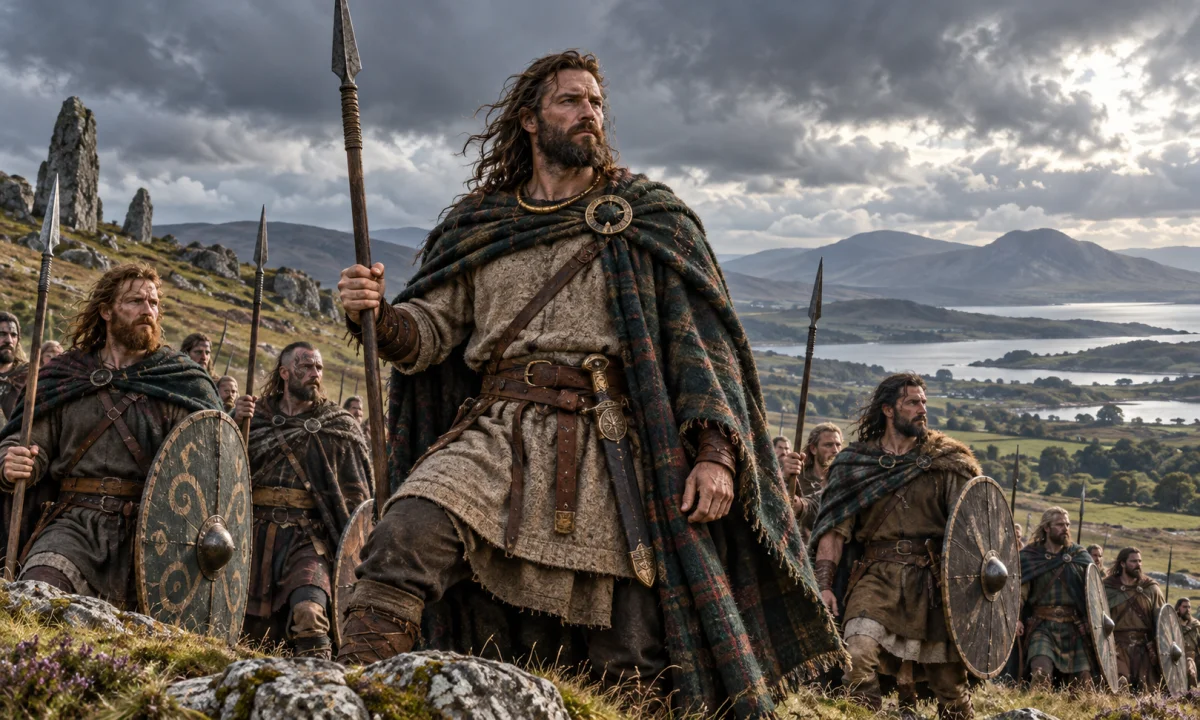
Oisín belongs to the body of Irish narratives commonly called the Fenian Cycle or Fianna Cycle. These stories centre on Fionn mac Cumhaill, the Fianna, and the landscapes, battles, hunts and rivalries associated with them. The Fianna are presented as an elite band of warriors, hunters and protectors who live partly outside ordinary society. Their world includes loyalty, hospitality, martial skill, poetic knowledge and encounters with beings from the Otherworld.
The Fenian tradition was preserved through a combination of oral storytelling, poetry and medieval manuscript writing. The surviving texts were written by Christian scribes, often many centuries after the period in which the stories are imagined to take place. As a result, they preserve older mythic and heroic material but do not provide a simple, unchanged record of pre-Christian Irish religion. Some narratives place Oisín in direct conversation with Saint Patrick, creating a dramatic contrast between the old heroic world and the Christian present.
One of the most important works associated with Oisín is Acallam na Senórach, usually translated as Colloquy of the Ancients or Dialogue of the Elders. In this medieval narrative, the aged Oisín and the warrior Caílte mac Rónáin meet Saint Patrick. They recall the deeds of Fionn and the Fianna while travelling through a Christian Ireland. The work survives in manuscripts from the medieval period, although its stories draw on traditions that may be older than the surviving written versions.
Other material appears in Fenian lays and poems, many of which were copied in later manuscripts. These poems are not all identical, and the details of Oisín's genealogy, adventures and relationship with other figures can vary. The name “Ossianic Cycle” is sometimes used in English for the broader body of traditions concerning Oisín and the Fianna, but “Ossianic” can also refer specifically to the later literary tradition inspired by James Macpherson's Ossian.
Name and identity
The modern Irish spelling is Oisín, with the diminutive ending often understood as giving the sense of “little deer” or “fawn.” The word is related to os, a term associated with a deer or stag. The name suits stories in which Oisín's mother, Sadb, is connected with deer and transformation. English-language forms include Oisin and Ossian, but these forms have different histories and should not always be treated as interchangeable.
Oisín is generally classified as a heroic poet rather than as a deity. He fights alongside the Fianna, but he is also one of the principal voices through which their history is remembered. In many narratives, his authority comes not only from personal bravery but from having witnessed the deeds of an older generation. He can therefore function as both participant and narrator.
The traditional material does not present one completely fixed biography. Some accounts emphasise his role as the son of Fionn and Sadb, while others give greater attention to his marriage or association with Niamh Chinn Óir, his relationship with his son Oscar, or his conversations with Patrick. The differences reflect the nature of Irish heroic tradition, which was transmitted in multiple forms rather than through a single canonical scripture.
Birth and connection with the deer
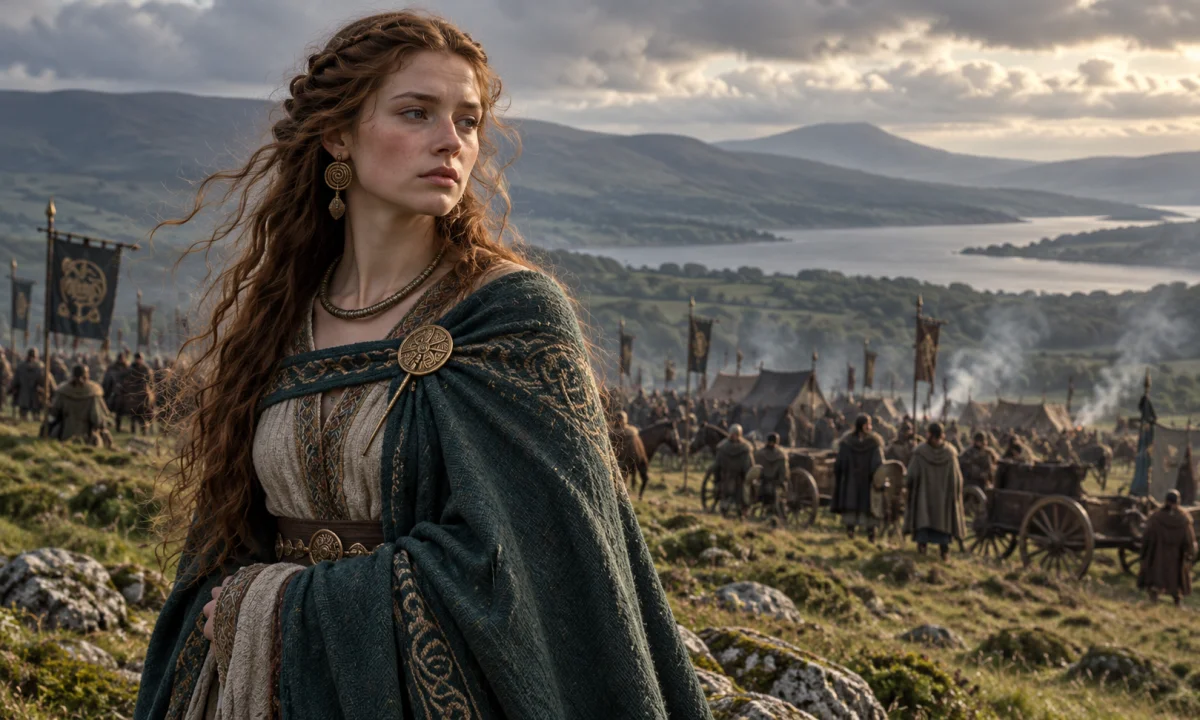
Oisín's birth is linked to one of the most memorable transformations in the Fenian stories. Sadb is commonly described as a woman who has been changed into the form of a doe through magic. In several versions, a druid named Fer Doirche is involved in the enchantment. The exact circumstances differ, including the reason for the transformation and the way Sadb encounters Fionn.
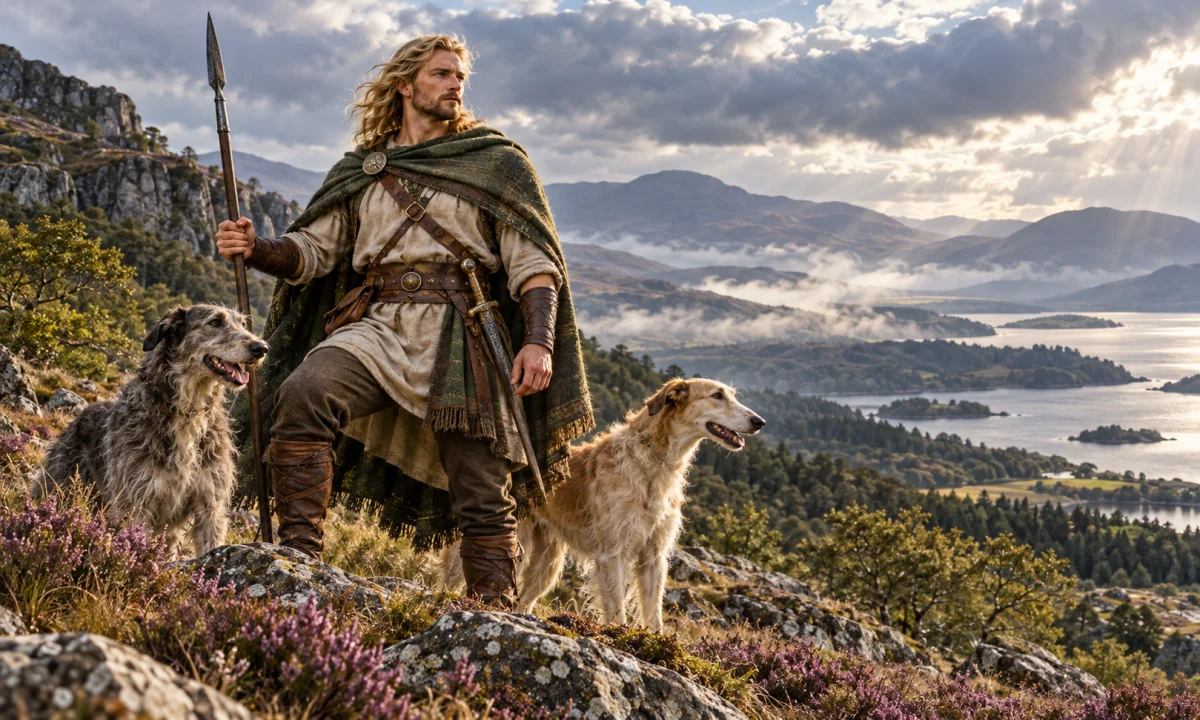
Fionn meets Sadb while she is in deer form, and the enchantment is temporarily lifted or altered when she is with him. They become partners, but Sadb is later transformed again or taken away while Fionn is absent. Their child, Oisín, is then separated from his mother. In versions of the story, he is discovered living in the wilderness and is recognised as Fionn's son. Some accounts give him a childhood closely associated with deer, while others vary in how long he remains outside human society.
This origin connects Oisín with the boundary between the human and animal worlds. The deer is an important animal in Irish tradition, appearing in hunting stories, encounters with the Otherworld and tales of magical transformation. Oisín's birth does not make him a deer deity, however. His connection with the animal is part of a family legend and a symbolic pattern of transformation, separation and return.
Oisín among the Fianna
As a member of the Fianna, Oisín is portrayed as a skilled warrior, hunter and poet. The Fianna's ideal is not based on military power alone. A worthy warrior is expected to show courage, generosity, loyalty and knowledge of poetry. Oisín embodies this combination particularly well, since his role in the tradition includes both combat and remembrance.
He is usually presented as one of Fionn's most important companions, although the prominence of individual warriors changes from story to story. Caílte mac Rónáin, Diarmuid Ua Duibhne, Goll mac Morna and Oscar may each be central in different narratives. Oisín is often associated with the later phase of the Fianna's history, when the group's fortunes are declining and its heroic world is coming into conflict with new political and religious arrangements.
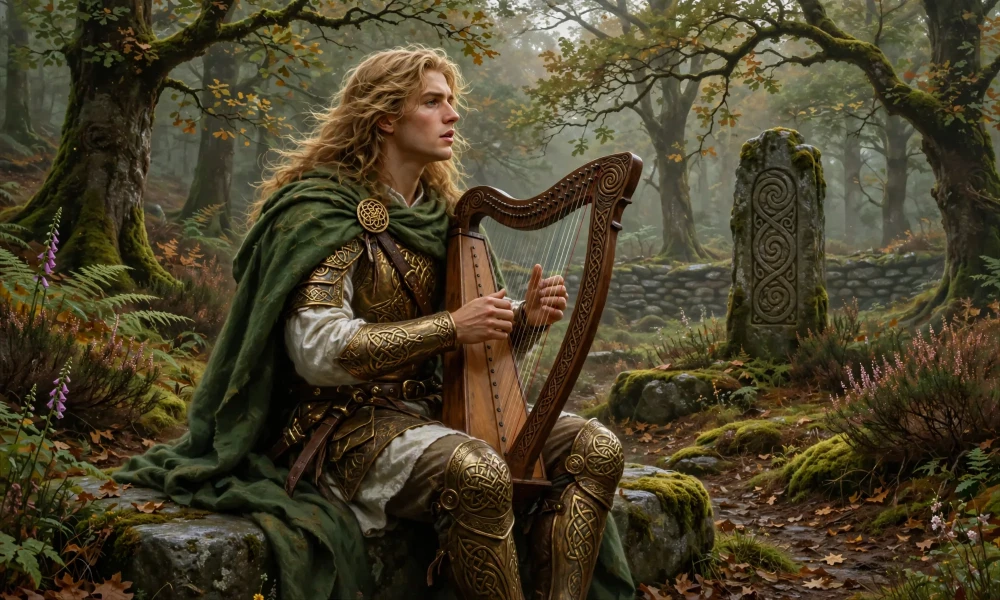
His poetry gives him a special place within the storytelling tradition. He can preserve the names of places, battles and warriors, and his recollections turn the landscape of Ireland into a repository of heroic memory. In the Colloquy of the Ancients, this function becomes especially important: Oisín and Caílte explain the meaning of places and recount events from the time of the Fianna to Saint Patrick and his companions.
Fionn mac Cumhaill and family relationships
Fionn mac Cumhaill is Oisín's father and the central leader of the Fianna. Their relationship is not always simple or harmonious. Fionn is a powerful and sometimes difficult figure, capable of wisdom, generosity and suspicion. Oisín's loyalty to him is part of the wider loyalty owed to the Fianna, but the stories also allow for disagreement and grief within the family.
Oisín's son is Oscar, one of the most renowned young warriors of the Fenian tradition. Oscar is often depicted as brave, formidable and deeply attached to the heroic code. His death in the battle of Gabhra, also called the battle of Gabhair in some forms, marks a decisive tragedy for the Fianna. Oisín's grief over Oscar is among the strongest emotional themes associated with him.
The battle of Gabhra is commonly treated as a turning point in the decline or destruction of the Fianna. The details of the conflict and its causes vary among sources, but the event represents the end of an era. Oisín survives in the tradition, allowing him to become a witness to the loss of Fionn, Oscar and the old warrior order.
Niamh Chinn Óir and the Otherworld
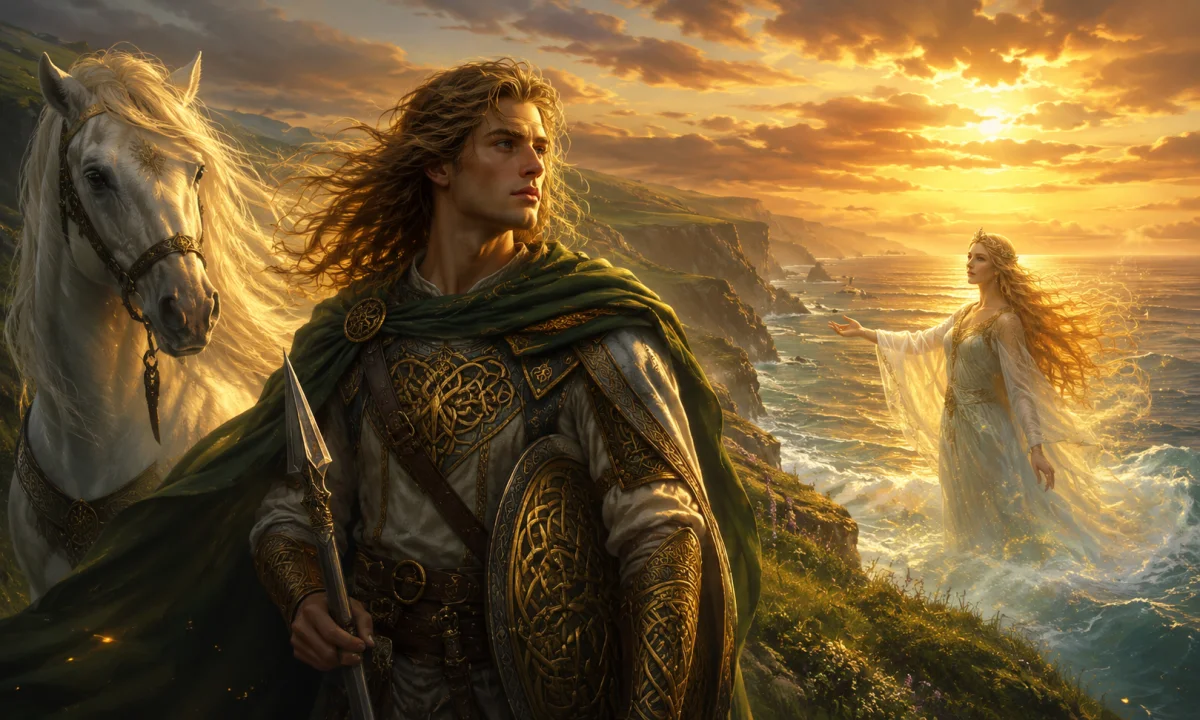
Oisín's best-known Otherworld adventure concerns Niamh Chinn Óir, whose name is often translated as “Niamh of the Golden Hair.” She comes from a realm variously called Tír na nÓg, the Land of the Young, or another Otherworld kingdom. The geography and name of this realm are not entirely uniform across the tradition, and the familiar version of the story reflects a number of related motifs.
Niamh arrives on a magnificent horse and invites Oisín to leave Ireland with her. He travels across the sea or through a supernatural passage to her land, where he lives for what seems to him a comparatively short time. The Otherworld is associated with youth, beauty and freedom from ordinary human decay. Oisín and Niamh become partners, and in some versions they have children.
Eventually, Oisín wishes to return to Ireland. Niamh gives him a warning not to touch the ground or dismount from his horse. When he reaches Ireland, he discovers that centuries have passed even though little time seemed to pass in the Otherworld. The Fianna have disappeared, and the heroic age is over. Oisín falls from the horse or touches the earth, and he suddenly becomes an aged man.
The precise ending varies. In the commonly circulated form, Oisín is brought into contact with Saint Patrick, who hears his memories of the Fianna. In other versions and retellings, the emphasis may fall more strongly on his isolation, his grief or the contrast between the Otherworld and Christian Ireland. The story is not simply a romance: it is also a narrative about the cost of returning from a timeless realm to a world in which everyone and everything familiar has vanished.
Oisín and Saint Patrick
The meeting between Oisín and Saint Patrick places two cultural perspectives in dialogue. Patrick represents Christianity and the social order associated with it, while Oisín embodies the heroic past of the Fianna. Their conversations can include disagreements about warfare, feasting, courage, animals and the value of the old traditions. Oisín often defends the virtues of the Fianna even when their world is no longer dominant.
This framework should not be read as a verbatim record of a historical meeting. Oisín is a legendary figure, and the dialogue belongs to medieval literary tradition. Nor does the story present a single simple judgement. Christian texts may criticise aspects of heroic life, yet they also preserve detailed and sympathetic accounts of the warriors, their generosity and their attachment to the land. Oisín's dignity and sorrow can make him more than a representative of a defeated religion: he becomes a voice for memory in a changing society.
The narratives also show how older heroic material was adapted within a Christian culture. Supernatural landscapes, magical transformations and Otherworld journeys remain central, but they are placed beside churches, saints and Christian teaching. Scholars therefore distinguish between the likely age of particular motifs and the dates of the surviving written texts. It is not possible to reconstruct an original, undisturbed pagan biography of Oisín from these sources alone.
Symbolism and cultural significance
Oisín's stories repeatedly explore the relationship between youth and age, memory and loss, nature and society. His name and maternal connection with the deer associate him with the wilderness, while his life among the Fianna places him within a highly organised heroic community. His journey to the Otherworld then removes him from ordinary time, only to return him to a transformed Ireland.
As a poet, Oisín represents the survival of the past through speech. The warriors may die, the Fianna may disappear and political or religious systems may change, but their deeds remain available through song and storytelling. His role is therefore closely related to the function of the traditional storyteller, who preserves genealogies, place-lore and heroic memory.
The story of Oisín's return is also a particularly powerful expression of cultural transition. He is not merely an old man who has travelled abroad. He is a survivor from a vanished order, unable to restore the world he remembers. His knowledge is valuable precisely because it comes from a time that cannot return.
Oisín and Ossian in later literature
The spelling Ossian became especially influential through the eighteenth-century publications of the Scottish writer James Macpherson. Macpherson presented his poems as translations from an ancient Gaelic bard named Ossian, but the works were substantially composed, adapted and arranged by Macpherson. They drew on Gaelic material and on figures related to the Irish and Scottish heroic traditions, yet they are not straightforward translations of a single ancient Irish text.
Macpherson's Ossian had a major influence on European Romanticism, inspiring poets, artists and composers. The name Ossian consequently acquired a literary identity partly separate from the Irish Oisín of the Fenian narratives. Similarities between the figures reflect shared and overlapping Gaelic traditions, but the two should not be merged without qualification.
In modern Ireland, Oisín remains present in literature, poetry, personal names and cultural discussions of the Fenian Cycle. His stories are also retold in children's books, fantasy works and other media. Such adaptations may simplify the genealogy, combine episodes or present Tír na nÓg as a fixed fantasy kingdom. These versions can preserve the central themes of adventure, otherworldly time and heroic memory, but they are modern interpretations rather than uniform statements of Irish tradition.