WORLD
WORLD
Nyyrikki
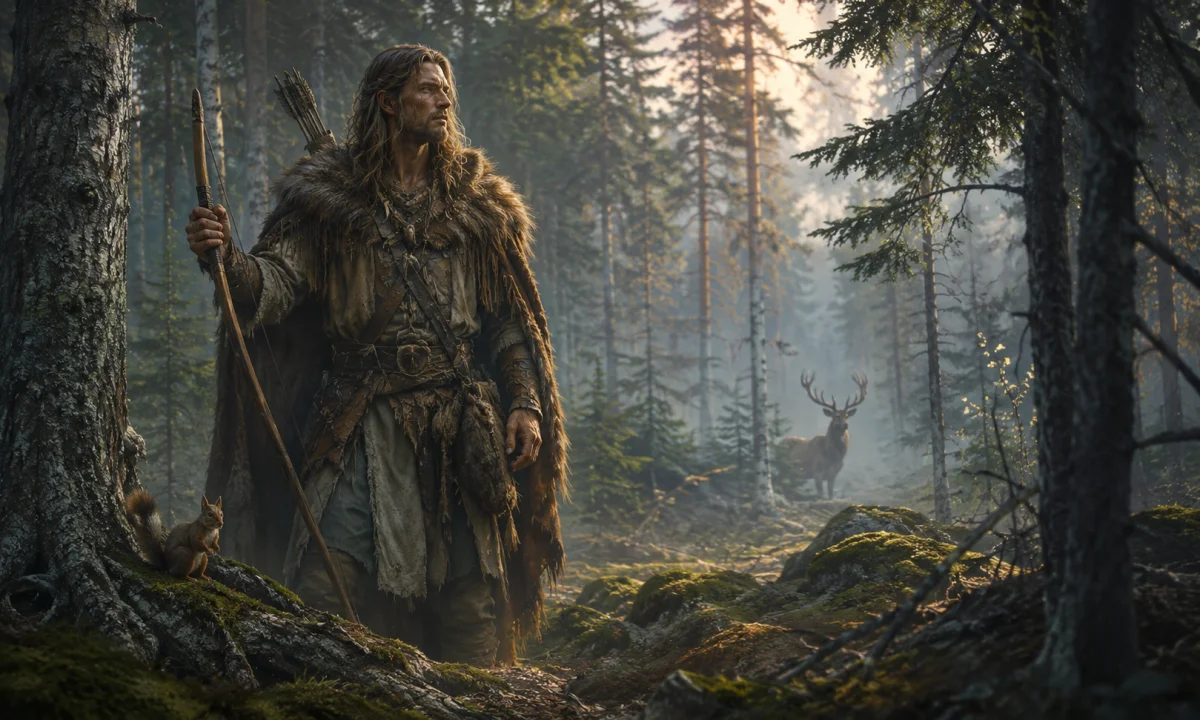
Nyyrikki is a figure associated with the forests and hunting in Finnish mythology. In the Finnish epic poem Kalevala, he is presented as a son of Tapio, the powerful master or spirit of the forest. Nyyrikki’s most distinctive role is practical rather than cosmic: he marks a route through the wilderness and helps a hunter find his way. He is therefore connected with the guidance, accessibility and hidden paths of the forest, as well as with the success of the hunt.
Although Nyyrikki is often called a Finnish forest god, that description needs some qualification. The surviving evidence comes mainly from Finnish oral poetry and from literary collections made in the nineteenth century. It does not show that all Finnish communities imagined Nyyrikki in exactly the same way, or that he possessed a separate, organised cult throughout Finland. In many contexts, he is better understood as a forest being within the family of Tapio, whose identity became especially clear through epic poetry.
Origins and cultural setting
Traditional Finnish religion placed great importance on the forest. Forests supplied game, timber, berries and other resources, but they were also difficult, dangerous and mysterious places. A person could lose the trail, encounter wild animals or fail to find the game that sustained the household. Hunting therefore involved more than skill with weapons. It also depended on respectful relations with the unseen powers believed to govern the wilderness.
The most prominent of these powers was Tapio, commonly described as the master, lord or deity of the forest. His female counterpart was Mielikki, who was associated with the forest’s beauty, animals and the prosperity of hunters. Other figures belonged to the same woodland community. Tellervo, often represented as a daughter of Tapio and Mielikki, appears as a forest maiden or spirit. Nyyrikki is generally named as their son, although the details of these relationships belong primarily to poetic tradition rather than to a single universally fixed mythology.
These forest beings were not always treated like distant gods ruling a separate divine world. In Finnish and wider Finnic folk belief, the boundary between deity, spirit, personified natural force and legendary character could be flexible. A forest power might be addressed in a spell, thanked for a successful hunt, blamed for withholding animals or imagined as a human-like figure moving through the trees. Nyyrikki belongs to this fluid religious and folkloric environment.
Surviving sources and the Kalevala
Nyyrikki is best known today through the Kalevala, the Finnish national epic compiled by Elias Lönnrot from oral poems collected in Finland and Karelia. The first edition appeared in 1835, and a substantially revised edition followed in 1849. Lönnrot arranged and edited traditional poetic material into a large narrative. The poem is therefore an important record of Finnish and Karelian oral culture, but it is not a direct transcript of a single ancient pagan scripture.
The Kalevala preserves names, formulas, relationships and episodes that reflect older oral traditions. At the same time, its arrangement and presentation were shaped by Lönnrot’s editorial decisions. A character appearing in the epic should not automatically be treated as evidence for a standardised pre-Christian religion. This is particularly important for Nyyrikki, whose surviving profile is relatively limited compared with that of Tapio or Mielikki.
Nyyrikki also belongs to the wider tradition of Finnish poetic descriptions of hunting and the forest. Oral incantations and songs could invoke woodland powers in order to make hunting successful, calm animals, open a path or secure the goodwill of the forest. The exact form and importance of individual beings varied between regions and performances. Consequently, interpretations of Nyyrikki should distinguish between the character known from epic poetry and the broader religious ideas surrounding Finnish forests.
Name and identity
The name is normally written Nyyrikki. Finnish pronunciation differs from the way an English speaker might instinctively read it, particularly because Finnish y represents a rounded vowel that has no exact equivalent in ordinary English pronunciation. The doubled vowels and consonants in Finnish spelling also indicate length.
The meaning and origin of the name are not completely certain. It is safest not to assign it a definite translation without qualification. Some popular explanations connect the name with the idea of making marks, cutting branches or opening a route, reflecting Nyyrikki’s role in the Kalevala. That association may arise from the character’s actions in the poem rather than from a securely established etymology. The name should therefore be treated as an inherited mythological name whose precise linguistic history remains uncertain.
Nyyrikki’s classification also varies. He may be called a forest god, a hunting deity, a forest spirit, a son of Tapio or a mythic helper of hunters. “Forest god” is convenient and widely used in modern English descriptions, but it can imply a more clearly defined individual deity than the evidence supports. “Forest spirit” or “woodland being” may better reflect the flexibility of Finnish traditional categories.
Appearance and attributes
Nyyrikki does not have a single, fully developed physical description comparable to the elaborate portraits of some figures in later mythology. His best-known attribute is a red cap or red-coloured head covering, an image attached to him in the poetic tradition. He is also described as a youthful or heroic woodland figure, sometimes with an epithet identifying him as Tapio’s son.
The red cap helps distinguish Nyyrikki in the forest landscape. It may be read as a visual sign of his supernatural identity, making him recognisable among trees and hunters. Interpretations that connect the colour with blood, autumn foliage or a specific ancient ritual symbolism go beyond what the surviving tradition securely establishes. The cap is an important poetic feature, but its original symbolic meaning is not known with certainty.
His principal ability is the creation or revelation of a route. Nyyrikki can cut branches, make marks on trees or otherwise indicate the way through dense woodland. This power is especially significant in a hunting culture where a reliable trail could determine whether a person returned safely or reached the animals being pursued. His assistance is not usually presented as spectacular magic. Instead, it is a form of practical supernatural guidance.
Nyyrikki’s attributes can therefore be grouped around several related ideas:
- Guidance: he helps a traveller or hunter move through difficult forest terrain.
- Marked paths: he leaves signs or clears a route through the trees.
- Hunting: his presence is associated with the pursuit of game and the hunter’s success.
- Woodland belonging: as Tapio’s son, he represents the forest community rather than human society.
- Youthful energy: his red cap and heroic presentation give him the character of an active woodland helper.
Nyyrikki in the hunting episode of the Kalevala
Nyyrikki’s most important appearance occurs during the episode in which Lemminkäinen seeks the elk of Hiisi. Lemminkäinen is one of the epic’s restless and dangerous heroes, known for his adventures, boasting and involvement in difficult quests. The animal he must pursue belongs to the realm of Hiisi, a name that can refer in Finnish tradition to a sacred place, a local spirit or a hostile supernatural power. In the Kalevala, Hiisi’s animals are not ordinary quarry.
The hunt takes the hero into a challenging wilderness. Nyyrikki, identified as Tapio’s son, assists him by marking the trees and opening a way through the forest. His intervention gives the hunter direction where the landscape would otherwise be confusing. The episode presents Nyyrikki as a mediator between the human hero and the forest world: he does not simply deliver the animal, but makes movement through the woodland possible.
This scene is important because it reveals that mastery of the forest does not belong entirely to the human hunter. Lemminkäinen may possess courage and determination, but he still requires help from a woodland power. The forest has its own order, and success depends upon access to that order. Nyyrikki’s signs transform an apparently impenetrable landscape into a readable one.
The episode should not be treated as a complete biography of Nyyrikki. The Kalevala gives him a memorable function, but it does not provide a long cycle of myths about his birth, marriage, death or independent adventures. Later summaries sometimes expand his role into that of a general god of hunting, but the epic evidence most clearly supports his identity as a forest helper and path-maker.
Relationship with Tapio and other forest figures
Nyyrikki is most closely linked with Tapio. Tapio represents the authority of the forest as a whole, while Nyyrikki appears as a younger member of that woodland household. This family arrangement gives the forest a social structure that resembles a human community: it has a lord, a lady, children and other inhabitants. Such personification makes it possible for hunters to speak to the forest as though it were a powerful household with which they must negotiate.
His relationship with Mielikki is less central to the surviving stories, though genealogical descriptions commonly identify her as his mother. Mielikki is often portrayed as compassionate towards hunters and animals, or as the keeper of the forest’s gifts. Tellervo, usually treated as Nyyrikki’s sister, is a forest maiden associated with woodland life. These connections are useful for understanding the mythic landscape of the Kalevala, but the exact family tree should not be assumed to have been uniform across all Finnish regions.
Nyyrikki should also be distinguished from Tapio himself. Tapio is the dominant forest master and the figure most directly connected with the governance of game and woodland resources. Nyyrikki is a subordinate or younger figure whose specialised role is guiding and marking paths. He is not simply another name for Tapio.
He is likewise distinct from Mielikki, whose character is more strongly associated with the care of the forest and its animals, and from Tellervo, who is generally represented as a woodland maiden. These figures form a related group, but they do not have interchangeable identities.
Meaning in Finnish religious culture
Nyyrikki reflects the practical religious concerns of people who lived close to the forest. A marked trail was both a physical aid and a sign of supernatural favour. If a hunter could find the right direction, locate game and return home, the outcome might be understood as evidence that the forest had permitted his success. Conversely, getting lost or finding no animals could suggest that the forest powers were displeased, withholding their gifts or protecting the creatures from human pursuit.
In this setting, Nyyrikki symbolises the legibility of nature: the possibility that a confusing wilderness may reveal a route to someone who has the right knowledge or assistance. His power is not the domination of nature but cooperation with it. The hunter must enter the forest on terms partly determined by woodland beings.
His role also illustrates how mythology can preserve everyday concerns. Large mythological systems are not made only of stories about creation, war or the fate of the gods. They also include figures connected with navigation, weather, illness, childbirth, farming and hunting. Nyyrikki belongs to this more immediate level of traditional belief. His importance lies in the specific problem he addresses: how a person finds a way through a living and potentially hostile forest.
Nyyrikki and similar figures
Confusion can arise because Finnish mythology contains several forest-related beings, and English-language sources often use broad labels such as “forest god” for all of them. Nyyrikki is not equivalent to every spirit associated with trees, game or hunting.
- Tapio: the principal master or personification of the forest, with greater authority than Nyyrikki.
- Mielikki: Tapio’s female counterpart or wife in many accounts, associated with woodland abundance, animals and the welfare of hunters.
- Tellervo: usually described as a daughter of Tapio and Mielikki and as a forest maiden.
- Hiisi: a complex Finnish term and figure connected with sacred places, local supernatural beings and, in later Christian-influenced usage, hostile powers. Hiisi’s elk in the Kalevala is not simply an ordinary forest animal.
- Local forest spirits: regional traditions could include other named or unnamed beings. Their presence should not automatically be attributed to Nyyrikki.
Nor should Nyyrikki be equated with a generic “green man,” a universal woodland god or a figure from Norse mythology. Similar functions occur in many cultures, but functional resemblance does not prove a shared origin. Nyyrikki belongs specifically to the Finnish and Karelian poetic and religious environment.
Later reception
Nyyrikki’s modern identity is shaped strongly by the status of the Kalevala in Finnish national culture. Once the epic became a central work of Finnish literature, its forest figures gained a lasting place in education, art, mythology books and discussions of Finnish heritage. Nyyrikki is less prominent in popular culture than Väinämöinen, Ilmarinen, Lemminkäinen or Louhi, but he remains recognisable as one of Tapio’s woodland companions.
Modern fantasy writing, games and reconstructed or revived pagan practices may use Nyyrikki as a forest god, hunter’s patron or guardian of paths. Such uses are contemporary interpretations rather than evidence that an identical role was maintained continuously from pre-Christian Finland. They often simplify the layered source material by turning a poetic forest helper into a fully developed deity with a fixed appearance and powers.
The most historically cautious understanding of Nyyrikki is therefore also the most distinctive: he is a red-capped son of Tapio in Finnish mythic poetry, a woodland figure who cuts or marks a path for a hunter, and a personification of the forest’s ability to guide—or deny—human movement. His tradition is small in surviving form, but it offers a clear glimpse of how Finnish mythology imagined the forest as an inhabited world with its own relationships, rules and powers.