WORLD
WORLD
St. Ronan Of Iona

St. Ronan of Iona is a little-known Christian figure associated with the monastery of Iona and with the early medieval controversy over the date of Easter. His identity is not entirely secure. The surviving evidence most clearly presents Ronan as an Irish bishop who visited Iona and argued with its clergy about the proper method of calculating Easter. Later calendars and traditions treated him as a saint, while the title “of Iona” reflects his association with the island rather than a securely documented office as its bishop or abbot.
Origins and historical setting
Iona is a small island off the western coast of Scotland. In the sixth century, it became the centre of a major monastic community founded by Columba, or Colum Cille, an Irish monk traditionally dated to 521–597. From Iona, Columban monks travelled through parts of western Scotland and northern Ireland, establishing churches, monasteries and networks of religious influence.
The community belonged to a Christian world that was already connected across the Irish Sea. The terms “Irish Church” and “Celtic Church,” often used in older writing, can be misleading if they suggest a single, sharply separate institution. The Christians of Ireland, western Britain and Iona shared many practices, but they were not completely uniform. Their customs also changed over time through contact with churches in Gaul, Northumbria, Rome and other regions.
One important difference concerned the calculation of Easter. Christian communities agreed that Easter was the central feast of the liturgical year, but different tables and methods could produce different dates. The form of calculation used at Iona and in some Irish communities came into conflict with the system increasingly accepted by churches connected with Rome and the Anglo-Saxon kingdoms. The dispute involved more than arithmetic. It raised questions about tradition, ecclesiastical authority, communication with other churches and the public coordination of major religious festivals.
Ronan appears in this setting. The best-known account describes him as an Irish bishop who came to Iona and challenged the community’s practice. His visit is significant because it shows that the Easter question was debated within the Gaelic Christian world itself, not simply imposed by outsiders on an isolated island monastery.
Surviving sources and the question of identity
The principal early narrative is found in the Ecclesiastical History of the English People by Bede, written in the early eighth century. Bede refers to an Irish bishop named Ronan who argued with the people of Iona about the celebration of Easter. The account presents Ronan as learned and forceful, but it does not provide a complete biography. It does not clearly state where he was born, where he died, whether he remained on Iona, or whether he held a permanent position there.
The writings connected with Adomnán’s Life of Columba also belong to the background of Iona’s early history, although references to Ronan and the Easter controversy must be handled carefully. The surviving traditions do not provide enough information to construct a continuous life story comparable to the biographies of Columba, Patrick or Brigid. Later ecclesiastical lists and calendars preserve the name as that of a saint, but they may combine memories from different local traditions.
For this reason, “St. Ronan of Iona” is best understood as a traditional designation rather than a fully documented historical identity. The early evidence supports the existence of an Irish bishop named Ronan who was involved in the debate at Iona. It does not securely establish that he was an abbot of Iona, a founder of a particular church, or a long-term member of Columba’s community.
The name itself is an Irish personal name, usually written Rónán in modern Irish spelling. It is commonly understood as a diminutive formed from rón, meaning “seal,” and may therefore be interpreted as “little seal.” This linguistic meaning does not, by itself, prove that Ronan had a seal as an emblem or that stories about him involved the sea. Medieval names often had meanings that were no longer active in the bearer’s personal story.
Ronan and the Easter controversy
Ronan’s most important traditional role is that of a disputant in the Easter controversy. The disagreement concerned the calculation of the date rather than the theological importance of Easter itself. Both sides regarded the resurrection of Christ as the centre of Christian worship. The problem was that different systems for determining the date of the feast could cause communities to celebrate Easter on different Sundays.
At Iona, the older calculation had been maintained for generations. Ronan, coming from Ireland, is said to have opposed it. This detail is especially valuable historically because it complicates the idea that all Irish or Columban Christians followed one unchanging custom. Irish churchmen themselves could disagree, and travel allowed such disputes to reach the communities that preserved older practices.
The debate also illustrates the importance of learned clerics in early medieval Christianity. A bishop’s authority did not rest only on pastoral duties. Bishops could be teachers, interpreters of scripture, guardians of inherited custom and representatives of wider ecclesiastical networks. Ronan’s appearance at Iona suggests that the island was engaged in active intellectual and institutional exchange.
The controversy did not end immediately with one discussion. Iona continued to follow its traditional Easter practice for some time after disagreements had become prominent elsewhere. Around the early eighth century, the community eventually adopted the Roman system. This change is often associated with the abbacy of Dúnchad and the influence of figures who supported the newer calculation. Ronan should therefore be placed within a prolonged process of change rather than presented as the single person who converted Iona.
It is also inaccurate to describe the matter simply as a struggle between “Celtic” and “Roman” Christianity. The communities involved were part of the same Christian religion and shared scripture, sacraments, saints and central doctrines. The dispute concerned calendars and institutional relationships, although those issues carried considerable symbolic weight.
Attributes and religious character
Unlike many better-known saints, Ronan has no widely established collection of miracles, visions or dramatic legends. The early record does not describe a distinctive physical appearance, a special supernatural power or a standard object that identifies him in religious art. There is no firm basis for assigning him a particular staff, book, animal or colour as an ancient attribute.
His principal religious characteristic is his role as a bishop and defender of a liturgical position. In a saintly context, this can be interpreted positively: Ronan represents conscientious debate, attachment to inherited practice and the authority of learned Christian leadership. His story also reminds readers that saints were not always portrayed as silent examples of agreement. Some entered disputes because they believed that the correct ordering of worship mattered to the life of the Church.
At the same time, the surviving narrative does not present a developed devotional portrait. Ronan is not known for a large body of prayers, a major pilgrimage cult or a universally recognized patronage. His importance lies chiefly in the historical and ecclesiastical setting in which his name survives.
Feast day and later classification
Later calendars commonly associate St. Ronan of Iona with 7 February, although feast-day information can vary between local calendars and modern listings. The existence of a feast day indicates that Ronan was remembered within a tradition of saintly commemoration, but it does not by itself establish the details of his life.
Some lists describe him as a bishop of Iona, while others use the more cautious association “of Iona.” These descriptions should not automatically be treated as equivalent. The early narrative shows Ronan visiting or engaging with the Iona community; it does not clearly document him as the island’s regular episcopal office-holder. Medieval and modern catalogues sometimes turn a saint’s place of activity into a title, even when the original evidence is less precise.
The uncertainty is increased by the fact that Rónán was not a unique name. Several saints and local holy figures were called Ronan, and traditions from Ireland, Scotland, Wales and Brittany can be difficult to separate when later writers use Latin or vernacular forms without enough geographical detail.
Important distinctions from other St. Ronans
St. Ronan of Iona should not be automatically identified with St. Ronan of Locronan, a Breton saint associated with the town of Locronan in Brittany. The Breton figure has his own local legends, place-name traditions and devotional history. Similar names and connections with Celtic Christianity do not prove that the two saints were the same person.
Nor should Ronan of Iona be merged with Scottish saints or local holy men remembered in places such as Innerleithen, where traditions of St. Ronan developed around a local church and holy well. Those traditions may preserve memories of other individuals, or they may reflect later expansion of a popular saint’s name. Without a continuous early record, geographical similarity is not enough to establish identity.
Ronan should also be distinguished from figures named Rónán in Irish genealogies, annals and hagiographical material. The same personal name could belong to clerics, rulers, poets or local saints living in different periods. A reference to “Ronan” without a place, date or associated community cannot safely be assigned to the bishop linked with Iona.
Cultural significance
Ronan’s significance lies less in a rich legend than in what his brief appearance reveals about early medieval Christianity. Iona is sometimes imagined as a remote centre that preserved an isolated form of religion. Ronan’s presence presents a different picture. The island was part of a mobile religious world in which bishops travelled, argued, exchanged information and brought competing traditions into contact.
His story also demonstrates how liturgical practice could carry cultural memory. The Easter calculation maintained at Iona was associated with the authority of earlier generations, especially the Columban tradition. Changing it was not merely a technical adjustment. It could feel like a decision about the credibility of ancestors, the unity of the Christian community and the proper relationship between local custom and wider ecclesiastical standards.
From a historical perspective, Ronan is valuable precisely because he is not a perfectly documented hero. The evidence does not allow a confident account of his childhood, missionary journeys or death. It does, however, preserve a moment in which an Irish bishop challenged the practice of one of the most influential monasteries in the western Christian world. That episode places him within the intellectual life of the period rather than at its margins.
Representation in modern culture
St. Ronan of Iona has made little impact on modern popular culture. He does not have a substantial presence in film, television, fantasy fiction or widely circulated devotional art. When he appears in modern writing, he is usually discussed in connection with Iona, the Easter controversy or the wider history of early medieval Christianity.
Modern retellings sometimes present him as a dramatic challenger who personally forced Iona to abandon its old calendar. That version gives the story a clear protagonist and climax, but it goes beyond the evidence. The historical change at Iona developed over time and involved broader ecclesiastical pressures and discussions. Ronan is best portrayed as one participant in that process, not as its sole cause.
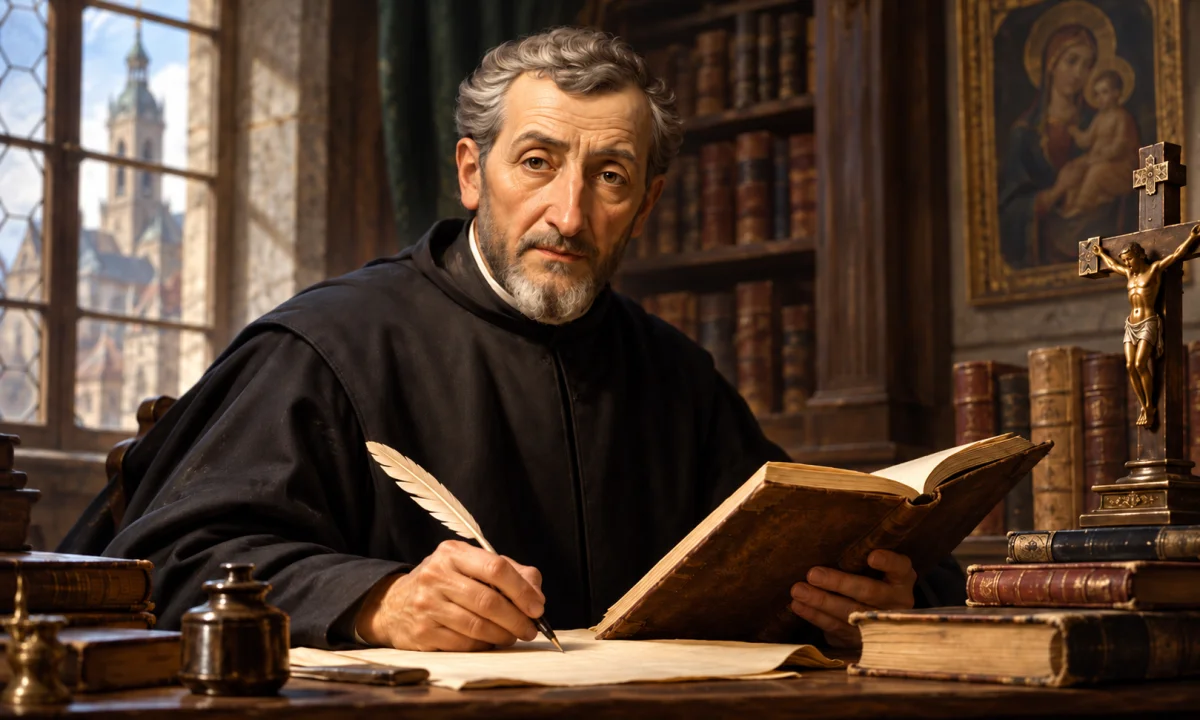
For the same reason, images of Ronan as a wandering missionary, a miracle-working hermit or a sea-associated saint should be treated as later interpretation unless they are tied to a specific local tradition. The securely grounded figure is an Irish bishop remembered for his dispute with the Iona community over the date of Easter.