WORLD
WORLD
Onatah
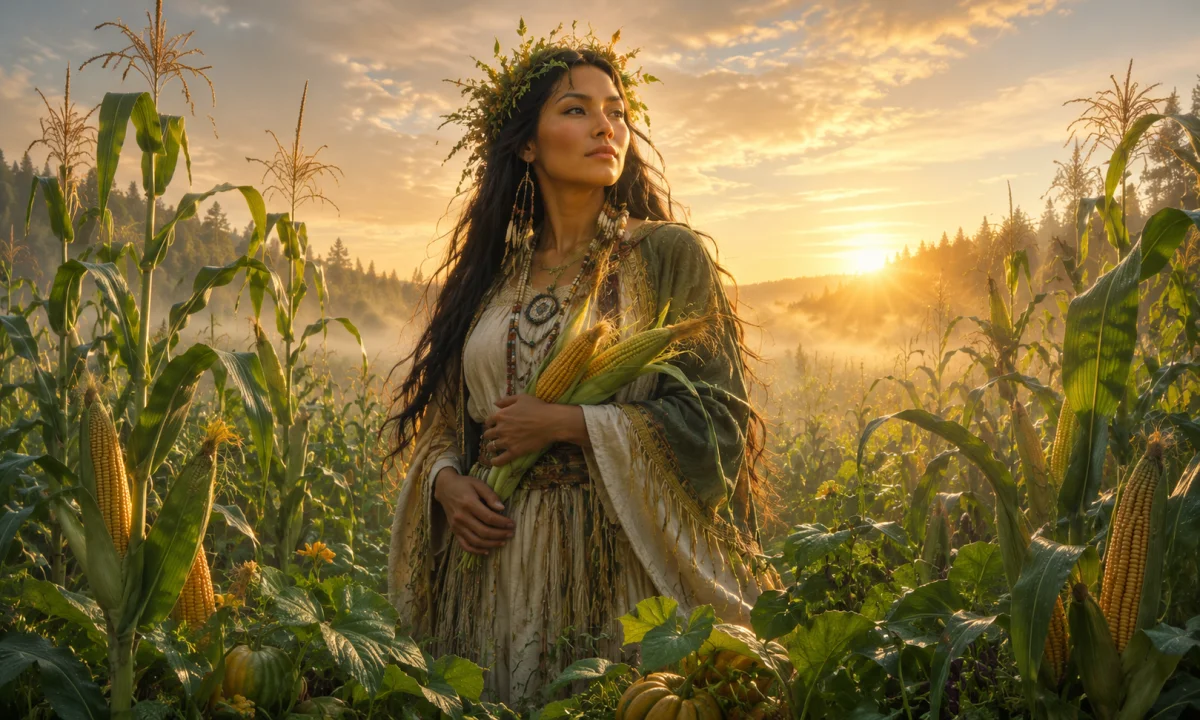
Onatah is a figure associated with Iroquois mythology, especially in modern retellings of Indigenous North American traditions. She is often described as a corn spirit, corn goddess, or personification of the corn harvest, but the details of her identity vary widely from source to source. In many cases, the name and story appear in later literary, folkloric, or popular adaptations rather than in a clearly documented ancient Iroquois religious corpus, so it is important to treat her carefully and distinguish tradition from later interpretation.
Cultural setting
The Iroquois, or Haudenosaunee, are a confederacy of Indigenous nations in northeastern North America, including the Mohawk, Oneida, Onondaga, Cayuga, Seneca, and later the Tuscarora. Their religious life and ceremonial cycle are deeply connected to agriculture, especially the cultivation of the Three Sisters: corn, beans, and squash. Among these crops, corn holds central importance as both a food and a sacred gift, tied to thanksgiving rituals, seasonal observances, and the relationship between human beings and the natural world.
Within this cultural context, a female spirit associated with corn is a natural and meaningful figure. However, surviving sources on Haudenosaunee beliefs are uneven. Some older ethnographic accounts emphasize ceremonial practice and oral tradition, while later popular retellings often present more fixed “goddess” profiles than the traditions themselves support. Because of that, Onatah is best understood as a figure whose identity is shaped by a mixture of Indigenous agricultural symbolism, oral storytelling, and later reinterpretation.
Name and identity
The spelling Onatah is not uniform, and other spellings or related forms may appear in secondary sources. The meaning of the name is also not always given consistently. In many modern explanations she is presented as the spirit or goddess of corn, often linked to the idea of abundance, fertility, and the life-sustaining power of maize. Yet the precise status of Onatah is uncertain: some sources treat her as a divine being, others as a mythic personification, and still others as a literary or folkloric construct inspired by Iroquois themes.
Because of this uncertainty, it is safer not to assume that Onatah occupied a single, universally recognized place in precontact Haudenosaunee religion. Rather, she belongs to a broader pattern in which crops and natural forces are understood as alive, relational, and spiritually significant. In that sense, Onatah reflects an Indigenous worldview in which food plants are not merely resources but gifts requiring respect, gratitude, and reciprocity.
Association with corn and the agricultural cycle
Onatah is most commonly linked with corn, one of the most important foods in Haudenosaunee life. Corn is not only a staple crop but a cultural symbol of sustenance, seasonal rhythm, and communal survival. A corn-associated figure would naturally be connected with planting, growth, ripening, harvest, and thanksgiving. In modern summaries, Onatah is often described as watching over the cornfields or embodying the spirit of the ripened crop.
This symbolism fits the broader ceremonial importance of agriculture among the Haudenosaunee. Seasonal thanksgiving observances honor the fruits of the earth at different times of year, and the harvest is understood as a moment of gratitude to the Creator and to the living powers of the natural world. A corn spirit such as Onatah can therefore be read as a mythic expression of this sacred relationship between people and the land.
It is worth noting, however, that traditional Haudenosaunee ceremonial life is not always organized around the sort of individualized pantheon familiar from Greco-Roman religion. Modern readers sometimes expect a single named goddess for each crop or natural force, but Indigenous traditions may instead emphasize distributed spiritual presence, clan relationships, or story figures with regional variation. Onatah’s role should be interpreted in that flexible context.
Stories and narrative themes
Compared with major figures in some other mythological traditions, Onatah does not have a large, standardized cycle of stories that is widely and securely documented across all Haudenosaunee communities. The material associated with her is often brief, symbolic, or embedded in later retellings. In those versions, she may be described as a beautiful young woman connected with a cornfield, or as a personified presence who ensures the crop’s health and abundance.
Where narrative detail appears, common themes include:
- the sacred origin or blessing of corn;
- the dependence of people on the plant’s generosity;
- the seasonal renewal of life through planting and harvest;
- the close relationship between feminine life-giving power and agriculture;
- the moral importance of gratitude, restraint, and proper use of natural gifts.
These themes are significant even when the exact plot of a story is not stable. In many Indigenous traditions, the meaning of a figure may matter more than a single fixed narrative. Onatah’s association with corn makes her a symbol of nourishment, continuity, and reciprocal responsibility rather than merely a supernatural character in a tale.
Attributes and symbolism
Descriptions of Onatah are usually spare, but she is often portrayed in ways that emphasize gentleness, fertility, and abundance. She may be imagined as a maidenly or youthful presence, reflecting the vitality of growing corn. In symbolic terms, she stands for the ripening field, the sustenance of the people, and the seasonal return of plenty after winter scarcity.
Several layers of meaning are often attached to a corn figure such as Onatah:
- Fertility — not only in the sense of human reproduction, but also in the fruitful capacity of the earth.
- Provision — the assurance that food will exist if humans care properly for the land.
- Balance — the idea that taking from nature requires respect, ceremony, and restraint.
- Community — corn is grown, harvested, stored, and eaten within social relationships rather than as an isolated individual possession.
- Seasonality — the life of the corn mirrors the cycle of planting, growth, harvest, and rest.
These associations are broader than any one character. They reflect the spiritual importance of maize in Haudenosaunee life and in many other Indigenous traditions of North America. Onatah’s image, when used, condenses those values into a single feminine figure.
Relationship to other figures and traditions
Because Onatah is often described in modern sources as a “corn goddess,” she is sometimes compared with agricultural deities from other cultures. Such comparisons can be useful in a limited sense, but they can also distort the original context. Haudenosaunee spiritual traditions are not simply interchangeable with classical pagan pantheons, and it is misleading to treat Onatah as if she were identical to Demeter, Ceres, or other harvest goddesses.
There is also room for confusion with other Indigenous figures whose names may sound similar or who share thematic roles. Care is needed not to merge distinct beings from different nations. A figure associated with corn in one tradition may not have the same origin, functions, or story as a figure with a comparable role elsewhere. Onatah should therefore be discussed as a name connected with Iroquois or Haudenosaunee mythology specifically, while acknowledging that the evidence for her is not equally strong across all nations of the confederacy.
In some modern summaries, Onatah may be treated as a personification of the “Corn Mother” archetype. That broader category can be helpful for understanding agricultural symbolism, but it should not erase local specificity. Among the Haudenosaunee, corn has ceremonial and relational significance that goes beyond abstract fertility symbolism. The crop is part of a living moral world shaped by thanksgiving, stewardship, and memory.
Historical evidence and the problem of sources
One of the most important things to know about Onatah is that her status in the historical record is uncertain. Many popular statements about her repeat claims without making clear whether they come from early oral tradition, later ethnography, schoolbook folklore, or modern retelling. Unlike better documented Haudenosaunee cultural elements such as the Great Law of Peace, the Thanksgiving Address, or the central role of the Three Sisters in agriculture, Onatah is not as firmly anchored in widely cited traditional records.
That does not mean the figure is meaningless. It means that her precise precolonial form may be difficult to reconstruct. Names and stories can shift over time, especially when they pass through translation, missionary writing, amateur folklore collections, and modern internet summaries. A figure may become more explicitly “divine” in later retellings than she was in older oral contexts, or may be combined with regional concepts of a corn spirit.
For that reason, statements about Onatah should be framed with caution. It is reasonable to say that she is associated with corn and with Iroquois mythology. It is not responsible to claim certainty about her full genealogy, standardized rituals, or universal recognition unless a specific tradition clearly supports that claim.
Feminine power, nourishment, and cultural values
Onatah’s significance lies not only in her connection to a crop but also in the values encoded in that connection. In many agricultural mythologies, female figures embody nourishment because they mirror the generative power of the earth. In Haudenosaunee thought, this symbolism is especially apt, since the Three Sisters sustain bodily life and the community’s seasonal rhythm.
The emphasis is not simply on fertility in a narrow biological sense. It is also about responsibility. Corn must be planted at the right time, tended carefully, harvested properly, and stored for use. The harvest depends on knowledge, labor, and respect as much as on natural abundance. A figure like Onatah can be understood as representing the success of that cooperative relationship between people and land.
This also helps explain why corn figures are often tied to thanksgiving and ceremony. Gratitude is not ornamental; it is part of the moral economy of survival. Onatah’s role, where described, belongs to that world of thanks and reciprocity.
Modern popular culture and retellings
In modern popular culture, Onatah may appear in retellings of Indigenous myths, educational materials, or creative works that draw on Native American themes. These uses are often loosely based on folklore rather than on a single authoritative traditional source. Some versions simplify her into a generic harvest deity or a romanticized nature spirit, which can obscure the stronger cultural context of Haudenosaunee agriculture and ceremonial life.
Because of this, modern portrayals should be read as adaptations rather than direct windows into ancient tradition. When Onatah is presented in books, games, or online summaries, the role may be expanded, standardized, or altered to fit familiar fantasy patterns. Such retellings can increase visibility, but they can also flatten cultural distinctions if they are not careful.
Where contemporary use is respectful, it may help readers notice the significance of corn in Indigenous North American life. Where it is careless, it can turn a culturally specific agricultural symbol into a vague “earth goddess” stereotype. The difference matters.
How Onatah is best understood
The clearest way to approach Onatah is as a corn-associated figure linked to Iroquois mythology and to the wider symbolic world of Haudenosaunee agriculture. She represents nourishment, seasonal abundance, and the sacred value of maize, but the exact shape of her story is not fully fixed in the surviving record. Her name appears most securely in later retellings and interpretive traditions, so any account of her should acknowledge uncertainty rather than overstate certainty.
That uncertainty is not a weakness in the tradition; it is a sign of how living oral cultures work. A story may exist in multiple forms, emphasized differently by different tellers, communities, or historical periods. Onatah, when discussed carefully, offers a glimpse into the way Haudenosaunee symbolism joins food, ceremony, and the moral relation between human beings and the earth.
Key points for understanding Onatah
- Onatah is associated with Iroquois or Haudenosaunee mythology, especially as a corn-related figure.
- Her exact status is uncertain and varies by source; she is often described as a corn spirit or corn goddess.
- She reflects the sacred importance of maize in Haudenosaunee agriculture and ceremonial life.
- Her symbolism includes abundance, fertility, seasonal renewal, and gratitude.
- Modern portrayals often simplify or standardize her, so traditional context should come first.
- She should not be confused with unrelated figures from other Indigenous nations or with harvest deities from other mythologies.