WORLD
WORLD
Ofo
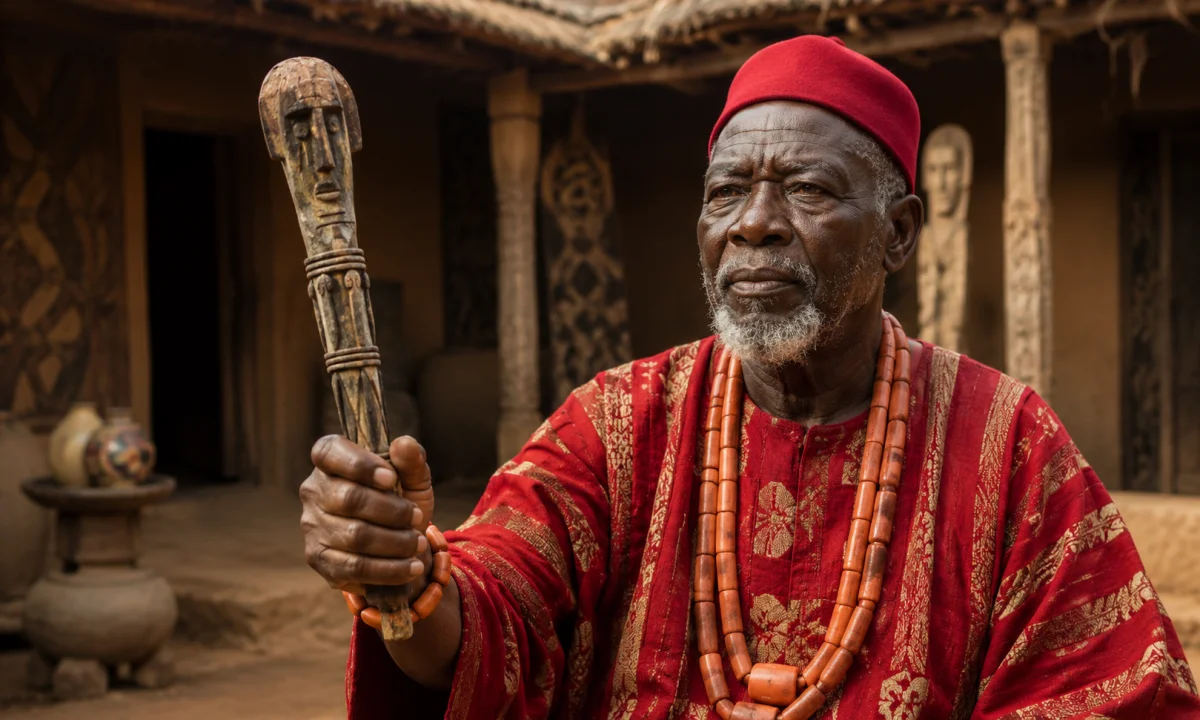
Ofo is a sacred symbol of authority in many Igbo communities of southeastern Nigeria. Usually represented by a carved staff, rod or branch, it is associated with legitimate leadership, ancestral presence, truth, justice and the right to speak or act on behalf of a family, lineage, village or religious office. Ofo is sometimes described as an object, sometimes as an institution of authority, and sometimes as a spiritual principle. It is not normally a god or a legendary creature, although it may be addressed during prayers and ritual speech.
Origins and cultural setting
Ofo belongs primarily to Igbo religious and social traditions. The Igbo-speaking peoples are not a single culturally uniform group: communities differ in political organization, dialect, ritual practice and religious vocabulary. As a result, the precise form and meaning of an ofo can vary from one locality to another. In many communities, however, it represents a continuing relationship between the living, their ancestors and the moral order of society.
Traditional Igbo religious life has often been organized through families, lineages, villages and titled associations rather than through a single centralized priesthood. Authority may be distributed among household heads, elders, lineage custodians, priests, diviners, titled men and assemblies. Ofo operates within this social structure. It does not simply signify personal power; it indicates that a person has inherited, received or been entrusted with the right to exercise a recognized form of authority.
The object is especially connected with ancestors. A lineage may preserve an ancestral ofo as a material link with the founders and deceased heads of the family. Through it, the authority of earlier generations is understood to remain present in the community. This does not mean that every ofo has exactly the same history. Some belong to a household, some to a wider lineage, and others to a religious or political office.
The name and identity of Ofo
The name is commonly written ofo in English-language writing and ọfọ when Igbo orthographic marks are used. The under-dotted vowels represent sounds in Igbo that are not shown in ordinary English spelling. Spellings without diacritics are widespread, but they can conceal distinctions between Igbo words. The term may refer both to the physical object and to the authority symbolized by that object.
Ofo should therefore not be treated as a personal name in the same way as the name of a deity or hero. A particular community may speak of its ancestral ofo, the ofo of a titled office, or the ofo belonging to a lineage. In these contexts, the word identifies a sacred emblem and the authority attached to it rather than one universally defined supernatural individual.
Descriptions of ofo sometimes use words such as “staff,” “wand,” “rod,” “sceptre” or “symbol.” Each translation captures only part of the idea. A royal sceptre, for example, may primarily display the power of a monarch, whereas an ofo can express inherited legitimacy, ancestral sanction, moral responsibility and ritual protection at the same time. Its significance depends on who holds it, how it was inherited and the setting in which it is used.
Appearance and materials
An ofo is generally a small ritual staff, rod or carved wooden object. Its form is not entirely standardized. Some examples are plain, while others have carefully carved handles, branching shapes, figures or additional elements. The design may reveal something about the office or lineage to which it belongs, but appearance alone is not always enough to identify its status.
Wood is especially important because the object must be durable, portable and suitable for carving. Accounts of Igbo ritual objects associate ofo with particular trees or types of wood, but the species used are not identical everywhere. Local custom, availability and the history of a specific object may determine the material. Some ritual staffs may also incorporate metal or other materials, although the essential meaning lies in the authority and ritual history of the object rather than in one universal shape or substance.
Because an ofo can be inherited, it may become old and visibly worn. Age can reinforce its significance, particularly when it is believed to have passed through the hands of several generations. It is not simply an antique kept for decoration. Its condition, storage and handling may be governed by rules that distinguish it from ordinary household property.
Authority, ancestry and moral order
The central meaning of ofo is often expressed through the ideas of legitimate authority and moral accountability. A person who holds an ofo is expected to use it in accordance with customary law and the welfare of the community. The object cannot automatically make an unjust person legitimate. Rather, it represents an authority that is supposed to be exercised correctly.
In many Igbo settings, the ancestors are understood to support social balance and to oppose serious violations of accepted moral order. Since an ofo may stand for the ancestors of a lineage, invoking it can affirm that a statement or decision is made under ancestral witness. This is why the object may appear in disputes, oaths, reconciliations and decisions concerning land, inheritance or family obligations.
Ofo is also associated with truth. A person who swears by an ofo is not merely making a solemn promise in a private sense. The oath may place the speaker under the observation of ancestors and spiritual powers. False testimony or a broken oath can therefore be feared as a source of spiritual and social consequences. The seriousness of such an act depends on local practice, but the general principle is that speech made in the presence of an ofo carries unusual weight.
This connection between authority and moral conduct is sometimes summarized in the expression ofo-na-ogu, often translated as “authority and innocence,” “justice and moral integrity,” or “legitimate power and right conduct.” The exact interpretation varies. Ogu is a complex Igbo idea associated with righteousness, innocence, justice or a clear moral standing. Ofo and ogu are related in discussions of rightful authority, but they are not identical objects and should not be treated as interchangeable names.
Ritual uses
Ritual use of an ofo can include prayer, invocation, oath-taking, blessing and the confirmation of decisions. The holder may raise, touch, place or point the object according to the custom of the community. In some situations, it is displayed during deliberation; in others, it remains in a protected shrine or household space and is brought out only for a particular ceremony.
Among the contexts associated with ofo are:
- Lineage ceremonies: An ancestral ofo may be present when a family honours its predecessors, confirms succession or addresses a serious internal matter.
- Public deliberation: Elders or recognized authorities may use it when discussing disputes, obligations, land and community decisions.
- Oaths and testimony: Statements made before an ofo can carry religious force because the ancestors are treated as witnesses.
- Prayer and sacrifice: An ofo may be included in rituals directed toward ancestors or other spiritual powers, depending on local tradition.
- Installation and succession: The transfer of an ofo can mark the passage of a family or office from one custodian to another.
- Protection and blessing: It may be invoked to safeguard a household, affirm peace or establish the legitimacy of a communal act.
These uses should not be assumed to occur in every Igbo community. Ritual specialists, elders and lineage heads may have different responsibilities, and some objects may be kept away from general view. A person may be permitted to handle an ofo only after inheritance, initiation, title-taking or formal recognition.
Custodians and inheritance
The custodian of an ofo is not necessarily a “priest” in the narrow sense. A lineage head, elder or titled person may hold it because of family position, while another ofo may belong to a shrine and be managed by a designated ritual specialist. In some settings, political and religious authority overlap; in others, they are more clearly separated.
Inheritance is an important theme. An ofo may be passed from a father to a son or through another recognized line of succession, but the exact rules are local rather than universal. Inheritance is not merely the transfer of a valuable object. It carries duties toward living relatives, ancestors and the wider community. The new custodian is expected to preserve the object, observe ritual restrictions and use its authority responsibly.
Where an office or lineage becomes divided, the question of which person possesses the legitimate ofo can become a question of identity and political authority. The object’s history may be invoked to support claims about seniority, descent and customary rights. In this way, ofo can function both as a religious emblem and as a record of social continuity.
Stories and traditional interpretation
Unlike figures such as Amadioha or Ala, Ofo does not have one widely shared cycle of myths in which it acts as a character with a fixed biography. Its significance is usually preserved through ritual practice, oral explanations, genealogies, proverbs and accounts of ancestral events. A community may tell how a particular ofo was received by a founder, recovered after a crisis or transferred to the rightful successor.
Such narratives are often local. One lineage’s account should not automatically be presented as an origin story for all Igbo people. Some communities may describe the object as carrying ancestral power; others may stress its role as a visible emblem of customary authority. These interpretations can coexist without producing a single standardized mythology.
Ofo is also understood through the actions performed with it. A prayer, oath or judgment can communicate its meaning more clearly than an abstract definition. When an elder invokes the ancestors through the ofo, the object becomes a meeting point between remembered descent, present responsibility and the anticipated consequences of violating moral law.
Ofo and other Igbo religious concepts
Ofo belongs to a broader religious vocabulary that includes ideas of personal destiny, spiritual forces, ancestors, earth morality and justice. It is not equivalent to Chukwu, a major name for the supreme deity in many Igbo traditions, nor is it a type of alusi, the term often used for a spirit or divinity associated with a place, community or natural force. An ofo may appear in rituals involving such powers, but it remains a symbol and instrument of authority rather than a universal deity.
It is also distinct from ogu. Ogu refers to moral rightness, innocence or justice in ways that vary by context, while ofo is represented by a tangible emblem and the authority connected with it. The phrase ofo-na-ogu links the concepts, especially when legitimate power must be joined to righteous conduct, but the two terms should not be collapsed into one.
Confusion may also arise because “ofo” can be used in different ways in English-language descriptions of Igbo culture, and because similar-looking words occur in other African languages. A term from Yoruba, Akan, Edo or another cultural tradition should not be assumed to describe the Igbo ofo. The surrounding language, ritual setting and community history are essential for identifying which concept is meant.
Historical change and religious continuity
Christian missionary activity, colonial administration, urbanization and legal change altered the public role of many Igbo ritual institutions. Missionaries often condemned ancestral objects and indigenous authority symbols as pagan, while colonial systems sometimes replaced or reshaped customary forms of leadership. Some ofo were hidden, destroyed, transferred to museums or removed from ritual use.
These changes did not eliminate the concept everywhere. In many families and communities, the ofo continued as an emblem of descent, customary identity and social responsibility, even when its ritual use became less public. In other cases, its significance was reinterpreted within Christian or secular settings, or preserved mainly through memory and family history. Contemporary Igbo attitudes are diverse: some people regard the object as a living sacred inheritance, while others see it chiefly as a cultural or historical symbol.
Scholarly descriptions must therefore distinguish between older accounts, present-day practice and generalizations drawn from one locality. Written records produced during the colonial period often describe Igbo customs through outside categories and may not capture local differences. Oral tradition, surviving objects, community explanations and contemporary religious life can provide different perspectives, none of which should be treated as a single universal version.
Modern representation
Ofo has not become a major figure in global popular culture in the way that some African deities and legendary heroes have. When it appears in modern writing, art, theatre or cultural education, it is usually presented as an emblem of Igbo heritage, ancestral authority or customary justice. Such representations can be valuable, but they may simplify a complex institution into a generic “magic staff.”
The most important distinction is that an ofo is traditionally meaningful because of its relationship to a particular community, lineage, office and moral order. Its power is not best understood as a fantasy weapon with independent abilities. It is a sacred sign whose authority depends on ancestry, recognized custodianship, ritual correctness and the obligations placed upon the person who holds it.