WORLD
WORLD
El-lal
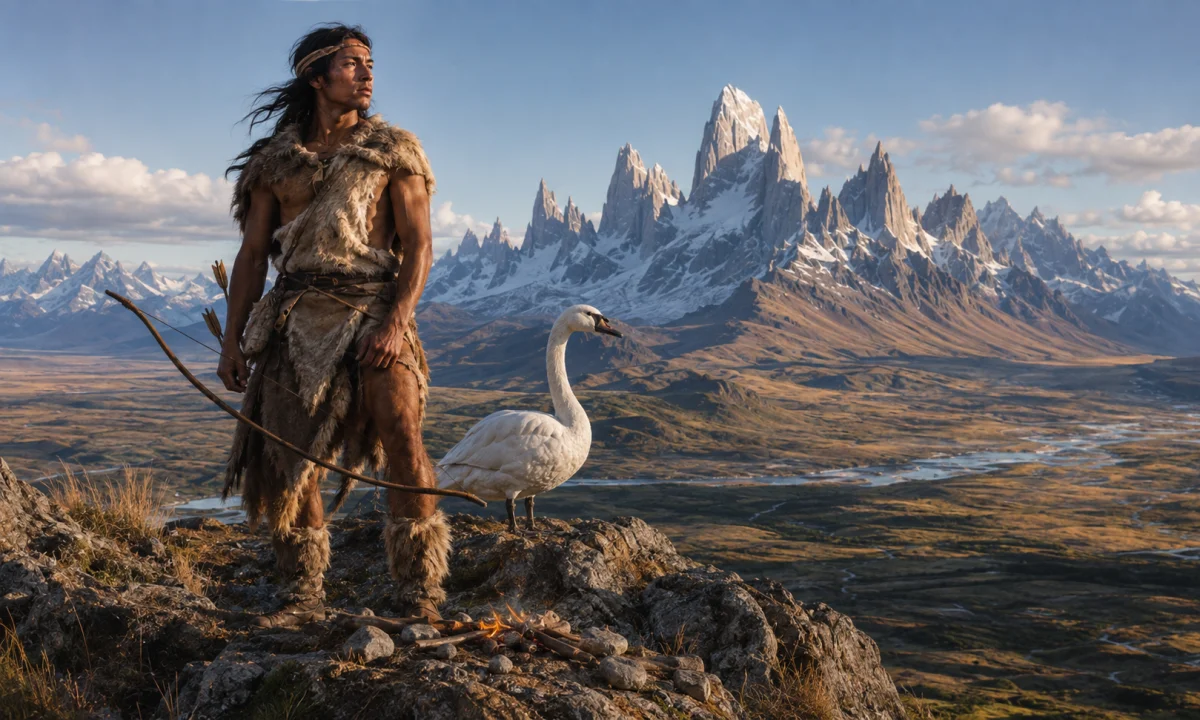
El-lal, also written Elal or with other spelling variations, is a major mythic figure in the traditions of the Tehuelche peoples of Patagonia. He is especially associated with the Aónikenk, the southern Tehuelche-speaking people whose traditional territory included parts of present-day Argentina and Chile. El-lal is commonly described as a culture hero, creator or demiurge, and teacher of humanity, although these labels do not always correspond exactly to the categories used within Tehuelche religious thought.
Stories about El-lal belong to an oral tradition preserved through narrative, ritual knowledge and teachings about the natural world. They were later recorded by ethnographers, travellers and Indigenous informants, often in different regions and under different spellings. As a result, there is no single universally fixed version of his life. Details about his birth, parentage, enemies, journeys and supernatural powers vary between accounts.
The Tehuelche cultural setting
The Tehuelche peoples traditionally lived across much of the vast Patagonian steppe, extending from the Atlantic coast towards the Andes. Their societies were adapted to a mobile hunting way of life, and guanacos were especially important as food, clothing and raw material. The landscape of Patagonia—its windswept plains, rivers, mountains, animals and changing skies—forms the setting for many Tehuelche narratives.
The word Tehuelche is a broad name applied to several peoples and linguistic groups. It was used extensively by outsiders, and its historical meaning has not always been consistent. The Aónikenk are the group most often connected with the surviving accounts of Elal, but neighbouring peoples had their own traditions, names and mythic systems. A story recorded among one group should not automatically be treated as the belief of every community called Tehuelche.
Traditional narratives were not simply entertainment. They could explain the origin of customs, the behaviour of animals, the structure of the world and the responsibilities of human beings. Their meaning also depended on who told the story, on the circumstances of its telling and on the relationship between the narrator and the listeners. Written versions therefore preserve important evidence, but they do not represent a complete or unchanging scripture.
Name and identity
The name appears in several forms, including Elal, El-lal and forms influenced by the spelling practices of early recorders. Such variation is common when Indigenous names are written in languages using different alphabets and when researchers attempt to represent sounds that do not have a direct equivalent in Spanish or English.
El-lal is often called a “god” in general accounts of mythology. That description can be useful for readers, but it may also be misleading if it suggests a precise equivalent to a supreme deity in a formal theological system. In many narratives, El-lal functions more clearly as a culture hero or demiurge: a powerful being who shapes the conditions of human life, teaches essential skills and establishes relationships between people, animals and the landscape.
Some retellings present him as a creator of the world, while others describe him as a being who enters an already existing cosmos and gives it order. These descriptions should not be forced into a single system. The surviving tradition includes different layers of interpretation, including Indigenous concepts, the assumptions of colonial observers and later comparisons with European mythological categories.
Birth and supernatural ancestry
One widespread group of stories makes El-lal the child of a powerful male being, often identified as Noshtex, and a female figure associated with the clouds or sky. The names and precise roles of these figures vary in different accounts. In some versions, Noshtex is depicted as a giant or dangerous supernatural being whose actions lead to El-lal’s birth and subsequent abandonment.
The circumstances surrounding El-lal’s early life are usually marked by violence, danger and opposition. Some narratives say that his father tried to kill or dispose of him, while others describe the infant being cast away or left in a remote place. These episodes establish a contrast between El-lal and the destructive forces around him. His authority does not come simply from inheritance; it is demonstrated through survival, intelligence and the ability to overcome beings stronger than ordinary humans.
Accounts of his rescue or protection differ. Animals, birds or other beings may shelter him, guide him or help him reach the land where his later deeds take place. Birds are particularly important in several versions of the story, reflecting the close relationship between supernatural beings and animal powers in Patagonian mythology. The narrative is not merely a childhood adventure: it presents El-lal’s emergence as part of the ordering of the human world.
El-lal as culture hero
El-lal’s most consistent role is that of a teacher. He is credited in different traditions with giving people or showing them how to use fire, make weapons, hunt, travel and live within the Patagonian environment. The bow and arrow are especially prominent in retellings. Because hunting was central to Aónikenk life, instruction in hunting was also instruction in social survival, cooperation and respect for the animals on which people depended.
Rather than inventing civilisation in an abstract sense, El-lal is often portrayed as making practical knowledge available. He reveals techniques that allow human beings to live in a difficult landscape. Such stories can be read as accounts of cultural origin, but they also express a moral relationship with nature: animals are not merely resources, and the skills needed to hunt are part of a larger order established by powerful beings.
Fire has a similar importance. In many traditions throughout the world, the acquisition of fire represents the passage from an exposed and vulnerable condition to an organised human life. In El-lal’s stories, fire can be connected with knowledge, protection, food preparation and social gathering. The emphasis is not necessarily on a single dramatic theft from a fire-owning monster, as in some other mythologies. The exact episode varies, and general summaries should not be treated as a definitive version of the tradition.
Encounters with giants and dangerous beings
Several accounts place El-lal in conflict with giants, monsters or hostile supernatural beings. These opponents may represent disorder, cruelty, predatory violence or the dangers present in a world not yet made suitable for human life. El-lal defeats them through a combination of courage, skill and cleverness rather than by relying only on physical strength.
The conflict with Noshtex is particularly important in versions that identify Noshtex as El-lal’s father. In such narratives, the father’s hostility gives the hero’s story a family dimension as well as a cosmic one. El-lal must separate himself from a destructive power and establish a different order. The precise ending of this conflict is not uniform in the recorded material, and details should be treated as variant rather than as parts of one fixed biography.
El-lal’s victories do not make him a warrior hero in exactly the same sense as figures from epic traditions. His battles are significant because they clear the way for human life and customary knowledge. The hero’s success is measured by what becomes possible afterwards: hunting, movement across the land, the use of fire and the creation of a habitable social world.
Relationship with animals and the landscape
Animals frequently act as helpers, companions or teachers in El-lal narratives. Their involvement reflects the importance of animals within Tehuelche life and cosmology. Birds may rescue or guide the hero, while other creatures can become involved in the distribution of knowledge or the establishment of relations between humans and the natural world.
Guanacos, in particular, occupy a central place in the material culture of Patagonia, although not every story involving El-lal gives them the same mythic role. A careful reading distinguishes between what is directly stated in a particular narrative and what is inferred from the wider importance of guanacos to Aónikenk society.
The landscape itself is not a passive background. Mountains, plains, water and the sky may be connected with the movements and actions of supernatural beings. Some modern summaries describe El-lal as having physically created major features of Patagonia. Such claims may reflect particular versions or later interpretive expansions, but they should not be presented as a single detail shared by all Tehuelche traditions.
El-lal and other Tehuelche supernatural figures
El-lal is sometimes compared with or confused with Kóoch, a powerful figure associated in certain Tehuelche traditions with the creation or ordering of the cosmos. The two should not automatically be merged. Their roles, names and importance vary according to the community and source, but they are not simply alternative spellings of one universally defined being.
Kóoch is often described in general accounts as a primordial creator, while El-lal is more commonly presented as a culture hero who brings knowledge and practical arts to humans. This distinction is useful, although it is not absolute. Oral traditions do not always arrange supernatural beings according to the neat categories used by modern reference works. A particular account may give El-lal a more cosmic role or describe Kóoch differently.
El-lal should also be distinguished from figures belonging to other Indigenous traditions of southern South America. Similar themes—an abandoned child, a heroic teacher, the discovery of fire or the defeat of giants—occur widely across the world. Similarity of motif does not prove that the figures are identical or that one tradition was borrowed from another.
Sources and historical transmission
Knowledge of El-lal comes primarily from oral traditions recorded during the nineteenth and twentieth centuries, together with later ethnographic work and Indigenous cultural transmission. Many early records were produced under colonial conditions. Researchers often relied on interpreters, used Spanish spellings for Indigenous words and selected stories according to their own ideas about “myth,” “religion” or “folklore.”
These limitations do not make the records worthless, but they require care. A written transcription may preserve a valuable narrative while omitting ceremonial context, alternative versions or the identity of the storyteller. It may also combine material from different communities under the general label “Tehuelche.” For this reason, statements about El-lal should ideally specify whether they refer to a particular Aónikenk account, a later scholarly reconstruction or a popular retelling.
The loss of speakers and the disruption of Indigenous communities caused by colonisation, state expansion and other historical forces affected the transmission of traditional knowledge. At the same time, Indigenous people have continued to preserve, reinterpret and reclaim cultural narratives. El-lal therefore belongs not only to historical records but also to living discussions of Aónikenk and wider Patagonian identity.
Symbolism and cultural significance
El-lal can be understood as a figure of transition. He moves from danger and isolation into a role that benefits human communities. His story links the supernatural origins of the world with ordinary activities such as making fire, hunting and travelling. This combination gives the narrative its distinctive force: sacred knowledge is expressed through the practical skills required for daily life.
His opposition to destructive giants also presents a contrast between two kinds of power. One is violent, possessive and threatening; the other is creative, instructive and socially useful. El-lal’s authority is shown through his ability to make life possible rather than through domination alone.
The stories further suggest that human culture is not separate from the natural world. Skills are received through relationships with animals, sky beings and the land. Such themes should not be reduced to a modern environmental message, but they do show why El-lal remains relevant when discussing Tehuelche understandings of human dependence, responsibility and belonging.
Later retellings
El-lal has appeared in Argentine and Patagonian cultural writing, educational materials, museum interpretation, children’s retellings and regional discussions of Indigenous heritage. These versions often simplify his genealogy or present him solely as a “creator god.” Some also combine episodes drawn from different sources in order to produce a continuous adventure narrative.
Such adaptations can help introduce the figure to new audiences, but they are not interchangeable with traditional accounts. A retelling that gives El-lal a fixed appearance, a complete biography or a single set of powers may be a modern literary construction rather than a detail consistently preserved in Aónikenk tradition. El-lal is best understood through the diversity of the narratives associated with him, the cultural setting in which they were told and the continuing importance of Tehuelche voices in interpreting them.