WORLD

Chiuta
Chiuta is a name associated with a supreme or creator deity in several traditions of south-central Africa, especially among Tumbuka-speaking communities in Malawi and eastern Zambia. The related form Chauta is also used in Chewa contexts, particularly in Malawi. Chiuta is commonly connected with the sky, rain, fertility, creation and the rainbow. However, accounts differ between communities and between the oral traditions recorded by outsiders. The name does not describe one uniformly defined figure across all African religions.
Cultural setting
Chiuta belongs to the religious traditions of peoples living around the modern borders of Malawi, Zambia and Mozambique. These communities have historically included the Tumbuka, Chewa and groups with related languages and cultural practices. Political borders created during the colonial period do not correspond neatly to the distribution of local religious traditions, so the same or similar divine name may occur in more than one country.
Traditional religious life in the region has generally involved a relationship between a high god, nature powers, ancestral spirits and local ritual specialists. These categories are not always sharply separated in the way that modern reference works may suggest. A supreme creator could be regarded as powerful and distant, while ancestors, territorial spirits or rainmaking authorities were approached in matters affecting ordinary life.
Chiuta is therefore best understood within a wider religious world rather than as an isolated mythological character. Rain, the growth of crops, human fertility, illness, death and the well-being of a community were interconnected concerns. A deity associated with the sky and rain could also be understood as the source of life and order.
The name Chiuta and related forms
The spelling Chiuta is especially associated with Tumbuka traditions, while Chauta is a common form in descriptions of Chewa religion. Spellings can vary because these traditions were recorded in different languages and through different systems of transcription. A difference in spelling does not necessarily indicate a different deity, but it should not be assumed that every account refers to precisely the same religious concept.
Interpretations of the name also vary. It is often explained in connection with a bow, a great bow or the rainbow. In this interpretation, the rainbow is not merely a visual sign but a manifestation or symbol of the sky deity. Some descriptions translate the name as “Great Bow,” whereas others use expressions such as “the great archer.” These translations reflect attempts to explain a local name through English and should not be treated as a single universally agreed definition.
The association with the rainbow is particularly significant because rainbows appear between rain and sunlight. They can be seen as signs of a connection between the heavens and the earth, making them appropriate symbols for a deity who controls rain or sustains life. The bow may also suggest power, protection or the ability to send something from the sky.
Chiuta as creator and sky deity
In many descriptions, Chiuta is a supreme creator. The deity is said to have brought the world, human beings, animals or the conditions necessary for life into existence. Such statements should be treated as broad features rather than as evidence of one fixed creation narrative. Tumbuka and Chewa oral traditions have been preserved through performance, teaching and ritual, and different narrators may emphasize different episodes or relationships.
Chiuta’s position is often associated with the sky or a high realm above the human world. The sky is the source of rain, weather and the celestial signs that affect agriculture. This makes the deity both physically remote and vitally important. A distant high god may not be represented by a permanent human-shaped image or approached through a single central temple. Religious attention may instead focus on prayer, customary observance, ancestral mediation and rites connected with rain and communal welfare.
Accounts of Chiuta commonly describe the deity as powerful, benevolent or morally authoritative, but these qualities should not be turned into a rigid theological system. Oral religions do not always define gods through a standardized list of attributes. The meaning of Chiuta may be expressed through stories, praise names, ritual language and explanations of natural events rather than through a formal creed.
Rain, fertility and agriculture
Rain is one of the most important aspects of Chiuta’s traditional significance. Communities dependent on seasonal farming naturally developed religious ideas concerning the arrival, abundance and timing of rain. Too little rain could bring hunger, while destructive storms could damage crops and homes. Rain was therefore a blessing, but it also required balance and proper relations between people, the spirit world and the land.
Because rain makes crops grow, Chiuta may also be associated with fertility in a wider sense. Fertility includes the reproduction of people and animals, the productivity of fields and the continuing life of the community. The deity’s power is consequently not limited to weather. It concerns the conditions that allow society to endure.
References to Chiuta in this context should not be confused with the idea of a specialized “rain god” in a modern catalogue of mythology. A rainmaking deity may be simultaneously a creator, moral power and source of life. Local rain rituals could involve people with particular ritual responsibilities, sacred places or ancestral spirits, and these practices do not necessarily imply that Chiuta was worshipped in the same manner everywhere.
Stories and oral tradition
No single ancient scripture preserves a definitive cycle of stories about Chiuta. The principal sources are oral traditions, later descriptions by missionaries and colonial-era ethnographers, and accounts passed down within communities. These records can be valuable, but they must be read carefully. Outsiders sometimes translated local ideas into familiar categories such as “God,” “heaven,” “devil” or “myth,” even when those categories did not map exactly onto local religious language.
Some traditions describe Chiuta as the originator of human beings and the natural world. Others emphasize the deity’s connection with the sky, the rainbow and rain rather than narrating a detailed creation sequence. In accounts where the rainbow is treated as a bow, the image presents Chiuta as a powerful being whose sign stretches across the heavens. Such imagery can communicate divine presence without requiring a physical statue or a human-like portrait.
Creation stories in the region may also include first ancestors, emergence from the earth, trees, hills or other natural features. These narratives are not automatically stories about Chiuta, even when they occur within the same cultural area. A community can recognize a high creator while retaining separate traditions about the origin of particular clans, landscapes or social institutions.
For this reason, it is misleading to combine every creation story from Malawi or Zambia into one “Chiuta myth.” The details may belong to different peoples, languages or ritual contexts. The safest generalization is that Chiuta is remembered in relevant traditions as a high divine power connected with creation, the sky and life-giving rain, while the surrounding stories vary.
Relationship with other spiritual powers
Chiuta is sometimes presented as the highest being in a hierarchy that includes ancestors and local spirits. In practice, however, religious relationships may be more complex than a simple ladder from god to lesser beings. Ancestors can remain active members of the moral community, while territorial or nature spirits may be linked to specific rivers, hills, forests or settlements.
In some traditions, the supreme deity is considered too remote to be approached in every ordinary matter. People may therefore address ancestors or ritual specialists who act as intermediaries, advocates or interpreters. This does not necessarily mean that Chiuta is unimportant. It reflects a religious understanding in which divine power, ancestral responsibility and community obligations operate together.
Descriptions of Chiuta should also be distinguished from accounts of Mulungu, a widespread name for a high god in several Bantu-speaking societies. Mulungu is sometimes used as a translation or equivalent for the Christian God, and in some contexts it may overlap with local ideas of a creator. In other contexts, it represents a different linguistic or religious tradition. Chiuta, Chauta and Mulungu should not be treated as interchangeable names without specifying the community and source of the description.
Images and symbols
The rainbow is the most widely reported symbol associated with Chiuta. Its form naturally encourages interpretations involving a bow, a bridge between heaven and earth, or a visible sign of divine activity. The rainbow also follows rain, making it especially appropriate for a deity connected with storms, fertility and renewal.
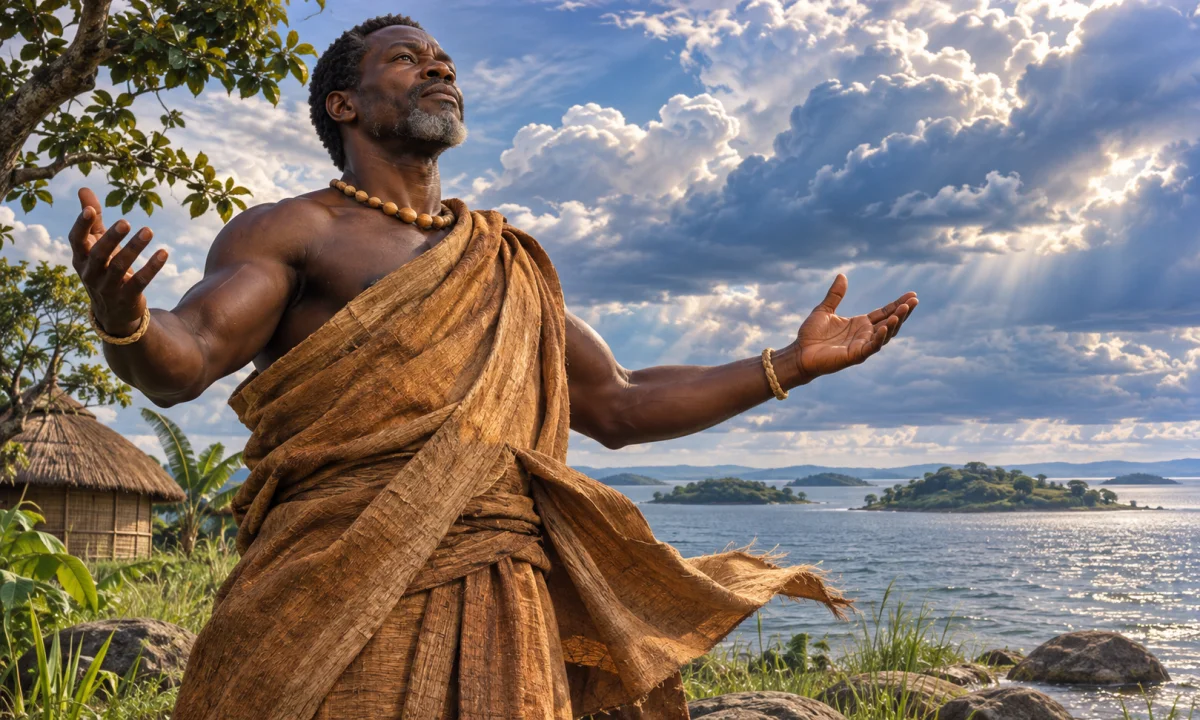
There is no reliable basis for claiming that Chiuta has one standard physical appearance across all traditions. Some modern illustrations depict a human-like male figure holding a bow or standing among clouds, but these are artistic interpretations rather than universally attested traditional images. A symbolic association with a bow does not prove that communities worshipped a carved archer or told stories in which the deity regularly appeared in that form.
Likewise, the title “creator” should not be used to assign every familiar attribute of creator gods from other mythologies. There is no need to add a consort, family, palace, weapon or set of divine offspring unless a particular tradition clearly preserves such details. The available accounts are stronger on Chiuta’s cosmic role and connection with rain than on a standardized divine biography.
Religious significance
Chiuta expresses an understanding of the world in which the natural environment is morally and spiritually meaningful. Rain is not simply a mechanical process. It is part of a relationship involving human conduct, communal harmony, ritual practice and the continuing generosity of the powers that sustain life.
This does not mean that every drought or storm was automatically interpreted as punishment from Chiuta. Religious explanations differ according to circumstance, tradition and the people involved. Nevertheless, the association of the deity with rain and fertility shows how closely agriculture, spirituality and social responsibility were connected.
The idea of a remote creator also offers a way to understand the relationship between the visible world and a higher source of order. Chiuta may be invoked as the origin of life while ancestors and local spirits remain important in everyday religious practice. This combination of a high god with active intermediary powers is common in many African religious traditions, although its precise form differs from one society to another.
Historical recording and interpretation
Knowledge of Chiuta has reached modern readers through several layers of interpretation. Oral teachings were recorded in local languages, translated into European languages and then classified by writers who often compared African deities with figures from the Bible or classical mythology. Missionaries sometimes identified a local high god with the Christian God, while ethnographers sometimes arranged fluid religious ideas into fixed categories such as “supreme god,” “lesser god” and “spirit.”
These records should not be dismissed, but neither should they be treated as transparent transcripts of ancient belief. Traditions change through migration, intermarriage, religious conversion, political transformation and contact with neighboring communities. A description of Chiuta from one district or period may preserve genuine local knowledge without representing every Tumbuka- or Chewa-speaking community.
The most responsible descriptions therefore distinguish between recurring themes and uncertain details. The recurring themes include the deity’s high status, association with creation or the origin of life, and connection with the sky, rain and rainbow. The uncertain details include the exact meaning of the name, the shape of the creation story, the degree of formal worship and the relationship between Chiuta and similarly named or translated divine figures.
Chiuta in modern understanding
Chiuta is not a major character in globally distributed popular culture, and modern novels, games or films have not established a single standard image comparable to those of gods from Greek, Norse or Egyptian mythology. When the figure appears in contemporary educational material or online mythology collections, the presentation may simplify a varied regional tradition into the image of a universal “African sky god.” That treatment can obscure the specific Tumbuka, Chewa and neighboring contexts in which the name has meaning.
Contemporary religious communities may also use Christian vocabulary alongside older names and concepts. Such overlap does not by itself show that Chiuta and the Christian God were originally identical. It reflects the history of translation, conversion and religious change in Malawi, Zambia and surrounding regions. Chiuta is best approached as a figure whose significance belongs to particular African traditions, especially those linking the creator and sky with the rain on which communal life depends.