WORLD

Ndo’yet
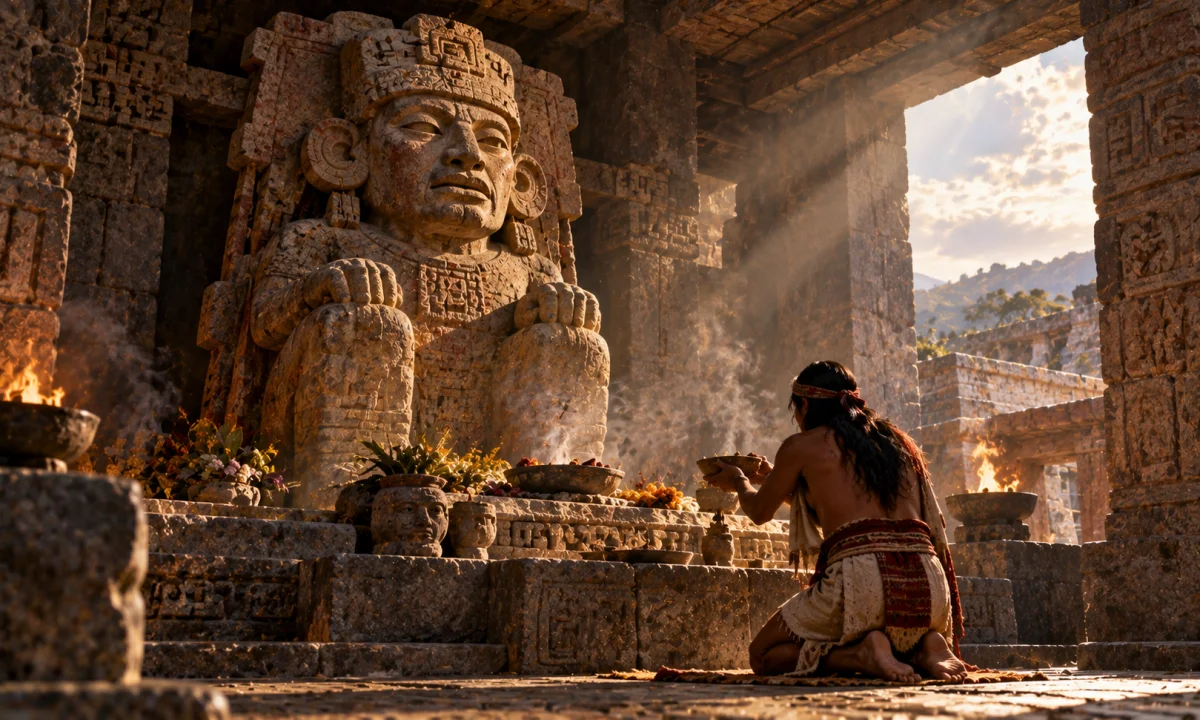
Ndo’yet is a name associated with earthquakes and the power of the earth in some accounts of Zapotec mythology. The evidence for Ndo’yet is limited, however, and the figure is not documented as consistently or extensively as better-known Zapotec deities such as Cocijo, the god of rain and lightning, or Coqui Bezelao, a lord associated with death and the underworld. Zapotec religious traditions developed among many communities in Oaxaca, Mexico, and names, stories and divine classifications could vary from one region and language variety to another.
Origins and cultural setting
The Zapotecs are an Indigenous people of southern Mexico, especially associated with the Central Valleys of Oaxaca, the Sierra Norte, the Sierra Sur and the Isthmus of Tehuantepec. Zapotec-speaking communities have never formed a single culturally uniform society. They share important historical connections, but their languages and local traditions are diverse. This diversity matters when interpreting a relatively obscure name such as Ndo’yet.
Zapotec civilisation has deep roots in Oaxaca. The city of Monte Albán, founded during the first millennium BCE, became a major political and ceremonial centre, while later Zapotec communities maintained their own local institutions and religious practices. Archaeological remains show a religious world concerned with rain, maize, fertility, rulership, ancestors, mountains, caves and the forces that shaped agricultural life.
Much of the written information about pre-Hispanic Zapotec religion comes from colonial-period records, especially descriptions produced after the Spanish conquest. These sources are valuable but incomplete. They were written through Christian and European categories, often focused on suppressing Indigenous religious practices, and they do not provide a complete account of every local deity or ritual tradition. Indigenous knowledge also continued through oral teaching, community ceremonies, place traditions and the work of later Zapotec-language scholars and cultural historians.
Against this background, Ndo’yet should not automatically be treated as a universally recognised god of all Zapotec peoples. The name is most often presented in modern summaries as belonging to a Zapotec earth or earthquake power, but the surviving documentation does not establish a single, detailed mythological biography.
Name and identity
The spelling Ndo’yet uses an apostrophe to represent a sound found in some systems of Indigenous-language transcription. Zapotec languages are tonal and highly diverse, and a word or name may be written differently according to the community, orthography or source in which it appears. For that reason, spellings such as Ndo'yet, Ndoyet or other forms should not automatically be assumed to refer to precisely the same traditional expression without further linguistic evidence.
The meaning of the name is also not securely established across Zapotec languages. It is sometimes explained in connection with the earth, the ground or earthquakes, but these interpretations should be treated cautiously. A translation that is meaningful in one Zapotec language or local tradition may not apply to another. Zapotec religious names were not necessarily fixed proper names in the same way as the names of characters in a modern literary mythology.
In general descriptions, Ndo’yet is classified as an earthquake deity or an earth-associated supernatural being. This classification reflects the way the name has been transmitted in modern mythological reference material rather than a large, securely documented body of pre-Hispanic texts. Some accounts describe Ndo’yet as the force responsible for the trembling of the ground. More elaborate details—such as a definite appearance, genealogy, dwelling place or set of sacred objects—are not consistently supported.
Earthquakes and the living earth
An earthquake is not merely a natural event in a religious worldview. It can be understood as a manifestation of a living and powerful landscape. Mountains, caves, springs, rocks and fields often possess spiritual significance in Indigenous Mesoamerican traditions. The earth may nourish human communities through soil and crops while also displaying dangerous, uncontrollable power.
When Ndo’yet is identified with earthquakes, the figure represents this unstable dimension of the earth. The ground that supports houses, temples and fields can suddenly move, break and destroy. Such a power would have been especially significant in Oaxaca, a region shaped by active geological processes and marked by mountainous terrain, valleys and fault lines. The association does not mean that Zapotec people lacked practical explanations for natural events. Religious interpretation and observation of the physical world could exist together.
Attributing an earthquake to a supernatural power may also express a relationship of obligation between people and their environment. Ritual action, respect for sacred places and proper conduct could be understood as ways of maintaining balance. It would be misleading, though, to assign a single universal ritual purpose to Ndo’yet when the available evidence does not describe a complete cult or standard ceremony devoted to the figure.
Attributes and representation
There is no securely established ancient iconographic image of Ndo’yet comparable to the well-known representations of rain and lightning beings in Mesoamerican art. Claims that Ndo’yet had a particular animal form, carried a specific weapon or wore a fixed headdress should therefore be treated with caution unless they can be tied to a clearly identified local tradition.
The limited descriptions of Ndo’yet concentrate on function rather than appearance. The name is connected with the shaking or disturbance of the earth, making geological force the central attribute. In a broad symbolic reading, Ndo’yet may stand for the hidden energy beneath the surface of the land: a power that is normally unseen but becomes evident through sudden movement.
This symbolism fits a wider Mesoamerican tendency to connect sacred power with landscape. Caves could be imagined as entrances to otherworldly realms; mountains could be sources of rain and fertility; and the earth could be regarded as a being or sacred substance that required respect. These wider patterns help explain why an earthquake power might belong to a religious world concerned with agricultural survival, but they should not be used to invent specific Ndo’yet myths.
Stories and relationships with other Zapotec powers
No single canonical story about Ndo’yet survives in which the figure has a clearly defined origin, spouse, family or sequence of adventures. Unlike mythological characters preserved in extensive literary traditions, Ndo’yet appears mainly as a brief name and classification in modern accounts. There is no reliable basis for presenting a detailed cycle of tales in which Ndo’yet battles other gods, creates humanity or rules a particular underworld.
The most important comparison is with Cocijo, one of the principal Zapotec rain and storm deities. Cocijo was associated with rain, lightning, fertility and agricultural abundance, and is represented in pre-Hispanic art with distinctive features related to storm beings. Because thunder, lightning, rain and earthquakes are all dramatic forces of nature, modern retellings may place them together or confuse their functions. They are not automatically the same figure. Cocijo has substantially stronger archaeological and historical documentation than Ndo’yet.
Ndo’yet should also be distinguished from Zapotec deities associated with death and the underworld, including figures whose names appear in variant spellings such as Pitao Pezelao or Coqui Bezelao. These beings belong to a different area of religious concern. Similar-looking spellings in sources written by outsiders do not prove that the figures were related, and Zapotec titles and divine names can be difficult to compare across regions.
Nor should Ndo’yet be merged with the many Mesoamerican earthquake or earth beings from other traditions. Nahua, Maya, Mixtec and other peoples had their own cosmologies, sacred landscapes and explanations of earthquakes. A shared concern with the earth does not demonstrate a shared deity. The category “Mesoamerican mythology” is a modern comparative label, not evidence that every Indigenous tradition used the same pantheon.
Religious significance
The possible association of Ndo’yet with earthquakes highlights the importance of environmental forces in Zapotec religious thought. Agriculture depended on seasonal rain, fertile land and the stability of settlements, while the region’s mountains and seismic activity made the landscape a source of both nourishment and danger. A figure connected with the movement of the ground would therefore represent a serious sacred power rather than a minor monster or fictional villain.
Earthquakes can also challenge human ideas of permanence. A city, shrine or household may seem stable, yet the earth beneath it can shift without warning. In this sense, an earthquake deity can symbolise the limits of human control and the need to live respectfully within a wider natural and spiritual order.
It is important not to turn this interpretation into a claim about every Zapotec community. Contemporary Zapotec people maintain diverse religious identities, including Indigenous traditions, Roman Catholic practices and forms of religious life shaped by local history. Community knowledge is not reducible to lists of ancient gods. The significance of a name may also change over time, and a local tradition may preserve meanings that are absent from general reference works.
Sources, uncertainty and modern classification
Ndo’yet is difficult to study because the name is not supported by a large body of surviving Zapotec-language mythology or a universally accepted ancient account. Much of the information repeated about the figure comes from short modern summaries that classify Ndo’yet as an earthquake or earth deity but provide little contextual detail. Such summaries may preserve a genuine local or scholarly tradition, yet they can also flatten regional differences and make a complex religious landscape appear to have a single fixed pantheon.
The absence of extensive documentation does not prove that Ndo’yet was invented recently. Indigenous traditions were transmitted in ways that colonial writers did not always record, and many local sacred beings never entered the surviving written record. At the same time, uncertainty should not be filled with unsupported details. The safest description is that Ndo’yet is a sparsely documented Zapotec-associated earth or earthquake power whose precise origin, name meaning and traditional attributes remain unclear.
Later reception
Ndo’yet has little established presence in internationally known literature, film, games or other popular media. When the name appears online, it is usually in encyclopedic lists or brief modern retellings of Mesoamerican mythology. These presentations may give the figure a dramatic personality, an exact physical form or a larger role in a divine family, but such additions are not automatically part of documented Zapotec tradition.
Modern retellings can make an obscure name more visible, but they should be separated from the evidence for historical religious practice. Ndo’yet is best approached as a culturally specific and uncertainly documented Zapotec figure associated with the power of earthquakes and the living earth—not as a universally defined character with a complete canonical mythology.