WORLD

Cocijo
Cocijo is the principal rain and lightning deity associated with the ancient Zapotec peoples of Oaxaca, in southern Mexico. He is commonly identified with storms, thunder, lightning, agricultural fertility and the life-giving water on which Zapotec communities depended. Archaeological images of a distinctive fanged, goggle-eyed supernatural figure appear at important Zapotec sites, especially Monte Albán, and are widely interpreted as representations of Cocijo. The identification is strong but not completely certain in every individual image, since the ancient Zapotec writing system has not yielded a fully readable mythological record and religious traditions varied across time and place.
Origins and cultural setting
The Zapotecs developed one of the earliest complex civilizations in Mesoamerica. Their cultural heartland lay in the Central Valleys of Oaxaca, although Zapotec-speaking communities occupied a much broader region, including the mountainous areas and the Isthmus of Tehuantepec. Monte Albán, founded on a high mountain above the Oaxaca Valley, became a major political and religious centre from the late first millennium BCE and remained influential for many centuries.
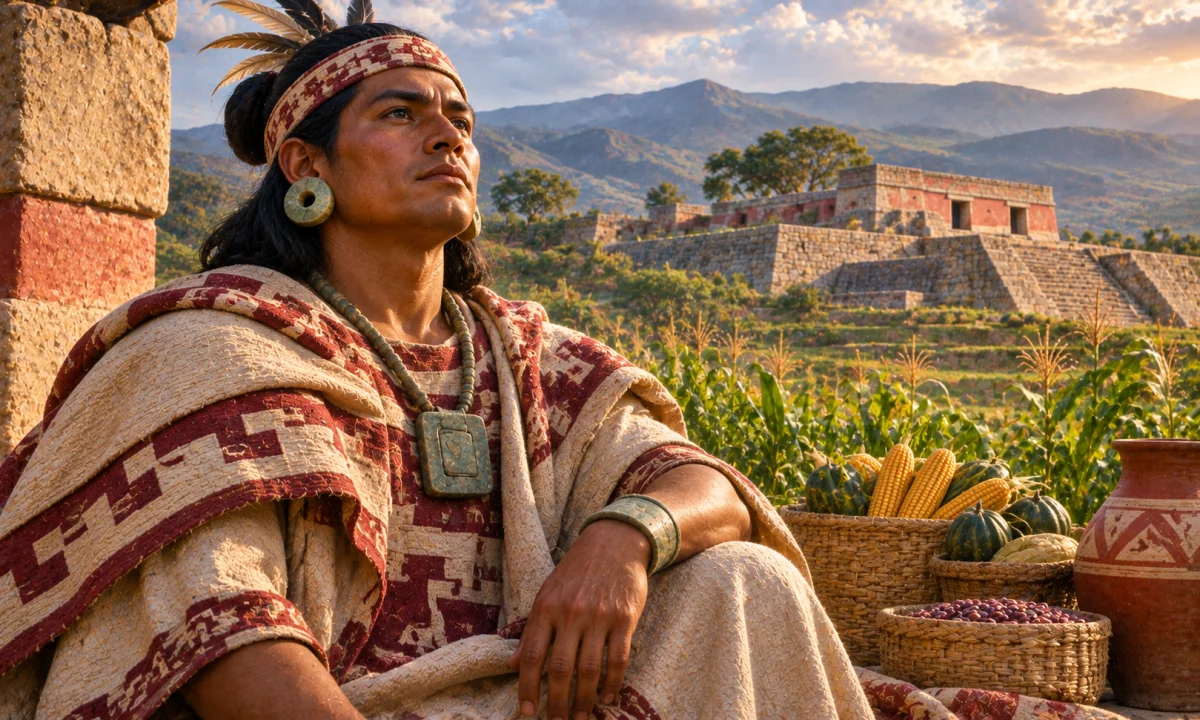
Rain was a matter of survival in this environment. Although rivers, springs and seasonal watercourses were important, farming depended heavily on the arrival and timing of the summer rains. Maize, beans, squash and other crops could flourish or fail according to the storm cycle. A deity associated with rain was therefore not merely a weather spirit. Such a being could also be connected with fertility, maize, clouds, agricultural renewal and the prosperity of human communities.
Cocijo belonged to a wider Mesoamerican religious pattern in which rain, lightning, mountains, caves and agricultural abundance were closely related. This resemblance does not mean that Cocijo was simply a Zapotec version of another culture’s god. Zapotec religion had its own languages, political institutions, ritual practices and visual conventions. Similar concerns arose because many Mesoamerican societies depended on seasonal agriculture and regarded mountains and clouds as sources of sacred water.
The name Cocijo
The form Cocijo is the spelling most often used in English-language scholarship and popular reference works. Other spellings, including Cociyo, occur in discussions of colonial Zapotec vocabulary and pronunciation. The variation reflects the difficulty of representing Zapotec sounds with Spanish orthography, as well as the fact that Zapotec languages are diverse rather than identical.
The name is sometimes preceded by Pitao, producing forms such as Pitao Cocijo. Pitao is generally understood as a Zapotec religious title or term for a deity, although its exact use and significance depend on the source and linguistic context. It should not automatically be treated as a separate divine person. Likewise, spellings found in modern publications do not necessarily represent different gods.
Ancient Zapotec religious terminology cannot always be reconstructed with precision. Colonial dictionaries and descriptions were written after the Spanish conquest, often by Europeans attempting to interpret unfamiliar beliefs through Christian categories. These records are valuable, but they do not provide a transparent transcript of pre-conquest religion. The most secure evidence for Cocijo comes from the combination of colonial references, linguistic analysis and a large body of archaeological imagery.
Evidence from archaeology
Images interpreted as Cocijo appear on ceramic urns, vessels, architectural elements and other objects from Zapotec sites. Many come from tombs and elite ceremonial contexts. Monte Albán is particularly important, but related imagery has also been found at sites across Oaxaca. The repeated appearance of the same general figure suggests that the rain deity held a major place in Zapotec religious life.
The characteristic image has a broad, mask-like face, large circular or goggle-like eyes, a prominent nose, exposed teeth or fangs and a mouth that may contain a projecting tongue. In some examples, the mouth and facial features create a powerful, almost animal-like appearance. Headdresses and surrounding motifs vary considerably. Some figures incorporate signs associated with clouds, water, lightning or maize, while others are shown in a more formal and compact style.
Scholars identify these figures as Cocijo because of their recurring features and their association with contexts connected to water, fertility and ritual power. The identification is not based on a single ancient inscription that plainly says, “This is Cocijo.” Zapotec writing survives in inscriptions and monuments, but much of the system remains difficult to interpret, and the surviving texts do not provide a complete catalogue of the gods. As a result, iconographic identifications are sometimes provisional.
Some Cocijo urns were placed in tombs, where their presence may have linked rain, fertility and the ancestors. This does not necessarily mean that Cocijo was a god of death. In many agricultural religious systems, the worlds of the living, the dead, the earth and the weather were connected. Tomb offerings could invoke protection, continuity, ancestral power or the renewal of life. The precise meaning of any one urn depends on its archaeological context and cannot always be recovered.
Identity and divine functions
Cocijo is best understood as a rain and storm deity whose powers included lightning and thunder. He was also connected with the fertility of the earth, especially the water required for crops. Rain could be beneficial, but storms could also bring destructive winds, floods and crop damage. A storm deity therefore embodied both generosity and danger.
Lightning may have been regarded as a manifestation of supernatural power rather than merely a natural event. Its sudden descent from the sky, its destructive force and its connection with rain made it an especially visible sign of divine action. In descriptions of Zapotec religious concepts, Cocijo is often associated with lightning bolts or flashes, but the surviving evidence does not justify assigning one fixed weapon, tool or emblem to every representation.
His sphere may also have included clouds, mountains, springs and the seasonal renewal of vegetation. These associations are reasonable within the wider pattern of Zapotec art and agriculture, but not every one is equally well documented as a formal attribute. Modern summaries sometimes expand Cocijo into a god of all weather, creation, war or death. Such broad lists should be treated cautiously unless they are tied to a specific historical or archaeological source.
The rain deity’s importance probably extended beyond the needs of individual farmers. Rulers and priests had an interest in presenting themselves as mediators between the community and powerful supernatural forces. Rituals for rain and agricultural success could reinforce political authority, particularly when the well-being of the valley depended on coordinated ceremonies and control over water or fertile land.
Appearance and symbolism
The large eyes and fangs of Cocijo have led to comparisons with other Mesoamerican rain deities, especially the goggle-eyed imagery associated with Tlaloc among the Nahuas. The visual resemblance is real, but it should not be used to erase the differences between Zapotec and Nahua traditions. Similar facial conventions may have expressed supernatural power, storm violence, or a connection with dangerous nonhuman forces without indicating a shared identity.
Some images show what appears to be a forked or projecting tongue. It is often interpreted as a sign of lightning, although the exact meaning is uncertain. The facial mask may also combine human and animal qualities. Mesoamerican artists frequently used such combinations to show that a deity belonged to a realm beyond ordinary human experience. A frightening face did not necessarily imply evil. It could communicate authority, potency and the ability to nourish or destroy.
Rain-deity imagery is sometimes linked with the lightning serpent motif found in Mesoamerican art. However, not every serpent or lightning image is automatically an image of Cocijo, and Cocijo should not be reduced to a single serpent creature. The relationships among masks, storm signs, animals and deities differ from one object to another. Careful interpretation requires attention to the object’s date, location and accompanying symbols.
Stories and ritual traditions
There is no surviving Zapotec mythological cycle about Cocijo comparable to the extensive narrative traditions preserved for some better-documented Mesoamerican religions. Ancient Zapotec inscriptions record rulers, dates, warfare and political events more clearly than they record complete stories about the gods. Colonial accounts also tend to describe ceremonies and religious offices rather than preserve long, verbatim myths.
Consequently, statements about Cocijo’s family, birth, marriage or personal adventures are often uncertain. He is sometimes presented in modern retellings as part of a fixed pantheon with clearly defined relatives and narrative episodes. Some of these accounts may derive from later interpretations, regional traditions or comparisons with other Mesoamerican religions rather than from securely documented ancient Zapotec stories.
Colonial records indicate that Zapotec communities maintained ceremonies involving offerings, prayer and ritual specialists. The exact details varied by region and period, and Spanish observers frequently described Indigenous practices through the lens of Christian ideas about idolatry and paganism. Such testimony must therefore be read critically. It can reveal that particular rituals existed, but it may distort their meanings or combine practices from different communities.
Rainmaking ceremonies in agricultural societies commonly involve petitions for timely rain, offerings of food or drink, observance of sacred places and appeals to ancestors or earth powers. These general patterns can help explain the religious importance of Cocijo, but they do not establish a single universal ritual system for all Zapotec peoples. There was never one entirely uniform Zapotec tradition extending unchanged across every community.
Cocijo and other Mesoamerican rain gods
Cocijo is frequently compared with Tlaloc, the major rain deity of the Nahua and Aztec religious tradition. Both are represented with prominent eyes, strong teeth or fangs, and associations with rain, lightning, fertility and agricultural abundance. The comparison is useful for showing a shared Mesoamerican concern with storm power, but Cocijo and Tlaloc are not interchangeable names for one god.
The two traditions developed in different cultural and linguistic settings. Their images may have influenced one another indirectly through long-distance exchange, or they may reflect related artistic conventions circulating in Mesoamerica. Similar iconography alone cannot prove that one deity was copied directly from the other. Nor should Cocijo be identified with Maya Chaac, a rain deity with his own history, names, imagery and ritual context.
Another possible source of confusion is Chalchiuhtlicue, an important Nahua water goddess. She is associated with springs, rivers, lakes and water, but she is not simply another name for Cocijo. Likewise, later accounts of a unified Mesoamerican “rain god” can conceal significant differences among local traditions.
Zapotec diversity and changing traditions
“Zapotec” refers to a broad family of communities and languages rather than a single society with one unchanging religion. Political centres rose and declined, local customs differed, and religious ideas changed over the long pre-Hispanic period. The Cocijo known from Monte Albán imagery may not have been understood in exactly the same way by communities in the Valley of Oaxaca, the Sierra Norte or the Isthmus.
The Spanish conquest introduced Christianity, colonial institutions and new forms of religious control. Indigenous beliefs did not simply disappear. In many communities, older ideas about sacred landscapes, rain, maize, ancestors and ritual obligations continued in altered forms, sometimes alongside Christian saints and ceremonies. It is often difficult to determine whether a later practice preserves a direct ancient reference to Cocijo, reflects a broader Indigenous worldview, or developed through colonial and modern change.
For this reason, living Zapotec communities should not be treated as museum survivals of an ancient religion. Contemporary Zapotec people have diverse identities and religious practices. Some may use ancestral symbols in cultural or artistic settings, while others may not identify with reconstructions of pre-Hispanic deities. Claims about an uninterrupted, identical worship of Cocijo from Monte Albán to the present require evidence and should not be assumed.
Interpretation and cultural significance
Cocijo’s importance lies partly in the way the deity brings together natural force, agriculture, political authority and the sacred landscape. Rain is beneficial, but it arrives unpredictably; lightning nourishes the storm yet can kill; water sustains crops but floods can destroy settlements. The deity’s frightening facial expression may therefore communicate the double character of divine weather power: generosity inseparable from danger.
The repeated presence of Cocijo-like images in tombs and ceremonial spaces also shows that Zapotec religion was material and public. Gods were not only ideas preserved in stories. They were represented in clay, stone, architecture and ritual objects, placed in locations where people encountered them during funerals, ceremonies and acts of political display. Art provided a durable way to connect rulers, ancestors, communities and the forces that governed agricultural life.
Modern museums, textbooks and visual artists often use the striking Cocijo mask as a symbol of ancient Oaxaca. Such uses can help bring attention to Zapotec history, but they may simplify a complex and regionally varied tradition. A stylized “rain god mask” in a modern design is not automatically evidence of a surviving religious practice, and a contemporary artistic representation should be distinguished from an archaeological object or a community tradition.
Cocijo is therefore most securely understood through converging evidence rather than through a single complete myth. Archaeological images establish the prominence of a storm and rain power in ancient Zapotec religion; colonial and linguistic records help preserve the name and some of its associations; and agricultural and cultural context explains why such a deity mattered so deeply. The boundaries of the evidence remain important: many details of Cocijo’s personality, stories and worship are still unknown.