WORLD

Coqui Bezelao
Coqui Bezelao is a figure associated with death and the realm of the dead in accounts of Zapotec religious tradition. The name is also written Coqui Bezelao, Coqui Pezelao, Pitao Bezelao and in several other forms because Zapotec languages have changed over time and early Spanish writers recorded Indigenous words according to Spanish spelling conventions. Although modern summaries often describe him simply as a “Zapotec god of death,” the surviving evidence is more complicated. It comes from a combination of colonial descriptions, Indigenous-language records, archaeology and later interpretations rather than from a single complete Zapotec mythology.
Zapotec religious setting
The Zapotecs developed one of the most important civilizations of ancient Mesoamerica, especially in the Valley of Oaxaca and the surrounding highlands. Major centres included San José Mogote, Monte Albán and Mitla. Zapotec-speaking communities continued to live in Oaxaca after the Spanish conquest, and Zapotec languages and cultural traditions remain living traditions today.
Before Spanish colonisation, Zapotec religious life included ceremonies connected with rain, lightning, agriculture, fertility, rulership, ancestors and death. Religious practice was not necessarily organised around a fixed pantheon resembling the gods of classical Greece or Rome. Divine names, titles and roles could vary between regions and historical periods. A single supernatural power might also be understood through several related names, titles or manifestations.
Colonial observers attempted to translate Zapotec religious ideas into categories familiar from European Christianity and classical mythology. As a result, a figure described as a god of death may have possessed a broader role involving ancestors, burial, the earth, caves, darkness or the destination of the dead. The available records do not provide a complete, consistent biography for Coqui Bezelao.
The name and its uncertain spelling
The first part of the name, coqui, is commonly understood as a Zapotec title associated with a lord, ruler or noble person. In colonial and historical contexts, Coqui appears in names connected with Zapotec rulers. It should not automatically be treated as a personal name in the modern sense. It may indicate rank or authority.
The second element appears in forms such as Bezelao and Pezelao. The difference between B and P reflects, in part, the difficulty of representing Zapotec sounds with the Spanish alphabet used by colonial writers. The precise meaning and historical pronunciation of this element are not entirely secure. Different Zapotec languages and dialects also mean that a word recorded in one area cannot necessarily be applied unchanged to every Zapotec community.
For these reasons, the name is best treated as a historically recorded designation rather than as a perfectly standardised ancient spelling. Some modern publications use Pitao Bezelao, interpreting Pitao as a divine title. Other sources use Coqui Bezelao. These forms are related in modern discussion, but the evidence does not justify assuming that every occurrence represents exactly the same religious concept in every period.
Coqui Bezelao as a death deity
Coqui Bezelao is most often classified as a lord or deity of death. In that role, he is associated with the dead and with the place to which human beings go after life. The title “god of the underworld” is also widely used, although “underworld” is a modern comparative term. It does not prove that Zapotec ideas of the afterlife were identical to the underworlds described in Aztec, Maya or European traditions.
Accounts of Zapotec religion suggest that death was not understood only as personal destruction. The dead remained connected with family, community and sacred places. Ancestors could have continuing importance, and burial practices created a relationship between the living community and those who had died. A ruler or noble person might also be remembered through tombs, offerings and ritual commemoration. Within this setting, a death deity could represent the authority of the realm of the dead rather than an evil force.
Descriptions of Coqui Bezelao do not preserve a large cycle of myths comparable to the surviving stories about some other Mesoamerican figures. There is no securely documented canonical narrative that explains his birth, deeds, battles or death. Much of his modern profile comes from brief identifications in colonial records and from the interpretation of Zapotec archaeological sites. Claims about a detailed kingdom, court or family history should therefore be treated cautiously unless they can be tied to a specific tradition or source.
Mitla and the realm of the dead
Coqui Bezelao is especially associated in modern writing with Mitla, one of the most important Zapotec sites in Oaxaca. The modern name Mitla derives from Nahuatl Mictlan, a term that can be translated as the place of the dead. A Zapotec name connected with the site is Lyobaa, often translated in discussions of colonial sources as “place of rest” or associated with the dead, although the precise interpretation and historical usage require care.
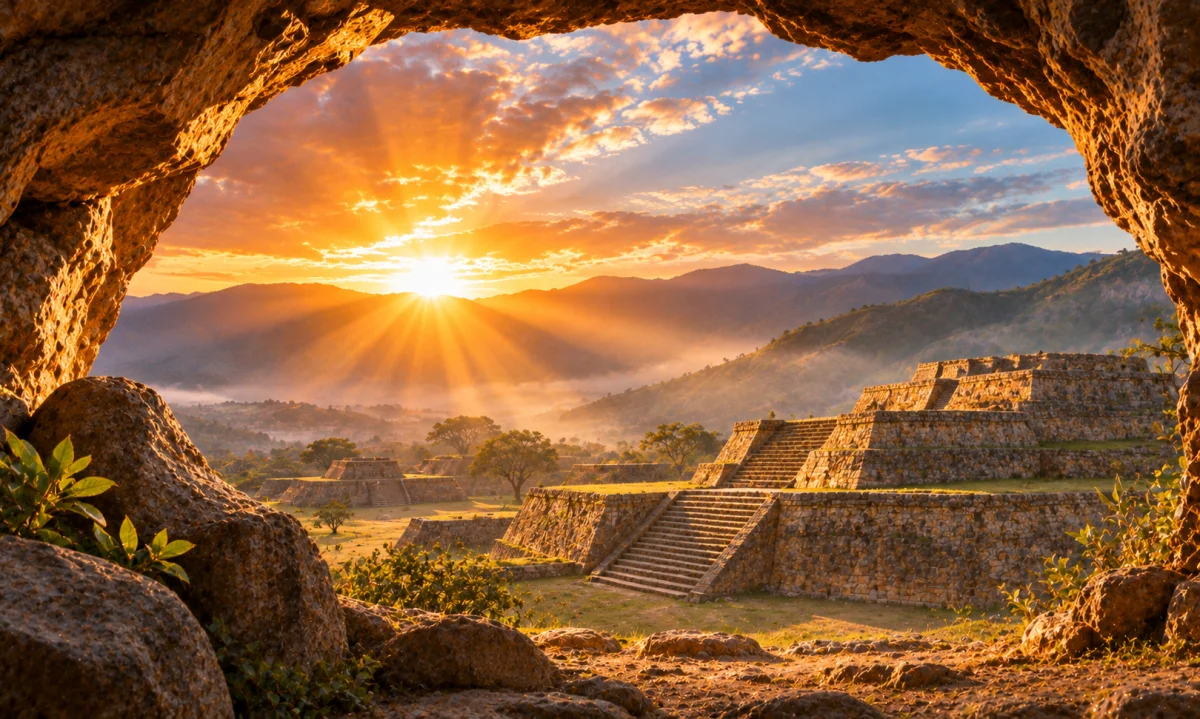
Mitla contains monumental buildings with distinctive geometric stone mosaics, courtyards, tombs and evidence of long religious and political importance. Spanish-era descriptions linked the site with death, burial and sacred authority. These accounts helped create the enduring association between Mitla and a Zapotec underworld ruled by a death god.
Archaeology, however, cannot by itself prove that a particular building was the palace of Coqui Bezelao or that every tomb belonged to worshippers of one named deity. Religious complexes change over time, and the meaning of a building cannot always be recovered from its architecture alone. Mitla was probably a place of ritual and political significance, but the details of its relationship to Coqui Bezelao remain interpretive rather than certain.
Appearance and attributes
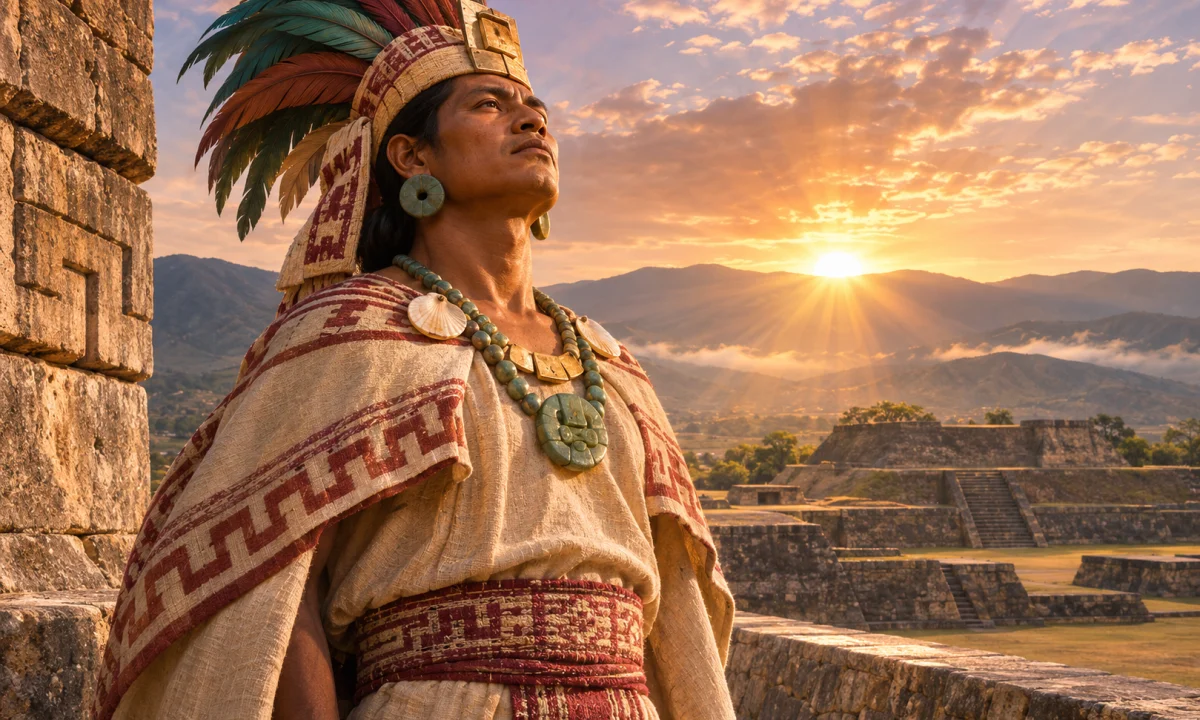
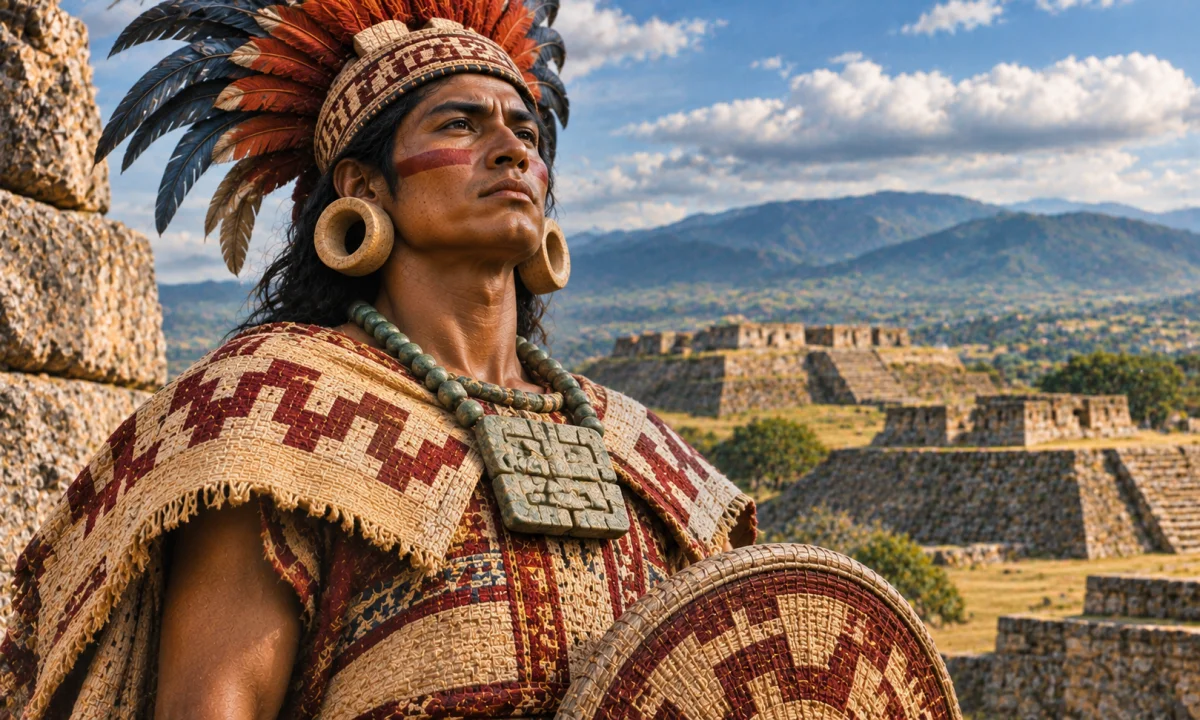
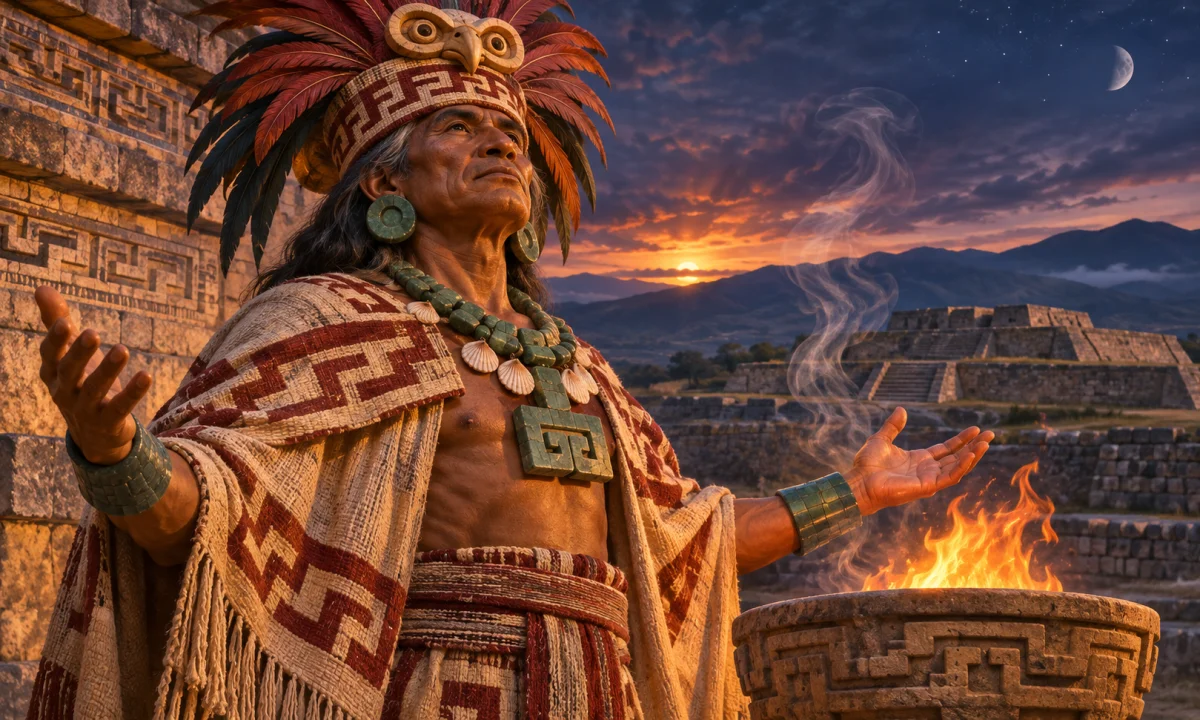
No universally accepted ancient image can be identified with confidence as a portrait of Coqui Bezelao. Some modern illustrations show him as a skeletal ruler, a corpse-like lord, or a richly dressed figure surrounded by bones and darkness. These images draw on broader Mesoamerican artistic conventions and on popular representations of death, but they should not automatically be presented as authenticated Zapotec iconography.
Zapotec archaeological art includes human figures, supernatural beings, masks, funerary objects and symbols whose meanings are not always known. Images of skulls or skeletal remains can reasonably be connected with death, but they do not necessarily identify a named deity. Likewise, bats, owls, caves and darkness are often assigned to Coqui Bezelao in modern retellings because they seem appropriate to an underworld ruler. The surviving evidence does not establish a complete and fixed set of such attributes.
The same caution applies to claims that Coqui Bezelao controlled earthquakes, disease, sacrifice or particular animals. These associations sometimes appear in general descriptions of Zapotec religion, but they are not equally well supported for this figure. Other Zapotec supernatural beings, including rain and lightning powers, have also been merged with death-related material in modern summaries.
Relationships with other Zapotec figures
Coqui Bezelao is sometimes described as the partner or counterpart of Xonaxi Quecuya, a female figure associated in some accounts with death, the dead and the underworld. This pairing appears in modern presentations of Zapotec mythology, but the documentation is not as extensive or consistent as the confident wording of many popular summaries suggests. The relationship may reflect a genuine tradition, a colonial interpretation, a regional belief or a later synthesis of scattered information.
The title Coqui can also create confusion with historical Zapotec rulers. A person whose name includes Coqui was not necessarily a supernatural being. In some contexts, the title indicates royal or noble status. The name should therefore be interpreted in relation to the source and the period in which it was recorded.
Coqui Bezelao should also be distinguished from Cocijo, the major Zapotec rain and lightning deity. Their names may look similar in abbreviated or poorly edited modern lists, but they are not the same figure. Cocijo is associated primarily with rain, storms, lightning and agricultural fertility, while Coqui Bezelao is associated primarily with death and the realm of the dead.
Death, ancestors and sacred power
Interpreting Coqui Bezelao only as a frightening monster misses the broader religious context. In many Mesoamerican traditions, death-related powers were not simply embodiments of moral evil. They governed necessary transitions and maintained the boundaries between the living, the dead and the sacred world. A deity connected with death could be feared, respected, invoked or honoured without being “evil” in the later European sense.
Zapotec communities placed importance on burial, lineage and the continuing presence of the dead. Tombs beneath or near buildings made the relationship between domestic, political and ancestral spaces especially visible at sites such as Monte Albán and Mitla. The dead could be part of the history and legitimacy of a ruling family or community. A lord of the dead would therefore fit within a religious system concerned not only with the end of life but also with memory, continuity and the authority of ancestors.
Colonial Christianisation changed the public expression of Indigenous religion. Spanish authorities often described native deities as demons or false gods, while Indigenous communities adapted, concealed or reinterpreted older practices. Later ethnographers and historians encountered traditions that had already passed through these changes. This is one reason why the evidence for Coqui Bezelao is fragmentary and why a simple reconstruction of pre-conquest belief is difficult.
Sources and limits of reconstruction
Knowledge of Coqui Bezelao does not come from a single Zapotec sacred book. Unlike some Mesoamerican manuscripts, the surviving colonial records do not provide a continuous mythological narrative centred on him. Information must be pieced together from early descriptions, dictionaries and vocabularies, accounts of Zapotec customs, archaeological remains and comparisons among regional traditions.
Colonial dictionaries are valuable because they preserve Indigenous words and sometimes record religious meanings. They are also limited: their authors selected the terms they considered important, translated them through European categories and often wrote down only what they could understand through interpreters. Archaeological evidence provides a material record but rarely identifies a deity by name. Later folkloric accounts may preserve genuine local memories while also reflecting changes caused by Christianity, tourism, schooling and popular mythology.
Consequently, statements about Coqui Bezelao should be separated into levels of certainty. His association with death and the dead is the most widely repeated identification. His exact name, language of origin, appearance, relationship with Xonaxi Quecuya and authority over a particular underworld are less certain or vary by source. A careful account should preserve those distinctions rather than turn a partial record into a detailed invented mythology.
Modern representations
In contemporary books, websites, games and artwork, Coqui Bezelao is often presented as a dramatic skeletal king of Mitla. He may be given a weapon, a throne, an elaborate genealogy or powers borrowed from other Mesoamerican gods. Such portrayals can introduce the name to a wider audience, but they are modern adaptations unless they are specifically grounded in a documented Zapotec tradition.
The popularity of Mesoamerican death imagery has also encouraged comparisons between Coqui Bezelao and figures such as the Aztec Mictlantecuhtli or the Maya gods of the underworld. These comparisons can be useful when explaining broad themes, but the figures belong to different religious systems and should not be treated as interchangeable. Nor should Coqui Bezelao be equated with La Catrina, the modern Mexican skeletal figure associated with the Day of the Dead. La Catrina developed in a much later artistic and political context and is not an ancient Zapotec goddess.
Coqui Bezelao is best understood as a historically recorded Zapotec death-related power whose exact identity and mythology remain partly uncertain. His importance lies not in a large surviving cycle of dramatic legends, but in what his name reveals about Zapotec ideas of sacred authority, burial, ancestors and the continuing relationship between the living community and the dead.