WORLD

Ndan
Ndan is a name associated in some modern accounts with Zapotec concepts of the earth, fertility and agricultural abundance. The identification is not fully secure, however. Unlike better-documented Zapotec deities such as Cocijo, the rain and lightning god, Ndan is not supported by a large, consistent body of surviving myths. Descriptions of Ndan vary, and some references may simplify or reconstruct Zapotec religious ideas rather than preserve a clearly recorded ancient figure.
Zapotec religious setting
The Zapotecs are an Indigenous people of southern Mexico, especially associated with the Central Valleys, the Isthmus of Tehuantepec, the Sierra regions and parts of Oaxaca. Zapotec civilization has a long history, reaching back to the first millennium BCE and including the major urban centre of Monte Albán. It continued through many regional traditions after the decline of Monte Albán and remains a living cultural tradition among diverse Zapotec communities.
“Zapotec mythology” does not describe a single, unchanging system. Zapotec peoples speak several related but distinct languages, and religious customs have differed between communities and historical periods. Ancient religious practices, colonial Christian influence, local oral traditions and modern cultural revitalisation have all shaped the material now described as Zapotec mythology.
Zapotec religion placed strong emphasis on the relationship between human communities, ancestors, agricultural cycles and powerful forces of the natural world. Rain, lightning, maize, mountains, caves, springs, the sun, the earth and death could all be treated as sacred realities. These forces were not necessarily arranged in one fixed pantheon like the gods of a single literary mythology. Their names, forms and relationships could change according to place and language.
The name and identity of Ndan
The spelling Ndan appears in modern descriptions of Zapotec mythology, usually with an association with the earth or with fertility. The name should not automatically be treated as a universally recognised ancient title. Zapotec languages have different sound systems and spelling conventions, and colonial writers often recorded Indigenous names imperfectly. A name written in one source may therefore not have a single standard form across all Zapotec communities.
Some reference works describe Ndan as an earth goddess or a female power connected with fertility. Other accounts give little information beyond an association with the land. Ndan is also sometimes presented as a consort or counterpart of Cocijo. That relationship is frequently repeated in summaries, but it is not supported by a uniform set of traditional stories known across Zapotec communities.
The uncertainty is important because surviving evidence does not provide a complete Zapotec theological catalogue. Much of the information about pre-Hispanic religion comes from archaeology, colonial observations, Indigenous-language materials recorded after the Spanish conquest and later comparative interpretation. These sources preserve valuable information, but they do not always identify deities in the same way or explain how ordinary worshippers understood them.
Ndan and the earth
When Ndan is identified as an earth power, the association reflects a central theme in Mesoamerican religious thought: the land was not merely passive ground but a living and productive power. Agriculture depended on the interaction of soil, rain, seeds, labour and seasonal change. A figure connected with the earth could therefore be linked to nourishment, fertility, crops and the continuity of human life.
This does not mean that every Zapotec community necessarily worshipped a single goddess named Ndan in precisely these functions. Rather, the name is used by some modern accounts to represent an aspect of the sacred earth. In local traditions, similar responsibilities might belong to other named beings, to mountain or landscape powers, to ancestral forces or to a broader network of supernatural agencies.
Earth symbolism can also include danger as well as abundance. The ground gives maize and supports settlements, but it is also associated with burial, decay and the return of the dead. Mountains and caves may be understood as entrances to powerful interior realms or as places where rain and fertility originate. A deity or sacred force associated with the earth could therefore occupy a more complex position than that of a benevolent agricultural mother.
Relationship with Cocijo
Modern summaries often describe Ndan as the female partner of Cocijo, one of the most prominent Zapotec supernatural figures. Cocijo is commonly associated with rain, lightning, storms and agricultural nourishment. Archaeological and historical evidence for Cocijo is considerably stronger than the evidence for Ndan, although interpretations of Cocijo also vary according to period and source.
The pairing of an earth power with a rain and storm power is symbolically understandable. Crops require both fertile land and water from the sky. In many agricultural religions, the interaction of earth and rain expresses the renewal of life, the growth of maize and the continuation of the community. It is reasonable to interpret the supposed relationship between Ndan and Cocijo in this broad symbolic context.
It is less certain that the two were consistently understood as a married couple with a fixed mythology. Available descriptions do not preserve a well-attested cycle of stories about their courtship, offspring, conflict or household. Statements that Ndan was definitively the “wife” of Cocijo may reflect later efforts to organise a varied religious tradition into familiar categories of husband and wife.
Attributes and representations
No securely identified ancient image can be assigned to Ndan solely on the basis of the name. Zapotec art contains many supernatural and symbolic forms, including figures connected with rain, lightning, maize, ancestors, death and rulership. The meaning of an image often depends on its archaeological context, associated inscriptions and comparison with other objects.
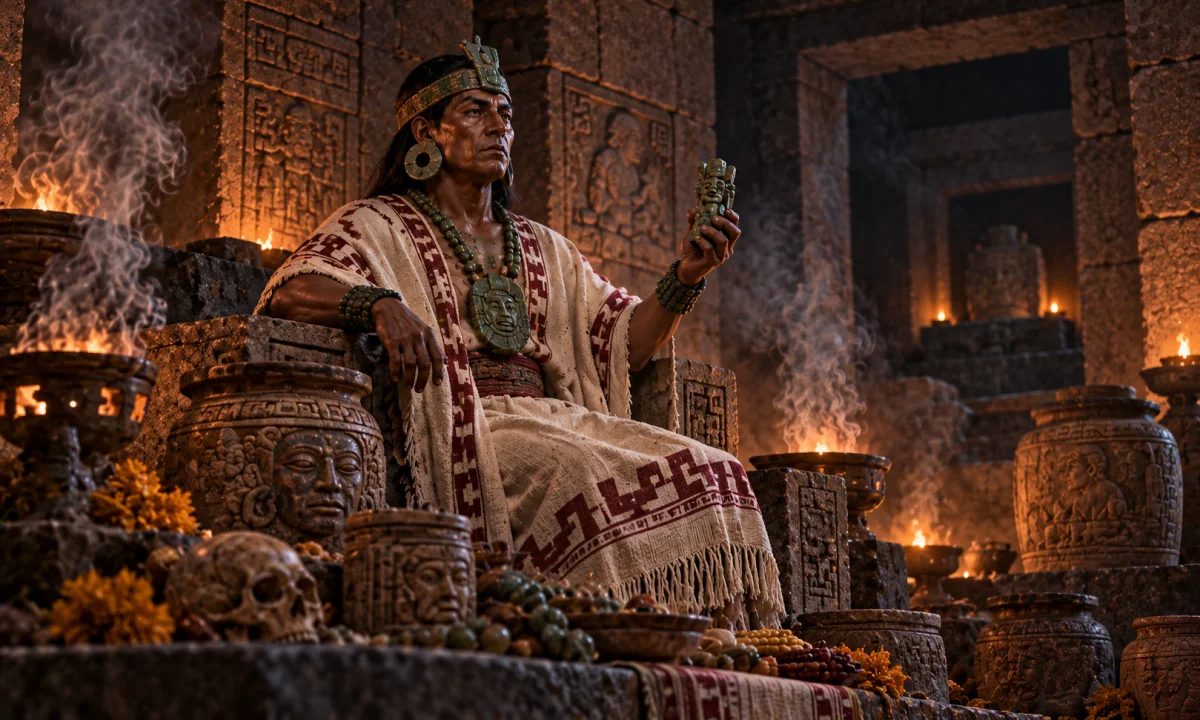
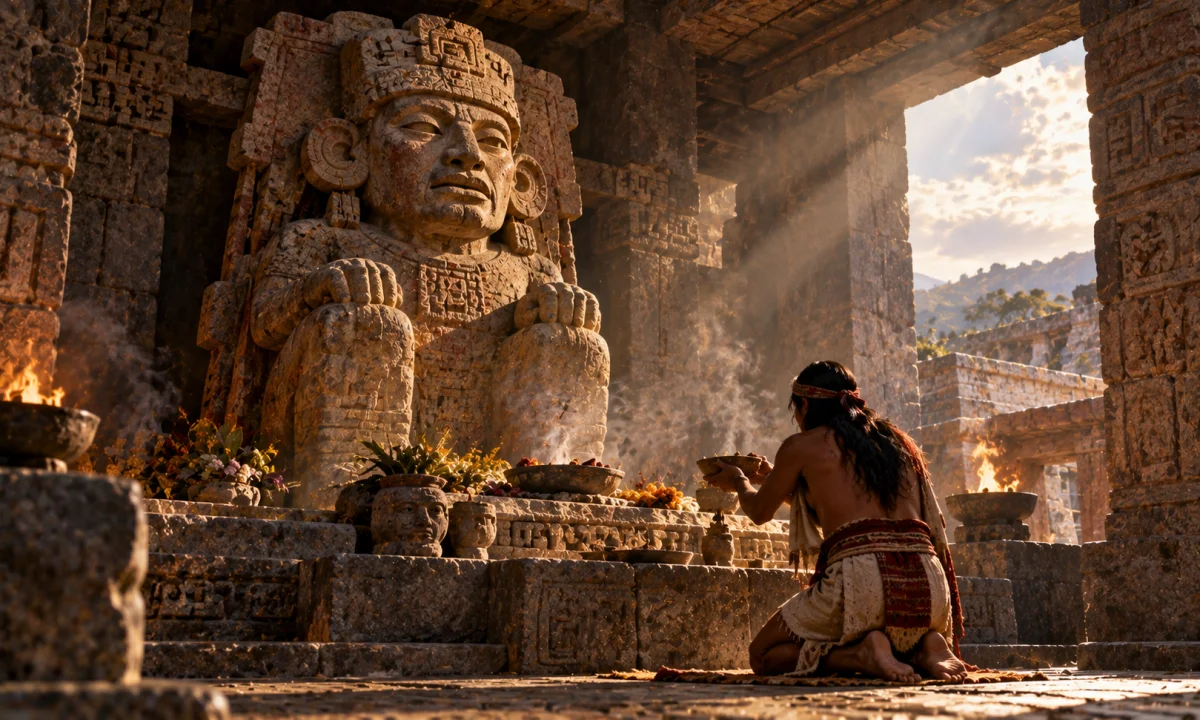
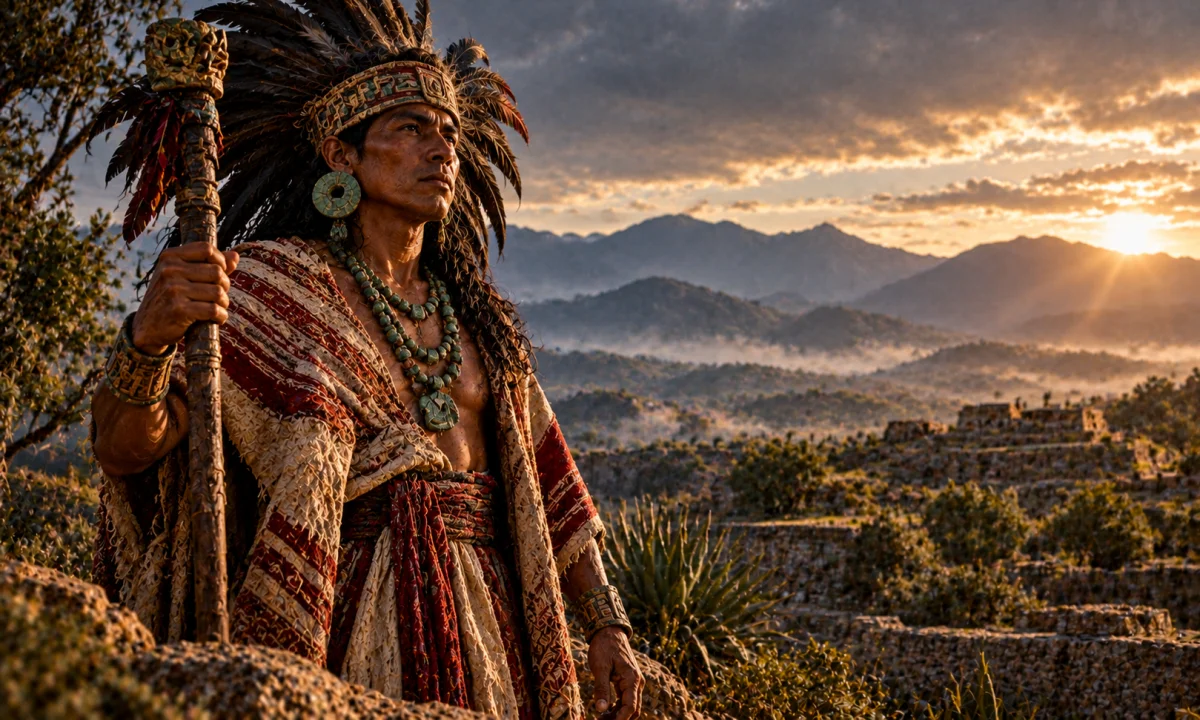
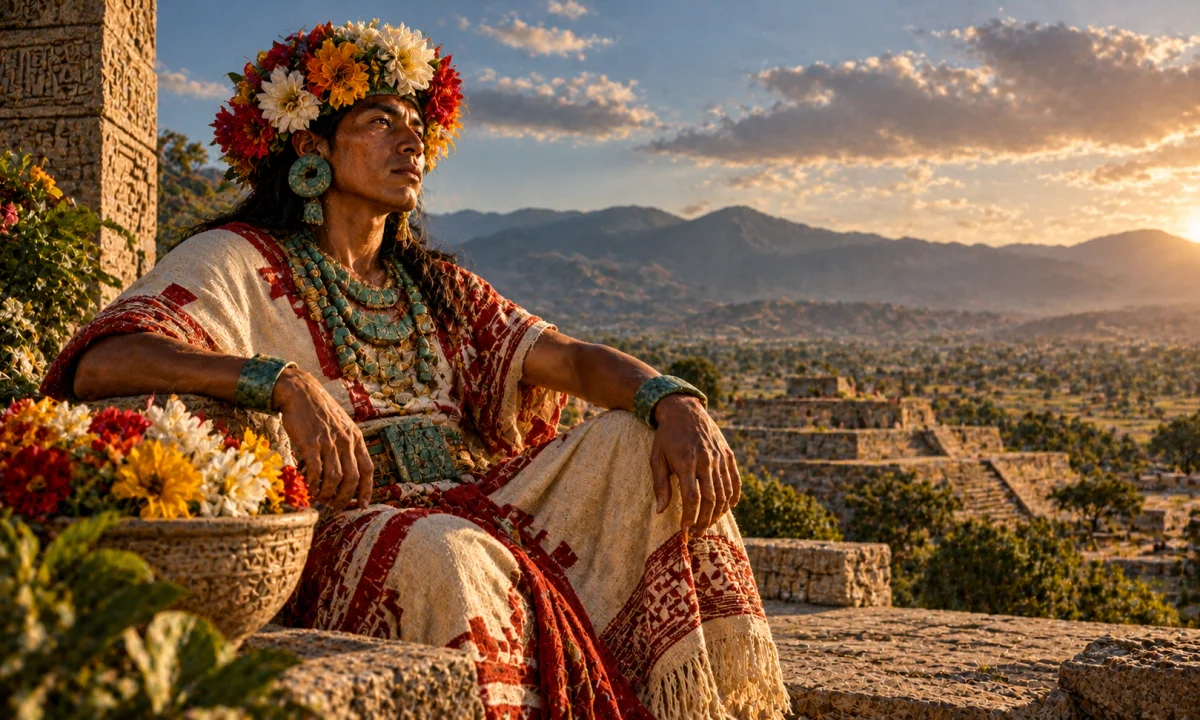
For that reason, claims that Ndan had a particular costume, animal companion, headdress or emblem should be treated cautiously unless they are tied to a specific community tradition or clearly documented source. Modern illustrations sometimes portray her as a woman emerging from the soil, a mother holding maize or a queen beside Cocijo. Such images can communicate an interpretation of her supposed role, but they are not established ancient representations.
If Ndan is understood as an earth and fertility figure, plausible symbolic associations include soil, planted seed, maize, vegetation, caves, mountains and the seasonal renewal of crops. These are interpretive associations rather than a confirmed list of personal attributes. The distinction matters because the broader symbolism of the earth is not proof that every earth-related image represented Ndan.
Stories and narrative traditions
There is no widely attested, standard myth about Ndan comparable to the famous creation stories preserved for some other Mesoamerican traditions. Modern sources may state that she created the earth, gave fertility to the land or joined with Cocijo to produce abundance, but these details are not consistently documented as a single ancient narrative.
The absence of a surviving story does not demonstrate that no oral traditions about Ndan ever existed. Oral traditions can be lost, altered, kept within particular communities or recorded under another name. Colonial religious suppression also affected the transmission of Indigenous ceremonial knowledge. At the same time, the lack of evidence means that later retellings should not be presented as securely preserved pre-Hispanic myths.
Zapotec oral traditions collected in different regions often focus on landscape beings, animals, saints, ancestors, rain, illness, maize and the origins of particular places. A sacred earth figure may appear in such a setting without belonging to a universal Zapotec pantheon. Local stories can preserve important religious ideas even when they do not use the name Ndan.
Archaeological and historical evidence
Evidence from ancient Zapotec culture includes monumental architecture, tombs, carved stone, ceramics, offerings and inscriptions. These remains demonstrate the importance of religion, rulership, ancestors and natural powers, but they rarely provide simple labels equivalent to modern encyclopedia entries. Many images cannot be identified with certainty, and the same symbol may have had different meanings in different periods.
Colonial-period accounts offer additional information but must also be read critically. Spanish observers often interpreted Indigenous religious practices through Christian categories, while Indigenous informants worked under conditions of conquest, conversion and political change. Names could be translated, altered or grouped according to assumptions that did not match local religious systems.
Later ethnographic work has documented living Zapotec practices and beliefs, but those traditions should not be treated as unchanged survivals from Monte Albán. They are valuable religious traditions in their own right, shaped by continuity, adaptation and community interpretation. A contemporary Zapotec understanding of the land may illuminate themes associated with Ndan without proving that an identical goddess was worshipped in every ancient Zapotec centre.
Interpretation and cultural significance
Ndan is most useful as a reminder that agricultural religion cannot always be reconstructed from a neat list of gods. The earth, rain, maize, ancestors and seasonal cycles formed an interconnected sacred environment. Fertility was not only a biological process but also a social and religious concern involving planting, ritual obligations, community survival and respect for the forces that made food possible.
The figure also illustrates a common problem in writing about Indigenous mythologies. Modern classifications may assign a single gender, domain and family relationship to a power whose historical identity was more fluid. Calling Ndan an “earth goddess” can be a convenient description, but it should not erase regional differences or imply that Zapotec religion followed the same structure as a classical mythology with a fixed pantheon.
There is also a difference between the broad concept of sacred earth and the specific identity of Ndan. Zapotec languages and communities possess their own words and concepts for land, territory, place and the forces inhabiting particular landscapes. Not every sacred mountain, agricultural spirit or earth-related being should be merged with Ndan merely because the figures share a connection with fertility.
Distinction from similar figures
Ndan should not be automatically identified with Cocijo. Cocijo is primarily associated with rain, lightning and storms, whereas Ndan is described in modern sources as an earth or fertility power. The two may be paired in some interpretations, but they are not simply different names for one being.
Ndan should also not be merged with Pitao Cozobi, a Zapotec deity commonly associated with maize and agricultural produce. Pitao Cozobi’s name and functions are documented in traditions that are distinct from the uncertain material surrounding Ndan. Earth, maize and fertility may overlap symbolically without proving that the figures were identical.
Likewise, Ndan is not the same as the Zapotec powers associated with death and the underworld, often represented in modern writing by names such as Coqui Bezelao or Pitao Pezeelao. The earth can be linked with burial and the return of life, but that symbolic connection does not collapse agricultural and funerary beings into one figure. The spellings and identities of these other figures also vary between sources, so each should be considered separately.
Modern reception
Ndan has little established presence in major popular media. The name is more often encountered in internet mythology lists, short encyclopedic entries, fantasy discussions and modern illustrations than in a continuous tradition of novels, films or games. These presentations frequently give Ndan a detailed appearance and a firmly defined divine family, even though the historical evidence is limited.
Such creative portrayals can be legitimate modern interpretations, but they should be labelled as adaptations rather than presented as recovered ancient mythology. A careful description of Ndan keeps the central association with earth and fertility while acknowledging that the name, gender, relationship with Cocijo and precise religious role remain uncertain and may not apply uniformly across Zapotec traditions.