WORLD
WORLD
Kasha
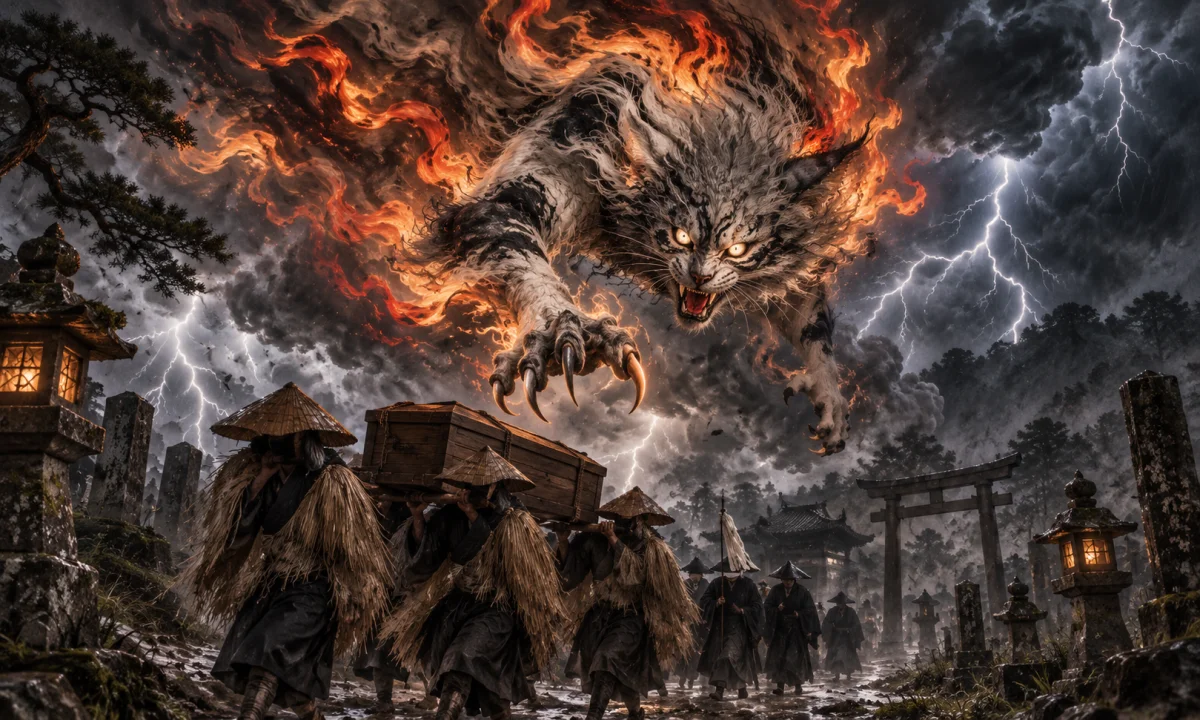
Kasha (火車, commonly read kasha) is a frightening being associated with Japanese Buddhist folklore and tales of the dead. Its name means “fire cart” or “fiery vehicle.” In traditional stories, a kasha descends during a funeral or appears in a storm to seize the corpse of a person believed to have lived a morally corrupt life. It is often imagined as a blazing cart, a monstrous spirit, or a creature with a cat-like appearance. These forms overlap in folklore, but they should not be treated as one fixed, universally accepted image.
Meaning of the Name and Religious Background
The word kasha is written with the characters for “fire” and “vehicle” or “cart.” The image belongs to a wider Buddhist tradition in which supernatural vehicles transport the dead. In Buddhist descriptions of hell, fiery carts may carry sinners through regions of punishment. Japanese accounts adapted such imagery into stories about a supernatural force that comes to claim the bodies of the wicked.
A kasha is therefore not a god or demon with a single canonical biography. It does not occupy a clearly defined position like Enma, the judge of the dead, or one of the officially organized classes of Buddhist guardians and heavenly beings. Instead, it belongs mainly to the world of religious storytelling, local belief, illustrated yokai catalogues, and ghost lore. Its identity developed at the meeting point of Buddhist ideas about karma, popular funeral customs, and older Japanese traditions concerning dangerous spirits.
In Buddhist moral teaching, a person’s actions affect the circumstances of death and rebirth. Folklore made this principle vivid by imagining that a sinful person might not be allowed to rest peacefully after death. The kasha became a dramatic sign that a corpse was being claimed by a terrible fate. Such stories do not necessarily represent formal Buddhist doctrine. They are better understood as popular religious imagination shaped by Buddhist language and imagery.
Origins and Surviving Traditions
References to fiery vehicles and the removal of the dead appear in Japanese religious and anecdotal traditions before the modern period, although the stories vary greatly in detail. Medieval Buddhist tales frequently describe strange signs at the deathbed, supernatural visitors, and forces that carry the dead away. Later accounts place the kasha more specifically at funerals, where mourners are gathered around the body and the boundary between the living and the dead is especially vulnerable.
The best-known visual tradition developed during the Edo period, when artists and writers compiled illustrated collections of strange creatures. Works associated with the hyakki yagyō, or “night parade of the hundred demons,” helped give many supernatural figures recognizable forms. The artist Toriyama Sekien included a kasha in his influential late-eighteenth-century yokai publications. His image helped establish the creature as part of the expanding printed catalogue of Japanese monsters, although such illustrations often interpreted and rearranged earlier beliefs rather than recording a single ancient tradition.
Stories about the kasha also circulated in temple communities and regional oral traditions. Some accounts describe a fiery cloud or chariot appearing above a funeral. Others speak of a monstrous hand reaching down from the sky to drag away the body. In still other stories, the creature is connected with a cat that has grown old, acquired supernatural power, or developed an appetite for human corpses. Because these traditions were transmitted through different regions and genres, there is no single standard version of the kasha story.
Appearance
The most literal form of the kasha is a cart or carriage surrounded by flames. It may be drawn by strange animals or appear amid black clouds, violent wind, and thunder. The fiery vehicle reflects the Buddhist image of punishment and gives the being its name. In this form, the kasha is less an animal than a supernatural instrument of judgment or transportation.
Other depictions show a vaguely human or demonic creature emerging from the flames. It may have claws, wild hair, sharp teeth, and a distorted face. Some versions emphasize its speed and ability to descend suddenly from the sky. The creature is often difficult to see clearly because it arrives in a storm or passes in a flash of fire.
A cat-like kasha may have the body of a large, unnaturally powerful cat, sometimes with a long tail, glowing eyes, or a grotesque human-like expression. This form is especially important in later yokai discussions, but it should not be assumed that every traditional kasha was originally a cat. The fiery vehicle and the corpse-snatching cat represent related strands of folklore that gradually became associated with one another.
The Kasha at Funerals
The central setting of kasha stories is the funeral. While mourners are keeping watch over a corpse or carrying it to burial or cremation, an ominous disturbance begins. The sky may darken, a fierce wind may rise, or a fiery apparition may appear overhead. The kasha then attempts to seize the body and carry it away.
In many versions, the intended victim is someone known for greed, cruelty, sexual misconduct, violence, or other serious wrongdoing. The story presents the corpse’s removal as the consequence of the dead person’s conduct. The kasha is not necessarily punishing the living mourners; it is collecting someone whose actions have made a terrible postmortem fate appropriate.
Some tales give priests or attendants a role in resisting the creature. The body may be protected with Buddhist prayers, sutras, ritual objects, or determined vigilance. A priest may hold on to the corpse, recite sacred words, or use a consecrated object to drive away the apparition. These details vary widely, and they should not be treated as a universal funeral practice. They reflect the narrative idea that Buddhist ritual can protect the dead and prevent harmful spirits from interfering with proper rites.
In other stories, the kasha succeeds. It tears away the corpse, leaves only part of the body behind, or carries the dead person into the clouds. Such episodes create a supernatural explanation for a missing body or a disturbed grave. They also turn the funeral into a moral spectacle: the community witnesses the consequences of a person’s life after death.
Connection with Cats
The association between kasha and cats is one of the most familiar aspects of modern descriptions, but it requires care. Japanese folklore contains several traditions about cats acquiring supernatural powers. A cat that lives for a very long time may become a bakeneko, or “changed cat,” capable of transforming, speaking, dancing, or imitating human behavior. A more specific and often more dangerous feline monster is the nekomata, traditionally imagined as a cat whose tail has split in two and whose powers have grown with age.
These feline beings are not simply alternative names for the kasha. A bakeneko or nekomata may haunt a household, disguise itself as a human, manipulate corpses, or cause illness and misfortune. A kasha, by contrast, is defined primarily by its connection with fiery transportation and the taking of the dead. In some regional stories, however, an old cat becomes the creature responsible for stealing a corpse. This creates a genuine overlap between kasha lore and cat yokai traditions.
One explanation for the association is the old image of cats as animals that move silently at night and are attracted to warmth, darkness, and the smell of death. Their behavior around corpses could easily inspire suspicion. Folklore also frequently gives cats an ambiguous status: they live close to humans but remain independent, difficult to control, and capable of seeming uncanny. These qualities made them natural candidates for stories about spirits and bodies disturbed after death.
The cat form may also have been strengthened by later illustrated yokai culture. Artists and popular writers often connected separate motifs because they offered a more memorable monster: a huge supernatural cat driving or becoming a fiery vehicle. This later synthesis is influential, but it should not erase the kasha’s older Buddhist imagery as a blazing cart or vehicle.
What the Kasha Does
- It carries away the dead. Its defining action is the removal of a corpse from a funeral, grave, or place of mourning.
- It appears amid fire and storms. Flames, dark clouds, wind, thunder, and sudden changes in the weather are common features of the encounter.
- It exposes moral wrongdoing. The person whose body is taken is usually portrayed as having lived badly or died without spiritual preparation.
- It interferes with funeral rites. Its appearance makes proper protection of the body and completion of religious ceremonies urgent.
- It may be resisted by religious practice. Priests, sutras, prayers, and sacred objects sometimes prevent the kasha from taking the corpse.
These powers are narrative conventions rather than a fixed supernatural system. There is no universally recognized list of kasha abilities, and not every story includes all of these elements. Some accounts focus on karmic punishment, while others emphasize the terror of a body being stolen by an unknown force.
Symbolism and Cultural Significance
The kasha expresses anxiety about what happens to the body after death. Funeral rites create an ordered passage between life and death, but the kasha represents the possibility that this passage can be disrupted. A corpse may be seized before the community has completed its duties, suggesting that spiritual disorder has intruded into a carefully controlled ritual moment.
Its stories also reflect the tension between public reputation and private wrongdoing. A respected person may be revealed, through the appearance of the kasha, to have been morally corrupt. The supernatural event acts as a verdict that human society could not deliver. In this respect, the kasha resembles other folklore figures that expose hidden sin, although its method is unusually physical and dramatic.
Fire has several meanings in this context. It is associated with hellish punishment, destruction, purification, and violent transformation. A burning vehicle does not merely frighten the mourners; it signals that the dead person has entered a dangerous spiritual process. The flames separate ordinary death from a more terrible fate shaped by karma.
The creature can also be understood as a warning about attachment to worldly behavior. Greed, cruelty, and selfishness do not end simply because the body dies. The kasha makes this teaching visible by turning the corpse into the object of supernatural pursuit. At the same time, the stories are not philosophical treatises. Their power comes from combining religious morality with the immediate fear of a body disappearing before witnesses.
Distinguishing the Kasha from Related Figures
The kasha is sometimes described as a “Japanese demon,” but that label is broad and can be misleading. It is not identical to an oni, the horned ogre-like being found in Japanese Buddhist and folkloric traditions. Oni may guard hell, punish sinners, abduct people, or cause disasters, but the kasha’s distinctive role is to transport or steal corpses.
It is also different from Enma, the judge of the dead. Enma presides over judgment in Buddhist-influenced accounts of the afterlife, whereas the kasha is a frightening agent or apparition connected with the body at the funeral. A story may place both within the same broad moral universe, but they are not the same being.
Nor should the kasha be automatically identified with the shinigami of modern Japanese fiction. The term shinigami, usually translated as “god of death” or “death spirit,” has a complicated history and became especially prominent in later literature, theatre, manga, and animation. A kasha does not generally decide when a person dies; it appears after death to take the body.
Finally, a kasha is not simply another name for a bakeneko or nekomata. The three may overlap in regional or modern retellings, especially when an old cat is said to become a corpse-stealing monster. Their traditional emphases remain different: the kasha is linked to fiery transport and funerary punishment, while bakeneko and nekomata belong more broadly to the folklore of supernatural cats.
Later Reception and Modern Popular Culture
Modern writers, illustrators, games, films, manga, and anime frequently reinterpret the kasha. It may appear as a gigantic demonic cat, a flaming chariot, a ghostly thief, or a character with a recognizable personality and backstory. Contemporary works often combine the kasha with bakeneko or nekomata traits, giving it greater mobility, intelligence, or combat abilities than traditional funeral tales require.
These adaptations have helped make the kasha internationally recognizable, but they are creative reconstructions rather than evidence of one unchanged ancient image. Popular culture often treats the name as a convenient label for any fiery feline monster or supernatural corpse collector. Traditional accounts are more varied and more closely tied to Buddhist moral ideas, funerary ritual, and regional storytelling.
The most historically grounded image remains the fiery vehicle that comes for the dead, while the cat form represents an important but not universal development within Japanese folklore. Understanding both strands preserves the kasha’s religious and cultural depth without reducing it to either a generic devil or a simple monster cat.