WORLD
WORLD
Ilmatar
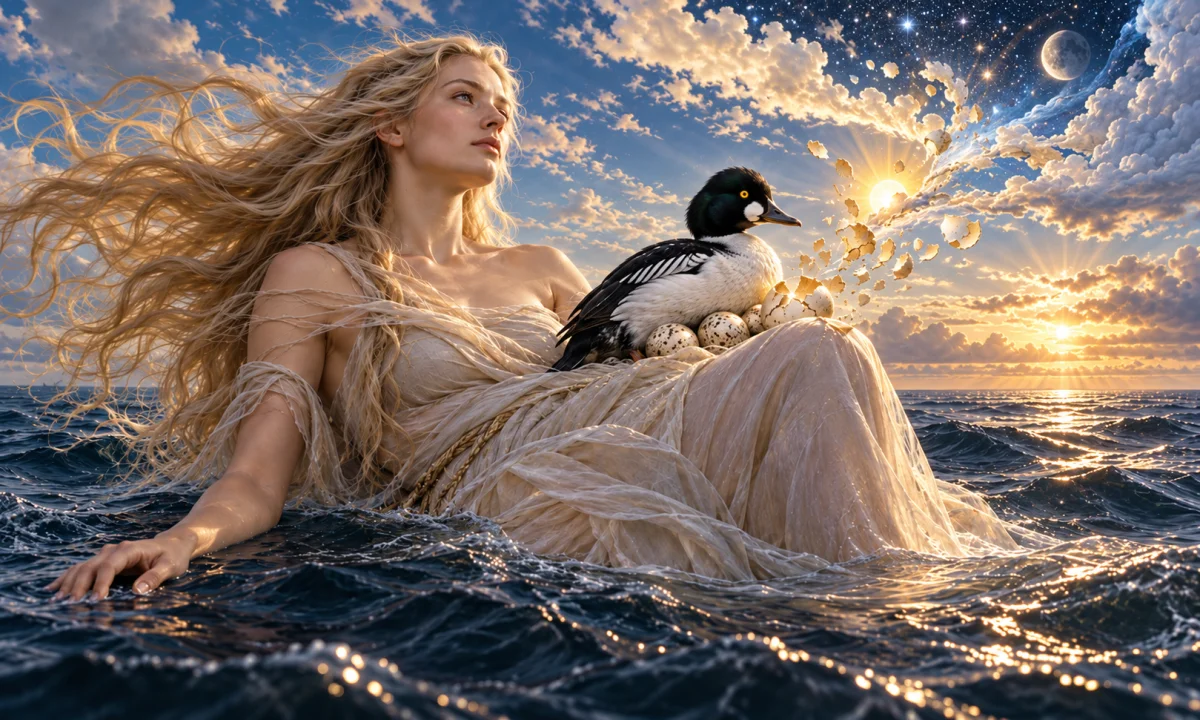
Ilmatar is a female figure in Finnish mythology best known from the Kalevala, the national epic compiled by Elias Lönnrot in the nineteenth century. She is described as a maiden of the air and as the mother of Väinämöinen, one of the epic’s central heroes. In the opening creation story, Ilmatar descends from the sky into the primeval sea, where her long pregnancy and the actions of a waterfowl help bring the ordered world into being.
Origins and cultural setting
Ilmatar belongs to the mythology presented in the Kalevala, rather than to a single securely documented ancient Finnish religious system. The Kalevala was assembled from oral poems collected in Finland and Karelia, regions where traditional songs were performed in a distinctive trochaic metre. Lönnrot selected, rearranged and combined material from many singers and local traditions to create a continuous epic narrative. The first complete edition appeared in 1835, followed by a substantially expanded edition in 1849.
These oral poems preserved stories, charms, genealogies and descriptions of the world, but they did not form a single fixed mythology comparable to a canonical scripture. Different singers could know different versions of a story, and figures could change in name, role or importance from one poem to another. Consequently, Ilmatar is most securely understood through her role in the Kalevala and related literary and folkloric material, not as a universally defined goddess worshipped throughout pre-Christian Finland.
The epic emerged during a period of growing Finnish cultural nationalism. Lönnrot’s work gave scattered poetic traditions the shape of a national epic and helped establish a shared Finnish literary identity. Its contents nevertheless draw on older oral material, some of which may preserve very old motifs. The existence of an ancient creation story does not, by itself, demonstrate that Ilmatar was an individual deity with a formal cult in earlier Finnish religion.
Name and identity
The name Ilmatar is formed from ilma, meaning “air” or “sky,” together with the feminine suffix -tar. The name can therefore be understood as “female spirit of the air,” “air maiden” or “daughter of the air,” although no single English translation captures every nuance. In the Kalevala, she is also called Luonnotar, a name associated with nature or the natural world. Depending on the translation, she may appear as Ilmatar, Luonnotar, or by descriptive titles such as “maiden of the air.”
Ilmatar and Luonnotar are generally treated as names or titles for the same figure within the Kalevala. The relationship is not entirely simple, because Finnish poetic names often function as epithets as well as personal names, and English translations differ in how they render them. Luonnotar should not automatically be treated as a separate goddess merely because it appears as a distinct word.
Her classification is also uncertain. She is frequently called a goddess in modern summaries, but the epic itself presents her primarily as a supernatural maiden, mother and cosmic figure. “Goddess” is a convenient modern category, not proof of a clearly documented religious status. Ilmatar has no securely established temple cult, priesthood or independent body of worship comparable to the better-documented deities of some ancient Mediterranean traditions.
Ilmatar in the creation story
The Kalevala begins with Ilmatar living alone in the empty regions of the air. She becomes weary of her solitude and descends into the primeval sea. There she floats upon the waters for a long period. The wind moves over her, and the sea joins with the sky in a mysterious act of conception. Ilmatar becomes pregnant, but she is unable to give birth.
Her pregnancy lasts for an extraordinarily long time. The exact duration and details can differ between translations and poetic versions, but the essential feature is prolonged waiting: Ilmatar carries the unborn child while the world remains unfinished. In the epic, she appeals for help and attempts to find a place where she can give birth. Her condition links her body to the unformed landscape, making the creation of the world part of a maternal and physical process rather than an act carried out by a distant creator alone.
While Ilmatar rests in the waters, a bird searches for a place to build its nest. In the best-known version, the bird is a waterfowl, often translated as a duck. It sees Ilmatar’s knee rising above the surface and mistakes it for a small island or mound. The bird lays its eggs there. When Ilmatar moves her leg, the eggs fall into the water and break.
The broken eggs become the structures of the cosmos. Their fragments form the earth and sky, while other parts become the sun, moon, stars and clouds. The precise allocation of each shell fragment varies among translations, but the symbolic pattern remains consistent: an ordinary bird’s eggs, resting briefly on Ilmatar’s body, become the visible universe.
This episode does not present creation as a simple command spoken by an all-powerful deity. Instead, the world emerges through a combination of water, wind, bodily transformation, animal activity and accidental movement. Ilmatar is not always portrayed as deliberately shaping every part of creation. Her body provides the temporary platform from which the eggs fall, and her movements help release the potential contained within them.
Mother of Väinämöinen
Ilmatar’s other major role is as the mother of Väinämöinen. In the Kalevala, Väinämöinen is an ancient and powerful singer, sage and culture hero. His birth follows Ilmatar’s long pregnancy and occurs after the world has begun to take shape. He is often described as being born already old or wise in appearance, a feature that emphasizes his primordial character.
Väinämöinen is not simply a human hero born into an ordinary family. His maternal connection to Ilmatar places him at the boundary between cosmic origins and human society. He is associated with the first generations of the world and with the power of sacred or magical song. Through him, the creation story leads into the epic’s later narratives about knowledge, rivalry, love, craftsmanship and the establishment of a human order.
The relationship between Ilmatar and Väinämöinen is not developed as a conventional family story. After his birth, Ilmatar does not remain a major active character in the epic. Her importance lies in having brought him into the world and in connecting him with the primeval elements. Väinämöinen’s later adventures are shaped by his own abilities and relationships, particularly his conflicts and contests with figures such as Joukahainen, Lemminkäinen and the smith Ilmarinen.
Attributes and symbolic role
Air, water and the boundary between worlds
Ilmatar’s identity joins the air and the sea. Her name refers to the air, yet she descends into the water and becomes pregnant through the wind moving across the sea. She therefore occupies a space between sky, water and land. This makes her an especially important figure in a creation narrative where the world begins without stable boundaries.
She is neither simply a sky goddess nor simply a sea spirit. Her movement from the air to the water allows different elements to meet. The creation story depends on this meeting: the wind brings conception, the water supports Ilmatar, the bird arrives from the natural world, and the eggs become the features of the sky and earth.
Maternal creation
Ilmatar’s creative role is expressed through pregnancy, waiting and birth. The Kalevala gives cosmic significance to experiences associated with the female body, including gestation, discomfort and the search for a suitable place to give birth. Creation is not presented as effortless. Ilmatar suffers uncertainty and confinement while carrying the unborn Väinämöinen, and her eventual movement helps set the world-making process in motion.
It would be misleading to reduce her to a general “fertility goddess.” The story does involve reproduction and the generation of life, but Ilmatar is specifically a primeval maiden and mother within a creation narrative. The surviving material does not establish a broad fertility cult or a complete set of agricultural functions for her.
The cosmic egg motif
The eggs laid on Ilmatar’s knee belong to a widespread type of creation image in which the cosmos develops from an egg or from the fragments of eggshell. Similar motifs appear in various cultures, but resemblance does not prove direct borrowing or a common historical source. In the Finnish epic, the eggs are incorporated into a local poetic story involving the sea, the waterfowl and Ilmatar’s body.
The egg is particularly effective as a symbol because it contains hidden life within a rounded shell. When it breaks, the enclosed potential becomes the visible structure of the world. The story also gives the natural landscape a material history: sky, earth and heavenly bodies are imagined as parts of a transformed object rather than as abstract concepts.
Variants and interpretive questions
The opening of the Kalevala exists in a literary form shaped by Lönnrot’s editorial decisions, while the oral poems behind it were not identical. Names, bird species, durations and narrative details can vary between versions and translations. Some English renderings emphasize Ilmatar as a virgin of the air; others use “daughter of nature” or similar expressions for Luonnotar. These differences reflect both the Finnish wording and the choices of individual translators.
Scholars also distinguish between motifs that may have circulated widely in oral tradition and the particular composite character created by the epic. An air maiden, a cosmic egg and a miraculous ancestor may each have older folkloric roots, but the exact sequence that makes Ilmatar the mother of Väinämöinen and the setting for the egg episode is especially associated with the Kalevala as it was compiled.
For that reason, claims that Ilmatar was the supreme creator goddess of all ancient Finns go beyond the evidence. Finnish pre-Christian religion included beliefs concerning spirits of natural places, ancestors, household powers and named supernatural beings, but the surviving evidence is fragmentary and was recorded largely after Christianization. The Kalevala is indispensable for studying Finnish mythic imagery, yet it should not be treated as a direct transcript of an unchanged pagan theology.
Ilmatar and similar figures
Ilmatar is sometimes confused with other female figures from Finnish and neighbouring traditions. She should not be merged with Louhi, the powerful mistress of Pohjola in the Kalevala. Louhi is associated with a northern realm, magic, hostility and the control of important objects, whereas Ilmatar belongs primarily to the creation story and the birth of Väinämöinen.
She is also distinct from Mielikki, a forest mistress known from Finnish and broader Finnic folklore, and from Tellervo, a forest-related figure appearing in the Kalevala. These beings occupy different mythic roles, even though later summaries may place them together under the broad label of Finnish goddesses.
Ilmatar should likewise not be confused with Ilmarinen. Their names share the element connected with air, and both are important in the Kalevala, but they are different figures. Ilmarinen is a male smith and culture hero, famed for forging the Sampo and other extraordinary works. Ilmatar is the air maiden and mother of Väinämöinen.
Cultural significance and later reception
Ilmatar became important to modern Finnish cultural identity through the influence of the Kalevala. Her appearance at the beginning of the epic gives Finland a distinctive literary creation scene, one rooted in northern landscapes, water, birds and oral song. Artists and writers have used her to represent the birth of the world, the creative power of nature and the maternal origin of Finnish poetic tradition.
Her story also attracted composers. Jean Sibelius’s tone poem Luonnotar, premiered in 1913, draws on the opening creation episode of the Kalevala and uses a solo soprano to convey the figure’s immense, dramatic presence. The work reflects the epic’s later place in Finnish art music rather than evidence of an ancient musical cult devoted to Ilmatar.
In modern retellings, Ilmatar may be presented as a creator goddess, nature spirit, elemental being or personification of Finland itself. Such descriptions can be meaningful artistic interpretations, but they should be separated from the more limited and specific evidence of the Kalevala. Traditionally, her defining image is that of the air maiden who enters the primeval sea, endures a miraculous pregnancy, becomes connected with the formation of the cosmos and gives birth to Väinämöinen.