WORLD

Guamansuri
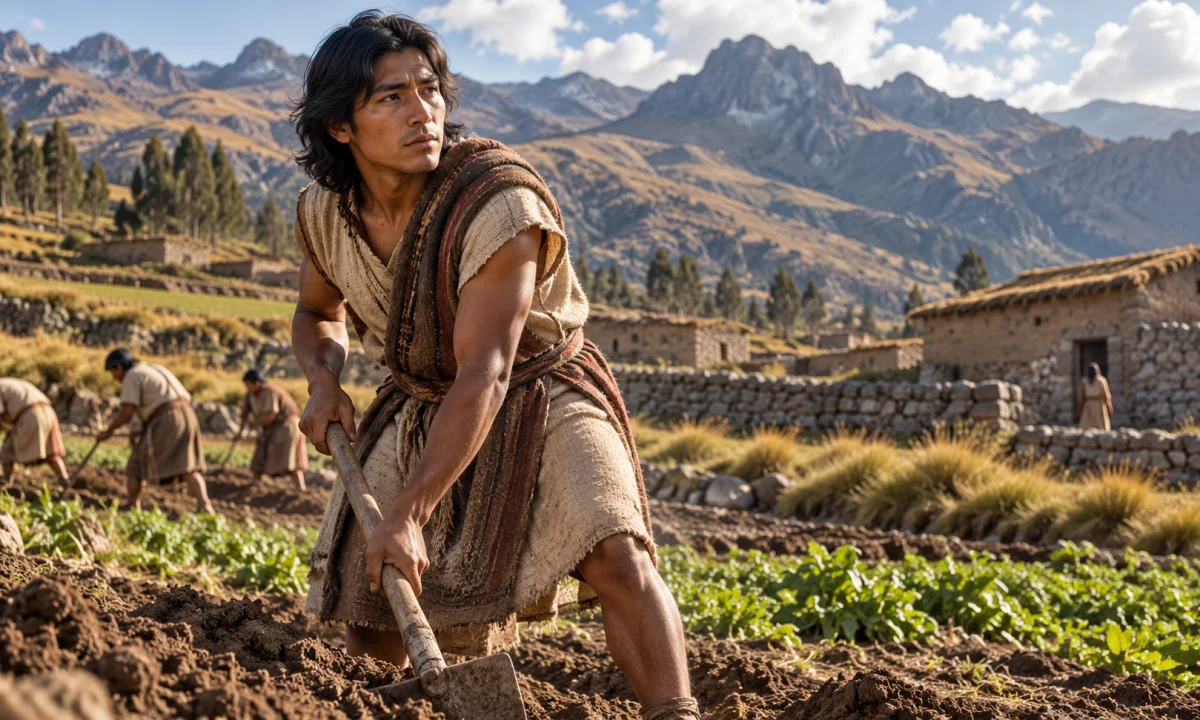
Guamansuri is a little-known figure associated with the mythology of the Cañari people of the northern Andean region, especially the area now known as Ecuador. He is often listed under Inca mythology because accounts of his story were preserved in Spanish colonial writings that classified Andean traditions through Inca and Quechua frameworks. The surviving evidence, however, suggests that Guamansuri belongs more specifically to Cañari origin traditions than to a universally shared Inca religious system.
His story concerns the meeting of a supernatural male figure and a human woman, the death of the visitor, and the birth of descendants who became connected with the Cañari people. The details vary considerably between summaries and source traditions. Guamansuri is therefore best understood as a figure known through fragmentary colonial records and later retellings, rather than through a single canonical myth.
Cultural setting
The Cañari lived in the highlands of what is now southern Ecuador, particularly around the regions of Cañar, Azuay and the valleys near present-day Cuenca. Before the expansion of the Inca state, they maintained their own political communities, sacred places and traditions. The Inca incorporated much of the region into their empire during the late fifteenth century, but Cañari identity and local religious traditions did not simply disappear.
When Spanish chroniclers began recording Andean beliefs in the sixteenth and seventeenth centuries, they frequently described local gods and ancestors using categories such as huaca, deity, ancestor or civilizing being. The Quechua term huaca could refer to a sacred place, object, ancestor, natural feature or supernatural presence. It did not always mean a god in the narrow sense used in modern mythology books.
Colonial writers also tended to compare local origin stories with better-known Inca traditions. As a result, Guamansuri is sometimes presented as an Inca god without qualification. That description is convenient for classification, but it can obscure his more particular connection with the Cañari cultural world.
Sources and historical uncertainty
No pre-colonial Cañari book survives that sets out the story of Guamansuri in a fixed form. The tradition is known through colonial documentation, later compilations and modern interpretations of Andean mythology. These records were produced after the Spanish conquest and were shaped by the interests, vocabulary and assumptions of European observers.
Colonial accounts of Indigenous religion often served several purposes at once. They could record local traditions, support missionary work, explain the political history of a region or fit unfamiliar beliefs into Christian and classical categories. Oral traditions were also flexible. A story could change between communities, generations or storytellers without being regarded as incorrect.
For these reasons, statements about Guamansuri should be treated with care. Some references call him a god; others describe him as a culture hero, supernatural ancestor or divine visitor. The sources do not provide a universally agreed genealogy, appearance or set of powers. Details that are repeated in modern summaries may come from a particular interpretation rather than from a consistent ancient tradition.
Name and identity
The spelling Guamansuri is common in modern reference works, but variations may occur, including forms such as Guaman Suri or Guamán Suri. Colonial orthography was inconsistent, and Spanish writers attempted to represent Indigenous names with an alphabet and sound system that did not always match the original language.
The meaning of the name is not securely established. Parts of it may invite comparison with words from Quechua or other Andean languages, but a similar-looking word is not enough to prove an etymology. The Cañari language was not identical to Quechua, and the historical evidence for the original form and meaning of the name is limited. Interpretations that translate Guamansuri as a particular animal, celestial body or natural force should therefore not be treated as certain unless supported by specific linguistic evidence.
There is also no firm basis for identifying Guamansuri with a major Inca deity such as Viracocha, Inti or Illapa. Some retellings place him within a wider divine order associated with the creator or with heavenly powers, but this does not establish that he was simply another name for one of those better-known figures.
The origin story associated with Guamansuri
The best-known form of the story presents Guamansuri as a supernatural being who came down to the human world and approached a Cañari woman. In several summaries, he impregnates her or becomes the father of children who are important to Cañari ancestry. The woman’s relatives react violently to the relationship, and Guamansuri is killed by her brothers or male kin.
The killing is significant because it places the supernatural visitor within a recognisable pattern found in many origin narratives: a being from another realm enters human society, establishes a line of descent, and dies before the community fully understands his nature. His death does not end his importance. Instead, his descendants carry the connection between the divine or otherworldly realm and the human people.
The mother and children are described differently in different versions. Some modern accounts say that she gave birth to twins who became ancestors of the Cañari. Other retellings provide additional names or episodes, but these details are not consistent across the available material. It is safest to say that the story links Guamansuri with the beginnings or sacred ancestry of the Cañari, while leaving the exact genealogy open.
Some accounts also connect the story with a later restoration of the dead or with the survival of the children after violence against their parents. Such motifs may have become blended with other Andean origin traditions during transmission. They should not automatically be treated as parts of one original, complete narrative.
Role as ancestor and culture figure
Guamansuri’s most important function is genealogical. He represents a supernatural source for a human community, making the Cañari people more than a political population: they become a people with a sacred origin. In Andean societies, ancestry was often tied to particular places, mountains, springs, caves and other sacred features. A founding ancestor could therefore be both a figure in a story and a continuing presence connected with the landscape.
Whether Guamansuri should be called a creator god is uncertain. The surviving descriptions do not clearly portray him as the maker of the entire universe, humanity or the natural world. His role is narrower and more personal. He enters an already existing world, forms a relationship with a human woman and contributes to the origin of a particular people.
He is also sometimes described as a civilizing or instructive figure. In Andean mythology, supernatural ancestors may introduce social customs, establish settlements or legitimise rulers. However, the evidence for a distinct set of teachings delivered by Guamansuri is limited. The most secure theme is his relationship to Cañari descent, not a detailed programme of civilisation.
Relationships with other traditions
The Cañari possessed several origin traditions, and Guamansuri’s story should not be assumed to replace all of them. One widely discussed Cañari tradition describes ancestors surviving a great flood and encountering mysterious women associated in later accounts with macaws. These women and the flood story are often connected with Cañari beginnings, but they are not automatically the same tradition as the story of Guamansuri.
Modern retellings sometimes combine the supernatural father, flood survivors, bird-women and ancestral twins into a single sequence. Such combinations may be useful for telling a broad story of Cañari origins, but they can blur distinctions between separate narratives. The evidence does not justify treating every Cañari origin motif as an episode in Guamansuri’s life.
Nor should Guamansuri be confused with Guamán as a personal name or title. Guamán appears in various Andean names and surnames, and a similar spelling does not prove identity. He is likewise not simply a version of the Inca creator Viracocha, the sun deity Inti or the storm deity Illapa. These figures belong to wider and better-attested religious traditions, while Guamansuri is known primarily through a more local and uncertain body of material.
Symbolism and interpretation
The story’s central relationship can be interpreted as a union between the sacred and the human. A visitor from outside ordinary society fathers descendants who belong to a particular community. This kind of narrative gives the community a sacred genealogy while also explaining why its ancestors possess a special relationship with the land and the supernatural world.
The violence against Guamansuri may express the danger of crossing social boundaries. His identity is not understood by the woman’s relatives, and his death results from treating an extraordinary stranger as an ordinary rival or offender. At the same time, the story does not portray the encounter as meaningless. The killing becomes part of the process by which a new lineage is established.
It is possible to read the myth as a reflection of wider Andean concerns about reciprocity, kinship and the relationship between different realms. Yet such interpretations remain scholarly readings rather than statements explicitly made by the surviving sources. There is not enough evidence to assign Guamansuri a single definitive symbol, such as the sun, a bird, a mountain or a particular celestial object.
Relation to Inca mythology
Calling Guamansuri an Inca mythological figure is not entirely wrong, but it requires qualification. The Cañari region was incorporated into the Inca Empire, and Inca influence may have affected the transmission and interpretation of local traditions. Some colonial accounts may also have represented non-Inca deities within an imperial religious framework.
Nevertheless, the available tradition does not show that Guamansuri was worshipped throughout the Inca Empire or that he held a standard position in the state cult centred on Cusco. His association is strongest with the Cañari and with the northern Andes. A more precise description is a Cañari supernatural ancestor recorded in sources about Andean mythology.
This distinction matters because the Andes contained many religious systems and local sacred traditions. The Inca state incorporated regional gods and ancestors in different ways, sometimes identifying them with imperial deities, sometimes allowing local worship to continue, and sometimes reorganising it around imperial centres. A figure’s appearance in an account of “Inca religion” does not prove that the figure originated in Cusco or belonged to a single pan-Andean pantheon.
Later reception
Guamansuri has not achieved the same presence in global popular culture as Viracocha, Inti or the Inca ruler figures. He appears mainly in encyclopaedic treatments of South American mythology, discussions of Cañari history and modern retellings of Indigenous origin stories. These treatments often simplify the available evidence by presenting one version as definitive.
Contemporary interest in Guamansuri is valuable when it draws attention to Cañari heritage and to the diversity of Indigenous traditions within the Andes. It is less reliable when it treats a fragmentary colonial record as though it were a complete ancient scripture. Any modern depiction should distinguish between what the sources clearly preserve, what belongs to a particular variant and what has been added by later interpretation.