WORLD
WORLD
Godasiyo
Godasiyo is a woman associated in some recorded Iroquois, or Haudenosaunee, traditions with the beginnings or separation of communities. She is usually described as a leader rather than as a universally recognized goddess. The name and story do not appear in one fixed form across all Haudenosaunee nations, and surviving accounts differ considerably in their details. For that reason, Godasiyo is best understood as a figure from a particular strand of Indigenous oral tradition and its later written recordings, not as a single, standardized character in all Iroquois mythology.
Cultural setting
The Haudenosaunee are a cultural and political alliance traditionally composed of the Mohawk, Oneida, Onondaga, Cayuga and Seneca nations. The Tuscarora later joined the confederacy. English-language writers have often used the broader term Iroquois, although many contemporary Indigenous people and institutions prefer the name Haudenosaunee, meaning “People of the Longhouse.” Each nation has its own history, ceremonial life, language traditions and narrative emphases.
Haudenosaunee religious traditions are not limited to stories about supernatural beings. Narratives may preserve teachings about proper conduct, political relationships, the origins of communities, the duties of leaders and the relationship between human beings and the natural world. A figure who appears as a leader in one account may therefore have a social and cultural importance that is not captured by the English word “goddess.”
Many traditional narratives were transmitted orally and were recorded by non-Indigenous collectors at different times. Translators and ethnographers rendered Indigenous names into varying English spellings, often without a consistent system for representing the original language. A name such as Godasiyo may consequently appear in other forms, and the exact pronunciation or etymology cannot safely be inferred from the English spelling alone.
Identity and classification
Godasiyo is generally presented as a female community leader, sometimes as the head or chief of a village. In accounts connected with her, the central concern is not a catalogue of divine powers but the fate of a people and the consequences of division, movement or conflict. Some modern reference works classify her as an Iroquois goddess, but that label can be misleading. The available tradition does not establish a single, widely accepted cult of Godasiyo comparable to the major ceremonial beings recognized across Haudenosaunee religious life.
It is more accurate to describe her as a legendary ancestral or founding figure in certain Iroquois narrative traditions. Even this description should be used with care. “Founding figure” may refer to the origin of a settlement, the division of a larger population or the explanation of relationships among nations, and different versions do not necessarily agree about which event the story explains.
There is also no secure basis for treating every appearance of the name in modern books or online summaries as evidence of an independent ancient deity. Some short entries repeat one another, simplify a complex narrative or present a localized tradition as though it were shared by all Haudenosaunee peoples. The limits of the surviving documentation are important when discussing Godasiyo.
The narrative associated with Godasiyo
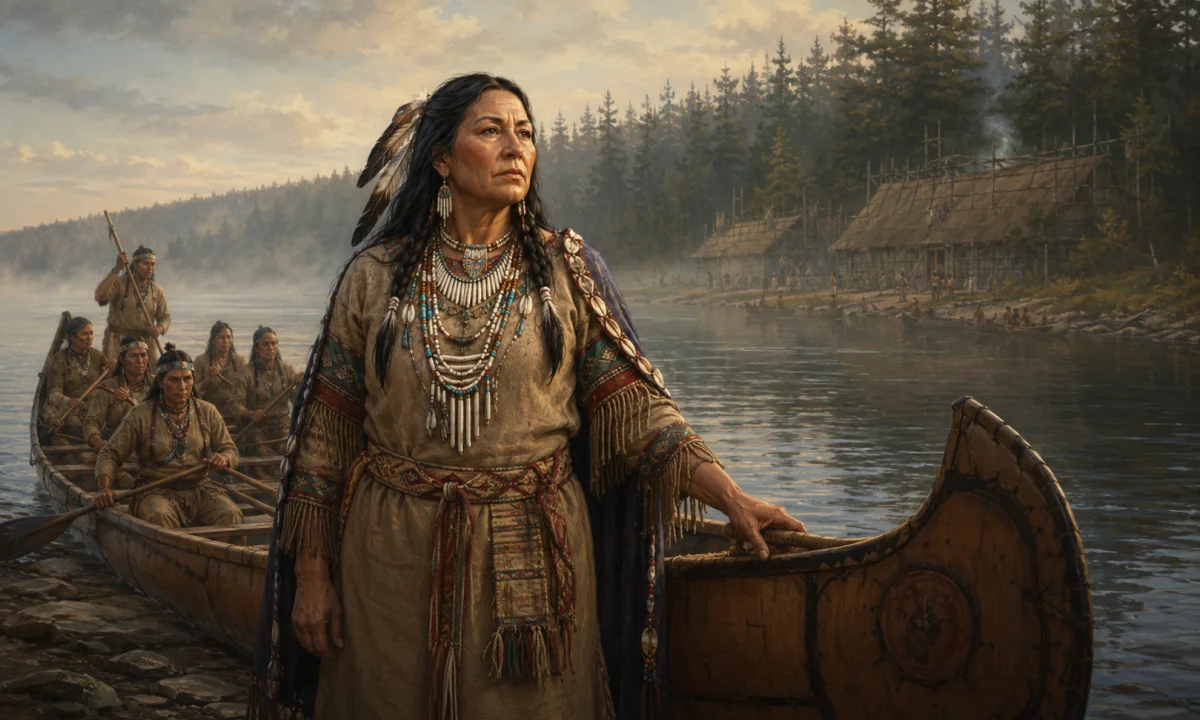
In the versions most often connected with her name, Godasiyo leads a community during a period of disagreement or disruption. The people associated with her are described as leaving their original home or travelling together, commonly in a watercraft. A crisis during the journey then separates the group or changes its fate. Later interpretations connect this separation with the emergence of distinct peoples or communities.
The details vary. Some retellings emphasize quarrelling within the community; others focus on a journey across water, an accident or the breaking apart of a vessel. The number and identity of the groups that result are also not consistent in every account. It is therefore unsafe to present a single sequence of events as the definitive “Godasiyo myth.” The broad pattern—a female leader, a community in difficulty, movement from one place and a resulting division—can be discussed with more confidence than the specific mechanics of the episode.
In some presentations, Godasiyo’s story is treated as an explanation for the origin of the Iroquois nations. This interpretation may reflect the way the tale was organized by later collectors rather than a universal Haudenosaunee explanation of political origins. The Haudenosaunee Confederacy has its own important founding traditions concerning the Peacemaker, commonly known as Dekanawida or Deganawidah, and the statesman Hiawatha. Those traditions explain the establishment of peace and the formation of the confederacy, not simply the physical creation of the peoples themselves.
Godasiyo should not automatically be inserted into the Peacemaker cycle. A story about the dispersal or formation of communities is not the same as the story of the Confederacy’s political foundation, even when later writers place both within a general account of “Iroquois origins.” The relationship between the traditions is uncertain, and they should be kept distinct unless a particular Indigenous source explicitly connects them.
Water, travel and separation
Water is a recurring setting in many North American origin and transformation narratives, but its presence does not give Godasiyo a fixed identity as a water goddess. In the stories associated with her, water is better understood as the setting for movement, danger and irreversible change. A journey by water can represent the movement of a community away from an earlier home, while the loss of a unified group can provide a narrative explanation for later differences among peoples.
The canoe or boat, where it appears in a particular version, should not be treated merely as a magical object. Watercraft were practical technologies essential to travel, fishing and communication in the Great Lakes region. Their appearance in a narrative may therefore carry both literal and symbolic significance. A vessel can hold a community together, but it can also become the point at which that unity fails.
Likewise, division in the story need not mean simple political failure. Haudenosaunee traditions recognize the importance of kinship, collective responsibility and the peaceful management of disagreement, but distinct nations also possess their own identities and territories. A narrative about separation may preserve an understanding that communities can share deep relationships while becoming politically or culturally distinct.
Leadership and social meaning
Godasiyo’s most consistent reported characteristic is leadership. She is not primarily remembered for a weapon, a monstrous form or a set of supernatural transformations. Her role places attention on decisions made on behalf of a community. Depending on the version, her actions may be interpreted as protective, necessary, tragic or inadequate. The surviving summaries do not provide enough stable information to assign one moral judgment to her in every telling.
The presence of a woman in a position of collective authority is also significant, although it should not be exaggerated into a claim that Godasiyo represents a universal “mother goddess.” Haudenosaunee societies have long included important forms of women’s authority, including roles connected with clans, family descent and the selection or removal of male chiefs. These institutions are historically and culturally specific. They should not be reduced to a generalized idea of female power drawn from comparative mythology.
Godasiyo can be read as a figure through whom questions of communal responsibility become visible: What should a leader do when a settlement is divided? Can a people preserve unity while moving into a new environment? Does separation destroy an original community, or does it produce new relationships and identities? Such interpretations are scholarly or literary readings, not statements that every Haudenosaunee community understands the story in exactly this way.
Sources and uncertainty
The written record for Godasiyo is limited compared with the extensive documentation surrounding figures such as Sky Woman, the Creator, the twins and the Peacemaker. Much of what is now repeated about her comes through English-language collections of Indigenous narratives, encyclopedic summaries and later retellings. These materials may preserve valuable traditions, but they also reflect the choices of collectors: which storyteller was consulted, how the language was translated, which details were omitted and whether a local account was generalized to represent an entire people.
Oral traditions should not be judged defective because they contain variants. Variation is normal in living narrative traditions, especially when stories are told in different communities or for different ceremonial and educational purposes. At the same time, the existence of variants means that a modern summary should not silently combine separate accounts. Claims about Godasiyo’s exact homeland, relatives, powers, death or transformation require a specific and reliable tradition behind them.
There is no firm evidence that she has one universally accepted appearance. Descriptions portraying her with a particular costume, animal form, magical weapon or set of symbols are likely to come from individual retellings or modern artistic invention unless they can be tied to a documented tradition. The same caution applies to claims that she is the wife, mother, daughter or rival of another well-known Haudenosaunee being.
Distinction from other Haudenosaunee figures
Sky Woman
Godasiyo is not the same figure as Sky Woman, also called the woman who falls from the Sky World. Sky Woman belongs to a major creation tradition in which animals help establish habitable land on the back of a turtle after her descent into the watery world. Her story is closely connected with the origins of human life, the earth and the powerful twins born to her daughter. Godasiyo’s reported narratives instead concern a human or ancestral leader and the movement or division of a community.
The Peacemaker and Hiawatha
Godasiyo should also be distinguished from the Peacemaker and Hiawatha. The Peacemaker is the central culture hero of the Confederacy’s founding tradition, while Hiawatha is his important ally in bringing an end to warfare among the nations. Their story focuses on peace, political order and the Great Law of Peace. A narrative linked to Godasiyo may concern origins or dispersal, but it does not automatically form part of that political history.
Other water-associated beings
Nor should Godasiyo be confused with water spirits, underwater creatures or beings known in particular Haudenosaunee traditions for controlling lakes and rivers. A story’s setting on or near water does not make its principal character a water spirit. Similarities in modern descriptions may arise because separate traditions have been compressed into broad categories such as “Iroquois water deity” or “Native American goddess.” Those labels often conceal important differences among nations and narratives.
Modern representation
Godasiyo has not become a major figure in mainstream popular culture. When she appears in modern books, websites or artwork, she is often presented as a goddess, tribal founder or universal Iroquois mother. Such portrayals may make the name more familiar, but they can also turn a variable and culturally specific tradition into a fixed fantasy character.
Responsible modern representation keeps the uncertainty visible. It identifies Godasiyo as a figure associated with particular Iroquois narrative traditions, avoids treating one retelling as the belief of all Haudenosaunee nations and separates traditional material from creative reconstruction. Her significance lies less in a standardized list of powers than in the questions raised by the story: how communities respond to conflict, how identities emerge through movement and separation, and how Indigenous histories have been preserved, translated and sometimes simplified in written form.