WORLD
WORLD
Gaoh
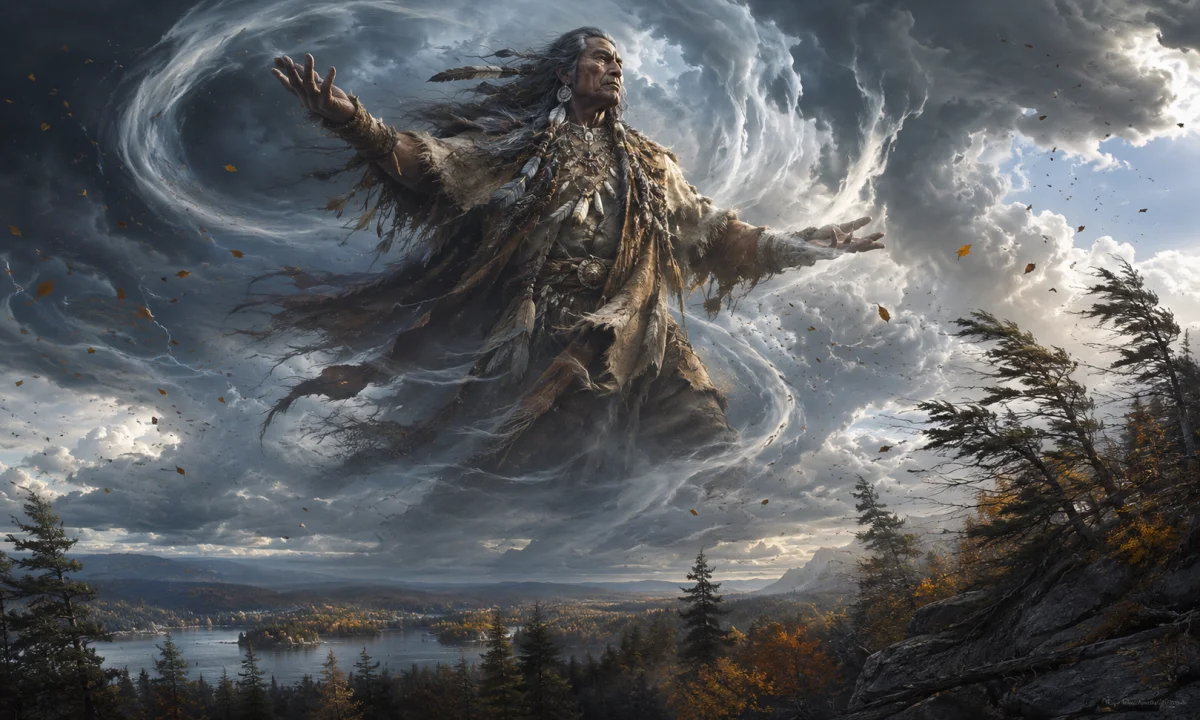
Gaoh, also written Gǎ-oh, Ga-oh or Gaho in English-language sources, is a giant spirit associated with the winds in traditions commonly described as Iroquois mythology. He is most often presented as the master or keeper of the winds, controlling the powerful air currents that shape weather and the changing seasons. The name and stories connected with Gaoh come primarily through oral traditions recorded and translated by outsiders, so details about his identity, appearance and mythology vary considerably.
Cultural setting
“Iroquois” is a historical English name for the peoples of the Haudenosaunee Confederacy, including the Mohawk, Oneida, Onondaga, Cayuga, Seneca and Tuscarora nations. Each nation has its own language, history and storytelling traditions, and the word “Iroquois mythology” can conceal important local differences. Gaoh is therefore best understood as a figure associated with some Haudenosaunee traditions and with later comparative accounts, rather than as a character belonging to one universally fixed mythology.
Haudenosaunee religious and cultural traditions were preserved chiefly through spoken performance, ceremonial practice and community memory. They were not originally organized around a single written canon that fixes every name, episode or attribute. European and American collectors later wrote down narratives in English or in other European languages. Their spellings, translations and decisions about whether to call a being a “god,” “spirit,” “giant” or “personification” influenced the way Gaoh came to be known outside the communities in which the stories developed.
For that reason, descriptions of Gaoh should not be treated as if they were entries from a single ancient handbook. Some accounts emphasize his role as a powerful giant; others describe him more abstractly as the living force or guardian of the winds. The surviving record does not establish one definitive version of his biography.
Name and identity
The form Gaoh is widely used in modern English reference works, but it is not the only spelling. Older sources and retellings may use forms such as Gǎ-oh, Ga-oh or Gaho. Differences can result from attempts to represent an Indigenous word with an alphabet not designed for the original language, as well as from differences between languages and transcription systems.
The precise meaning and pronunciation of the name are not consistently explained in general English-language accounts. It is therefore safer not to assign Gaoh a definite etymology without a particular linguistic source. The spelling Gǎ-oh, sometimes seen in older publications, should not automatically be interpreted as proof of a separate being. In many contexts it appears to represent the same wind-associated figure, although individual sources must be checked before assuming that every similar form refers to exactly the same tradition.
Gaoh is often called a wind giant. This description combines two ideas: the winds are treated as powerful, active forces, and those forces can be represented through a person-like being of extraordinary size and strength. “Giant” in this context does not necessarily mean a villain or a member of a race of giants. It is a way of expressing the immense scale of the natural power that Gaoh embodies or governs.
Gaoh and the winds
The central feature of Gaoh’s identity is his relationship with the winds. English summaries commonly describe him as keeping, directing or releasing the winds. Some versions place the winds under his control in a remote dwelling or enclosure, while others focus more generally on his authority over their movement. The exact setting and sequence of events differ among retellings.
The winds may be discussed in relation to the four directions. This reflects a widespread Indigenous pattern in which the directional winds are treated as distinct forces with different effects on the world. However, the details attached to each direction are not uniform in the sources that mention Gaoh. One account may emphasize seasonal changes, another storms or temperature, and another the practical movement of air across the land. It is not safe to assume that every standard list of “four winds” belongs to every Haudenosaunee nation or to every story about Gaoh.
In this role, Gaoh is not simply a poetic name for a gentle breeze. Wind can bring rain, clear the air, carry seeds, drive clouds and make travel possible, but it can also damage homes, uproot trees and threaten people. A being who commands the winds consequently represents both their usefulness and their danger. His power expresses the fact that human communities depend on natural forces they cannot fully control.
Some general descriptions portray Gaoh as keeping the winds confined until they are needed, then allowing them to move across the world. This image should be treated as a recurring motif in retellings rather than as a universally attested episode. The important underlying idea is the regulation of a force that must be released in proper measure. Too little wind may bring stillness and stagnation; too much may bring destruction.
Appearance and supernatural qualities
Gaoh’s most consistent physical attribute in English descriptions is his immense size. His gigantic form makes visible the strength and reach of the winds, which can travel over great distances and affect the whole landscape. Beyond this broad characterization, accounts are not consistent enough to support a single canonical portrait.
Illustrations and modern summaries may give him a human body, unusual clothing, dramatic hair or other visual features, but these details should not automatically be regarded as traditional attributes. They often belong to an artist’s interpretation or to a particular retelling. There is no securely established appearance shared by all accounts of Gaoh.
His supernatural power is likewise best described in functional terms. He is connected with directing or controlling air and weather rather than with a broad catalogue of magical abilities. Calling him the “god of wind” can be convenient for comparison, but it may impose a European category that does not precisely match the traditions from which the figure comes. “Wind spirit,” “wind giant” or “master of the winds” is generally more cautious.
Stories and narrative patterns
The stories associated with Gaoh are not preserved as one stable cycle with a universally agreed beginning, middle and end. Instead, reference works tend to preserve short descriptions or episodes concerning his authority over the winds. In some narratives, the winds are held back or restrained, and their release becomes necessary for the world to return to its proper condition. In others, Gaoh functions primarily as the being responsible for the movement and balance of the winds.
These stories often have an environmental and seasonal dimension. Wind is part of a larger system involving clouds, rain, cold, warmth, plant life and the conditions required for human survival. A narrative about Gaoh may therefore be less concerned with his personal adventures than with explaining why weather changes or how the forces of the natural world are ordered.
It is difficult to identify a single set of universally recognized relationships for Gaoh. Popular reference pages sometimes place him beside major figures from Haudenosaunee creation narratives, but a shared source tradition should not be assumed merely because several beings appear in an English retelling. Gaoh is not consistently presented as the child, spouse, enemy or servant of one particular deity across all available accounts.
Nor should every story about wind in Haudenosaunee tradition be attributed to Gaoh. Oral traditions include many ways of representing weather, animals, celestial powers and other natural phenomena. A story that mentions a storm or a directional wind does not necessarily concern the same figure. Careful identification depends on the language, community, recorder and context of the individual version.
Religious and symbolic significance
Gaoh’s importance lies partly in the way he gives agency to an element that is invisible but unmistakably powerful. Wind cannot be seen directly, yet its presence is revealed by moving branches, waves, smoke, clouds and falling leaves. Representing it as a giant spirit makes an unseen natural process imaginable without reducing it to an abstract scientific mechanism.
This does not mean that Haudenosaunee people uniformly treated Gaoh as a deity in the same sense as figures from classical European mythology. English collectors frequently arranged Indigenous beings according to categories such as gods, demons, fairies and giants. Those labels can be useful for orientation, but they may distort the relationships among spiritual beings, animals, natural forces, ancestors and culture heroes within the original traditions.
Gaoh can also be understood through the principle of balance. Wind is necessary, but its force must be appropriate. The idea that winds may be held, released or directed reflects a concern with order in the natural world. It does not necessarily mean that people believed weather could be controlled through a simple personal command. Rather, the figure provides a narrative language for the dependence of human life on powers beyond ordinary human authority.
The association with directions is significant as well. A directional system turns the landscape into an ordered field of relationships, with movement coming from different quarters and carrying different seasonal or environmental effects. Gaoh’s command over these movements places him at the meeting point between geography, weather and cosmology.
Sources and limits of the evidence
Knowledge of Gaoh in English is shaped by the work of collectors, translators and folklorists. Such records can preserve valuable material, but they are not transparent transcripts of an unchanged prehistoric mythology. A recorder may have combined versions, shortened a performance, supplied an English category or altered a name to make it readable to a non-Indigenous audience.
The date of publication of an English account should not be confused with the date when the tradition began. A nineteenth- or early twentieth-century record may document a much older oral history, but the written form itself reflects the circumstances under which it was collected. Conversely, a brief written reference may omit the ceremonial, linguistic and community context needed to understand the figure fully.
Modern discussions should therefore distinguish between traditional association and documented detail. It is well established in broad summaries that Gaoh is a wind-related giant or spirit. Claims about a precise dwelling, a fixed appearance, a complete family tree or a single definitive story require more caution because they are not consistent across the surviving accounts.
Distinguishing Gaoh from similar figures
Gaoh is sometimes compared with wind deities from other cultures, such as the Greek Aeolus or various storm and sky gods. These comparisons may help readers recognize a shared mythological interest in the power of air, but the figures are not equivalent. Aeolus belongs to Greek literary and religious traditions, while Gaoh is connected with Haudenosaunee traditions and their own cultural settings.
Gaoh should also not be confused with every Indigenous figure described in English as a “wind spirit.” Indigenous nations across North America have distinct languages and religious traditions, and similar English labels do not prove a common origin. A being from Plains, Southwestern, Arctic or Mesoamerican tradition is not a variant of Gaoh simply because wind is part of its symbolism.
Likewise, Gaoh is not automatically identical with a storm monster, a giant from a particular creation story or a general personification of nature. Similar names in different sources may reflect spelling variation, transcription error or entirely separate figures. The safest identification is the narrow one: Gaoh is the wind-associated giant or spirit known from some Haudenosaunee or Iroquois mythological accounts.
Later reception
Gaoh has appeared mainly in mythology dictionaries, encyclopedic lists, illustrated folklore collections and online summaries rather than in a large body of major modern fiction. These retellings often simplify him into “the Iroquois god of wind” or present him as a fantasy giant. Such descriptions can make the figure easy to recognize, but they may erase the uncertainty of the sources and the distinctions among Haudenosaunee nations.
When Gaoh is used in modern fantasy, games or popular media, the result should be treated as an adaptation rather than as evidence about traditional belief. A modern character may receive a fixed visual design, invented powers, new enemies or relationships that are not found in the recorded traditions. Respectful treatment keeps those creative additions separate from the cultural material associated with Gaoh.
In traditional context, Gaoh is most meaningfully understood not as a generic monster or as a direct equivalent of a European wind god, but as a powerful personification of the winds and their ordered movement. His presence in the record reflects a Haudenosaunee way of giving narrative form to the invisible forces that shape weather, seasons and life across the land.