WORLD
WORLD
Ekibiogami
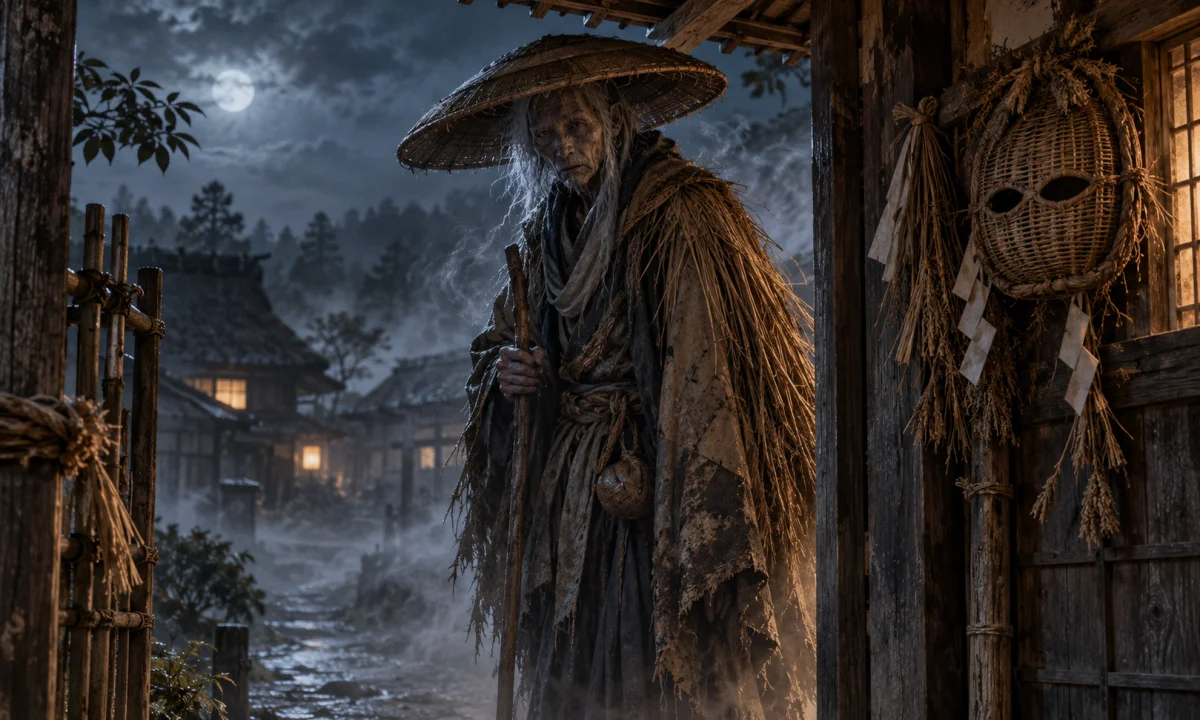
Ekibiogami is a Japanese term for a deity or spirit associated with epidemic disease. It is commonly written 疫病神 and may be romanised as ekibyōgami, ekibyougami or, in some English-language contexts, ekibiogami. The name does not usually identify one universally defined god with a fixed biography. Rather, it describes a class of harmful supernatural beings believed to bring contagious illness, particularly when disease spread through a community.
Meaning and identity
The word combines eki, meaning epidemic or pestilence, byō, meaning illness, and kami, meaning deity or spirit. In Japanese religious language, kami does not always imply a benevolent creator or a god with a clearly established personal identity. It can refer to a powerful presence, an occupying spirit, a force of nature, or a being whose influence must be respected and ritually managed.
For that reason, Ekibiogami is better understood as a category of epidemic-causing supernatural powers than as a single character comparable to a hero or a member of a fixed divine family. Descriptions differ according to period, locality and source. Some accounts treat the being as an independent plague deity; others understand epidemic disease as the work of angry spirits, wandering demons, polluted forces or supernatural beings collectively described as plague gods.
Another reading of the same kanji is yakubyōgami, often translated as “god of pestilence” or “plague god.” The terms overlap, although usage is not perfectly uniform. A spelling or pronunciation encountered in one source should not automatically be treated as evidence for a separate creature. The name Ekibiogami is therefore useful, but its identity remains broader and less fixed than that of figures such as Susanoo or Inari.
Historical and religious setting
Before the development of modern epidemiology, large outbreaks of disease were difficult to explain. Illness could move rapidly through towns, villages and military camps, while its causes were invisible. Japanese communities interpreted epidemics through several overlapping religious and cultural frameworks. Disease might be attributed to pollution, malicious spirits, restless dead, angry deities, seasonal forces or dangerous beings entering from outside.
These explanations did not necessarily form a single system. Shinto ideas about ritual impurity and the presence of kami existed alongside Buddhist teachings, Chinese-influenced cosmology, medical theories and practices associated with onmyōdō. The result was a flexible religious vocabulary in which an epidemic could be described both as a physical disaster and as a manifestation of hostile spiritual power.
Plague gods were especially associated with the fear that illness could cross a boundary. A disease might arrive with travellers, armies, merchants or refugees, or appear at a particular season. Roads, bridges, gates and village entrances consequently became important locations for protective rites. Communities sought to prevent a harmful power from entering, to persuade it to pass by, or to send it away after an outbreak had begun.
In this context, Ekibiogami was not simply a personification of medical disease. The figure represented the danger, agency and unpredictability of epidemic illness. Treating the disease as a supernatural visitor also made ritual responses possible: people could appease it, divert it, purify themselves, protect a household or escort the threat beyond the settlement.
Appearance and representations
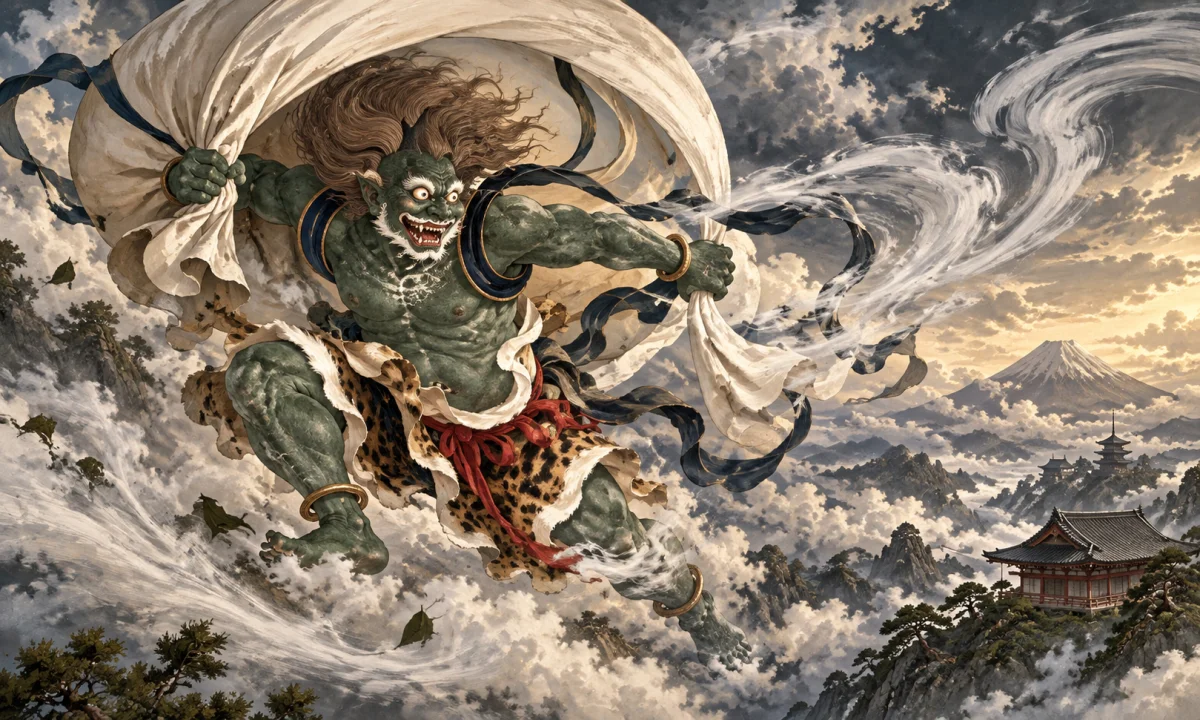
There is no single canonical appearance for Ekibiogami. Popular descriptions and later illustrations may show a frightening, human-like spirit with an unhealthy or distorted face. Some plague deities are portrayed with red or dark skin, wild hair, fierce expressions, horns or other features associated with demons and threatening supernatural beings. These images should not be mistaken for a universal ancient portrait.
Visual representations were shaped by the conventions of Japanese yōkai art and by changing ideas about disease. A plague deity could appear as an imposing divine figure, a demon-like creature, an invisible presence or a person carrying the signs of illness. In some contexts, the emphasis was not on its body at all but on objects used to repel it, including protective charms, ritual papers, boundary markers and images of powerful deities.
The absence of a fixed appearance reflects the nature of the term. Ekibiogami names a function—bringing epidemic disease—rather than a consistently described species. One local tradition may imagine a plague spirit as a travelling outsider, while another may connect it with a resident shrine deity, a disgruntled ghost or a force arising from ritual pollution.
Roles and supernatural powers
The primary power attributed to Ekibiogami is the ability to cause or spread epidemic illness. The idea does not require the deity to infect every person directly. In traditional thought, an epidemic could result from the spirit’s arrival, presence, anger or passage through a community. Its influence might be felt in fever, sudden death, widespread sickness or the repeated misfortune of a household.
Its powers were therefore associated with:
- bringing contagious disease to a settlement or family;
- causing illness to spread rapidly among people or animals;
- appearing during dangerous seasons or times of social disorder;
- crossing roads, boundaries and household thresholds;
- withholding protection from communities that had neglected ritual obligations; and
- departing or being driven away through prayer, purification, offerings or communal rites.
These attributes were not always presented as moral judgement. A plague god was dangerous, but not necessarily “evil” in the absolute sense used in some modern fantasy. In Japanese religious practice, harmful and beneficial powers could sometimes be related. A deity feared during an epidemic might be honoured in the hope that it would refrain from causing harm, accept an offering or protect those who approached it correctly.
Ritual responses to epidemic danger
Protective responses to epidemic spirits varied widely. People used purification rites, prayers, amulets, talismans and ritual observances intended to block or remove harmful influences. Household protection could include placing sacred objects near an entrance, displaying auspicious images or relying on a local shrine’s power. Communities might mark roads and village boundaries, perform processions or conduct ceremonies intended to expel dangerous forces.
One important pattern was the sending away of misfortune. A harmful spirit could be symbolically transferred to an object, placed in a vehicle or carried beyond the community’s boundaries. In some regional customs, ritual objects were floated down a river, taken along a road or removed from the settlement. Such practices were not identical everywhere, and not every rite was specifically directed at Ekibiogami, but they express the wider religious logic associated with epidemic spirits.
Other responses involved appeasement rather than expulsion. Offerings, prayers and the establishment of a shrine could acknowledge the dangerous power and seek to transform its relationship with the community. In this respect, a plague deity could become connected with protective worship. A feared power might be given a proper place, title or ritual honour so that its destructive capacity would be restrained.
Goryō, epidemic spirits and Gion traditions
Ekibiogami is often discussed alongside goryō, the angry or vengeful spirits of people who had died unjustly or violently. In medieval and earlier Japanese religious thought, goryō were sometimes blamed for epidemics, crop failures and other disasters. Rituals to pacify them were intended to calm their resentment and prevent further harm.
The relationship between plague gods and goryō is one of association, not identity. A goryō is defined primarily by its status as a dangerous restless spirit, whereas Ekibiogami is defined by its connection with epidemic disease. In some settings, the two categories overlap; in others, they remain distinct.
The Gion tradition offers an important example of the wider religious environment surrounding epidemic protection. The Gion Goryō-e, an early medieval rite associated with the pacification of dangerous spirits, developed into the religious background of the Gion Festival in Kyoto. Over time, the festival became closely associated with protection against disease. Its history also involves the Buddhist deity Gozu Tennō and the kami Susanoo in forms shaped by the longstanding interaction of Buddhist and Shinto traditions.
Neither Gozu Tennō nor Susanoo should simply be renamed Ekibiogami. They are distinct figures with their own histories and identities. They became connected with protection from epidemics because religious communities associated them with the control, pacification or warding off of dangerous disease-bearing forces.
Related figures and concepts
Yakubyōgami
Yakubyōgami is another reading and name for a plague god. In many explanations, it is effectively synonymous with Ekibiogami. Differences may reflect regional pronunciation, transliteration choices or the preference of a particular writer. The two terms should not automatically be presented as separate beings.
Hōsōgami
Hōsōgami refers to a deity or spirit associated especially with smallpox, historically one of the most feared infectious diseases in Japan. Hōsōgami belongs to the broader world of disease-related supernatural belief, but it is more specific than the general category of Ekibiogami. Traditional practices connected with smallpox included distinctive images, colours, songs and protective customs. A general plague deity and a smallpox deity may be related in function without being identical.
Gozu Tennō
Gozu Tennō was a powerful Buddhist-associated deity linked in medieval and early modern religious culture with epidemics and protection from disease. He was sometimes connected with Susanoo through syncretic interpretations. Gozu Tennō is an individually recognised religious figure, not merely another name for every Ekibiogami.
Dōsojin and boundary deities
Dōsojin are protective boundary deities found in various local traditions. They may guard roads, village entrances and the edges of inhabited space against disease, misfortune and hostile spirits. Their protective role can bring them into contact with beliefs about plague gods, but dōsojin are not themselves a single form of Ekibiogami. Their function is generally defensive, while Ekibiogami describes a disease-bringing power.
Interpretation and cultural significance
Ekibiogami reveals how communities gave social and religious meaning to collective illness. An epidemic threatened more than individual health: it disrupted funerals, trade, agriculture, travel, worship and family life. Describing the threat as a deity or spirit made it possible to express fear in personal and ritual terms.
The figure also reflects the importance of boundaries in Japanese folk religion. Disease was imagined as something that could enter from outside, move through a neighbourhood and be escorted away. Gates, roads, rivers and village borders consequently became spiritually significant. The contrast between inside and outside was not absolute, however. A harmful presence might be excluded, redirected or transformed through ritual rather than destroyed.
From a modern perspective, these traditions should not be confused with scientific explanations of infection. Historical Japanese communities used religious concepts because they lacked modern knowledge of pathogens and transmission. At the same time, ritual practices often existed alongside practical measures such as isolation, cleaning, herbal treatment and restrictions on movement. Religious belief and empirical observation were not always treated as mutually exclusive.
The term also demonstrates why translating every Japanese supernatural being as a “monster” can be misleading. Ekibiogami may be frightening, but it belongs to a religious vocabulary concerned with disease, ritual danger and the management of powerful forces. Calling it only a monster removes the social and ceremonial context that gives the concept its meaning.
Ekibiogami in modern culture
In contemporary discussions of Japanese folklore, Ekibiogami may appear in encyclopaedias of yōkai, illustrated references, games, manga and fictional settings involving supernatural disease. Modern artists often give the being a single memorable design, such as a horned demon, masked spirit or robed deity. Such designs can be effective visual interpretations, but they do not establish a universally traditional appearance.
Popular culture may also combine Ekibiogami with demons, oni, goryō, Hōsōgami or other disease-related figures for dramatic effect. These combinations are modern creative choices unless a particular historical tradition supports them. Traditional sources and local customs present a more varied picture: sometimes a plague god is an independent supernatural presence, sometimes part of a wider group of epidemic spirits, and sometimes connected through ritual with a deity who is also invoked for protection.
Ekibiogami is therefore best approached as a flexible Japanese religious and folkloric concept: the personified power of epidemic disease, feared for its ability to enter communities and spread illness, yet sometimes addressed through worship, appeasement or protective ritual rather than treated as a simple embodiment of absolute evil.