WORLD

Echdae
Echdae is an obscure and uncertain name associated with Irish mythological tradition. It does not designate a clearly defined character in the way that names such as the Dagda, Lugh, Brigid or Cú Chulainn do. The name appears in variant forms and has sometimes been connected with Eochaid or treated as an epithet of a male figure among the supernatural peoples of early Irish tradition. Because the surviving evidence is limited and inconsistent, Echdae should not be presented as a fully documented god or hero with a fixed biography.
The problem of identifying Echdae
Early Irish literature preserves a large number of personal names, epithets and genealogical forms. Many occur only once, while others appear in different spellings because medieval scribes copied much older material into manuscripts written in changing forms of the Irish language. A name that looks like a separate person in one list may be a variant, title or grammatical form of another name elsewhere.
Echdae belongs to this uncertain group. Modern reference works and popular lists sometimes treat it as an individual figure from Irish mythology. The surviving tradition, however, does not provide a widely accepted story centred on Echdae. There is no stable account of his birth, deeds, appearance, family or death that can be separated confidently from similarly named figures.
The uncertainty is increased by the relationship between Echdae, Eochaid, Eochu and related spellings. These forms occur in the names of several different characters, including kings, members of the Tuatha Dé Danann and figures connected with the Ulster and Mythological Cycles. Similar spelling does not by itself prove that the people bearing these names were the same.
Irish mythological and literary context
Irish mythology survives mainly through medieval and early modern manuscripts produced by Christian scribes. These manuscripts preserve stories that had circulated orally and through learned poetic tradition, but they do not form a single sacred canon. The material includes heroic tales, origin legends, genealogies, place-name explanations, king lists and stories about supernatural beings.
The most important bodies of material are often grouped into literary cycles. The Mythological Cycle deals particularly with the Tuatha Dé Danann, the Fomorians and earlier peoples said to have inhabited Ireland. The Ulster Cycle centres on figures such as Conchobar mac Nessa and Cú Chulainn. The Fenian Cycle concerns Fionn mac Cumhaill and his companions, while the so-called Cycles of the Kings combine legendary history with accounts of early Irish rulers.
A name such as Echdae must therefore be evaluated within a manuscript and a passage, rather than by assuming that every occurrence belongs to one universal mythic character. Medieval Irish texts frequently preserve alternative genealogies and conflicting versions. A figure may also receive several names, while the same name may belong to unrelated individuals in different stories.
Name and possible meaning
The form Echdae appears to be related to the Irish word-family associated with ech, meaning “horse”. Irish personal names beginning with Eoch- or Ech- are common in early literature. The exact interpretation of Echdae, however, depends on its spelling, grammatical form and manuscript context.
It is tempting to translate the name simply as “horseman” or “horse-like”, but such translations should be used cautiously. An element connected with horses may describe a person, indicate a family name or function as part of an epithet. It does not automatically establish that Echdae was a horse deity, a divine rider or a being with a particular equine appearance.
The related name Eochaid is especially important because several prominent Irish legendary figures bear it. Among them are Eochaid Airem, the legendary high king associated with Étaín; Eochaid Feidlech, traditionally described as the father of Medb; and Eochaid Ollathair, a name linked with the Dagda in some traditions. These figures are not interchangeable, and the presence of a similar name does not demonstrate that any one of them was Echdae.
Possible association with the Dagda
Some modern summaries associate Echdae with the Dagda, one of the leading figures of the Tuatha Dé Danann. The connection probably arises from the many names and titles attributed to the Dagda, including forms related to Eochaid and Ollathair. In medieval tradition, the Dagda is not represented by one simple personal name. He is known through several titles that emphasise his abundance, wisdom, strength, authority and fatherly status.
The Dagda is called Eochaid Ollathair in parts of the Irish tradition, and some modern writers have treated Echdae as an alternative name or form connected with him. This identification is not uniformly accepted, and it should not be stated as an established fact without specifying the relevant textual context. The evidence does not support describing Echdae as a separate, fully developed god with all of the Dagda’s familiar attributes.
The distinction matters because the Dagda has a substantial body of surviving narrative material. He is associated with the Tuatha Dé Danann, the magical cauldron that never runs empty, a powerful club and a harp capable of summoning or controlling emotions. He appears in stories involving the Second Battle of Mag Tuired, the Morrígan, Brigid and Aengus Óg. None of those features can automatically be assigned to Echdae merely because a name may be related to one of the Dagda’s titles.
Possible association with Eochaid and other figures
Other identifications are equally hazardous. The name Eochaid occurs in several unrelated genealogies and legends. Eochaid Airem is a human king in the Ulster Cycle, best known for his marriage to Étaín and for the events surrounding the fairy mound of Brí Léith. Eochaid Feidlech belongs to a different layer of legendary history and is linked with the Connacht queen Medb. Eochaid Ollathair is connected with the divine world in some accounts.
There are also figures whose names appear as Eochu, Echach or similar forms. Irish grammar changes the appearance of names according to their role in a sentence, and scribal spelling was not fixed in the modern sense. A form that resembles Echdae may therefore be difficult to classify without the original passage.
For this reason, Echdae should not be casually identified with Eochaid Airem, Eochaid Feidlech, Eochaid Ollathair or any other Eochaid. They belong to different narrative settings, and the tradition contains no universally accepted genealogy making them one person.
Attributes and role
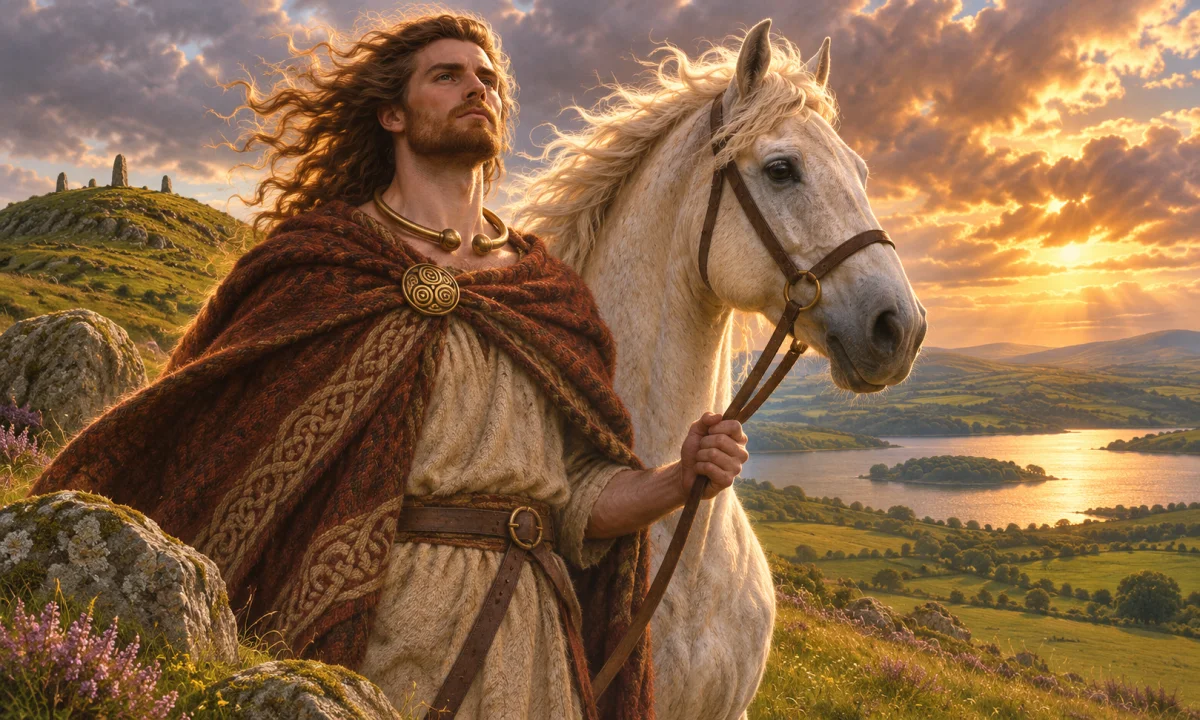
No reliable traditional description gives Echdae a distinctive physical appearance. There is no secure evidence that he possessed horns, wings, animal features, unusual weapons or a specific magical object. Images that portray Echdae as a mounted warrior or horse-headed spirit belong to modern invention or speculative reconstruction rather than to a well-attested Irish story.
Likewise, Echdae has no securely documented role as a god of horses, travel, war, fertility or the dead. The horse was important in early Irish culture and appears frequently in royal, heroic and supernatural narratives, but a name containing a horse-related element is not enough to establish a separate equine cult.
If the name is being used as a form connected with Eochaid Ollathair or the Dagda, its significance may lie in the naming practices surrounding that larger figure. The Dagda combines several roles: powerful warrior, provider, magician, ruler and figure of abundance. Yet those attributes belong to the Dagda’s established tradition, not necessarily to an independent being called Echdae.
Stories and relationships
There is no securely identified myth in which Echdae acts as the principal protagonist. The name is not associated with a standard cycle of adventures comparable to the tales of Lugh, Cú Chulainn, Fionn mac Cumhaill or Étaín. Nor is there a universally accepted account of Echdae’s spouse, children, enemies or political position.
Claims that Echdae was the father, son or partner of a famous Irish deity should therefore be treated with caution. Irish mythological genealogies are extensive, but they often vary between manuscripts and sometimes reflect attempts by medieval scholars to organise older traditions into family trees. A genealogy may preserve useful evidence, yet it does not always represent an original religious belief or a consistent mythic system.
The absence of a surviving story does not prove that the name was meaningless. It may once have belonged to a local tradition, a lost tale, an epithet or a genealogical entry. Many early Irish names survive in exactly this fragmentary way. What can be said with confidence is limited: Echdae is an obscure name whose interpretation depends heavily on the source in which it occurs.
Interpretation and cultural significance
Echdae illustrates an important feature of Irish mythology: it is not a neatly organised pantheon with a single authoritative list of gods. The surviving material is layered. It includes pre-Christian religious ideas, heroic storytelling, medieval genealogy, Christian literary interpretation and local traditions attached to particular places.
Names were especially vulnerable to reinterpretation. A poet or scribe might preserve an old name without retaining the story that explained it. A later writer might connect that name with a better-known figure, while a modern compiler might list it as a separate deity. Over time, a minor title can appear to be an independent character.
The uncertainty surrounding Echdae is therefore historically meaningful. It demonstrates why Irish mythological figures should be distinguished according to the strength of their evidence. A well-attested character may be supported by several narratives, recurring relationships and consistent attributes. An obscure name may be supported only by a spelling, a gloss or a disputed identification.
Distinguishing Echdae from similar names
- The Dagda: a major member of the Tuatha Dé Danann, associated with abundance, magical power, strength and wisdom. Echdae is sometimes connected with one of the Dagda’s name forms, but the identification is not universally secure.
- Eochaid Airem: a legendary human king of the Ulster Cycle and husband of Étaín. He should not be equated with Echdae simply because the names are related in spelling.
- Eochaid Feidlech: a different legendary king, traditionally associated with Medb and the royal traditions of Connacht.
- Eochaid Ollathair: a name or title associated in some sources with the Dagda. Its relationship to the form Echdae requires textual justification.
- Eochu and Echach: variant-looking forms that may represent different names, grammatical forms or individuals depending on the manuscript and passage.
Later reception
Echdae has little established presence in mainstream modern fiction, film or games. When the name appears in contemporary fantasy material, it may be expanded into a horse lord, a forgotten god or a supernatural king. Such portrayals can be imaginative, but they should be labelled as modern adaptations rather than presented as recovered Irish tradition.
Modern encyclopaedic lists can also give Echdae a more definite identity than the evidence warrants. A short entry may repeat an earlier uncertain identification until it appears to be an established fact. The most responsible description is that Echdae is an obscure and disputed name in the wider field of Irish mythological tradition, possibly connected with Eochaid-related forms and, in some interpretations, with the Dagda, but not securely documented as an independent mythological character.