WORLD

Ecne
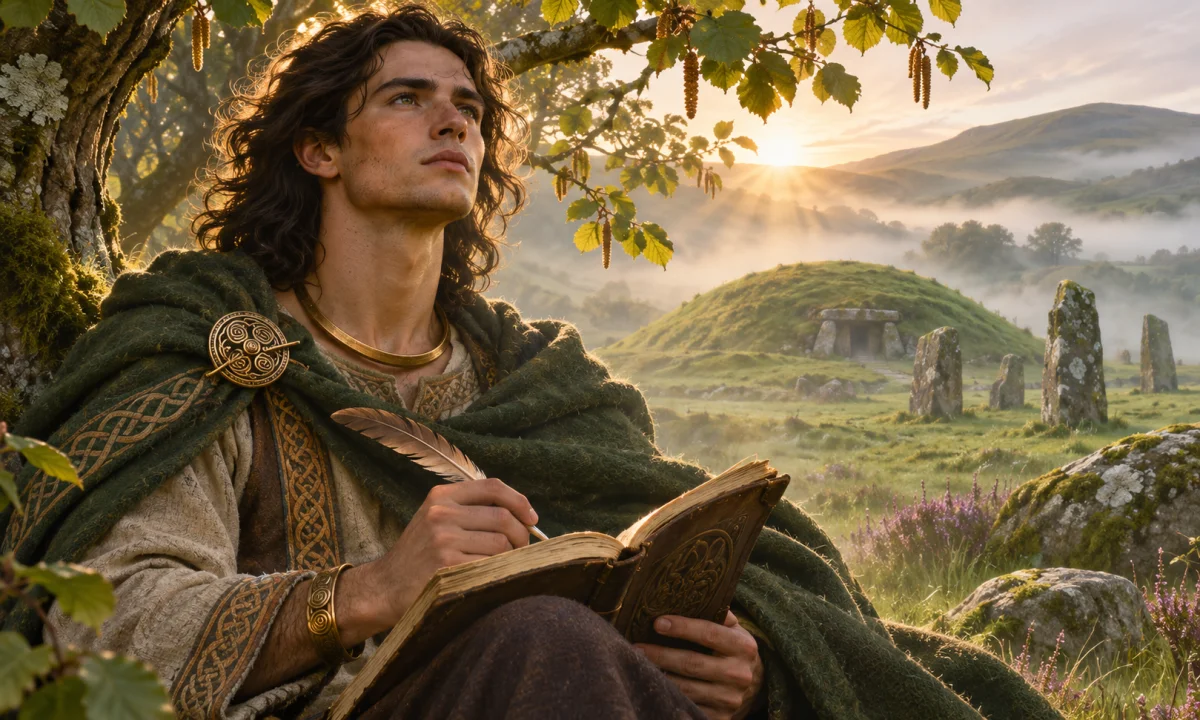
Ecne is a little-known figure associated with Irish mythology and with the idea of knowledge or wisdom. His name is commonly connected with the Old Irish word for knowledge, learning or understanding, and modern reference works often describe him as a god of knowledge. The surviving evidence is limited, however. Ecne is not the central character of a well-preserved Irish myth, and the details usually repeated about him come from medieval learned tradition rather than from a complete narrative devoted to his deeds.
Origins in Irish mythological tradition
Ecne belongs to the mythological world of the Tuatha Dé Danann, the supernatural people who occupy a central place in medieval Irish literature. The Tuatha Dé Danann are presented as a powerful race associated with Ireland before the arrival of the Milesians, the legendary ancestors of the later Irish people. They include figures such as the Dagda, Brigid, Lugh, Nuada and Manannán mac Lir.
Irish medieval writers did not preserve a single, systematic mythology comparable to a modern pantheon. Genealogies, glossaries, origin legends, heroic tales and local traditions often provide different levels of information about supernatural figures. Some names occur in major stories, while others survive only in brief notices or in learned explanations of words and names. Ecne belongs largely to the second group.
The name of Ecne is associated with the family of three brothers called Brian, Iuchar and Iucharba. These brothers are best known from the story of Oidheadh Chlainne Tuireann, or The Fate of the Children of Tuireann. In that tale they are sons of Tuireann and members of the Tuatha Dé Danann. Some accounts also connect them with Danu, the maternal figure whose name is preserved in the designation Tuatha Dé Danann. Genealogical traditions are not always consistent, and relationships can vary between texts.
Ecne is sometimes described as the child or product of the three brothers together. This unusual genealogy has encouraged symbolic interpretations: knowledge may be imagined as arising from the combined power, experience or lineage of several supernatural ancestors. The surviving tradition does not provide a detailed birth narrative explaining the circumstances, so the relationship should not be expanded into a full myth without qualification.
The meaning and spelling of the name
The name Ecne is generally understood in relation to an Old Irish word meaning knowledge, wisdom or learning. The precise form can vary according to manuscript spelling, historical period and editorial practice. Modern discussions may use forms such as Ecné or Eicne, although these should not automatically be treated as separate beings. The spelling of early Irish names is often normalized differently by editors and modern writers.
The association with knowledge is therefore more secure than most of the biographical details attached to Ecne. A name derived from a meaningful abstract noun could indicate a personification, a divine attribute or a literary name created to express a concept. It does not necessarily prove that Irish religious practice involved a fully developed cult of Ecne comparable to the worship of a major deity.
Modern descriptions frequently call Ecne a “god of knowledge.” That label is useful as a short description, but it needs context. Medieval Irish texts contain divine, heroic, ancestral and symbolic figures without always separating them according to the categories used by modern mythology. Ecne is better presented as a mythological or supernatural personification associated with knowledge than as a major god whose worship and rituals are well documented.
Sources and the limits of the evidence
Most knowledge of Irish mythology comes from medieval manuscripts written by Christian scribes and learned authors. These writers recorded traditional material, reshaped it through literary methods and sometimes interpreted older names using the language of Christian-era scholarship. The texts therefore preserve valuable evidence about Irish legend, but they are not direct transcripts of pre-Christian religious practice.
Major narrative collections such as the Lebor Gabála Érenn, the Cath Maige Tuired and the stories concerning the children of Tuireann provide the wider setting in which figures of the Tuatha Dé Danann appear. They do not, however, give Ecne an extensive role comparable to that of Lugh, the Dagda or Nuada. His presence is chiefly understood through genealogical and explanatory material.
Irish learned texts often preserve short definitions of names, words and legendary figures. These notices can be important, especially when a figure is absent from longer tales, but they are difficult to interpret. A brief gloss may reflect an older tradition, a medieval attempt to explain a name, or a combination of both. For Ecne, the evidence supports an association with knowledge but does not establish a large body of independent mythology.
No securely documented festival, sacred site, ritual or historical cult can be assigned to Ecne. Nor is there reliable evidence for a standard image, weapon, animal, colour or physical appearance. Descriptions of him as a bearded sage, radiant deity or keeper of secret books belong to modern imaginative elaboration unless specifically supported by an early source.
Identity and classification
Ecne is most plausibly understood as an abstract quality given mythological form. Irish tradition contains several figures whose names and functions express concepts such as sovereignty, fertility, battle, poetry or knowledge. In such cases, the figure can operate both as a character within a genealogy and as a symbolic representation of an important cultural value.
Knowledge held a particularly significant place in early Irish learned culture. Poets, judges, genealogists and scholars were associated with the preservation of law, history, lineage and traditional learning. The Irish word fíréne, commonly translated as truth or righteousness, and the complex vocabulary surrounding poetry, wisdom and inspiration show how strongly intellectual and moral authority could overlap in the culture represented by the medieval texts.
Ecne should not be confused with a simple equivalent of a classical god such as Athena or Apollo. There is no evidence that he governed every form of learning, maintained a temple-based cult or played a sustained role in stories about teaching humanity. The surviving material suggests a name and figure connected with the idea of knowledge, but the exact boundaries of that role remain uncertain.
Relationship with Brian, Iuchar and Iucharba
The connection with Brian, Iuchar and Iucharba is the most distinctive feature associated with Ecne. These three brothers are sometimes called the sons of Tuireann and are important members of the Tuatha Dé Danann. Their story is tragic and closely connected with Lugh.
In The Fate of the Children of Tuireann, the brothers kill Cian, the father of Lugh, after a conflict between their families. Lugh imposes a series of seemingly impossible tasks as compensation. The brothers obtain a number of magical objects and fulfil much of the demanded quest, but they are mortally wounded on their return and are denied the healing that might have saved them. The tale gives Brian, Iuchar and Iucharba a major narrative identity of their own.
Ecne is not a prominent participant in this story. The relationship between him and the three brothers belongs to genealogical tradition rather than to the action of the quest narrative. This distinction matters because later summaries can make Ecne appear to be a central member of the family, when the surviving tales do not give him a comparable role.
The idea that one figure is descended from, or somehow generated by, three brothers is unusual but not impossible within Irish mythological genealogy. Early Irish literature often preserves complex family relationships, overlapping ancestries and symbolic groupings. It is safest to report the association without claiming that the tradition explains it in a single, universally accepted way.
Knowledge in Irish mythology
Although Ecne has few stories, the concept represented by his name appears throughout Irish mythology. Knowledge is frequently connected with poetry, prophecy, kingship and magical skill. Lugh's many arts, the Dagda's wisdom and power, the prophetic abilities of poets and the specialized learning of druids all reflect the importance of understanding hidden relationships and proper ritual or social order.
One of the best-known Irish stories about knowledge concerns the Salmon of Fintan, often called the Salmon of Knowledge. In the tale, a salmon gains wisdom by eating hazelnuts from the Well of Segais. The young Fionn mac Cumhaill accidentally receives the knowledge while cooking the fish and gains extraordinary insight by touching his thumb to the burned spot and then placing it in his mouth.
Ecne is not the Salmon of Knowledge, Fionn, or another name for the salmon's keeper. The figures belong to different narrative traditions. The comparison is useful only because it shows that knowledge in Irish literature may be represented through people, animals, food, wells, trees and acts of initiation. Ecne's name places him within this broad symbolic field, but no surviving story gives him a role equivalent to Fionn's acquisition of wisdom.
Knowledge in these traditions is also morally and socially charged. It can grant authority, reveal hidden truth or make a person capable of wise judgment, but it may also carry danger. Secret knowledge can be restricted, gained through suffering or obtained accidentally. A figure named for knowledge therefore need not represent simple academic learning; the association may include insight, sacred lore, prophecy and the understanding required to act correctly.
Ecne and Danu
Because Ecne is linked in some accounts with the three sons associated with Danu, his name is sometimes brought into discussions of Danu's family. Danu is a difficult figure to define. She is named in the expression Tuatha Dé Danann, usually translated as “the people of Danu” or “the tribe of the goddess Danu,” but the medieval texts provide little consistent narrative information about her.
Some interpretations connect Danu with a mother or ancestral goddess, while others emphasize that her character may have been reconstructed from a place-name or from medieval interpretation. The evidence does not justify assigning her a complete mythology with certainty. Ecne's genealogy should therefore not be used as proof of a detailed mother-goddess system that the sources do not clearly describe.
Distinguishing Ecne from similar figures
Ecne can be confused with several better-known Irish figures associated with wisdom or learning:
- The Dagda: a leading member of the Tuatha Dé Danann, associated with abundance, power, fertility and supernatural knowledge. He is a major narrative character, unlike the sparsely attested Ecne.
- Lugh: a gifted warrior, ruler and master of many arts. His intelligence and versatility do not make him another form of Ecne.
- Fionn mac Cumhaill: a heroic leader who acquires exceptional wisdom through the Salmon of Knowledge. He belongs primarily to the Fenian tradition.
- The Salmon of Knowledge: a magical animal in a story about the acquisition of wisdom. It is not an alternative name for Ecne.
- Ogma: a Tuatha Dé Danann champion associated in later tradition with eloquence and, in some accounts, with the creation of the ogham script. His functions and stories are distinct from the limited evidence for Ecne.
The similarity between these figures lies in the importance of intelligence, eloquence or hidden understanding in Irish tradition, not in a shared identity. Names connected with knowledge may overlap symbolically without referring to the same supernatural being.
Cultural significance and later interpretation
Ecne is significant less because of a large cycle of stories than because he illustrates how Irish mythology preserves concepts in personal form. A name meaning knowledge could be attached to a supernatural genealogy even when no independent narrative survived. This offers a glimpse of the way medieval Irish writers and traditions organized the supernatural world: through family relationships, meaningful names and brief explanatory notices as well as through dramatic tales.
Modern books, websites and pagan or mythological discussions sometimes present Ecne as a fully defined Irish deity of wisdom, learning and intellectual inspiration. Such descriptions may be reasonable symbolic interpretations, but they often go beyond the evidence if they add sacred animals, ritual practices, appearance or detailed myths. The safest distinction is between the traditional core—a figure named Ecne, associated with knowledge and connected in genealogy with Brian, Iuchar and Iucharba—and later attempts to develop that figure into a more complete deity.
Ecne has not become a major figure in widely known film, television or game franchises. When he appears in modern works or contemporary spiritual practice, those portrayals are generally creative adaptations rather than continuations of a well-documented ancient cult. They can give the name new meaning, but they should not be mistaken for evidence about Ecne's place in medieval Irish tradition.