WORLD

Ethlinn
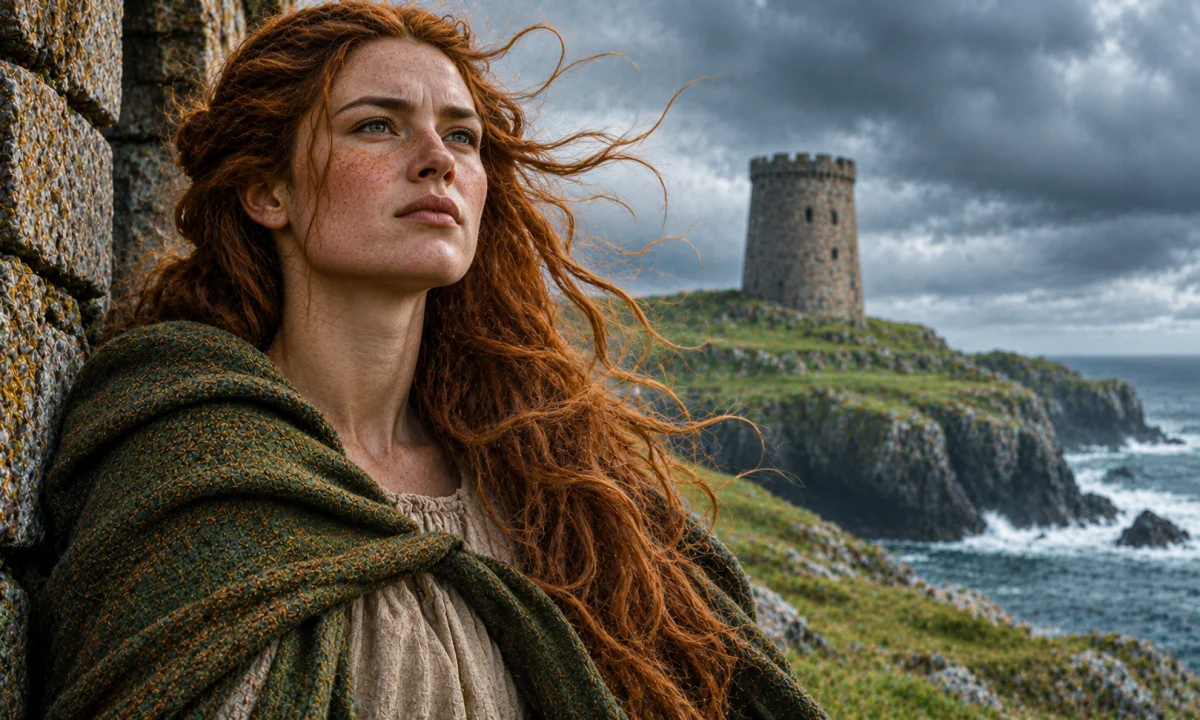
Ethlinn is a figure of Irish mythology best known as the mother of Lugh, one of the greatest heroes and divine figures of the Tuatha Dé Danann. She is usually identified with Ethniu or Eithne, the daughter of Balor, a powerful leader of the Fomorians. In the stories most closely associated with her, Ethlinn is confined in a tower because of a prophecy concerning her future son. Her hidden relationship with Cian leads to the birth of Lugh, whose later deeds fulfil the prophecy and change the balance of power between the Fomorians and the Tuatha Dé Danann.
The name Ethlinn represents one of several spellings used in English-language discussions of Irish tradition. Irish mythological names were transmitted through manuscripts, translations and different systems of spelling, so Ethlinn, Ethniu, Ethne and Eithne may appear in related contexts. These forms should not automatically be treated as separate characters. At the same time, Ethne and Eithne were common personal names, and several women in Irish literature bear similar names. Identification therefore depends on the particular story and source.
Ethlinn in Irish mythological tradition
Ethlinn belongs to the mythological cycle of Irish literature, especially the stories concerned with the Tuatha Dé Danann and their conflict with the Fomorians. The Tuatha Dé Danann are presented in medieval Irish tradition as a supernatural people associated with kingship, skill, knowledge and sovereignty. The Fomorians are their recurring opponents, often portrayed as an older or hostile supernatural power connected with the sea, oppressive rule and bodily deformity, although their character varies considerably between texts.
Ethlinn is not consistently described as an independent goddess with a separate cult or a large body of myths of her own. Her importance comes principally through her family relationships and through the circumstances surrounding Lugh's birth. She is a link between two opposing groups: she is the daughter of the Fomorian Balor, while the father of her child is Cian, a member of the Tuatha Dé Danann in the best-known version of the story. Their son Lugh consequently has ancestry on both sides of the conflict.
This mixed parentage is central to Lugh's mythic role. He is not simply a hero who defeats the Fomorians from outside their world. He is connected to them by blood, yet becomes one of the principal champions of the Tuatha Dé Danann. Ethlinn's story helps explain why Lugh can stand between the two peoples and why the defeat of Balor is also a family tragedy.
Origins and surviving literary traditions
The story of Ethlinn survives in medieval and early modern Irish literary tradition rather than in a single canonical version. Irish mythology was preserved by Christian-era scribes who copied, adapted and combined older materials. The surviving narratives therefore contain different layers of tradition, and details may shift from one text or retelling to another.
Her family connections are particularly important in the Lebor Gabála Érenn, or Book of the Taking of Ireland, and in narratives associated with the Cath Maige Tuired, or Battle of Moytura. The story is also found in later retellings and historical compilations that expand or rearrange episodes. These works are valuable evidence for medieval Irish ideas about the past and about supernatural peoples, but they are not straightforward transcripts of a single pre-Christian myth.
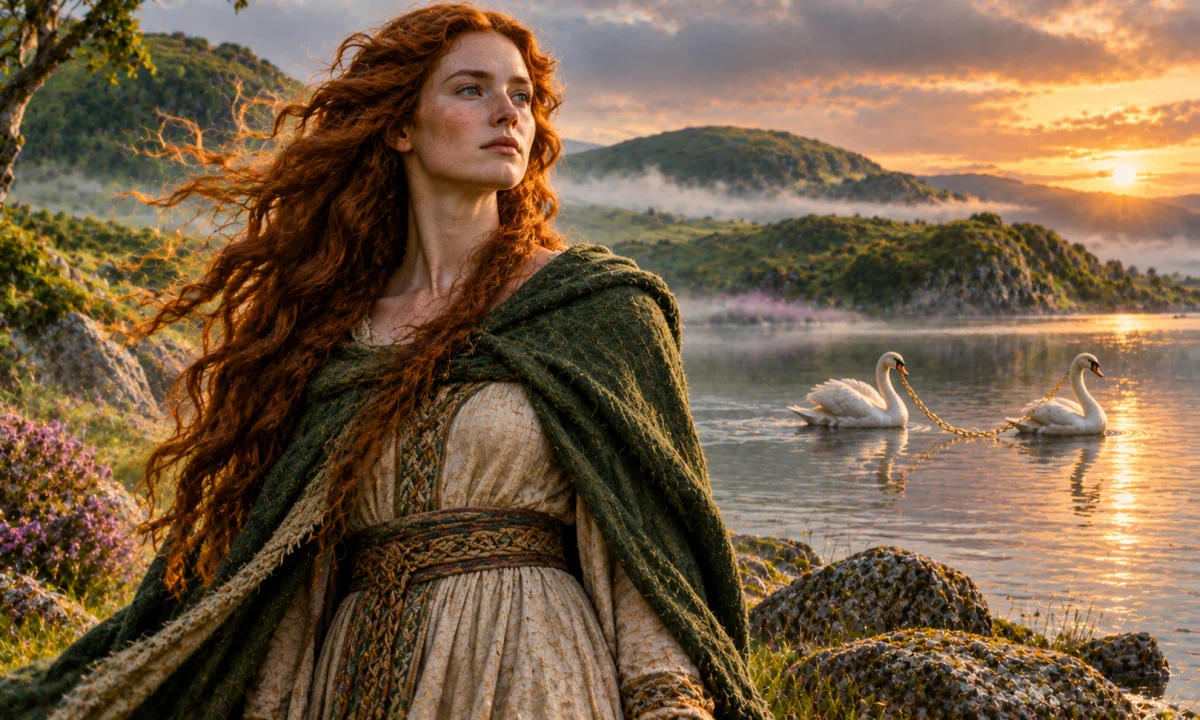
The form of the story most familiar today is especially prominent in later prose accounts. In these, Balor learns from a prophecy that he will be killed by his own grandson. To prevent this, he confines his daughter in a tower on Tory Island, traditionally associated with his power. The prophecy causes Ethlinn's imprisonment before she has an opportunity to form an ordinary family life, and it establishes the pattern of captivity and fate that dominates her story.
The precise details are not uniform. Some accounts describe three children born from Ethlinn's encounter with Cian, while other versions or summaries focus on Lugh alone. The circumstances of the children's abandonment and survival also differ. Such variations are normal in Irish mythological materials and should not be silently combined as though they came from one unchanged narrative.
The name Ethlinn and related forms
Ethlinn is commonly used in English to refer to the daughter of Balor, but it is not the only form of her name. Medieval Irish forms include Ethniu and Ethne, while Eithne is a familiar modern Irish form. Anglicised spellings can reflect different manuscript readings, translation practices or attempts to represent Irish pronunciation in English.
The exact meaning and historical development of the name are not certain enough to support a single confident interpretation. Some explanations connect related forms with words associated with a kernel, grain or seed, but such interpretations are debated and should not be presented as an established definition of Ethlinn's character. The name itself does not prove that she was originally a grain goddess, fertility goddess or agricultural deity.
The similarity between Ethlinn and other names beginning with Eth- or Eith- has also encouraged attempts to find a wider mythological pattern. Some such comparisons may be useful in studying Irish naming traditions, but they do not establish that all figures with similar names are the same person. Ethlinn should be identified specifically as Balor's daughter and Lugh's mother when discussing the story of Lugh's birth.
Balor's prophecy and the tower
Balor is commonly known as Balor of the Evil Eye, a Fomorian ruler whose destructive eye is opened only under controlled circumstances. The eye is said to possess a lethal power, sometimes explained as the result of exposure to a poisonous substance or a magical influence. Balor's supernatural eye is one of the most memorable features of the tale, but it is distinct from the story of Ethlinn's confinement.
According to the best-known account, Balor hears a prophecy that his grandson will kill him. He responds by isolating Ethlinn in a tower and placing her under the supervision of women who are ordered to prevent all contact with men. The purpose is to stop her from conceiving a child. This episode reflects a familiar mythic pattern in which an attempt to evade fate becomes the means by which fate is fulfilled.
Ethlinn's imprisonment is not usually presented as a punishment for anything she has done. She is confined because of her father's fear. The narrative gives her little political control, but her body and descent become the field on which the conflict between Balor and the powers opposing him is decided. This treatment is characteristic of many dynastic myths, in which marriage, sexual access and childbirth carry consequences for kingship and succession.
The tower itself is associated with Tory Island in later tradition. Tory, or Toraigh, lies off the north-west coast of Ireland and has strong associations in folklore with Balor and the Fomorians. The geographical setting gives the story a recognisable place in the Irish landscape, although the literary and folkloric associations developed over time rather than providing direct proof of a single ancient cult centred on Ethlinn.
Cian, Biróg and the birth of Lugh
The man who reaches Ethlinn is generally Cian, a member of the Tuatha Dé Danann. In many versions, Cian is connected with the cow Glas Gaibhnenn, whose extraordinary milk is desired by Balor or by one of his allies. The conflict over the cow provides the motive for Cian's revenge or secret entry into Balor's domain.
A woman known as Biróg assists Cian. She is often described as a female supernatural helper, sometimes characterised as a banfháidh, or woman of prophetic or magical knowledge, depending on the version and translation. With Biróg's aid, Cian gains access to Ethlinn despite the guards and the restrictions placed around her. The encounter results in the birth of Lugh and, in some accounts, two other sons.
The story varies in its treatment of the children. A familiar version says that Balor discovers the births and orders the infants to be thrown into the sea or otherwise disposed of. One child, Lugh, survives or is rescued, while the others perish or disappear from the narrative. The exact number of children and the manner of Lugh's survival are not identical in every telling.
In some retellings, Lugh is brought up by foster parents or by figures associated with the Tuatha Dé Danann. This removes him from Ethlinn's immediate household and means that she does not become a continuing character in his adventures. The separation is narratively important: Lugh grows up away from Balor's control and develops the exceptional abilities that later make him a champion of the Tuatha Dé Danann.
Lugh and the fulfilment of the prophecy
Lugh is described as a figure of extraordinary versatility. He is associated with kingship, craftsmanship, warfare, poetry, law and many other skills. At the court of Nuada, he gains entry by demonstrating that he possesses abilities for which the Tuatha Dé Danann have separate specialists. His epithet Lámhfhada, usually translated as “Long-Arm” or “Long-Hand,” reflects his prowess and reach, although the exact significance of his epithets varies by context.
During the Second Battle of Moytura, Lugh leads the Tuatha Dé Danann against the Fomorians. Balor appears as a major opponent and opens his deadly eye. Lugh ultimately defeats him by striking or using a projectile to force the destructive eye around so that its power harms the Fomorian host. In this way, the prophecy is fulfilled: Balor is killed by his grandson.
The story does not always give Ethlinn a direct role in the battle. Her importance lies in the genealogy that makes the confrontation possible. Through her, Balor's attempt to eliminate the threat produces the very grandson he fears. Through Lugh, Ethlinn is connected to the rise of a hero who becomes one of the central figures of Irish mythological tradition.
This family structure also gives the conflict a tragic dimension. The battle is not merely a contest between unrelated peoples. Lugh's victory is achieved against his maternal grandfather, and Balor's death fulfils a prediction created by his own treatment of his daughter. The story combines political conflict, family violence and the inescapability of fate.
Character, symbolism and interpretation
Ethlinn is often overshadowed by Balor and Lugh, but her position in the story has several meanings. She is the hidden mother of a culture hero, the daughter of an enemy king and the bearer of a lineage that cannot be controlled by imprisonment. Her confinement makes her a symbol of suppressed succession: Balor tries to prevent the birth of a rival heir, yet his own family produces the agent of his downfall.
Her story can also be read as a myth about the limits of patriarchal power. Balor controls Ethlinn's movement, guards her body and attempts to determine the future of her descendants. Nevertheless, his control fails. The narrative does not portray Ethlinn as a warrior or political ruler, but it makes her reproductive lineage more powerful than the authority imposed upon her.
At the same time, modern interpretations should avoid turning this limited literary role into evidence for a fully developed ancient goddess cult. There is no secure evidence that Ethlinn was worshipped independently in pre-Christian Ireland, nor that she possessed a clearly defined sphere such as fertility, the sea or sovereignty. Such associations may be proposed as interpretations, but they remain speculative unless supported by stronger historical evidence.
Her relationship with Cian is also shaped by the needs of the myth. It is not a long-developed romance in the surviving narratives. The encounter is brief, secretive and driven by prophecy, revenge and supernatural assistance. Presenting Ethlinn and Cian as a conventional heroic couple can therefore obscure the stark circumstances under which Lugh is conceived and separated from his mother.
Distinguishing Ethlinn from other Eithnes and Ethnes
Irish literature contains multiple figures called Ethne, Eithne or related forms. The name is not exclusive to Balor's daughter. In different traditions, women with similar names may belong to entirely separate genealogies and stories. A famous example is Ethne, or Eithne, connected with the life of Saint Patrick in Christian tradition; she should not be confused with the mother of Lugh.
Some mythological genealogies also use similar names for women linked to gods, kings or supernatural peoples. Spellings may make two distinct figures look identical in English, while a change in manuscript tradition may make one figure appear under more than one form. The identifying details—daughter of Balor, partner of Cian and mother of Lugh—are more reliable than the spelling alone.
Ethlinn should likewise not be merged with Balor's wife, with Lugh's later partners or with other female figures associated with the Tuatha Dé Danann. Irish mythology contains overlapping genealogies, variant traditions and repeated names, but resemblance of name does not establish identity.
Later reception
Ethlinn has received less attention in modern popular culture than Lugh, Balor or other figures such as the Morrígan and Brigid. When she appears in modern fiction, games, fantasy literature or neo-pagan writing, authors may expand her personality, give her magical powers or portray her as a goddess of motherhood, fate or sovereignty. These developments may be meaningful as creative or religious reinterpretations, but they are not all features of the medieval Irish sources.
Modern retellings also commonly standardise the story by choosing one spelling, one number of children and one account of Lugh's rescue. That can make the legend easier to follow, but it may conceal the variation in the underlying tradition. A careful presentation therefore uses Ethlinn for the figure in the Balor and Lugh genealogy while acknowledging the related forms Ethniu, Ethne and Eithne, and distinguishes inherited mythic material from later imaginative additions.