WORLD

Emain Ablach
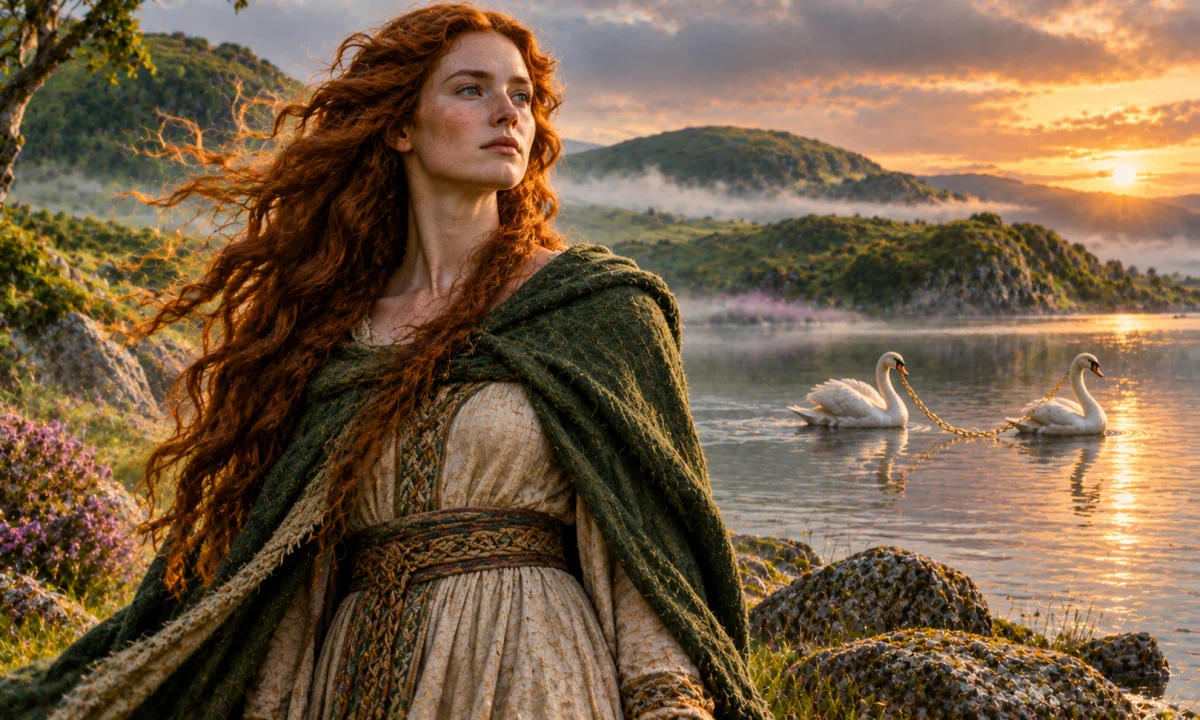
Emain Ablach is an otherworldly place in Irish mythology, usually imagined as an island or paradisal realm associated with Manannán mac Lir, the sea-god and powerful figure of the Tuatha Dé Danann. Its name is commonly understood as “Emain of the apple trees” or “Emain of the apples,” although the exact meaning and history of the name remain uncertain. Emain Ablach is not primarily a person, deity or monster: it is a supernatural landscape, presented in medieval Irish literature as a place of beauty, abundance, music, healing and marvellous encounters.
The island belongs to the imaginative geography of the Irish Otherworld. In Irish tradition, the Otherworld is not always a single, clearly bounded kingdom. It may appear as a distant island, a hidden mound, a magical shore, a palace beneath the earth or a realm reached through mist and enchantment. Emain Ablach is one of the names used for such a realm, especially in material connected with Manannán and with journeys across the sea.
Name and identity
The spelling Emain Ablach reflects medieval Irish forms, but manuscripts and modern editions may show variations in spelling. The first element, Emain, is also found in Emain Macha, the famous royal site of Ulster associated with the Ulster Cycle. The two names should not be confused. Emain Macha is a specific place in the human and legendary landscape of Ulster, whereas Emain Ablach is generally an otherworldly location.
The second element is often connected with uball, an apple, and is therefore interpreted as referring to apples or apple trees. English translations may render the name as “Apple Emain,” “Emain of Apples” or “the Isle of Apples.” These translations communicate an important association, but they should not be treated as proof that the name originally referred to a single, universally defined island. Medieval Irish place-names and supernatural geographies often have overlapping meanings, and the surviving texts do not provide one complete description of Emain Ablach.
Some scholars and writers have connected the name with Emain as a word for a ridge, elevated place or notable settlement, while others focus on the apple imagery. The etymology is therefore best presented with caution. The association with apples is strong in literary tradition, but the precise linguistic development of the name is not entirely settled.
Sources and literary setting
Knowledge of Emain Ablach comes from medieval Irish literature rather than from a single surviving myth devoted exclusively to the island. Irish scribes recorded and reshaped older oral traditions over many centuries, and the texts that preserve them combine pre-Christian themes with Christian literary frameworks. As a result, Emain Ablach should not be treated as a direct transcript of an ancient pagan religious system.
One of the most important contexts is the tale usually known in English as The Voyage of Bran, or Immram Brain maic Febail. In this story, Bran mac Febail receives a mysterious silver branch bearing blossoms. Its music draws him toward a supernatural journey by sea. The branch and the voyage belong to a world of magical islands, beautiful inhabitants, and timeless or distorted experiences of reality. Manannán appears as a guide and prophetic figure, and the narrative presents the western sea as a route toward realms beyond ordinary human experience.
Emain Ablach is also associated with traditions concerning Manannán in other medieval texts and poems. These references are not always consistent. In some passages, the name seems to identify Manannán’s own realm or residence; in others, it functions as one name among several for a paradisal place reached across the sea. The island’s significance is therefore cumulative: it emerges from a group of related descriptions rather than from one fixed mythological profile.
Medieval Irish literature frequently gives several names to supernatural territories. A magical island may be identified with a particular ruler, a special tree, a group of inhabitants or a distinctive quality such as youth or abundance. This fluidity makes it difficult to draw a precise map of the Otherworld. Emain Ablach is better understood as a literary and mythological image than as a location with consistently defined borders.
Relationship with Manannán mac Lir
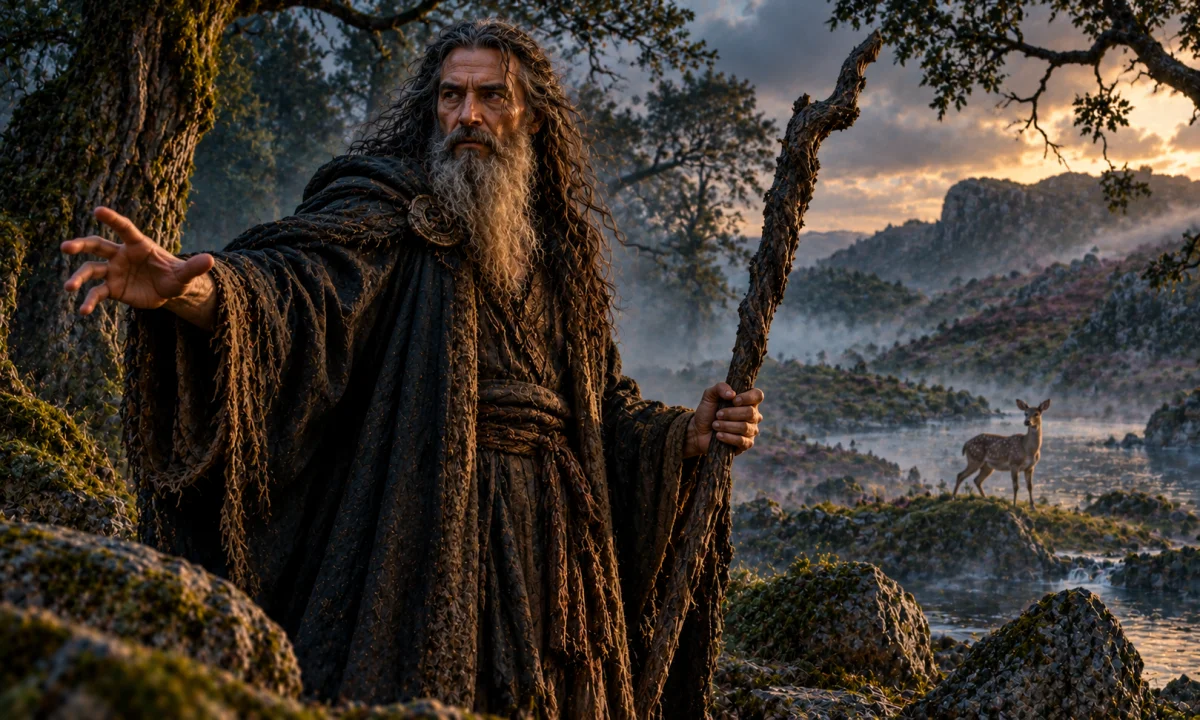
Manannán mac Lir is the figure most closely connected with Emain Ablach. He is associated with the sea, seafaring, prophecy, enchantment, sovereignty and the hidden world. In later Irish tradition he is counted among the Tuatha Dé Danann, the supernatural people who retreat from the visible world after the arrival of the ancestors of the modern Irish. Manannán is not simply a sea god in the narrow sense. He is also a ruler, magician, guide and guardian of boundaries between worlds.
Emain Ablach suits this role because an island lies between land and sea, and because the sea frequently serves as a passage into the Irish Otherworld. Manannán’s presence gives the island political and supernatural importance. It may be imagined as his domain, his dwelling place or a realm under his protection, although the texts do not always define the relationship in exactly the same way.
In several traditions, Manannán possesses extraordinary objects that assist travel or confer supernatural advantages. These include boats, cloaks, weapons, horses or magical devices, depending on the tale and its textual form. Such objects are part of his broader role as a mediator between human heroes and the Otherworld. They should not automatically be assigned specifically to Emain Ablach unless a particular version makes that connection.
The island’s landscape and qualities
Descriptions associated with Emain Ablach emphasize beauty, abundance and altered time. The island belongs to a class of Irish otherworldly places where ordinary suffering is absent or transformed. Trees may bear fruit continuously, music may arise without visible musicians, and inhabitants may remain eternally young. The setting is attractive, but it is not merely a pleasant garden. It is also a place governed by laws that humans do not fully understand.
Apples and apple trees are especially important symbols. In Irish and wider European traditions, the apple can suggest fertility, health, knowledge, immortality and the boundary between the ordinary and supernatural worlds. In Emain Ablach, the apple branch or apple tree evokes a source of life and wonder rather than a simple agricultural feature. The tree’s fruit belongs to an environment where natural processes have become magical.
Music is another recurring quality of the realm. Supernatural music in Irish literature often has an irresistible or transformative power. It can draw a person away from familiar society, reveal hidden desire or initiate a journey. The silver branch in The Voyage of Bran is a particularly important example of an enchanted object linked to the Otherworld. Its music makes the boundaries between the human world and the supernatural world permeable.
The island may also be connected with healing and restoration. Many Irish otherworlds contain a source of health, youthful vitality or freedom from disease. This does not mean that Emain Ablach is always described as a medical paradise in every text. Rather, healing belongs to the broader cluster of meanings surrounding Manannán’s realm and the apple-bearing Otherworld.
Time, travel and the danger of return
Journeys to supernatural islands in Irish literature often involve a different experience of time. A visitor may believe that only a short period has passed, while many years have elapsed in the human world. Alternatively, an individual may return from the Otherworld and discover that ordinary earthly life has become inaccessible.
This pattern appears in several Irish voyage and adventure tales, though not every version assigns the same events to Emain Ablach. The underlying idea is that the Otherworld is not simply far away. It operates according to a different order of reality. Distance across the sea represents a change in existence, not merely a long physical journey.
Such stories also warn that contact with the Otherworld has consequences. An invitation from a supernatural woman, a magical object or a distant island may promise pleasure and knowledge, but accepting it can separate a hero from family, community and human time. The Otherworld is desirable precisely because it is not ordinary, and that difference can make return difficult or impossible.
Emain Ablach and other Irish otherworlds
Irish mythology contains many named supernatural places, including islands, plains, palaces and lands beneath hills. These locations should not automatically be treated as interchangeable. Tír na nÓg, for example, is the “Land of the Young,” a name strongly associated with eternal youth in later Irish tradition. Mag Mell, often translated as “Plain of Delight,” is another name connected with a blessed or pleasurable otherworldly realm. Tech Duinn is associated with the house or dwelling of Donn and has a different function and character.
In practice, these names can overlap in medieval and later storytelling. A poet may use one name for a supernatural realm in one context and another name in a different context. This does not mean that every named otherworld is the same place. It means that Irish mythological geography is flexible and shaped by genre, local tradition and the needs of individual narratives.
Emain Ablach should also be distinguished from Avalon, the island associated with King Arthur in later British and European literature. Both places can be linked with islands, healing, magical fruit and an Otherworld-like atmosphere, and modern writers often compare them. However, Emain Ablach is an Irish name from Irish literary tradition, while Avalon belongs primarily to the Arthurian tradition. The two are comparable as supernatural island motifs, but they are not identical figures or locations.
Emain Ablach and the apple-island motif
The apple island is a widespread mythological and literary motif. Islands bearing miraculous fruit appear in several cultural traditions, and the apple has acquired additional meanings through later religious and artistic interpretation. Similar imagery does not by itself demonstrate direct borrowing between traditions.
In the Irish context, the apple-bearing tree is part of a broader pattern involving supernatural gifts, poetic inspiration, youth and passage into the Otherworld. The branch carried by Bran is not merely a botanical token. It is an invitation and a sign of contact. Its beauty and music reveal that the visitor is being called beyond normal human boundaries.
The prominence of apples has encouraged comparisons with the Greek Hesperides, whose garden contains golden apples guarded by supernatural beings. The resemblance is thematic rather than proof of a shared story. Irish texts developed within their own linguistic, religious and literary environment, and Emain Ablach should be interpreted first through Irish sources and Irish concepts of the Otherworld.
Religious and cultural significance
Emain Ablach reflects a worldview in which the natural landscape can contain entrances to sacred or supernatural realities. The sea is not an empty barrier. It is a living boundary, inhabited or controlled by powers that can carry people toward wisdom, danger, transformation or loss. Islands at the western edge of the known world naturally became suitable settings for stories about the unknown.
The island also expresses a tension between desire and belonging. Its eternal youth, abundance and beauty make it more attractive than the human world, which is marked by ageing, death, conflict and limitation. Yet the human world is also the place of family, duty, memory and social identity. A hero who enters Emain Ablach or a comparable realm may gain wonder but risk losing his place among ordinary people.
From a historical perspective, there is no secure evidence that Emain Ablach was the name of a single island worshipped in a standardized pre-Christian cult. The surviving evidence is literary and medieval, and the Christian scribes who preserved it may have reorganized older material. It is therefore more accurate to describe Emain Ablach as a mythological and literary otherworldly place than as a confirmed archaeological or historical location.
Emain Ablach in modern interpretation
Modern writers, artists and spiritual movements sometimes present Emain Ablach as an exact equivalent of Avalon, a distinct “Celtic paradise” or a fixed location in a reconstructed pagan cosmology. These interpretations can be imaginative and meaningful, but they go beyond what the medieval Irish material securely establishes.
Contemporary fantasy may also portray Emain Ablach as a bright island ruled by Manannán, a source of immortal fruit or a gateway between worlds. Such portrayals draw on genuine traditional elements, including the association with apples, the sea, magical music and Manannán. They remain adaptations rather than straightforward descriptions of a single canonical myth.
In traditional Irish literary context, Emain Ablach is best understood as a shifting name for an enchanted realm connected with Manannán and the western Otherworld: a place of apple trees, supernatural beauty, music, youth and perilous distance from human life. Its power lies less in a detailed map or fixed cast of inhabitants than in the threshold it represents between the mortal world and the realms beyond it.