WORLD

Domiel
Domiel is an obscure angelic name found in some later Jewish and Christian angelological catalogues. Unlike Michael, Gabriel, Raphael or Uriel, Domiel has no substantial narrative role in the Bible and is not the subject of a widely established independent cult or devotional tradition. The surviving references are brief, and the name appears in sources and compilations whose contents, dates and spellings vary. As a result, claims about Domiel’s rank, appearance or powers should be treated cautiously.
Origins and religious setting
Domiel belongs to the broad tradition of naming and classifying angels that developed around biblical religion. Jewish, Christian and later esoteric writers often attempted to organize the heavenly world into hierarchies, celestial realms, palaces, planetary spheres, days, hours or other ordered divisions. Many angelic names entered these systems through visionary literature, mystical speculation, magical manuals and medieval or early modern compilations rather than through canonical scripture.
The name is particularly associated in modern reference works with traditions concerning the heavens, especially the fourth heaven. This association is usually connected with later presentations of Jewish mystical or angelological material, including works linked—sometimes rather loosely—with the Sefer Raziel or Book of Raziel. The Sefer Raziel Ha-Malakh is a medieval Jewish esoteric compilation traditionally attributed to the angel Raziel, although its actual formation involved several layers of material and cannot be reduced to a single ancient revelation. Angel names appearing in texts associated with this tradition do not necessarily have the same status as names found in the Hebrew Bible or in early rabbinic literature.
Domiel should therefore be understood as a name preserved in secondary and esoteric angelology, not as a major figure with a continuous, universally recognized religious tradition. The available evidence does not provide a single authoritative account of Domiel’s identity.
The name Domiel
The meaning and linguistic origin of Domiel are uncertain. The ending -el is common in angelic names and derives from El, a Hebrew name or title for God. In names such as Michael, Gabriel and Raphael, this element forms part of a recognizable Hebrew construction. Domiel, however, is not sufficiently well documented to support a secure translation of its complete name.
Some attempts to interpret the name connect it with ideas such as judgment, dominion or divine authority, but these explanations are not firmly established by a clear Hebrew etymology. A resemblance to words associated with ruling or judgment may have encouraged later symbolic interpretations, yet resemblance alone does not prove the original meaning of the name.
Spelling is also a significant problem. Angelological catalogues frequently transmit names through Hebrew, Aramaic, Greek, Latin and later European languages. Transliteration can alter vowels and consonants, and scribal copying can produce new forms. Domiel may consequently appear in some lists with variant spellings, although each variation cannot automatically be treated as the same being.
Domiel and the heavenly realms
The most persistent description attached to Domiel is that of an angel connected with the fourth heaven. This claim occurs in modern discussions of angelic hierarchies and is often attributed to material associated with the Book of Raziel or related occult compilations. The exact wording, status and context of the attribution are not consistent across editions and summaries.
In Jewish and Christian cosmological writing, “heaven” could mean several different things. It might refer to the visible sky, the dwelling place of God, a level in a multi-layered universe, or a mystical realm encountered in visionary ascent. The number and arrangement of the heavens differed among authors. Some traditions spoke of seven heavens, while other texts used different numbers or described heavenly palaces rather than a fixed vertical structure.
For that reason, identifying Domiel as an “angel of the fourth heaven” does not necessarily mean that all traditions place Domiel in the same location. It may indicate that the name was assigned to a particular level in one classification system. In another system, the fourth heaven could have a different ruler, inhabitants or symbolic meaning.
There is no reliable early narrative describing Domiel governing this realm, fighting a particular enemy, delivering a prophecy or interacting with a named human. The title is best treated as a catalogue classification rather than evidence of a developed mythological story.
Attributes and functions
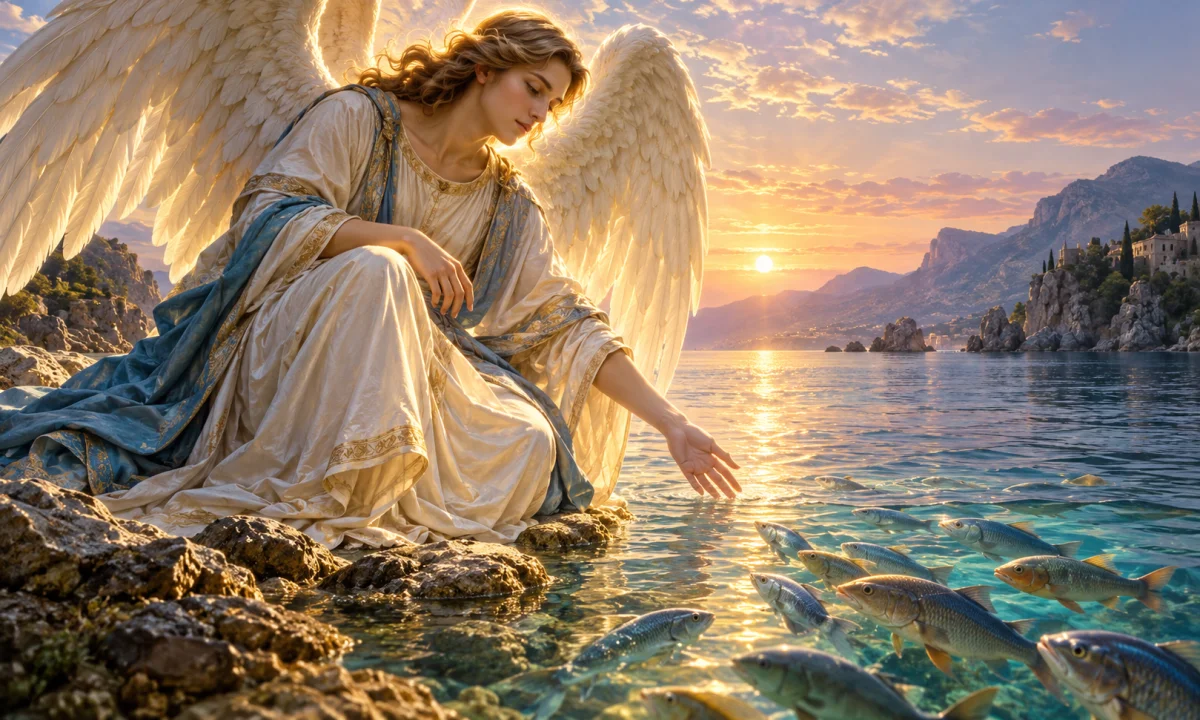
Traditional sources do not provide a stable physical appearance for Domiel. Descriptions sometimes found in modern angel books or online lists—such as wings of a particular color, a distinctive garment, a sword, a halo or a special gemstone—should not be assumed to belong to an old Domiel tradition unless they can be traced to a specific historical text. The surviving references do not establish a standard iconography.
Likewise, Domiel has no securely documented set of powers comparable to the functions traditionally associated with better-known angels. Michael is commonly portrayed as a protector and warrior, Gabriel as a messenger, Raphael as a healer, and Uriel as a revealer or bearer of wisdom in certain traditions. Domiel is not assigned an equally consistent role across Jewish, Christian or Islamic religious practice.
Where Domiel is linked with the fourth heaven, the name may symbolize participation in the ordering and administration of the celestial world. Such a role is compatible with the broader idea that angels serve as guardians, rulers, messengers or attendants within the divine cosmos. It does not, however, demonstrate that Domiel was specifically the angel of justice, dreams, death, weather, a planet or a particular day. Those associations are sometimes attached to obscure angelic names in later occult literature without a strong ancient basis.
Sources and transmission
References to Domiel need to be separated from the major scriptural and mystical traditions that are often grouped together under the general heading of “angelology.” The Hebrew Bible contains a relatively small number of named angels. Later Jewish literature greatly expands the angelic world, but it does so through several different genres, including apocalyptic visions, rabbinic commentary, mystical ascent texts, protective formulas and magical writings.
Texts concerned with heavenly palaces and ascents often describe angels who guard gates, supervise celestial regions or praise God. Names in these works can be difficult to interpret because manuscripts differ and because the same name may be transliterated in multiple ways. A name that appears in a later catalogue may also have been detached from its original context and reassigned to a different heaven or function.
The Sefer Raziel tradition is especially important in this regard. It combines materials concerning cosmology, divine names, astrology, angelic beings, letter mysticism and ritual knowledge. Its reputation in later European occultism helped circulate many angelic names beyond their original Jewish contexts. However, a name’s appearance in a work associated with Raziel does not automatically make it part of ancient Jewish belief, nor does it establish a single accepted interpretation.
Early modern occult writers and compilers also reorganized angelic names into tables. They might assign angels to hours, days, planets, directions, elements or levels of heaven. These systems were often influenced by older Jewish, Christian, Hermetic and astrological traditions, but they were not identical to them. Domiel’s presence in one such list may reflect the purpose of that particular system rather than a broadly shared tradition.
Domiel in relation to similar names
Domiel is sometimes confused with names such as Dumiel, Dumael or Dumah. The resemblance may result from copying, transliteration or later attempts to reconcile variant spellings, but the names should not be merged without evidence.
Dumah, in Jewish tradition, is associated in different contexts with silence and with the realm or condition of the dead. The name is also connected with a figure of judgment or the guardian of the dead in later interpretations. These traditions do not establish that Dumah and Domiel are the same angel.
Dumiel or Dumael-like forms occur in some Jewish mystical and apocalyptic materials, including traditions concerning heavenly palaces or angelic guardians. Because manuscripts and translations vary, an apparent resemblance to Domiel may be significant in one textual study and accidental in another. A modern list that treats Domiel, Dumiel and Dumael as interchangeable is making an interpretive decision, not reporting an uncontested fact.
Domiel should also be distinguished from Raziel, the angel traditionally associated with divine secrets and the transmission of heavenly knowledge. The connection between Domiel and Raziel is primarily a matter of the texts or catalogues in which their names may appear, not evidence that Domiel is an aspect, servant or alternate name of Raziel.
Religious and symbolic significance
The importance of a figure such as Domiel lies less in a body of stories than in the way angelic catalogues express a particular vision of the universe. Naming an angel can make an invisible order seem structured and intelligible. A heavenly realm becomes populated, governed and morally meaningful rather than remaining an undefined expanse beyond the human world.
The assignment of angels to levels of heaven also reflects a desire to connect earthly religious practice with a cosmic hierarchy. In mystical and magical settings, knowledge of angelic names could be regarded as a form of access to hidden wisdom. In more devotional settings, angels represented the nearness of divine action, even when an individual angel had no widely practiced cult.
Domiel’s obscurity is itself informative. Not every angelic name preserved in religious or esoteric literature developed into a major object of worship, storytelling or art. Some names remained limited to a manuscript, a catalogue or a later compilation. Their survival shows how expansive and fluid angelology could be, but it does not justify assigning them a complete mythology.
Later occult and popular usage
From the early modern period onward, angelic names were increasingly collected in encyclopaedias, magical manuals and occult reference works. Such publications often presented brief entries with a name, rank and supposed function. Later authors and websites sometimes repeated these details without identifying the original text, gradually giving uncertain claims the appearance of established tradition.
Domiel occasionally appears in contemporary lists of angels, especially those concerned with the hierarchy of heavens or with ceremonial and esoteric correspondences. These modern presentations may add attributes such as a color, seal, planetary association or area of spiritual influence. Unless such features are tied to a specific historical system, they belong to modern occult interpretation, not to a consistently attested ancient tradition.
Domiel has not achieved the broad presence in novels, films, games or comics enjoyed by angels such as Michael, Lucifer, Gabriel or Azrael. When the name is used in modern fantasy or occult fiction, its portrayal is normally an independent creative invention. A fictional Domiel may be a ruler, warrior, judge or guardian, but those roles should not be projected backward onto the limited religious evidence.
What can be said with confidence
Domiel is best described as a little-known angelic name preserved in later angelological and esoteric traditions, particularly in classifications associating the name with the fourth heaven. The name’s exact origin, meaning, rank and function remain uncertain, and no single canonical biography or universally accepted image exists.
The most responsible approach is therefore to distinguish the attested catalogue association from later elaboration. Domiel may represent the broader religious idea of an ordered heavenly administration, but claims about specific powers, symbols, relationships or stories require a source-by-source examination. Similar names such as Dumiel, Dumael and Dumah should remain separate unless textual evidence demonstrates that a particular tradition intentionally identifies them.