WORLD

Clementia
Clementia was the Roman personification of mercy, gentleness and the deliberate restraint of punishment. She belonged to the religious and political world of ancient Rome, where abstract qualities could be treated as divine powers and invoked in public ceremonies, inscriptions and official imagery. Clementia was especially associated with the mercy shown by a victorious ruler or magistrate toward defeated enemies, making her both a religious figure and a powerful language of Roman politics.
Meaning and Roman setting
The Latin word clementia means clemency, mildness or mercy. It could describe a personal virtue, particularly the willingness of someone in authority to spare a person who had been defeated or condemned. In Roman society, however, such qualities were not merely private emotions. They could be understood as forces that supported the stability of the state and as divine qualities worthy of honour.
Romans often personified virtues and political ideals. Fides represented trust and good faith, Pietas expressed dutiful respect toward gods, family and country, and Concordia embodied harmony. Clementia belonged to the same broad religious pattern, although her evidence is less extensive than that of some better-known Roman goddesses. She was not a major goddess with a large cycle of myths, a clearly established genealogy or a widely recorded set of festivals. Her importance lay chiefly in the meaning attached to her name and in her use within the language of power.
Roman ideas of mercy were shaped by a strongly hierarchical society. A general, governor or emperor possessed the legal and military power to punish. If such a person chose to spare an enemy, the act could be presented as a sign of strength rather than weakness. Clementia therefore implied controlled generosity from a superior toward an inferior. It was not necessarily an idea of equality or universal compassion in the modern sense.
Clementia and Julius Caesar
Clementia became particularly prominent during the career of Julius Caesar. During the civil wars of the first century BCE, Caesar repeatedly presented himself as merciful toward Roman opponents who surrendered or were defeated. Ancient writers discuss his policy of pardoning enemies, though they also preserve criticism of the political motives behind it and record cases in which violence continued. The image of Caesar as a ruler who could forgive was nevertheless important to his public identity.
Caesar's policy is often described by the Latin phrase clementia Caesaris, meaning “Caesar's clemency.” This was not simply a theological title. It was a political claim: Caesar portrayed himself as a victor who did not need to destroy every rival. Mercy could help him reconcile former enemies, reduce resistance and distinguish his rule from the cruelty associated with civil war.
Ancient evidence connects a proposed or decreed temple with Clementia Caesaris in the final period of Caesar's life. The precise circumstances are not entirely straightforward, and the project should not be treated as evidence for a fully developed independent cult with a rich mythology. Reports indicate that a temple or shrine honouring Clementia in association with Caesar was planned after his clemency had become a major element of his public image. Some ancient accounts describe a symbolic relationship between Caesar and the personified virtue, including imagery of Caesar and Clementia joining hands. Whether every detail belonged to an established monument, a proposal or a political representation remains subject to interpretation.
The association was also potentially controversial. Caesar's opponents could view his mercy as calculated self-presentation, while his supporters could describe it as a noble Roman virtue. In either case, Clementia gave a religious and moral vocabulary to a contemporary political programme. She helped transform a ruler's individual decisions into a quality that could be represented as beneficial to the Roman community.
Sources and surviving evidence
Knowledge of Clementia comes from several kinds of evidence rather than from one central sacred text. Roman literature uses the word as a moral and political concept; historical narratives discuss Caesar's clemency; coins and inscriptions provide evidence for public representation; and later imperial writers develop the idea in philosophical and political terms.
There is no surviving Roman myth in which Clementia acts as a protagonist alongside Jupiter, Juno or Venus. Nor is there a complete ancient account of her birth, family or adventures. Her character must therefore be reconstructed from scattered references. This is typical of Roman personifications. A quality might be honoured as divine without receiving the extensive mythological narratives associated with more anthropomorphic gods.
Coins are especially important because Roman coinage could communicate political ideals across the empire. Issues connected with Caesar and later rulers used names or images associated with clemency. A female figure labelled CLEMENTIA may appear seated and holding conventional symbols of authority or peace, although the details vary between coin types and interpretations. Such images should not automatically be treated as portraits of a goddess with a fixed visual form. Roman coin designers frequently adapted personifications to the message of a particular issue.
Inscriptions also show that Clementia could be treated as a divine or quasi-divine power. The evidence is uneven, and references do not prove that she had the same level of independent worship as long-established Roman deities. Her presence is most secure in official and ideological contexts, especially those connected with rulers, victory and the management of political conflict.
Appearance and symbols
Clementia had no universally fixed appearance recorded in Roman tradition. When represented in art or on coins, she was generally given the form of a dignified woman, following the usual visual language for female virtues and goddesses. Her identity often depended on an inscription rather than on a unique physical feature.
Possible attributes associated with her include a sceptre, a branch and gestures of reconciliation. A sceptre could indicate authority: Clementia was not helpless softness but mercy exercised by someone who possessed the right to punish. A branch could suggest peace or the end of conflict, although its exact meaning depends on the individual representation. The important visual idea was controlled power, not simple vulnerability.
Her imagery could also be connected with the seated posture commonly used for personifications on Roman coins. A seated female figure might signify a stable and authoritative quality rather than a wandering or heroic character. Where Clementia appears beside a ruler, the image could imply that the ruler's mercy was an enduring principle of government.
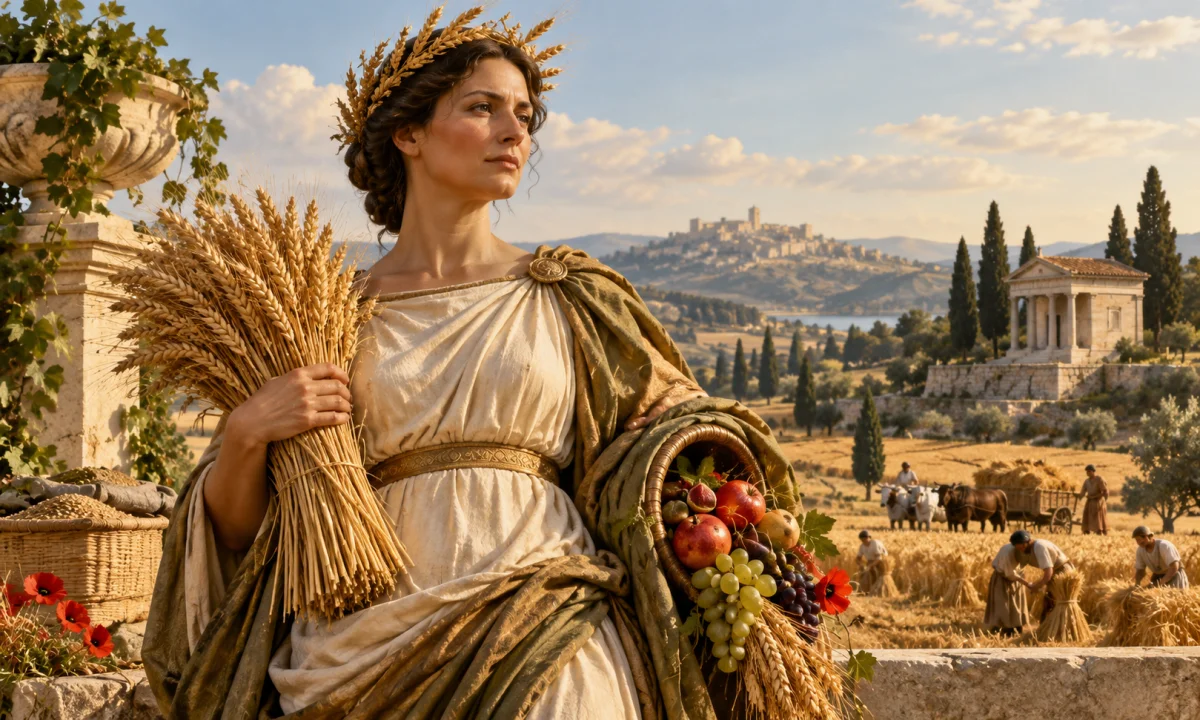
Modern illustrations sometimes give Clementia a distinctive costume, halo or collection of symbols. These reconstructions may be artistically effective, but they should not be mistaken for details securely established by ancient evidence. Unlike Minerva's owl or Mercury's winged equipment, Clementia does not possess a universally recognized set of attributes preserved throughout Roman art.
Clementia under the Roman emperors
After Caesar's death, clemency remained a valuable theme in Roman imperial ideology. Emperors held supreme military and judicial authority, so their decisions to pardon, reduce sentences or accept the surrender of opponents could be presented as signs of civilized rule. Clementia was therefore useful in imperial propaganda, especially after periods of civil war or political violence.
The emperor Augustus and later rulers could claim that they restored peace by combining victory with moderation. This did not mean that imperial government was consistently merciful. Roman emperors also ordered executions, confiscations, exile and collective punishment. The language of Clementia existed alongside severe coercion. Its function was often to show that punishment was selective and controlled rather than arbitrary.
In imperial political thought, clemency could distinguish legitimate authority from tyranny. A good ruler punished when necessary but did not act from uncontrolled anger. A tyrant, by contrast, was imagined as cruel, vindictive or eager to destroy enemies. This contrast appears in Roman moral writing and became particularly influential in discussions of monarchy.
The philosopher Seneca explored the subject in his treatise De Clementia, written for the emperor Nero during the early years of his reign. Seneca presents clemency as a central virtue of the ruler. He argues that mercy should not be confused with softness or indiscriminate pity. The wise ruler should understand when punishment is necessary, but should prefer correction, restraint and the preservation of the state when possible.
Seneca's work is philosophical rather than a myth about the goddess Clementia. It shows, however, how deeply the concept had entered Roman thinking about government. Clementia could be treated as a moral discipline for a ruler, a public image used by an emperor and a quality that writers compared with anger, cruelty and justice.
Mercy, justice and related Roman concepts
Clementia is sometimes translated simply as “mercy,” but several related Roman ideas should be kept distinct.
- Misericordia referred more directly to pity or compassion for someone suffering. Clementia was more strongly associated with the restraint of a person who possessed authority over another.
- Indulgentia could mean indulgence, favour or gracious concession. It became a prominent term in imperial language, but it was not identical to Clementia.
- Aequitas concerned fairness, equity and the proper balancing of claims. A ruler might act with both equity and clemency, but the two virtues described different aspects of conduct.
- Iustitia, or justice, involved the right ordering of law and punishment. Clementia could moderate justice, but Roman writers did not necessarily regard mercy as a replacement for legal judgment.
- Pax represented peace. Clementia might help produce peace after conflict, yet peace described the resulting condition more than the personal act of sparing an enemy.
- Venia could mean pardon or permission. It described an act of forgiveness or exemption, whereas Clementia suggested the broader virtue or disposition behind such acts.
Greek Eleos, meaning pity or mercy, offers a useful comparison, but it should not be treated as simply the Greek name for Clementia. Roman religious concepts often overlapped with Greek ideas, especially in the literary and artistic worlds, yet their histories and political uses were not identical. Clementia developed within Roman discussions of authority, civil conflict and the behaviour expected from magistrates and emperors.
Was Clementia a goddess or an idea?
The distinction between “goddess” and “personified concept” can be misleading when applied too rigidly to Roman religion. Romans could invoke an abstract quality as divine, represent it in human form and honour it publicly without giving it a large mythology or an independent cult network. Clementia occupied this intermediate space.
Calling her a Roman goddess is reasonable when referring to the personified divine power named Clementia, especially in connection with temples, images or inscriptions. It is equally important to explain that she was not a goddess of the same type as Juno or Diana. The surviving evidence presents her chiefly as a virtue made visible and sacred. Her identity was closely tied to the social role of the person who exercised clemency.
Her religious significance was therefore relational. Clementia appeared where there was a victor and a defeated person, a ruler and a subject, or a judge with the power to punish. She represented the choice to limit violence or punishment. That dependence on political circumstances helps explain why she became especially meaningful during the transition from Republic to Empire.
Political symbolism and criticism
Clementia could carry a humane message, but it also served the interests of rulers. Publicly advertised mercy was a way to shape memory after civil war. A victorious leader could present himself as generous while retaining complete control over the lives of former opponents. The person spared by a ruler might be grateful, politically obligated or simply reminded of the ruler's power.
This ambiguity was recognized in antiquity. Some writers admired clemency as a mark of civilized leadership, while others questioned whether a ruler's mercy was genuine or theatrical. An act could be morally praised and politically useful at the same time. Clementia was not necessarily propaganda in every context, but its connection with official authority made political interpretation unavoidable.
The concept also reveals a limitation in Roman ideals of mercy. Clementia generally flowed downward from the powerful. It did not challenge slavery, social rank or the authority of the state. A Roman leader could be praised for sparing a defeated aristocrat while continuing to exercise harsh power over other groups. The virtue expressed restraint within hierarchy rather than the abolition of hierarchy.
Later reception
Clementia continued to matter in discussions of Christian, medieval and early modern rulership, although later traditions did not preserve a continuous cult of the Roman personification. Latin writers could use clementia as a moral term, and Christian thinkers sometimes discussed mercy in relation to divine justice, forgiveness and the duties of rulers. These later uses belong to the history of the word and idea rather than proving the survival of an ancient goddess-worship.
In modern historical writing, Clementia is mainly studied through Roman political culture, coinage, inscriptions and philosophical literature. She may appear in books, games or fictional treatments of Roman religion, but she is less prominent in popular culture than figures such as Venus, Mars, Minerva or Pluto. Modern portrayals that give her a detailed mythology are creative expansions rather than recoveries of a lost, well-documented cycle of ancient stories.
Clementia is best understood as a Roman divine personification of mercy exercised through authority. Her importance lies not in a large body of myths, but in the way Romans connected clemency with victory, reconciliation, justice and the moral responsibilities of rulers. Through Caesar's political image, imperial coinage and philosophical writing, the idea became one of the clearest examples of how an abstract Roman virtue could be made religiously visible.