WORLD

Concordia

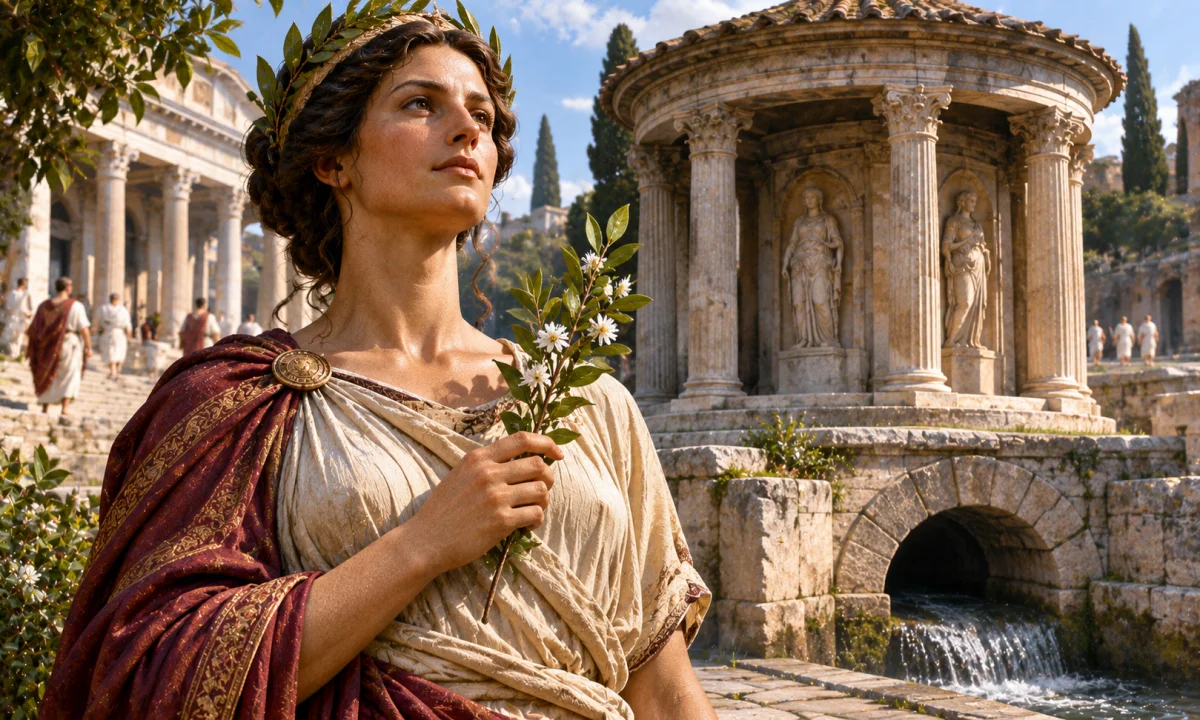
Concordia was the Roman goddess and personification of agreement, harmony, and civic unity. Her name expressed the ideal of people being “of one heart,” especially when members of a community set aside conflict and act together. Unlike many major Roman gods, Concordia was not chiefly known through a cycle of myths. Her importance lay in Roman religious and political life, where she represented peace within the state, cooperation between social groups, and the restoration of order after civil disagreement.
Origins and cultural setting
The Latin word concordia comes from concors, meaning harmonious, united, or sharing the same heart. It was related to the Roman idea that a healthy state depended on agreement among its citizens. Concordia therefore belonged to a broad category of Roman divine figures who personified qualities or institutions, including Victoria, Fides, Libertas, Pax, and Fortuna.
Calling Concordia a “goddess” is appropriate in the context of her public cult, but she was not a goddess with a clearly preserved birth story, family tree, or independent realm comparable to Jupiter’s sky or Neptune’s sea. Her identity was expressed through a moral and political principle. Romans could treat such principles as divine powers, build temples to them, offer sacrifices, and invoke them in prayers.
Concordia became especially significant during periods of internal tension. Roman history was marked by disputes between patricians and plebeians, struggles between political factions, and later conflicts between generals and their armies. A shrine to Concordia could therefore communicate a direct political message: disagreement had ended, the community had been restored, and legitimate order had returned.
The Temple of Concord in the Roman Forum
Concordia’s most famous sanctuary stood at the north-western end of the Roman Forum, beneath the Capitoline Hill. According to the historian Livy, Marcus Furius Camillus vowed a temple to Concordia in 367 BCE, after a long political struggle between patricians and plebeians. The conflict was connected with the Licinio-Sextian reforms, which helped open the consulship to plebeians and addressed wider disputes over political power and debt.
The traditional story presents the temple as a religious expression of reconciliation. After years of division, the Roman state was imagined as becoming united again. The historical details are not entirely independent of later Roman interpretations, since ancient historians often arranged the past to highlight moral and political themes. Nevertheless, the association between Concordia and the settlement of internal conflict was firmly established in Roman memory.
The sanctuary was repeatedly repaired, rebuilt, or politically reinterpreted. In 121 BCE, the consul Lucius Opimius was associated with a temple or rebuilding dedicated to Concordia after the violent suppression of the reformer Gaius Gracchus and his supporters. Ancient sources connect the project with the claim that public order had been restored, although the circumstances were marked by bloodshed rather than peaceful reconciliation. This contrast reveals how the image of Concordia could be used by competing political groups: one side might describe force as the restoration of unity, while another might regard it as the destruction of genuine civic agreement.
The temple was later rebuilt on a grander scale under the emperor Tiberius. Tiberius and his son Drusus dedicated the restored building in 10 BCE, and it became associated with the imperial idea of Concordia Augusta, the harmony of the imperial household and the Roman state. The building stood in a prominent location and was used for important meetings of the Senate.
In 63 BCE, the Senate met in the Temple of Concord during the crisis caused by the conspiracy of Lucius Sergius Catilina. Cicero addressed the conspirators in speeches connected with the events, and the Senate later debated the fate of Catiline’s captured associates there. The temple thus became linked not only with ideal harmony but also with the harsh political decisions made in the name of preserving the Roman state.
The sanctuary also contained works of art and valuable objects. Ancient descriptions suggest that it functioned in part as a display place for artworks, particularly after its later restorations. Its architectural remains are now fragmentary, but the podium and location have helped archaeologists identify the site at the Forum.
Name and identity
Concordia was a feminine personification of social and political agreement. Her name did not necessarily imply that all disagreement had disappeared. In Roman political language, concordia could mean cooperation between citizens, harmony between political orders, loyalty within a family, or unity between the emperor and the Senate.
The term could also be applied to relationships within the imperial household. Inscriptions and coins used expressions such as Concordia Augustorum or Concordia Augusta to present rulers, heirs, and empresses as united. These expressions were often political ideals rather than neutral descriptions. They could promote the appearance of dynastic stability even when tensions existed within the ruling family.
Concordia was sometimes compared with the Greek goddess or personification Homonoia, whose name also means agreement or unity. The two figures were conceptually related, especially in the religious culture of the Roman Empire, where Roman and Greek divine traditions frequently interacted. They should not, however, be treated as exactly the same figure in every context. Concordia developed within Roman political and religious traditions, while Homonoia belonged to Greek civic and religious settings. Their similarities reflect a shared Mediterranean interest in the divine representation of communal harmony.
Appearance and attributes
Concordia did not have one fixed appearance preserved in a single canonical description. Her surviving representations come primarily from coins, reliefs, statues, and inscriptions rather than from detailed myths. She was commonly shown as a dignified seated woman in a long robe, presenting the calm and stability expected of a civic virtue.
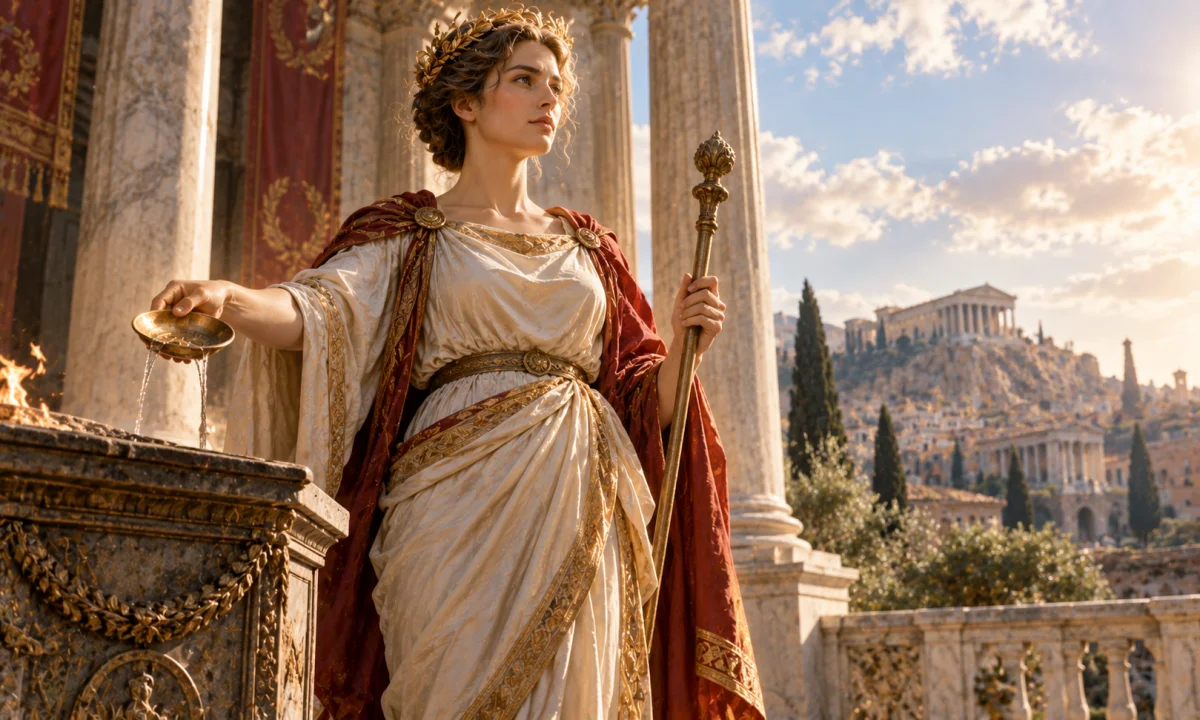
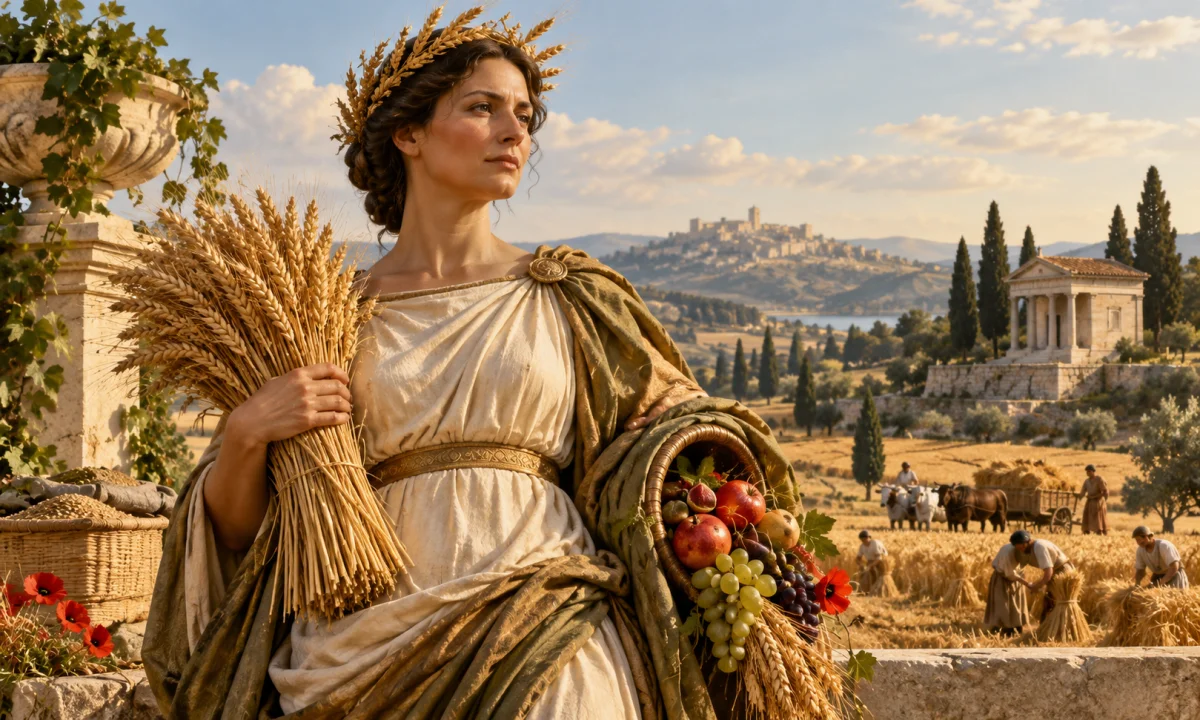
Common attributes included a patera, the shallow bowl used in ritual offerings, and a cornucopia, or horn of plenty. The patera emphasized her religious status and her role in maintaining a proper relationship between the Roman community and the gods. The cornucopia suggested prosperity resulting from peace and social stability.
Some images show Concordia holding or associated with symbols of cooperation, including clasped hands. On Roman coinage, pairs of clasped hands could represent agreement between rulers, military loyalty, marriage, or reconciliation between political groups. A caduceus, the staff associated with Mercury and negotiation, also appears in some representations connected with concord, although it is not an exclusive attribute of Concordia.
Coins issued under different rulers used Concordia in changing political contexts. A seated female figure with a patera and cornucopia could communicate the emperor’s claim to have secured peace, stability, and prosperity. Other coins used Concordia to emphasize harmony between an emperor and a designated successor, between members of the imperial family, or between Rome and the army.
Religious observance and festivals
Concordia had a festival recorded in the Roman calendar on 22 July, the traditional anniversary of the dedication of Camillus’s temple. The date connected the goddess with the political settlement remembered from the fourth century BCE. As with many Roman festivals, the surviving evidence does not provide a complete description of every rite performed, so the precise form of the observance is uncertain.
A separate celebration associated with Concordia Augusta was held in January. The date and significance are connected with the imperial restoration and dedication of the Forum temple under Tiberius. The distinction between the older civic cult of Concordia and the imperial language of Concordia Augusta is important. Both invoked unity, but the later form placed that unity within the political structure of the Roman Empire and the ruling household.
Her cult was not primarily concerned with private household worship in the way that some domestic gods were. Concordia’s strongest setting was public religion: temples, civic ceremonies, official vows, imperial coinage, and political declarations. Individuals could of course pray for harmony in marriage, family, or friendship, but the surviving evidence emphasizes her public and collective role.
Political meaning in the Roman state
Concordia was closely tied to the Roman belief that civil division threatened the entire community. Rome’s political vocabulary frequently contrasted concord with discordia, disagreement or factional strife. Discord was not merely an unpleasant social condition; it could lead to violence, civil war, the collapse of law, and divine displeasure. Concordia represented the opposite condition in which competing groups accepted a shared order.
This ideal was often selective. Roman leaders could proclaim concord while excluding large groups from political power, and they could describe military victory or political repression as the restoration of unity. The goddess therefore had both a religious and a propagandistic dimension. Her image expressed a real Roman aspiration toward civic peace, but it could also legitimize the authority of those who claimed to have achieved it.
The Temple of Concord illustrates this tension particularly well. It commemorated a settlement between social orders, yet it was also connected with disputes that ended in violence. Its use by the Senate during moments of political crisis shows that Concordia did not mean passive gentleness. In Roman public life, maintaining concord could involve debate, legal compromise, coercion, or punishment, depending on who defined the boundaries of legitimate order.
Relationships and mythology
Concordia has no widely accepted mythological genealogy. Ancient literature does not give her a standard set of parents, spouse, children, or adventures. Occasional literary personifications may place her among other virtues, but these poetic groupings should not be mistaken for a consistent religious family.
She was not the wife of a major Roman god, despite the tendency of later retellings to give every goddess a divine partner. Nor should she be confused with Venus, Juno, Pax, or Fides. Concordia could overlap with these figures in themes of peace, loyalty, marriage, and prosperity, but each had a distinct religious identity.
Roman poets sometimes used the concept of concord in connection with marriage or domestic unity. In such contexts, Concordia could be invoked as an ideal of mutual affection and cooperation. This literary use broadened the meaning of the goddess without creating a separate cycle of stories about her.
Concordia and related figures
- Homonoia: The closest Greek parallel, representing agreement and civic unity. The figures are related by meaning but are not interchangeable in every religious or historical setting.
- Pax: The Roman personification of peace. Pax generally emphasizes peace, especially peace secured after conflict, while Concordia focuses more specifically on agreement and unity within a community or relationship.
- Fides: The personification of trust, good faith, and reliability. Concordia depends on cooperation, while Fides concerns the trust that makes promises, treaties, and social obligations credible.
- Victoria: The goddess of victory. Roman rulers could present victory as producing concord, but victory and agreement were distinct ideals.
- Discordia: The personification of strife and division, often treated as Concordia’s conceptual opposite rather than as a direct mythological enemy with a developed story.
Later reception
After the decline of the ancient Roman religious system, Concordia survived mainly as an artistic and symbolic figure rather than as an actively practiced goddess. Her name continued to appear in discussions of civic unity, political reconciliation, and social harmony. Renaissance and neoclassical artists sometimes represented her as a Roman-style woman holding a cornucopia, patera, or other emblem of peace and cooperation.
The Latin word also remained influential in political and institutional language. Modern buildings, monuments, organizations, and public initiatives have used names derived from concordia to express cooperation or unity. Such uses draw on the classical meaning of the word but do not necessarily represent continuity with the ancient cult.
In modern popular culture, Concordia is less prominent than figures such as Venus, Mars, or Minerva. She may appear in historical fiction, fantasy games, museum reconstructions, or works inspired by Roman coinage and architecture. These portrayals often give her more individualized powers or a dramatic mythology than the ancient evidence supports. The traditional Concordia is better understood as a divine embodiment of a public ideal: the fragile, politically charged harmony on which Roman society believed its survival depended.