WORLD
WORLD
Aequitas
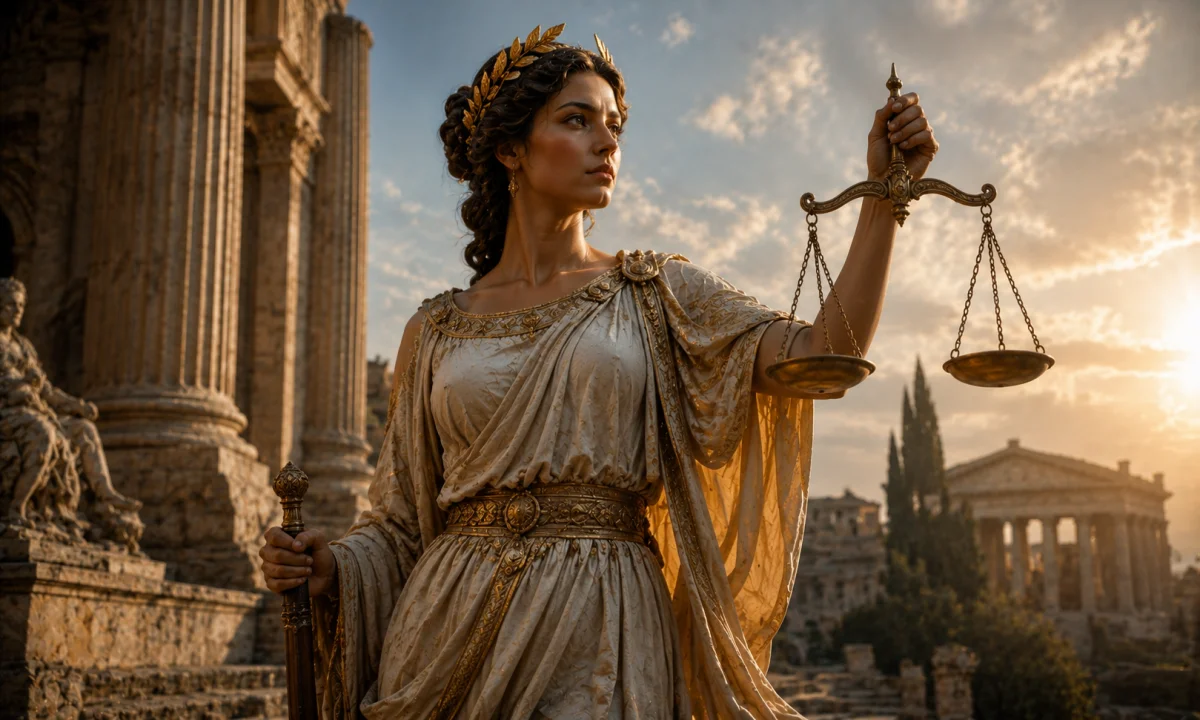
Aequitas was the Roman personification of fairness, equity, and balanced dealing. Her name comes from the Latin word aequitas, meaning fairness, impartiality, or a just adjustment between people and circumstances. Unlike many better-known Roman gods, Aequitas has no surviving mythological cycle, famous temple cult, or narrative adventures. She is known chiefly through Roman moral and legal language, inscriptions, and imperial coinage, where she represented the fair conduct expected from the emperor and the Roman state.
Meaning and cultural setting
Roman religion often gave human form to important moral, political, and social qualities. Concepts such as Fides, Concordia, Pietas, Victoria, and Virtus could be represented as female figures and honoured through temples, public ceremonies, inscriptions, or coins. These figures did not all function in the same way. Some had substantial cults and developed mythological identities, while others were primarily symbolic embodiments of Roman ideals.
Aequitas belongs mainly to the second category. The Latin noun aequitas was already important before Aequitas appeared as a clearly recognizable personification. It described fairness, even-handedness, and the proper adjustment of rights or obligations. The word could be used in moral discussion, political thought, and legal reasoning. In practical terms, it suggested that people should be treated appropriately rather than arbitrarily or with excessive partiality.
Roman ideas of fairness were not identical to modern ideas of equality. Aequitas could imply treating people according to their circumstances, status, duties, or deserts. It therefore involved proportion and suitability as well as equal treatment. A decision could be considered equitable without giving precisely the same result to everyone.
This meaning made Aequitas especially useful in Roman political communication. An emperor could present himself as a ruler who judged fairly, distributed benefits responsibly, respected legitimate claims, and corrected abuses. Aequitas therefore belonged both to private morality and to the public image of good government.
The name and identity of Aequitas
The name Aequitas is the feminine form used for the personification of the quality called aequitas. It is related to the Latin adjective aequus, which can mean level, even, equal, fair, or favourable depending on context. The same linguistic family produced several Roman expressions connected with balance and justice.
Aequitas should not automatically be treated as a fully independent goddess with a complete divine genealogy. Ancient Roman sources do not preserve a standard birth story, family tree, or set of myths about her. Modern descriptions sometimes call her a goddess because Roman personifications could be addressed or depicted as divine figures, but the surviving evidence more securely presents her as an embodiment of a virtue and principle.
Her classification is consequently a matter of emphasis. In a discussion of Roman religious art and imperial ideology, she may be described as a goddess or divine personification. In a legal or literary discussion, Aequitas is better understood as the personified form of a moral and juridical concept. Neither description should be taken to mean that she possessed the same kind of independent mythology as Jupiter, Mars, Venus, or Minerva.
Ancient sources and evidence
The earliest and broadest evidence concerns the word aequitas, not necessarily a distinct divine personality. Roman writers used the term when discussing justice, duty, public conduct, and the interpretation of laws. Philosophers and statesmen could contrast fairness with selfishness, oppression, fraud, or excessively rigid behaviour.
Roman legal thought also gave aequitas an important role. Roman jurists were concerned with the relationship between written rules and the fair application of those rules in particular cases. The legal history is complex, and aequitas did not simply mean that judges could ignore laws whenever they wished. Rather, it could express the ideal that law should be applied in a way consistent with reason, fairness, and the circumstances of a dispute.
The personified Aequitas becomes especially visible through imperial coinage. Coins issued under Roman emperors frequently displayed allegorical figures on their reverse sides. These images communicated claims about the emperor, the state, prosperity, military success, and the moral qualities of government. Aequitas appeared with legends such as AEQVITAS AVGVSTI, meaning “the equity of the Augustus” or “the fairness of the emperor.”
Such coins were official objects circulated across a vast empire. They did not merely illustrate private religious beliefs. Their imagery formed part of imperial messaging, presenting the emperor as the source or guarantor of fair administration, stable currency, proper distributions, and balanced rule. The appearance of Aequitas on a coin therefore says more about public ideology than about the existence of a widespread popular cult devoted specifically to her.
There is no securely established body of myths surrounding Aequitas, and evidence for an independent temple cult is limited compared with that for major Roman deities. Surviving representations and inscriptions are therefore more important than stories. They show how Romans wanted fairness to be understood and displayed, particularly in relation to authority.
Appearance and attributes
On Roman coins, Aequitas is generally shown as a standing female figure in a long robe. Her exact form varies according to the issuing emperor and the design of a particular coin, but two attributes are especially characteristic:
- Scales: The scales represent balance, measured judgment, and the weighing of competing claims. They connect Aequitas with fair assessment and the avoidance of arbitrary preference.
- Cornucopia: The horn of plenty represents abundance, prosperity, and the responsible distribution of resources. In the context of imperial coinage, it could suggest that fair government brought material security to the Roman world.
In some representations, the figure may hold a sceptre or another staff instead of, or in addition to, the more familiar attributes. Details depend on the coin type and period. The scales and cornucopia are not a complete mythological biography; they are visual signs that allow viewers to recognize the quality being proclaimed.
The combination is significant. Scales alone might suggest judgment or legal decision-making, while a cornucopia alone might signify abundance or prosperity. Together they suggest that prosperity should be administered fairly and that the ruler’s generosity should be measured rather than chaotic or self-serving.
Aequitas is usually represented as composed and dignified rather than aggressive. She is not normally shown as a warrior, a romantic figure, or a miraculous being. Her authority lies in balance, proportion, and orderly administration. This reserved appearance reflects the Roman preference for presenting civic virtues as stable qualities that support the structure of the state.
Aequitas and the Roman emperor
The most important religious and political association of Aequitas is with the emperor. The phrase Aequitas Augusti did not necessarily mean that the emperor personally possessed perfect moral fairness. It was an official claim that imperial authority was legitimate because it provided equitable rule.
Imperial fairness could be represented in several ways. It might refer to the emperor’s judgments, the protection of citizens, the distribution of money or grain, the remission or regulation of taxes, or the maintenance of reliable public order. The precise meaning depended on the historical setting and the broader message of the coin or inscription.
The image also had an economic dimension. Roman emperors controlled the issue of coinage, and monetary imagery was one of the most effective means of circulating political messages. A figure carrying scales and a cornucopia could communicate that the emperor maintained a balanced relationship between authority and prosperity. It could also imply that imperial gifts and financial decisions were not acts of random favour but expressions of rightful government.
These claims should not be confused with objective evidence that every imperial administration was equitable. Roman coin imagery was idealizing and propagandistic. It expressed the standard by which an emperor wished to be judged, not a neutral record of social conditions or legal practice.
Relationships with other Roman virtues
Aequitas shares territory with several other Roman concepts, but the distinctions are useful.
- Justitia: Justitia represents justice more broadly and later became the familiar personification of Justice. Aequitas is more specifically associated with fairness, proportionality, and the equitable handling of claims or circumstances.
- Fides: Fides concerns trust, good faith, and the keeping of obligations. Fair dealing may depend on good faith, but Aequitas is not simply another name for Fides.
- Pietas: Pietas refers to dutiful respect toward the gods, family, ancestors, and community. It describes proper obligation rather than primarily balanced judgment.
- Concordia: Concordia embodies harmony and agreement. Fairness can promote concord, but Aequitas focuses on the just basis of an arrangement rather than on harmony itself.
- Fortuna: Fortuna represents luck, fate, or changing fortune. Her gifts may be unpredictable, whereas Aequitas symbolizes measured and principled distribution.
Roman personifications frequently overlapped in meaning. A coin or inscription could invoke several virtues at once, and ancient viewers would not necessarily have expected sharply separated definitions. Even so, Aequitas is best recognized by the particular combination of fairness, balance, and equitable administration.
Aequitas, Themis, Dike, and later Justice figures
Aequitas is sometimes compared with the Greek figures Themis and Dike. The comparison is understandable because all are connected with justice or right order, but they are not interchangeable.
Themis in Greek mythology is associated with divine law, custom, sacred order, and the proper arrangements of society. She has a stronger mythological and genealogical identity than Aequitas. Dike represents justice and right judgment, especially in the moral order of human society. Greek artistic and literary traditions influenced Roman representations of justice, but Aequitas developed within Roman moral, legal, and imperial contexts.
Aequitas is also distinct from Justitia, even though modern art often blends their attributes. Justitia became particularly prominent in later European traditions and is commonly shown with scales, sometimes a sword, and occasionally a blindfold. The blindfold is not a defining ancient attribute of Aequitas. Roman images of Aequitas generally emphasize the scales and cornucopia, with no standard requirement that she be blindfolded.
The modern legal word “equity” has a long and complicated history. It reflects the continuing importance of fairness as a legal idea, but modern equity law cannot be reduced to the worship or imagery of the Roman personification. The connection is partly linguistic and intellectual, not evidence of an unbroken religious cult.
Mythological stories and religious practice
No famous Roman story tells of Aequitas intervening in the affairs of gods or mortals. She does not have a recognized set of heroic episodes, punishments, romances, or transformations. Stories sometimes associated with Roman justice generally concern other figures, historical exempla, or broader ideas of law and civic duty rather than Aequitas herself.
Likewise, the evidence does not establish a major festival devoted exclusively to her. If Romans invoked or represented Aequitas, the context was more likely to be moral discourse, public ideology, legal language, or imperial symbolism than a dramatic mythological cult centred on her personal deeds.
This absence is important rather than a deficiency in the evidence. Roman religion included many divine names and personifications whose significance lay in ritual formulas, inscriptions, public monuments, or official imagery. Aequitas demonstrates that a figure could be culturally meaningful without acquiring a large narrative tradition.
Interpretation and significance
Aequitas reveals how Roman society connected morality, law, economics, and political authority. Fairness was not imagined only as a private virtue between individuals. It was also a quality expected of governors, judges, patrons, generals, and emperors.
Her scales express the need to assess matters carefully. Her cornucopia expresses the material consequences of government: food, money, security, and prosperity. Together, these symbols present fairness as an active public responsibility. A good ruler was expected not merely to avoid cruelty but to distribute benefits, settle disputes, and maintain an ordered relationship between different groups.
At the same time, the Roman concept was shaped by a hierarchical society. Aequitas did not necessarily demand identical rights or conditions for every person in the modern sense. Roman ideas of fairness could operate within distinctions of citizenship, gender, legal status, wealth, and social rank. The ideal was often that each person should receive what was considered appropriate within the existing order.
This tension makes Aequitas historically valuable. She represents a genuine concern with fairness while also showing that ancient standards of fairness were defined by their own social and political assumptions. Her image could challenge arbitrary rule, but it could also help legitimize an unequal imperial system by presenting that system as balanced and benevolent.
Later reception
Aequitas has had a quieter afterlife than Justitia. Renaissance and later European artists often preferred the more widely recognized figure of Justice, whose attributes became standardized in civic buildings, courts, books, and political imagery. Aequitas nevertheless remained important to scholars of Roman law, ancient coinage, political symbolism, and the history of legal concepts.
In modern popular culture, Aequitas is not usually a major character in films, novels, games, or television. When she does appear in modern historical or mythological works, she is commonly portrayed as a Roman goddess of fairness, often using scales and a cornucopia. Such portrayals are reasonable visual interpretations, but they may give her a dramatic personality or mythology that ancient evidence does not provide.
Aequitas is therefore best understood not as a lost Roman heroine with forgotten adventures, but as a powerful personification of a principle. Her surviving image asks what fairness should look like in public life: balanced judgment, proportionate treatment, and the responsible distribution of prosperity under legitimate authority.