WORLD

Credulitas
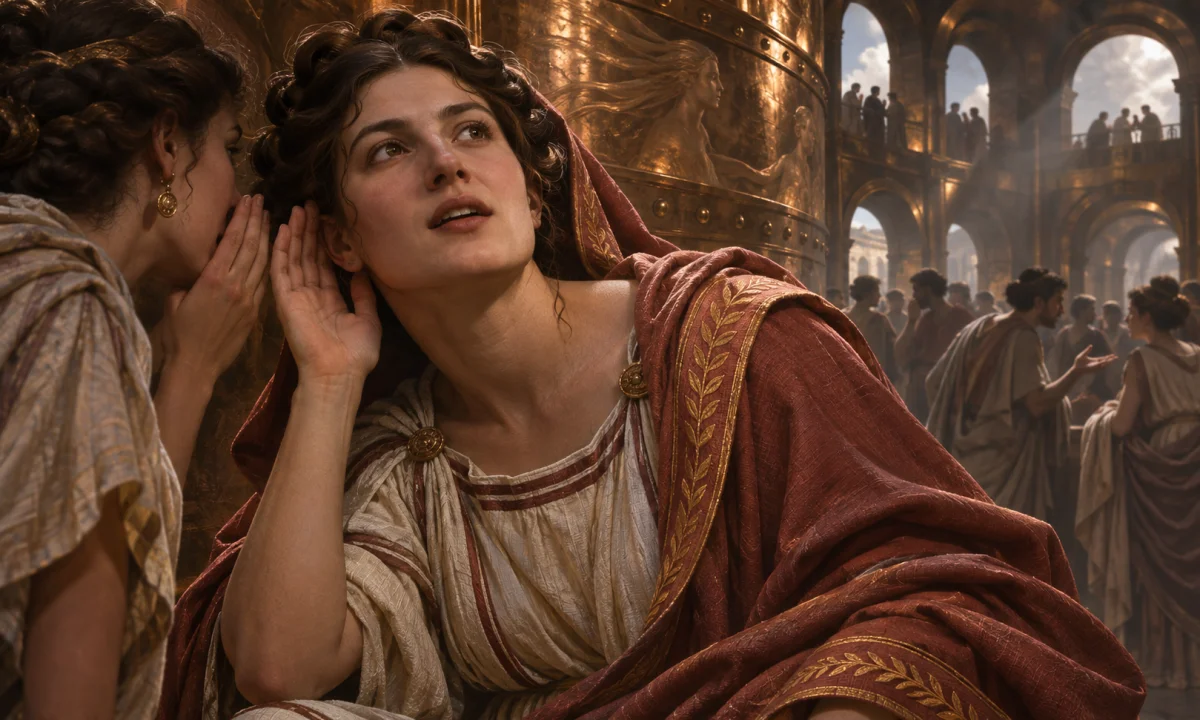
Credulitas is a Latin name associated with credulity, readiness to believe, or an excessive willingness to accept claims without sufficient proof. It is sometimes presented in modern lists as a minor Roman goddess, but the surviving evidence does not establish Credulitas as a well-attested independent deity with a recognized cult, mythology, temple, or standard iconography. The name is better understood as an abstract Latin concept that could be personified in literature or allegory than as a major figure in Roman religious tradition.
Name and meaning
The Latin noun credulitas comes from the verb credere, “to believe,” “to trust,” or “to give credence.” Depending on context, it can describe confidence in another person, but it more often suggests credulity: a tendency to believe too readily, especially when evidence is weak or a story is implausible.
This distinction is important. Roman religious language included many abstract nouns that could be treated as qualities, powers, or personified beings. A Latin writer might speak of Fortune, Rumour, Hope, Victory, or Faith as if each were an active force. That literary and rhetorical practice does not automatically mean that every abstract noun represented a goddess with an established public cult.
Credulitas therefore occupies an uncertain position. The word itself belongs to the Latin vocabulary, but the evidence for a distinct goddess named Credulitas is considerably weaker than the evidence for figures such as Fides, Spes, Victoria, or Fama. Some later reference works and modern mythology websites list Credulitas among Roman deities, yet these lists frequently provide no ancient inscription, ritual record, temple tradition, or classical narrative to support the classification.
Credulitas in the Roman religious world
Roman religion recognized both traditional gods and personified qualities. Some personifications had long-standing civic importance. Fides, for example, represented good faith, trustworthiness, and the reliability of agreements. Spes embodied hope, while Concordia represented harmony and social unity. Victoria was associated with military success and was honored in state ceremonies. These figures could possess temples, priesthoods, festivals, images, and political significance.
Other personifications appear mainly in poetry, rhetoric, moral discussion, or allegorical scenes. Roman authors regularly turned emotions, social conditions, and forces of public life into characters. Rumour could spread like a living creature; Discord could enter a community; Envy could torment a person; and Fortune could raise or destroy the powerful. Such personification was a flexible literary technique as well as a religious habit.
Credulitas fits more comfortably within this second category. A Roman author could describe credulity as an active weakness, especially in discussions of gossip, superstition, deception, prophecy, or public panic. The concept could be imagined as a force influencing human judgment without requiring the existence of a separate cult deity. Surviving evidence does not show that Romans commonly worshipped Credulitas in the same institutional sense as Fides or Fortuna.
No securely documented temple of Credulitas is known. There is also no established festival, priesthood, sacrificial practice, canonical genealogy, or body of myths belonging to her. Ancient sources do not preserve a standard story in which Credulitas acts as a goddess among the Olympian or Roman gods. Claims that she was the daughter, consort, or companion of another deity should therefore be treated cautiously unless they can be tied to a specific ancient text or inscription.
Identity and classification
Credulitas is often described as a Roman goddess of belief, faith, or credulity. That description combines several related but distinct ideas. In ordinary Latin usage, the word could refer to a person’s readiness to believe. In religious interpretation, it might be connected with trust or confidence. In moral writing, however, credulity was usually a defect rather than a virtue.
The most accurate classification is an uncertain or weakly attested personification. It is possible that the name was used allegorically, or that later writers inferred a divine figure from the existence of the abstract noun. It is not safe to assign Credulitas a fully developed mythology simply because Roman culture often personified concepts.
Roman religion did not operate with a single, fixed catalogue of gods. Divine powers could be local, functional, ancestral, political, domestic, or associated with a particular event. Some obscure names survive only in inscriptions or ritual fragments. Even so, obscurity alone is not proof of ancient worship. A name needs evidence of usage in a religious or literary setting before it can confidently be treated as a deity.
Attributes and appearance
No ancient image of Credulitas has been securely identified. There is consequently no traditional description of her clothing, hairstyle, physical appearance, sacred animal, plant, weapon, or emblem. Modern illustrations may depict a woman receiving a message, listening to a persuasive speaker, or holding a document or scroll. Such images are symbolic inventions rather than preserved Roman iconography.
If Credulitas is represented allegorically, likely visual ideas would include open ears, an attentive posture, a message being accepted, or a person deceived by appearances. These motifs communicate the meaning of credulity but should not be mistaken for traditional attributes. Roman personifications were often shown with recognizable objects, yet no established set of symbols belongs to Credulitas.
It is equally uncertain whether the figure should be imagined as female. Latin abstract nouns ending in -itas are grammatically feminine, and modern personifications commonly turn such nouns into women. Grammar, however, does not prove the existence or gender of a cult figure. The feminine identity assigned to Credulitas in modern lists follows the conventions of allegory rather than a clearly preserved ancient tradition.
Relationship to Fides
The figure most likely to be confused with Credulitas is Fides. Both names can be connected with belief and trust, but their meanings and religious status are different.
- Fides represented good faith, trustworthiness, loyalty, and the keeping of promises.
- Credulitas, where the concept is intended independently, refers more specifically to believing too easily or accepting claims without adequate judgment.
- Fides had a recognized place in Roman public religion, including a temple on the Capitoline Hill and associations with treaties, oaths, and the reliability of the Roman state.
- Credulitas has no comparable body of securely documented cult evidence.
Fides was therefore normally a socially valuable quality. A magistrate, ally, soldier, or citizen could be praised for possessing fides. Credulitas was more ambiguous and often negative. Trust can sustain families, friendships, contracts, and political relationships; credulity can make a person vulnerable to fraud, superstition, slander, or manipulation.
The Greek concept of Pistis provides another point of comparison. Pistis could mean trust, confidence, faith, or fidelity, and Greek religious and philosophical traditions used the term in several ways. In Roman contexts, Fides is the closer traditional parallel. Credulitas should not be automatically treated as a Latin name for Pistis.
Credulity, rumour, and deception
Although Credulitas lacks a securely preserved myth cycle, the idea behind the name belongs to themes that were important in Roman literature. Roman authors frequently examined how people respond to rumours, omens, prophecies, accusations, and spectacular stories. A credulous crowd could be moved by an unverified report, while an individual might be deceived by a flattering speech or a false appearance.
This theme connects Credulitas conceptually with Fama, the personification of rumour and report. Fama is especially prominent in poetic tradition as a force that travels rapidly and changes as it spreads. Credulitas would represent the receptive side of that process: the disposition that allows a rumour to gain acceptance. The two concepts are related, but they are not the same figure. Fama carries or spreads reports; credulity makes people inclined to believe them.
Credulitas can also be contrasted with reasoned judgment. Roman moralists often valued prudentia, discernment, self-control, and the ability to distinguish truth from deception. A person who believed every tale could be portrayed as foolish, unstable, or easily manipulated. In this setting, credulitas is not a divine blessing but a human weakness that may have social consequences.
Religious belief itself should not be confused with credulity. Romans participated in rituals, honored ancestral and civic gods, and interpreted omens within a religious culture, but that does not mean that every form of belief was considered irrational. The Latin term could carry a critical sense: it described an excessive or unguarded readiness to believe, not simply devotion to the gods.
Sources and limits of the evidence
The main difficulty surrounding Credulitas is not a conflict between several detailed myths. It is the lack of clear ancient evidence for a distinct divine personality. The Latin word appears within the broader vocabulary of belief and judgment, but a vocabulary term is not automatically a divine name.
Surviving Roman sources preserve many abstract personifications in different forms. Some occur on coins, inscriptions, altars, statues, or temple dedications. Others appear in epic poetry, philosophical works, speeches, satire, or moral essays. To establish a deity securely, scholars generally look for more than a single occurrence of a name. Evidence might include repeated religious usage, a dedication, a cult title, a ritual context, or an image with an identifying inscription.
For Credulitas, such evidence is not securely established. The figure may appear in modern catalogues because writers have expanded the Roman pantheon by treating abstract qualities as goddesses. This process can blur the difference between an ancient cult, a poetic personification, a medieval allegory, and a modern invention. A cautious account should preserve that distinction rather than present a speculative entry as established Roman mythology.
Later allegorical use
Abstract qualities continued to be personified in medieval and early modern European art and literature. Virtues and vices were frequently represented as women carrying symbolic objects or participating in moral dramas. In such traditions, belief, trust, deception, folly, and suspicion could all be turned into characters. A later allegorical figure called Credulitas would belong to this broad habit of representing moral states in human form, even if the representation had no direct basis in Roman cult.
Renaissance interest in classical mythology also encouraged the expansion of divine catalogues. Writers and artists sometimes collected names from dictionaries, inscriptions, poetry, and earlier mythographical works, placing major gods beside obscure personifications. Over time, an abstract Latin noun could acquire the appearance of a fully independent goddess through repetition in reference works.
Modern websites and popular summaries may consequently describe Credulitas as a Roman goddess with a defined domain, appearance, and divine family. Those details are not consistently supported by ancient tradition. The safest interpretation is that Credulitas is a marginal and uncertain personification associated with the idea of credulity, not a major Roman deity with a preserved mythology.
Cultural significance
Even without a documented cult, the concept remains useful for understanding Roman concerns about trust and deception. Roman society depended heavily on personal reputation, sworn promises, patronage, contracts, political loyalty, and public speech. The positive quality of fides helped maintain these relationships, while excessive credulity exposed individuals and communities to manipulation.
Credulitas also illustrates a broader principle in the study of mythology: not every named abstraction is a god in the same sense. Some names identify powerful cult deities; some belong to poetry; some describe moral qualities; and some acquire divine status only in later interpretation. Distinguishing these categories makes the surviving Roman tradition clearer and prevents an uncertain figure from being given an invented mythology.