WORLD

Decima
Decima is a figure of Roman mythology traditionally identified as one of the three Parcae, the Roman Fates. She is usually described as the Fate who measures or assigns the length of a person's life. In the familiar Roman division of their duties, her sisters are Nona, who spins the thread of life, and Morta, who cuts it. This neat arrangement is strongly influenced by the Greek Moirai, and the surviving evidence does not always present the three Roman figures with identical names or precisely fixed functions.
Decima among the Roman Parcae
The Parcae were divine powers associated with destiny, lifespan and the unavoidable limits placed upon gods and mortals. Roman writers often treated them as a group of three, but their earliest background is not entirely clear. They seem to combine native Roman ideas about fate with the more developed literary image of the Greek Moirai: Clotho, Lachesis and Atropos.
In later and modern descriptions, Decima is commonly assigned the middle position in the group:
- Nona spins the thread of life.
- Decima measures or determines its length.
- Morta cuts the thread at death.
This pattern corresponds broadly to the Greek roles of Clotho, Lachesis and Atropos. Decima is therefore often regarded as the Roman counterpart of Lachesis, whose name in Greek tradition is connected with the portion or lot allotted to a person. The comparison is useful, but it should not be treated as proof that Decima and Lachesis were originally the same goddess. Roman religion frequently identified foreign gods with Roman equivalents, especially in poetry and learned interpretation, while preserving differences in names, ritual context and cultural meaning.
Name and identity
The Latin name Decima means “the tenth” in the feminine form. It belongs to the same group of numerically based names as Nona, meaning “the ninth,” and Morta, whose name is associated with death. The numerical meanings have encouraged several explanations, but the evidence does not establish one universally accepted origin for the trio.
One interpretation connects Nona and Decima with stages of pregnancy or childbirth. A pregnancy was conventionally counted in lunar months, and the ninth and tenth months could be associated with the expected time of birth. This has led some modern accounts to describe Nona and Decima as originally connected with childbirth, with Morta representing death. Such an interpretation may reflect genuine religious associations or later attempts to explain the names, but it should be presented cautiously. The surviving evidence does not provide a complete early Roman myth explaining that the three goddesses were created specifically to preside over the ninth, tenth and final stages of pregnancy.
Another possibility is that the names are part of a Roman pattern of personifying stages, numbers or conditions. Roman religious language often turned an abstract force into a named divine presence, particularly when that force affected a person's household, health, social status or death. The exact development of the names Nona, Decima and Morta remains uncertain.
Decima should also be distinguished from the ordinary Latin word decima, which can mean “a tenth” or “a tenth part.” In later Roman and medieval contexts, similar words could refer to a tenth portion or tax. Those uses do not automatically indicate a reference to the goddess.
The Roman idea of fate
Decima is best understood within the Roman concept of fatum, meaning what has been spoken, decreed or destined. Roman fate was not always imagined as a single impersonal force. It could be expressed through the decrees of Jupiter, the will of the gods, prophetic speech, omens or the work of the Parcae.
The word Parcae is traditionally translated as “Fates.” Its singular form, Parca, could refer to a Fate as an individual, although literary usage often emphasizes the group. The origin of the name is uncertain. Ancient and later writers sometimes associated it with the Latin verb parcere, “to spare,” but this may be a folk or interpretive connection rather than a secure linguistic explanation.
Roman destiny was not necessarily presented as a simple philosophical doctrine in which every event was mechanically predetermined. In religious practice and literature, fate could coexist with divine decision, human responsibility, prophecy and the unpredictable experiences of life. The Parcae represented the limits that even powerful beings could not easily escape, particularly the limits of mortality.
Attributes and symbolic function
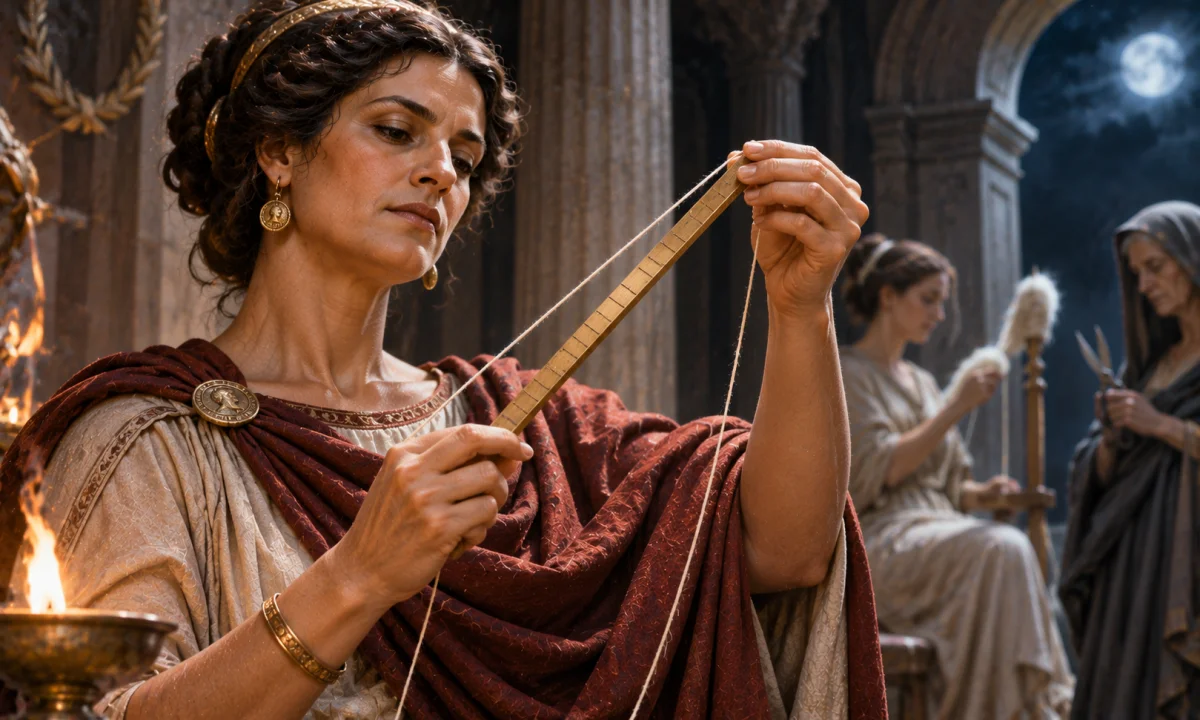
Decima is usually imagined with the tools shared by the Fates: a spindle, thread, measuring cord or scroll recording a life. These attributes are largely products of artistic and literary convention rather than details preserved in a single, consistent Roman myth. There is no universally established ancient appearance for Decima as an individual goddess.
Her principal symbolic act is measurement. The thread of life represents the duration and conditions of mortal existence, while the act of measuring expresses the idea that every life has a bounded allotment. Decima does not normally create a person's character, guarantee happiness or determine every ordinary event. Her role is more closely related to the limit and portion assigned to a life.
That symbolism made the Fates powerful figures in Roman poetry. They could represent the certainty of death, the vulnerability of dynasties and the inability of wealth or power to extend life indefinitely. A king, warrior or hero might possess exceptional status, but still remain subject to the measure allotted by fate.
In visual terms, the three Fates were often treated as a group of female figures rather than as easily distinguishable individual goddesses. Their relationship to spinning and thread also made them part of a wider Mediterranean symbolic tradition in which weaving represented creation, order, continuity and the shaping of human existence. These images should not be assumed to describe a formal Roman priesthood or a standardized cult practice for Decima.
Stories and literary tradition
Unlike Jupiter, Venus or Mars, Decima does not have a large independent cycle of myths. She appears mainly as part of the collective Parcae or as one element in Roman discussions of destiny. Ancient Roman poetry could invoke the Fates when describing birth, marriage, heroic destiny, death or the rise and fall of peoples.
In epic and lyric settings, the Parcae may be portrayed as weaving, singing or pronouncing what is destined to occur. Their words can lend solemn authority to a prophecy, especially when a poem concerns the future of Rome or the fate of a famous family. The Fates can also be presented as severe and inexorable, not because they are always malicious, but because the order they embody cannot be casually altered.
Roman poets did not always preserve a fixed division of labor among Nona, Decima and Morta. Some passages use the collective name Parcae or Fata without identifying an individual. Others adopt Greek names or Greek imagery. In learned Latin literature, the Greek Moirai, the Roman Parcae and other prophetic or destiny-related powers could overlap in meaning without being treated as completely identical.
The name Decima is therefore less important as the heroine of a particular story than as part of a religious and poetic vocabulary for life’s allotted duration. Her significance emerges through the larger presence of the Fates in Roman thought.
Relationship to Nona and Morta
Decima is most often understood through her relationship with the other two Parcae. Nona and Decima have names based on ordinal numbers, while Morta is explicitly connected by name with death. This creates a progression that modern retellings often describe as beginning with the start of life, continuing through its measured span and ending in death.
The three names can consequently be presented as a sequence:
- Nona represents the beginning or spinning of life's thread.
- Decima represents its allotted measure.
- Morta represents its ending.
This sequence is useful for explaining their symbolism, but it may make the tradition appear more systematic than the ancient evidence allows. Roman writers did not always assign each goddess a separate, clearly documented department. The familiar roles of spinning, measuring and cutting became especially influential through the comparison with the Greek Moirai and through later artistic tradition.
Decima should not be confused with every goddess or female spirit associated with childbirth. Roman religion included several childbirth-related figures and functions, among them Juno Lucina, who was associated with childbirth and the protection of mothers. A possible connection between the numerical names of Nona and Decima and the timing of birth is not enough to identify Decima with Juno Lucina or to make her a general goddess of childbirth.
Ritual and religious context
The Parcae occupied an important place in the Roman imagination of destiny, but evidence for a widespread, independent public cult dedicated specifically to Decima is limited. Literary references are more prominent than detailed descriptions of temples, festivals, priesthoods or sacrifices directed to her alone.
Roman religious life often involved collective divine powers whose names appeared in prayers, formulae or poetic invocations without producing a large mythology for each individual figure. The Parcae could be invoked as a group because destiny was experienced as a power extending over the whole human community. Their presence in religious language does not necessarily mean that Decima had a separate sanctuary or a standardized set of rites throughout the Roman world.
Roman attitudes toward death also help explain the importance of the Fates. Funerary inscriptions, epitaphs and household religious customs show sustained concern with the length of life, the timing of death and the fragility of human plans. Decima's symbolic function belongs to this larger cultural setting: life is a gift or allotment, but it is also a limited one.
Decima and similar figures
Several figures may be confused with Decima because they share themes of destiny, birth or death. The most important distinction is between Decima and Lachesis. Lachesis is one of the three Greek Moirai, while Decima is a Roman figure belonging to the Parcae. They are often compared because both are associated with measuring or allotting the course of life, but the names belong to different religious traditions.
Decima is also distinct from Atropos, the Greek Fate who cuts the thread of life. In a Romanized arrangement, that role is usually given to Morta, not Decima. Likewise, Clotho, the Greek spinner, corresponds broadly to Nona in the standard Roman scheme.
She should not be merged with Fatum, which is an idea or divine decree rather than simply another name for the goddess. Nor should she be identified with the Roman goddess Fortuna. Fortuna governs or symbolizes changing luck, prosperity, chance and the turning conditions of human life. Decima represents the allotted measure of life, which is a different aspect of destiny. A person might be fortunate or unfortunate while still remaining subject to the limit represented by the Fates.
Later reception
In medieval, Renaissance and modern art, the three Fates were frequently reimagined as aged women working with thread, scissors and a spindle. These images draw on a mixture of Greek and Roman sources, so an artwork labelled “Decima” may not reflect a specifically Roman portrayal. Artists and writers often use the Roman names while assigning the figures the roles best known from Greek mythology.
Modern fantasy, games and popular fiction sometimes present Decima as a fully individualized goddess with a detailed personality, distinctive costume, supernatural powers or a central role in a fictional pantheon. Such portrayals can be creative adaptations, but they should not be confused with the limited and varied ancient evidence. In the traditional material, Decima is primarily one member of the Parcae and is significant because of the function she represents: the measuring of mortal life.
Her enduring appeal lies in that precise image. The thread of existence may be spun, measured and eventually cut, but the Roman tradition does not give every life an equal length or every person the power to know the measure in advance. Decima embodies the unseen allotment between birth and death, a boundary that gives Roman ideas of fate both their solemnity and their sense of human vulnerability.