WORLD
WORLD
Cinteotl
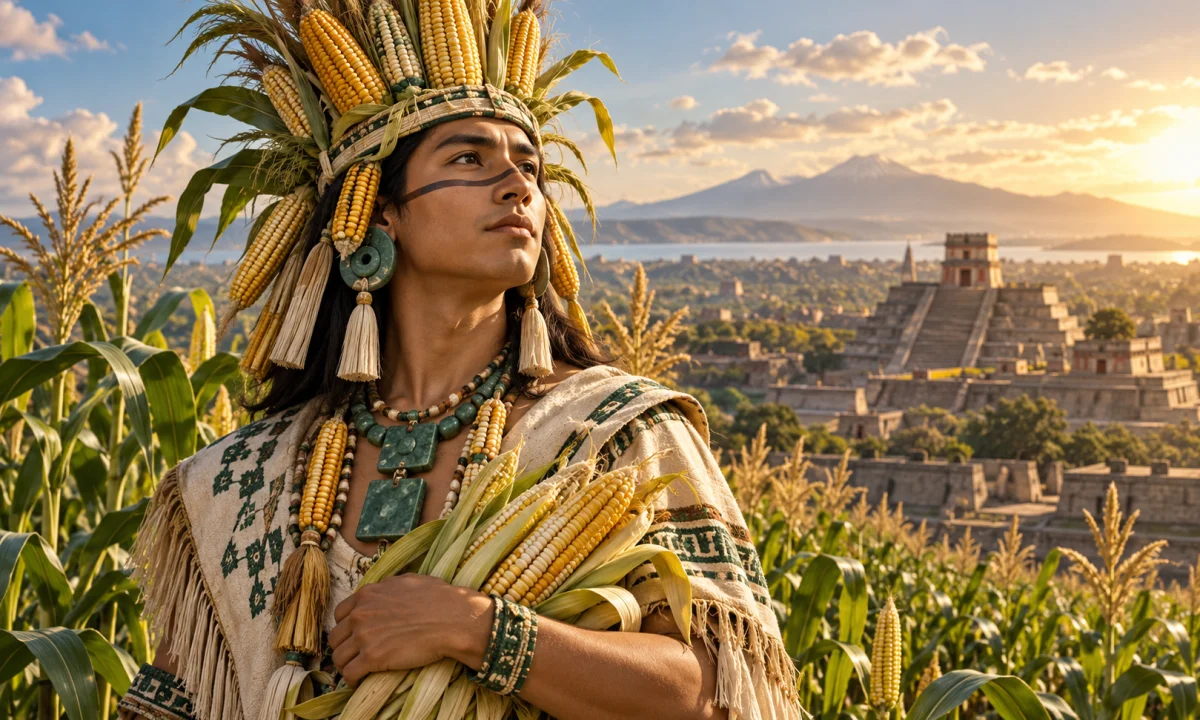
Cinteotl is a Nahua maize deity associated with corn, agricultural fertility, nourishment, and the generative power of the earth. The name is often written Centeotl, Centéotl, or Cintéotl in English-language works. Cinteotl belongs to the religious world of central Mexico before and during the Spanish conquest, commonly called “Aztec” or “Mexica” mythology, although the traditions surrounding maize were shared across many Nahua-speaking communities and were not limited to the Mexica capital of Tenochtitlan.
Maize was far more than an important crop in Mesoamerica. It was the foundation of daily food, agriculture, taxation, trade, ritual offerings, and social life. As a result, maize deities were connected with birth, death, sexuality, seasonal renewal, royal ceremony, and the survival of the community. Cinteotl represents one part of this wider sacred complex rather than a single, uniform figure with the same identity in every source.
Name and identity
The name Cintēōtl is usually interpreted as “Maize Deity” or “Maize God.” The first element is related to cintli, a Nahuatl word associated with maize, especially an ear or kernels of maize. The second element, teōtl, is conventionally translated as “god” or “deity,” although its meaning is broader than the idea of a god in some modern European religious categories. It could refer to a sacred or powerful being, force, or presence.
Colonial sources and later scholarship do not always present Cinteotl in exactly the same way. The deity is generally treated as male, particularly when the name appears in descriptions of a young maize god. However, maize was also represented through female deities, including Chicomecoatl, “Seven Serpent,” and Xilonen, a goddess associated with tender or young maize. The boundaries among these figures could be fluid in ritual practice and interpretation.
Some accounts use masculine and feminine imagery for maize without treating this as a contradiction. A growing maize plant could be understood as a young divine being, while the earth and the crop’s power to nourish the people could be expressed through motherhood, fertility, and female divinity. Consequently, identifying Cinteotl simply as the single male equivalent of every maize goddess is misleading. The surviving evidence reflects a network of related cults and symbols rather than a neat pantheon of separate agricultural departments.
Cultural setting
For Nahua agricultural communities, maize was part of a cycle involving seed, rain, soil, human labour, harvest, consumption, and renewed planting. Religious ceremonies did not merely ask a distant god to provide food. They acknowledged reciprocal obligations between people, the land, the gods, and the forces that sustained life. Maize was planted, tended, harvested, prepared, and eaten within a sacred framework.
Several colours and forms of maize were recognized in Mesoamerican agriculture, including white, yellow, red, and dark varieties. Colour symbolism could be connected with the directions, seasons, ritual offerings, and different forms of sacred power. Some colonial descriptions mention names for coloured maize deities or manifestations, but the terminology and classification vary between sources. These references should not automatically be treated as evidence for a universally fixed system of four separate versions of Cinteotl.
The religious importance of maize also shaped ideas about the human body. In a well-known Mesoamerican conception preserved most prominently in Maya sources, human beings are made from maize. Nahua traditions likewise treated maize as the substance of life and the basis of human existence, although the precise myths and wording differ between cultures. This shared emphasis does not mean that every Mesoamerican people held one identical maize creation story.
Sources and historical evidence
Most surviving written information about Cinteotl comes from sources recorded after the Spanish invasion. Nahua elders, priests, artists, and interpreters contributed information to colonial-era works, often through conversations with Spanish friars or officials. The most important descriptions of central Mexican religion come from compilations associated with Bernardino de Sahagún, especially the work now known as the Florentine Codex, along with other early colonial accounts and Indigenous pictorial manuscripts.
These sources are invaluable but complicated. They were produced in a period of conquest, Christian missionary activity, political upheaval, and cultural translation. Nahuatl religious terms were sometimes rendered through Christian categories such as “god,” “devil,” “idol,” or “saint.” Different informants also came from different communities and may have described local traditions rather than a single official Mexica doctrine.
For this reason, statements about Cinteotl should be distinguished according to their level of certainty. His association with maize is well established. His exact genealogy, gendered form, appearance, and relationship to other agricultural deities are less consistent. Some stories may preserve older local traditions, while others reflect ritual explanations recorded in a particular region or period.
Attributes and symbolism
Cinteotl is commonly imagined as a youthful maize deity. Youth is significant because tender maize is a crop in the process of becoming mature. The young god therefore embodies growth, vulnerability, and the promise of future nourishment. In artistic and scholarly reconstructions, maize leaves, ears of corn, and green or yellow agricultural imagery are often used to represent him, but no single surviving portrait can be treated as his definitive appearance.
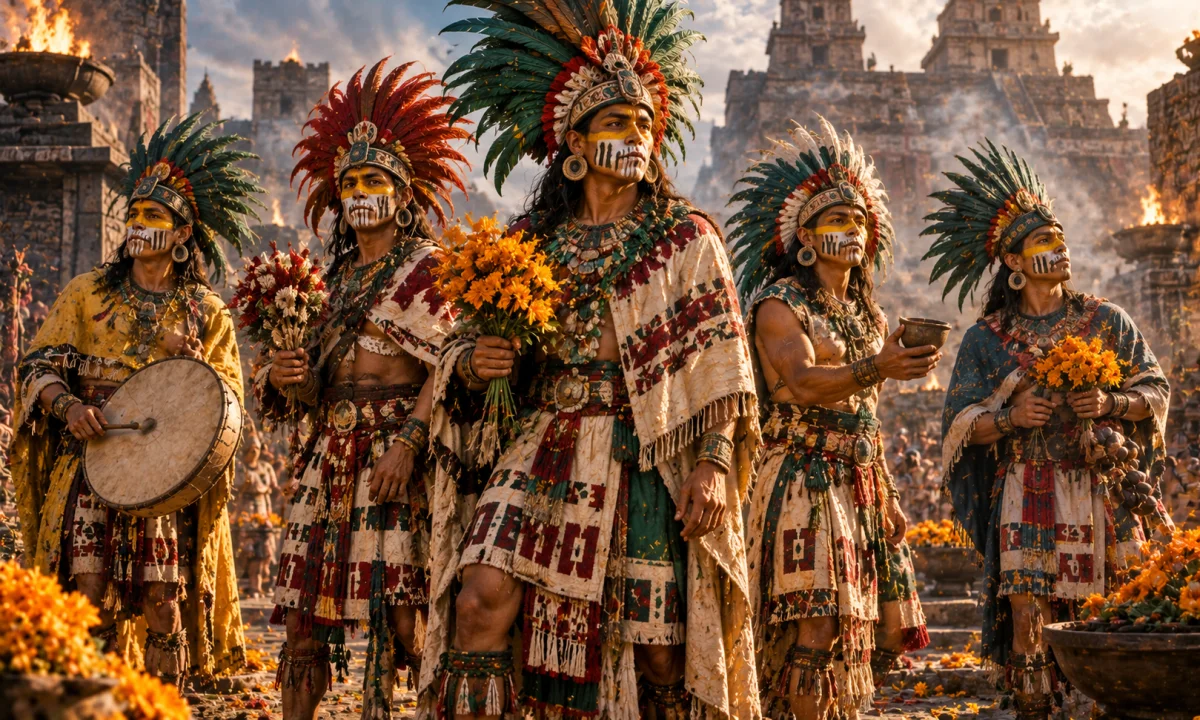
Maize deities could be represented through the plant itself, through a person impersonating the deity, or through offerings made from maize. Ritual impersonation was an important feature of central Mexican religion. A person selected to represent a deity might wear special clothing, ornaments, or sacred materials and participate in ceremonies as the deity’s living image. Such a person was not simply acting in a theatrical sense; the ritual created a temporary relationship between the human representative and the divine identity.
Cinteotl’s major symbolic associations include:
- Maize and food: the crop that supplied the principal staple of central Mexican society.
- Growth: the movement from seed to sprout, ear, harvest, and renewed planting.
- Fertility: the generative power of soil, rain, plants, animals, and human communities.
- Renewal: the return of life after the burial of seed in the earth.
- Reciprocity: the offerings and labour through which people maintained relationships with sacred powers.
These meanings overlap with those of other gods and goddesses. Cinteotl was not necessarily a god of agriculture in the broad sense of every crop, nor was every agricultural ceremony devoted to him. His strongest and most specific connection was with maize and the sacred processes surrounding it.
Myths of origin and transformation
Stories about the origin of maize often explain how a difficult-to-obtain substance became available to human beings. In one widespread Mesoamerican pattern, maize is hidden inside a mountain or other inaccessible place. A powerful being discovers that ants can enter the opening and uses their knowledge to obtain the grain. In central Mexican versions, Quetzalcoatl is frequently the figure who brings maize to humanity, sometimes after transforming himself or receiving assistance from ants.
Cinteotl is not the central protagonist in every version of this story. It is therefore inaccurate to claim that he universally “discovered” maize or that every maize-origin myth is specifically a story about his birth. His role belongs to the larger religious understanding of maize as a divine substance, whether the narrative focuses on Quetzalcoatl, a mountain, ants, the earth, or a maize deity.
Other traditions describe Cinteotl as the child of divine or semi-divine parents, with different sources naming figures such as Xochiquetzal or Piltzintecuhtli. Some accounts connect the maize god’s body with the emergence of useful plants. Motifs of this kind are difficult to reconstruct with certainty because they appear in varying forms and may have been interpreted differently by colonial writers.
In these stories, the transformation of a divine body into food is not merely a violent death followed by a miracle. It expresses a fundamental agricultural truth: new life comes from what is placed in the earth, and nourishment depends on cycles of decay, burial, growth, and harvest. This theme also helps explain why agricultural ceremonies could combine celebration, mourning, sexuality, sacrifice, and images of rebirth.
Festivals and ritual relationships
Cinteotl was connected with ceremonies in the agricultural calendar, particularly those involving maize, first fruits, and the renewal of vegetation. However, surviving descriptions do not provide a simple festival calendar in which one month belonged exclusively to him. Maize rituals frequently involved several deities whose functions overlapped.
Chicomecoatl played a major role in ceremonies for maize and sustenance. She was often represented with ears of maize and was honoured during rites connected with food and harvest. Xilonen was associated with young or tender maize and appears in accounts of seasonal ceremonies. Toci, whose name means “Our Grandmother,” was linked with earth, fertility, healing, and the renewal of vegetation. These figures could be placed in close ritual relationship with Cinteotl without becoming identical to him.
The festival known as Ochpaniztli involved rites concerning the earth, sweeping, fertility, maize, and the transition toward a new agricultural cycle. Accounts of the ceremony describe a woman who represented Toci and was sacrificed, after which a priest wore her flayed skin. A male figure associated with Cinteotl also appears in descriptions of the festival complex. The details are disturbing to modern readers, but within the ritual system they represented the transfer, renewal, or transformation of sacred power. The evidence is complex, and broad claims that the ceremony was simply “a sacrifice to Cinteotl” omit the participation of several deities and ritual identities.
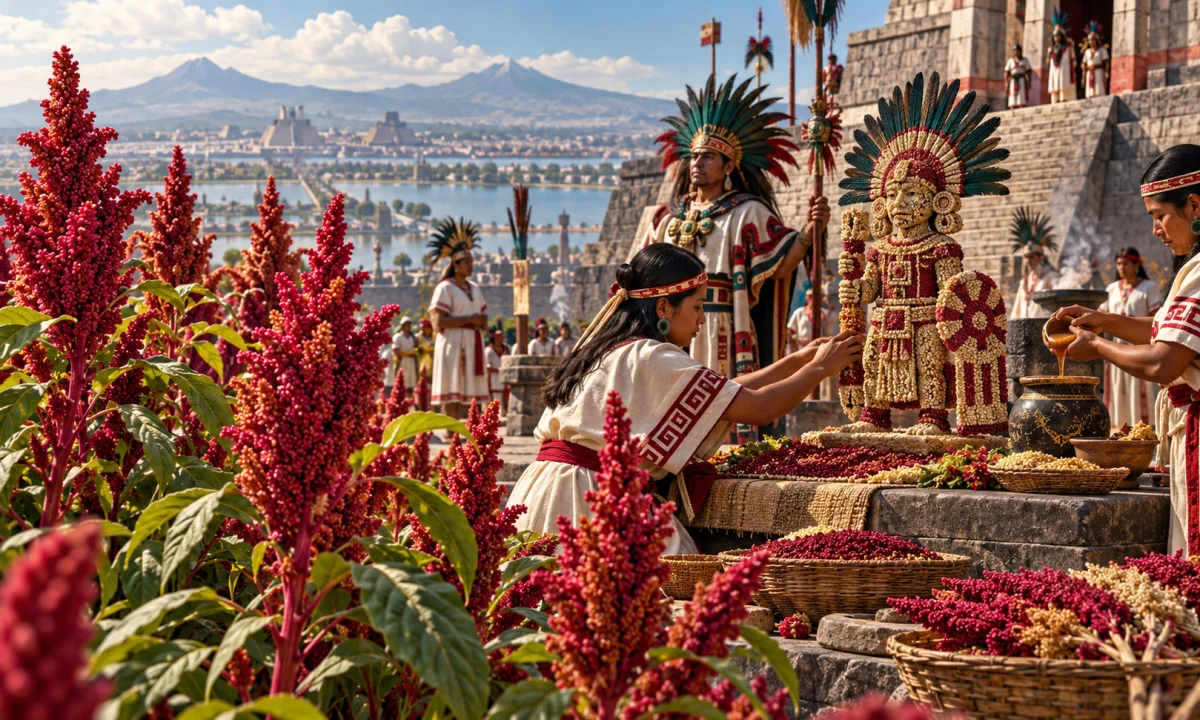
Other ceremonies involved offerings of maize dough, ears of corn, seeds, flowers, food, incense, and blood. Ritual participants could bless seed, dedicate the first produce of the season, or ask for rain and agricultural success. Such rites joined household practices with state religion. Farmers depended directly on the crop, while rulers and temples also depended on agricultural surplus to support cities, armies, markets, and ceremonies.
Relationships with other maize deities
Cinteotl is most often confused with Chicomecoatl because both are strongly associated with maize. They should not automatically be merged. Chicomecoatl is usually presented as a female deity of maize, food, and abundance, while Cinteotl is commonly presented as a male maize deity, often with the character of a young plant or youthful god. They could appear together in the same religious system because different aspects of maize were expressed through different divine figures.
Xilonen is another distinct figure. Her name is related to young maize, and she represents the tender stage of the crop. Because Cinteotl can also symbolize immature or growing maize, the two may seem interchangeable in brief summaries. The sources, however, preserve separate names and ritual identities.
Xochiquetzal is principally associated with beauty, sexuality, flowers, weaving, pregnancy, and fertility. Some genealogical traditions connect her with Cinteotl, but this relationship is not consistent enough to be treated as a universal feature of his mythology. Likewise, Cinteotl should not be confused with Quetzalcoatl, who appears in important maize-origin stories but is a much broader deity with associations including wind, knowledge, priesthood, and rulership.
Interpretation and cultural significance
Cinteotl demonstrates why Mesoamerican deities cannot always be understood through rigid modern categories such as “god of one thing.” A maize deity could also embody sexuality, death, earth, kingship, nourishment, social order, and the obligations that connected humans with the natural world. These associations were not random additions. They arose from the experience of cultivating a crop whose life depended on rain, soil, labour, time, and communal cooperation.
The deity’s significance also lies in the tension between dependence and agency. Human beings planted and tended maize, but they could not command rain or guarantee a harvest. Ritual therefore expressed both practical knowledge and recognition of forces beyond human control. Agricultural religion did not replace farming; it accompanied farming and gave its risks and rewards a sacred meaning.
Modern descriptions sometimes portray Cinteotl as a neatly defined “Aztec god of corn” with a fixed biography, standard costume, and unchanging list of powers. That presentation is convenient but can hide the variation in Nahua traditions. A more accurate understanding treats Cinteotl as a principal name within a changing network of maize symbolism, ritual impersonation, seasonal ceremonies, and stories about the origin and renewal of food.
Maize remains central to the lives, cuisines, landscapes, and cultural identities of many Indigenous peoples of Mexico and Central America. Contemporary respect for maize and the continuation of agricultural customs should not automatically be described as an unchanged survival of an ancient cult of Cinteotl. Present-day Indigenous traditions have their own histories and may combine precolonial, colonial, Christian, and modern elements. Even so, the enduring importance of maize provides essential context for understanding why a figure such as Cinteotl held such a powerful place in Nahua religious thought.