WORLD
WORLD
Chiconahuiehecatl
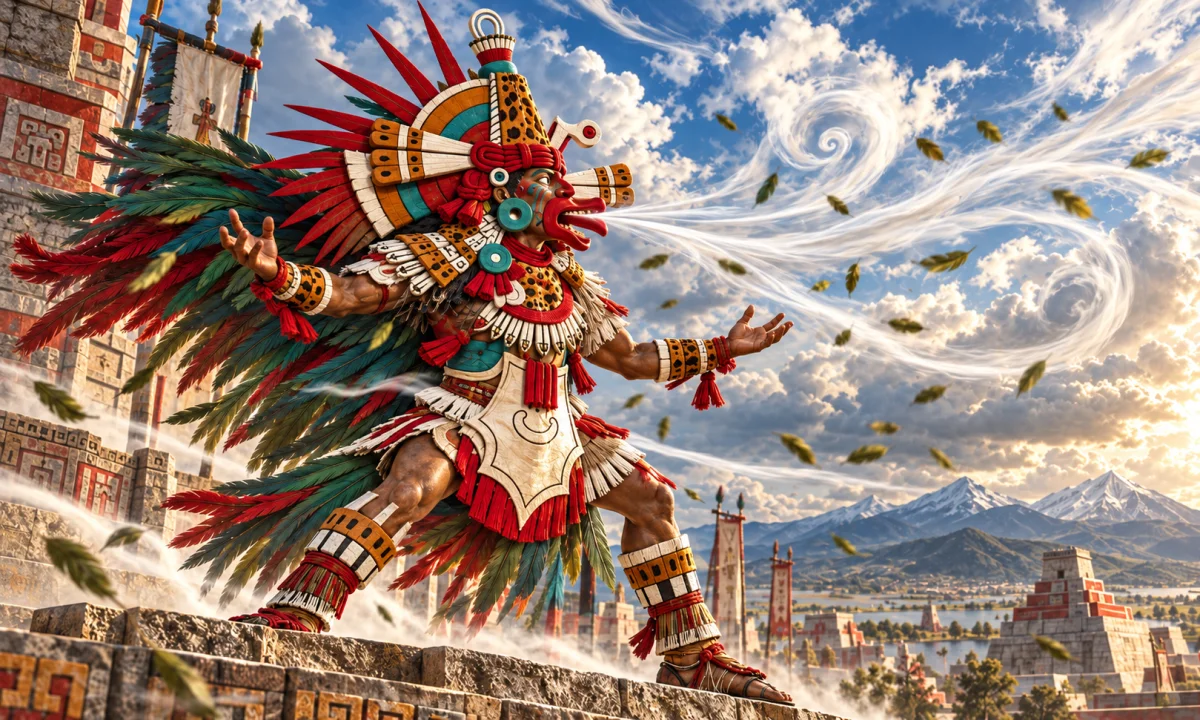
Chiconahuiehecatl is a Nahuatl name usually interpreted as “Nine Wind” or “Nine Wind-Breath.” In discussions of Aztec religion, it is most safely understood as a calendrical name, title or aspect associated with Ehecatl, the wind deity, and with Quetzalcoatl in his wind-related form. Evidence does not establish Chiconahuiehecatl as a completely separate god with an independent mythology. The name appears in a religious world in which numbers, day signs, divine titles and manifestations were closely connected.
The meaning of the name
The name is written in several ways, including Chiconahuiehecatl, Chiconahui Ehecatl and Chicnahui Ehecatl. These variations reflect differences in colonial spelling and in the modern transcription of Classical Nahuatl. The first element refers to the number nine, while ehecatl means “wind.” The literal sense is therefore “Nine Wind.”
Nahuatl religious names often combine a number with one of the twenty day signs used in the 260-day ritual calendar. A name such as Nine Wind may consequently identify a sacred day, a divine manifestation connected with that day, or a person whose calendrical name was Nine Wind. It should not automatically be treated as the personal name of a deity in the same way as Huitzilopochtli or Tlaloc.
The spelling Chiconahui is particularly familiar in older English-language discussions, but it should not be taken as evidence for a separate being called “Chiconahui.” The full expression is better understood as a form of “Nine Wind,” with orthographic variation between sources.
Wind in Aztec religious thought
Wind was more than a weather phenomenon in central Mexican religion. It was movement, breath and invisible force. Wind could announce a storm, clear the air, carry seeds and pollen, and give motion to clouds and celestial bodies. Breath was also closely connected with life. These associations made wind an important expression of divine power.
The principal wind deity of the Aztec religious tradition was Ehecatl. In many sources Ehecatl is not presented as wholly separate from Quetzalcoatl, the Feathered Serpent. Rather, Ehecatl is commonly understood as Quetzalcoatl’s wind aspect or as a closely related manifestation. The relationship between these names is not identical in every source, because Nahua religious traditions allowed gods to possess multiple names, forms and ritual identities.
Quetzalcoatl-Ehecatl was associated with breath, creation, fertility, the renewal of life and the movement of the sun. Wind could be destructive, but it was also a necessary force of animation. Without movement, the world was inert. This helps explain why a wind deity could be connected not only with storms but also with creation and the restoration of humanity.
Chiconahuiehecatl and the calendar
The Aztec ritual calendar, usually called the tonalpohualli, consisted of 260 days. Each day combined one of twenty signs with a number from one to thirteen. The cycle of numbers and signs created names such as One Crocodile, Four Jaguar or Nine Wind. These combinations were used in divination and could influence the interpretation of a day, a person’s character and the timing of ceremonies.
In this setting, “Nine Wind” may function primarily as a calendrical designation rather than as the name of a distinct divine personality. A day sign could nevertheless have strong religious associations. The sign Wind was linked to Ehecatl and to the wider Quetzalcoatl complex, while the number nine had its own ritual significance within the calendar and other forms of Mesoamerican symbolism.
It is therefore important to distinguish between three related possibilities:
- Nine Wind as a day name: a particular combination in the 260-day calendar.
- Nine Wind as a divine title or manifestation: a way of referring to wind power in a specific ritual or mythological context.
- Nine Wind as a separate god: an interpretation sometimes found in modern summaries, but not securely demonstrated by the surviving Aztec evidence.
These possibilities can overlap. Aztec religion did not always separate a calendar sign, a divine force and a named deity according to modern categories.
Relationship with Ehecatl and Quetzalcoatl
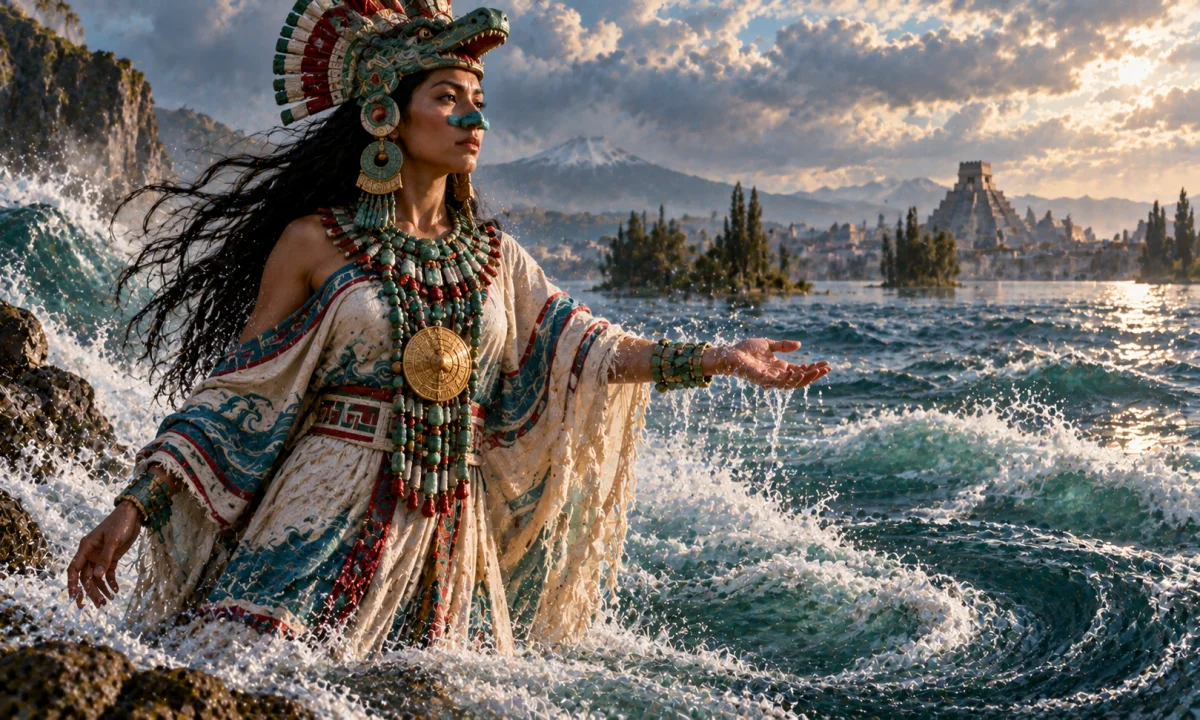
Most descriptions of Chiconahuiehecatl connect the name with Ehecatl rather than with an independent mythology. Ehecatl was often represented as a god with a projecting mouth or beaklike mask. This feature may refer to the wind’s ability to blow and to the god’s role in sending breath through the world. Circular temples and doorways are also associated with Ehecatl, perhaps because their forms allowed the wind to move freely around the structure.
A well-known sacred object connected with Ehecatl is the wind jewel, often described as a spiral or shell-like ornament worn near the chest. The object’s form evokes the curling motion of wind and is represented in several central Mexican artistic traditions. Some images of Quetzalcoatl-Ehecatl also show the god with a conical or pointed headpiece and other features associated with priestly or divine regalia.
These characteristics belong primarily to the broader Ehecatl-Quetzalcoatl tradition. There is no securely identifiable artistic type that can be labelled exclusively as “Chiconahuiehecatl.” If the name is used for Nine Wind in a particular interpretation, the relevant image may be that of Ehecatl or Quetzalcoatl rather than a separate figure with unique clothing and attributes.
Mythic themes associated with Nine Wind
No surviving Aztec narrative provides a complete, independent cycle of stories about Chiconahuiehecatl. The themes linked with the name therefore come from the traditions of Ehecatl and Quetzalcoatl, and from the significance of the Nine Wind calendrical combination.
One major theme is the giving of motion to the cosmos. In accounts of the creation of the current world age, the sun and moon do not move until divine action sets them in motion. Wind, as an invisible power capable of movement, is naturally associated with this cosmic transformation. Some accounts describe Ehecatl or Quetzalcoatl as playing a role in making the sun move, although the details differ between sources.
Another important theme is the recovery of human bones from the underworld. In the story commonly known as the creation of the present human race, Quetzalcoatl travels to Mictlan and obtains the bones of earlier beings. After overcoming obstacles, he helps bring about the creation of humanity. The surviving narratives do not consistently call the hero Chiconahuiehecatl, but the connection between Quetzalcoatl and wind makes the name relevant to interpretations of his life-giving and animating power.
Wind also had a purifying and transitional character. It moved between places, changed the atmosphere and marked the passage from stillness to action. A title meaning Nine Wind could therefore suggest a particular calendrical force rather than a fixed personality with a single function.
Sources and the limits of the evidence
Knowledge of Aztec religion comes from several kinds of evidence: Nahuatl-language manuscripts, alphabetic accounts written after the Spanish invasion, Indigenous pictorial manuscripts, archaeological remains and comparative study of central Mexican traditions. Each type of evidence has limitations.
The Florentine Codex, compiled in Nahuatl and Spanish under the direction of Bernardino de Sahagún with the assistance of Indigenous scholars and informants, preserves extensive information about gods, rituals, calendars and sacred stories. Other colonial Nahuatl works and pictorial manuscripts preserve additional names and images. However, these records were produced in a period of religious upheaval, and their authors did not always present divine identities in the same way.
Images from central Mexican codices can also be difficult to interpret. A figure may be identified by a day sign, an emblem, a costume or a scene rather than by an accompanying written label. Furthermore, the surviving manuscripts do not all come from the same community or date. Some are associated with regions outside the political centre of Tenochtitlan, even though they preserve related religious ideas.
For this reason, statements that Chiconahuiehecatl was a major Aztec god with a fixed genealogy, a unique appearance and a clearly defined set of myths should be treated cautiously. Such descriptions often result from turning a calendrical name or epithet into a fully independent deity.
Number nine and sacred identity
The number nine appears in several areas of Mesoamerican religious symbolism, including calendrical interpretation and ideas concerning the underworld. The Aztec underworld, Mictlan, was described as a place through which the dead passed through a series of difficult regions or trials. The number nine is also significant in other Mesoamerican traditions, although its meaning was not necessarily identical from one culture to another.
It would be misleading to assign a single universal meaning to the number in every appearance of “Nine Wind.” The significance of a numeral depended on the calendar, the text, the ritual situation and the tradition in which it occurred. In the name Chiconahuiehecatl, nine may be most important as part of the day-name system rather than as a simple statement that the god possessed nine winds or nine physical forms.
Distinction from other “Nine Wind” figures
Confusion is especially likely because “Nine Wind” is also important in Mixtec religious and historical traditions. In Mixtec pictorial manuscripts, a figure associated with the calendrical name Nine Wind can appear as a powerful creator, culture hero or divine being. This figure is sometimes compared with Quetzalcoatl because different Mesoamerican societies shared religious concepts, calendar structures and names built from similar day signs.
Such comparisons can be useful, but the Mixtec Nine Wind figure should not simply be identified with an Aztec Chiconahuiehecatl. The Mixtec codices have their own languages, political histories, artistic conventions and theological systems. A shared calendrical expression does not prove that the traditions describe precisely the same god.
Chiconahuiehecatl should also be distinguished from Nahui Ehecatl, “Four Wind,” which refers to the wind age or world era in Aztec accounts of the Five Suns. The similarity of the words can lead to confusion, but the numbers are different and the expressions serve different purposes. Nahui Ehecatl is associated with a cosmic age destroyed by wind, whereas Chiconahui Ehecatl means Nine Wind and is generally connected with the calendrical and divine identity of wind.
Cultural significance
Chiconahuiehecatl illustrates the difficulty of translating Aztec religious categories into modern ones. A name could be a date, a personal name, a title, an omen or a manifestation of a larger deity. The boundaries between these categories were not always rigid. A sacred day was not merely a point on a calendar: it could possess a character, influence human affairs and be linked to a divine power.
Understanding the name through Ehecatl and Quetzalcoatl also highlights the importance of movement and breath in Nahua thought. Wind was unseen but perceptible, capable of both destruction and renewal. It represented the force that animates the world, carries divine influence and changes one condition into another.
In modern popular culture, the name Chiconahuiehecatl may be presented as a standalone wind god, sometimes with invented powers, genealogy or visual design. Such portrayals can draw inspiration from Aztec terminology, but they should not be confused with securely documented pre-Hispanic tradition. The strongest historical interpretation treats Chiconahuiehecatl as “Nine Wind,” a calendrical and religious expression associated with Ehecatl and the wind aspect of Quetzalcoatl, while leaving open the precise meaning it held in any particular source or ritual context.