WORLD
WORLD
Chicomexochtli
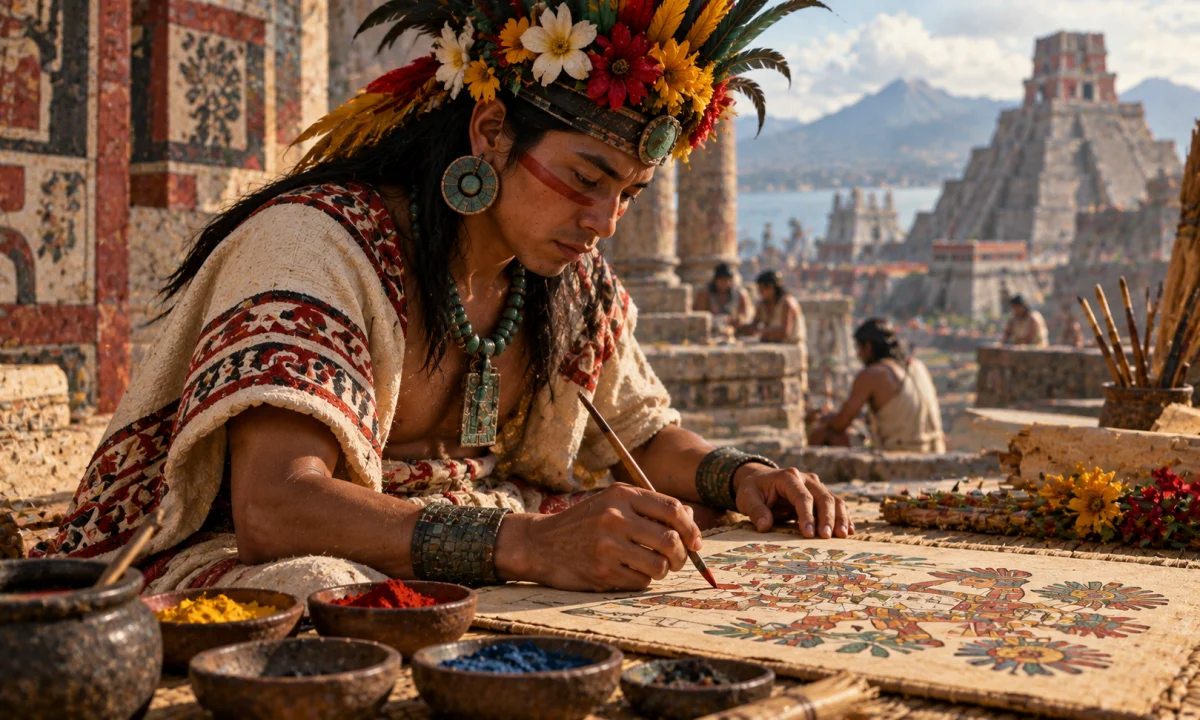
Chicomexochtli is a little-known figure in the religious traditions of central Mexico. His name is usually written in English as Chicomexochtli or Chicomexochitl and is commonly interpreted from Nahuatl as “Seven Flower.” In colonial descriptions of Nahua religion, he is associated especially with painters and painting. The surviving evidence is brief, however, and does not provide a large body of myths or a single, fully consistent portrait.
Name and identity
The name Chicomexochtli comes from the Nahuatl elements chicome, “seven,” and xōchitl, “flower.” Colonial orthographies vary considerably, so forms such as Chicomexochitl, Chicomexochtli, Chicome Xochitl and Chicome Xōchitl may refer to the same name. The spelling with -tl reflects a common way of recording Nahuatl words in sixteenth-century Spanish writing rather than a separate religious identity.
“Seven Flower” may have been a calendrical name as well as a divine name. In the Mesoamerican calendar system, numbers were combined with day signs, and Flower was one of the twenty day signs used in the 260-day ritual calendar. A person, deity or supernatural being could therefore be identified through a number-and-day-sign combination. The name does not, by itself, explain all of Chicomexochtli’s functions, and the significance of the number seven in his particular cult is not securely documented.
The most familiar classification of Chicomexochtli is as a patron of painters. Some descriptions treat him as a deity of painting or as a supernatural protector of painters, but the available material does not establish a sharply defined rank in the Aztec pantheon. He is not as extensively documented as Huitzilopochtli, Tlaloc, Quetzalcoatl, or the major maize deities. It is therefore safer to describe him as a specialized Nahua deity or patron figure connected with painting than to present him as one of the central gods of the Mexica state.
Cultural setting
Painting was not regarded merely as a private artistic pastime in central Mexican religious culture. Painted images appeared on temples, shields, ceramics, ritual objects, manuscripts and tribute records. Specialists who produced these images worked within a world in which pictures could preserve history, communicate religious knowledge and give visible form to gods, ancestors, places and ceremonies.
Nahuatl terms for painters and scribes could overlap in meaning because the same broad class of specialists might produce painted manuscripts and other important visual records. The Nahua word tlacuilo, often translated as “painter” or “scribe,” referred to a person trained in the production of painted signs and images. Such work required technical skill, knowledge of conventional symbols and familiarity with religious and political traditions. A patron associated with painters would therefore have belonged to a specialized and culturally important sphere rather than to an unimportant craft.
Painted manuscripts were not books in exactly the same form as European alphabetic volumes. They used combinations of images, signs, colors, place symbols, calendrical information and scenes of ritual or historical importance. Their interpretation depended on trained knowledge. Even when a manuscript was produced for administrative or historical purposes, visual representation remained connected with the broader religious understanding that signs and images could make invisible powers intelligible.
Surviving evidence
Knowledge of Chicomexochtli comes primarily from sources recorded after the Spanish invasion. The most important body of evidence for central Mexican religion was gathered by Franciscan missionaries, especially Bernardino de Sahagún, working with Nahua speakers and scholars. The Florentine Codex and related manuscripts preserve names and descriptions of many deities, including figures connected with particular professions and ritual activities.
These records are valuable but must be read carefully. They were produced in a colonial setting, through conversations shaped by Christian questions and European methods of classification. Some information was recorded in Nahuatl, some was translated or summarized in Spanish, and descriptions do not always preserve the exact form of pre-conquest religious practice. The records also tend to provide uneven information: a deity may be named and assigned a function without receiving a surviving myth, prayer or detailed account of worship.
Chicomexochtli belongs to this less fully documented group. The sources associated with him do not preserve an extensive cycle of stories comparable to the myths of the sun, the earth, or the great creator and culture heroes. Nor is there enough evidence to reconstruct a major state festival devoted exclusively to him. His importance is instead suggested by his association with a skilled and symbolically significant occupation.
Images in surviving codices cannot always be assigned to Chicomexochtli with confidence. Mesoamerican manuscripts use complex visual conventions, and the same colors, ornaments or body positions may occur in representations of different beings. A figure in a manuscript should not be identified as Chicomexochtli solely because it carries a flower or resembles a patron of artists. Written labels, contextual information and comparison with related sources are necessary, and even then the result may remain uncertain.
Role as a patron of painters
Chicomexochtli’s principal recorded role is that of a divine patron of painters. In this context, “painter” should be understood broadly. The relevant specialists may have worked on manuscripts, ritual objects, architectural decoration or other surfaces, although the surviving descriptions do not specify every activity connected with the deity.
A patron deity could be more than a symbolic representative of a profession. Religious specialists and artisans often operated within networks of ritual obligation. Their work might be accompanied by offerings, prayers, observances or ceremonies intended to secure success and avoid danger. The evidence for Chicomexochtli does not allow a detailed reconstruction of such practices, but his association with painters suggests that visual knowledge itself could be understood as something requiring divine protection.
Painting also had a relationship to memory and authority. A painted record could establish a claim to land, preserve the history of a ruling house, identify a community, or show the proper order of a ceremony. Religious images were not simply illustrations placed beside an independent text. They participated in the communication of meaning. A god connected with painters could therefore be associated indirectly with the preservation, transmission and correct representation of knowledge.
His name, “Seven Flower,” reinforces a connection with beauty and visual expression, although this interpretation should be treated as suggestive rather than certain. Flowers had rich associations in Nahua culture. They could represent beauty, preciousness, vitality and the refinement of speech or song. The famous expression in xōchitl, in cuīcatl, “flower and song,” referred to poetry and artistic expression. That broader symbolism makes a flower name appropriate for a deity linked with painting, but the surviving sources do not explicitly explain Chicomexochtli through this phrase.
Attributes and appearance
No universally accepted description of Chicomexochtli’s appearance survives. Modern illustrations sometimes portray him as a richly ornamented male deity holding a brush, pigment container or flower. Such details may communicate his association with painting, but they should not automatically be treated as securely attested ancient attributes.
The same caution applies to claims that he had a particular body color, headdress, animal companion or weapon. Mesoamerican artists used costume and color to identify deities, but many visual elements were shared among several figures. In the case of a relatively obscure deity, later artists and modern reference works may combine general Aztec visual conventions with reasonable but unproven assumptions.
It is also uncertain whether Chicomexochtli had one stable form across all Nahua-speaking communities. Central Mexico contained many related but politically independent traditions. The Mexica of Tenochtitlan, the peoples of neighboring cities, and communities farther from the imperial capital could preserve different names, local emphases and ritual associations. A short colonial description should not be expanded into a uniform portrait for every Nahua society.
Relationship to other gods
Chicomexochtli is sometimes discussed in connection with Xochipilli, the deity associated with flowers, music, dance, games and other pleasurable or creative activities. The association is understandable because both figures have names or functions connected with flowers and artistic expression. Nevertheless, the evidence does not justify simply declaring them identical. A deity could share attributes or belong to a related religious sphere without being the same being.
Xochipilli is a much more prominent and better-documented figure, with a wider range of associations. Chicomexochtli’s surviving description is narrower, centering on painters. Some modern accounts may merge the two because both can be placed under the broad category of art, but this is an interpretive connection rather than an established equivalence.
Chicomexochtli should also be distinguished from Chicomecōātl, whose name is usually translated as “Seven Serpent” or “Seven Serpents.” Chicomecōātl is a major central Mexican maize goddess, associated with maize, agricultural abundance and the sustenance of human life. The similarity between the names is limited mainly to the element chicome, “seven.” The flower element in Chicomexochtli and the serpent element in Chicomecōātl indicate different names and different traditional identities.
Confusion can also arise because forms of the name Chicomexochitl occur in other Mesoamerican regional traditions. In some ethnographic and historical contexts, a figure with this name is connected with maize, agriculture or fertility rather than primarily with painters. These traditions should not be automatically folded into the central Mexican patron of painting. They may reflect regional developments, related calendrical naming practices, or distinct beings whose names happen to be similar. The surviving evidence is not sufficient to prove that every Chicomexochitl represents one pan-Mesoamerican deity.
Interpretation and significance
Chicomexochtli illustrates how the Nahua religious world included specialized divine patrons alongside powerful gods of war, rain, maize and rulership. Religious life was not concerned only with cosmic events. It also encompassed the occupations and skills through which communities were organized and their knowledge preserved.
His connection with painting reveals the high status of visual expertise. A painter working on a manuscript or sacred object was not simply decorating a surface. The work could encode genealogies, places, calendrical cycles, ritual instructions and divine identities. Accuracy mattered because a mistake in an image or sign could alter meaning. A patron of painters thus represents the religious dimension of disciplined technical knowledge.
The name “Seven Flower” may also point toward the calendrical and aesthetic dimensions of Nahua culture. Numbers and day signs were not merely methods of counting time; they could form personal names, identify ritual qualities and situate events within an ordered universe. Flowers, meanwhile, were connected with beauty and expressive culture. Yet these associations should remain part of a careful interpretation, not be presented as a complete theology of Chicomexochtli.
Because the evidence is sparse, Chicomexochtli is especially vulnerable to imaginative reconstruction. It is tempting to give him a complete mythology, a fixed appearance, a temple and a detailed set of rituals. No such reconstruction is securely supported by the principal colonial records. The most defensible description remains modest: Chicomexochtli was a Nahua deity or patron figure named “Seven Flower,” recorded chiefly in connection with painters and painting, with additional regional and interpretive associations that remain uncertain.
Later reception
Chicomexochtli has had little presence in mainstream modern popular culture compared with Quetzalcoatl, Tezcatlipoca or Huitzilopochtli. He may appear in encyclopedic lists of Aztec gods, educational material about Mesoamerican religion, or modern discussions of ancient artists. In such settings, his designation as a god of painting is often repeated without the qualifications attached to the limited source material.
Contemporary illustrations may give him brushes, palettes, flowers or the elaborate costume of a major Aztec deity. These images can be useful imaginative interpretations, but they are not necessarily reconstructions based on an identified ancient portrait. Modern fantasy, games and fiction may also expand his role into a general god of creativity or art. Such portrayals belong to modern adaptation and should be kept distinct from the narrow evidence for his traditional identity.