WORLD
WORLD
Chup Kamui

Chup Kamui is a name associated with the celestial world in Ainu religious tradition, especially with the moon or a moon-related kamuy. The Ainu are an Indigenous people of northern Japan and the southern Kuril region, with a traditional culture extending across Hokkaido, Sakhalin and neighbouring areas. Although Chup Kamui is often presented in modern summaries as an Ainu moon deity, the name, spelling and precise identity vary between sources and Ainu dialects. It should therefore not be treated as the universally fixed name of one deity in the manner of a figure from a single canonical mythology.
The Ainu religious setting
Ainu religion traditionally understands the world as inhabited by kamuy. The word is frequently translated as “god,” “deity” or “spirit,” but none of these English terms fully captures its range. Kamuy may be powerful beings associated with animals, natural phenomena, places, household objects or aspects of human life. They are understood as existing in a realm of their own and appearing in the human world in forms that people can encounter.
Important kamuy include Kamuy Fuchi, the hearth deity; Kim-un Kamuy, the mountain and bear-associated kamuy; Repun Kamuy, associated with the sea; and Cikap Kamuy, commonly connected with birds or an owl. The Ainu relationship with kamuy is traditionally reciprocal. People show respect through prayers, ritual objects, offerings and correct conduct, while kamuy provide food, protection, knowledge or other benefits.
The sky is also populated by powerful beings. The sun, moon and stars are not merely physical objects in traditional Ainu thought. They can be understood as living or personified powers who follow their own paths and participate in the moral and religious order of the world. Chup Kamui belongs to this celestial sphere, although surviving descriptions do not establish one uniform account of the figure across all Ainu communities.
Name and spelling
The form Chup Kamui is a Romanized spelling used in English-language and Japanese-language discussions. Other forms include Chup Kamuy, Cup Kamuy and names containing kunne or other descriptive elements. The difference between kamui and kamuy generally reflects different systems for representing Ainu pronunciation rather than two separate religious beings.
The first element is also written in more than one way. Depending on dialect, transcription and interpretation, chup or cup may be connected with a heavenly light or celestial body, and is often rendered in modern summaries as “moon.” Some sources use the name for the moon itself or for a moon deity, while others distinguish between names for the day sun and the night moon. Because Ainu was historically transmitted primarily through speech, and because early records were written by outsiders using inconsistent systems, the exact meaning of a short name can be difficult to determine.
Names such as Kunne Chup Kamuy or Kunnechup Kamuy are sometimes associated with the dark or night celestial body and may be translated as a moon-related deity. In other contexts, Chup Kamuy is treated as a more general lunar name. These forms should not automatically be collapsed into one figure. A careful description identifies the variation instead of assuming that every occurrence refers to precisely the same being.
Chup Kamui as a celestial being
When Chup Kamui is identified with the moon, the figure represents the moon’s presence in the night sky and its place within the ordered movement of the heavens. The moon’s changing appearance naturally makes it a powerful subject for traditional explanation. Its phases, disappearance and return can be connected with stories about the conduct, responsibilities or relationship of celestial beings.
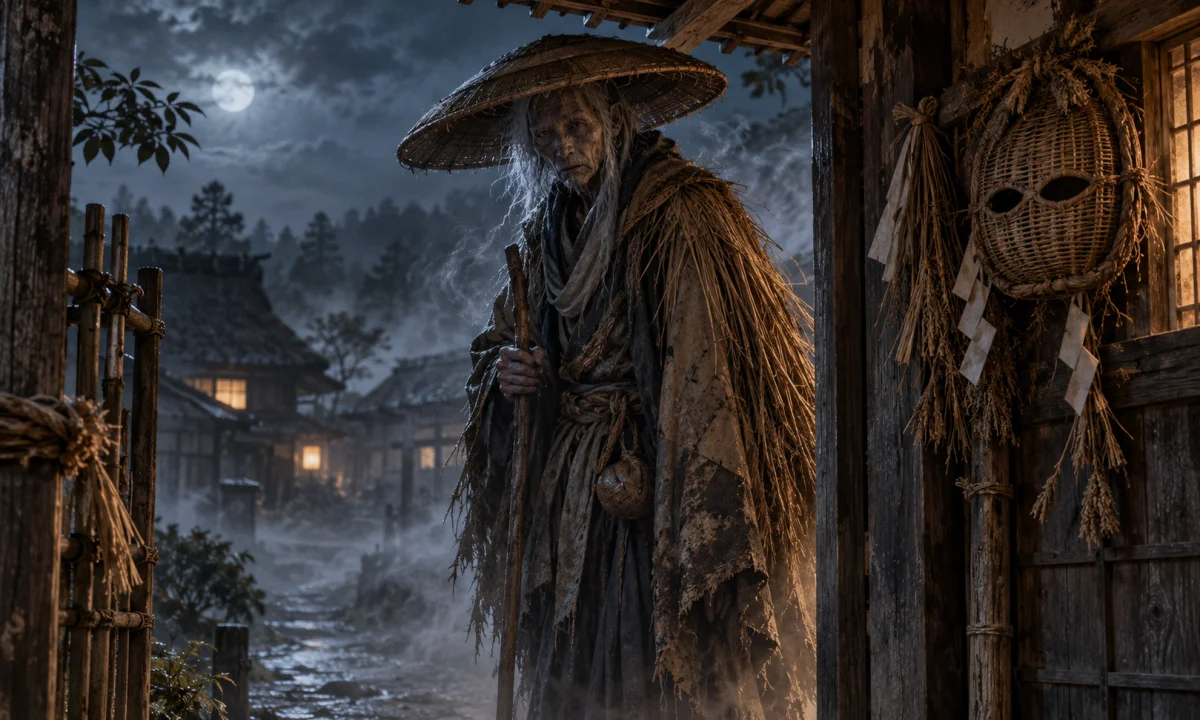
Unlike some better-known kamuy, Chup Kamui does not have a consistently recorded physical appearance. The figure is generally understood through the moon or lunar light rather than through a standardized human form, animal form or distinctive set of ritual attributes. Images showing a heavily personified moon deity should therefore be regarded as artistic interpretation unless a particular Ainu tradition is being discussed.
Nor is there a single agreed list of powers. A lunar kamuy may be described as governing or embodying the moon, but claims that Chup Kamui specifically controls fertility, tides, dreams, childbirth, hunting success or weather require evidence from a particular source or regional tradition. Such associations are sometimes added in modern retellings because lunar deities in many cultures are linked with these subjects. They should not be assumed to belong to Chup Kamui simply because they are common elsewhere.
Sun and moon traditions
Ainu oral traditions include accounts of the sun and moon as related celestial beings. In some versions, the sun and moon are siblings; in others, they are described through contrasting roles or as beings whose movements explain the division between day and night. The details vary according to the community, storyteller and recorded version.
Some traditions distinguish a daytime sun kamuy from a nighttime moon kamuy by using separate descriptive names. The sun may be associated with the visible brightness of day, while the moon belongs to the darkness and changing light of night. This contrast is not necessarily a simple opposition between good and evil. Day and night are both necessary parts of the world’s order, and the celestial beings may have complementary responsibilities.
Stories about the sun and moon can also express ideas about distance, duty and proper behaviour. A celestial being who fails in a task, behaves improperly or cannot meet another being may become separated from the human world or assigned a particular path across the sky. The precise plot, however, cannot be safely reduced to one official “myth of Chup Kamui.” The Ainu mythological record consists of many orally transmitted narratives, including long epic songs, personal prayers and local accounts, rather than a single standardized sacred book.
Sources and the limits of the evidence
Knowledge of Ainu religion comes from several kinds of material: orally preserved narratives, ritual language, songs, prayers, ethnographic records, linguistic study and accounts written by Ainu storytellers or by non-Ainu observers. These materials do not all use the same spelling or interpret religious terms in the same way. Early ethnographic descriptions may also reflect the assumptions of the people who recorded them.
The Ainu epic tradition, often called yukar, contains narratives about divine beings, culture heroes and encounters between human and non-human worlds. Other genres preserve shorter myths and ritual expressions. A name appearing in one narrative does not necessarily have the same meaning in every region. A word translated as “moon,” “sun,” “light” or “celestial being” may involve dialect differences or an interpreter’s choice.
For this reason, Chup Kamui is best described as a variable and incompletely documented lunar or celestial figure. The identification with the moon is common, but the evidence does not support presenting one detailed biography, fixed genealogy or universal set of myths as though these were accepted throughout Ainu tradition.
Religious significance
The importance of Chup Kamui lies less in a dramatic catalogue of adventures than in the wider Ainu understanding of the relationship between humans, nature and the divine. The moon is part of a living environment populated by powers that must be treated with respect. Celestial order, like the order of forests, rivers, mountains and households, is not separate from religious life.
The night sky could also function as a framework for time and observation. A community living through seasonal hunting, fishing, travel and agricultural activity would pay attention to recurring natural patterns. That practical awareness does not by itself prove that Chup Kamui had a specific calendrical office or controlled a particular activity. It does, however, help explain why celestial beings could hold religious significance within an oral culture closely attentive to the natural world.
Ainu religion does not require every natural phenomenon to be represented by a deity with a complete human-like personality. Some kamuy are encountered through the beings or things they animate, while others appear in stories, dreams, prayers or ritual speech. Chup Kamui may therefore be meaningful as the sacred identity of lunar light even where surviving accounts provide little narrative detail.
Distinction from similar names
Chup Kamui should not be confused with Cikap Kamuy, whose name is connected with a bird or bird-associated kamuy. The two names can look similar in Romanized spelling, but they belong to different semantic fields. Cikap Kamuy is also sometimes discussed in connection with an owl and with knowledge or communication, depending on the tradition being described; that figure is not a lunar deity.
Chup Kamui is also distinct from Kamuy Fuchi, the hearth deity. Kamuy Fuchi is one of the most important household and ritual figures in Ainu religious life, and fire serves as a medium through which prayers and offerings may be conveyed. Nothing in the name Chup Kamui makes the lunar figure a fire deity or a form of Kamuy Fuchi.
Names for the sun should likewise be handled carefully. Some sources distinguish a daytime sun kamuy from a night or moon kamuy, while others use broader celestial terminology. A reference to a “sun god” in an Ainu context is not automatically a reference to Chup Kamui, and the presence of a related sun-and-moon story does not mean that the two figures are interchangeable.
Modern representation
In modern books, websites and fantasy settings, Chup Kamui may be presented as a clearly defined moon goddess or moon god with a personal appearance, powers and mythology. Such portrayals can make an obscure name more familiar, but they often combine Ainu terminology with general imagery drawn from global fantasy, astrology or other mythological traditions.
The gender of Chup Kamui is not consistently established in the surviving material. Some summaries assign a gender because they interpret the moon as a male or female figure in a particular story, while others use gender-neutral language. It is more accurate to preserve the uncertainty unless a specific regional narrative gives the being a defined identity.
Contemporary interest in Ainu mythology has grown alongside broader recognition of Ainu history, language and cultural rights in Japan. This creates an important distinction between respectful cultural study and the extraction of isolated names for fictional use. Ainu religious terms should not be treated as interchangeable decorative labels, and a modern adaptation should not be presented as evidence for an ancient tradition.
Chup Kamui is therefore best understood as a name connected with Ainu ideas about the moon and the sacred sky, with its exact meaning dependent on spelling, dialect and source. The figure belongs to a living cultural tradition whose diversity is more significant than the simplified image of a single, universally defined lunar god.