WORLD
WORLD
Chiminigagua
Chiminigagua is a creator figure in the traditional religious worldview of the Muisca, an Indigenous people of the northern Andes whose historical homeland lay mainly on the high plateau of present-day central Colombia. In accounts recorded during the Spanish colonial period, Chiminigagua is associated with the origin of light, the ordering of the cosmos and the creation of the world. The figure is sometimes described as a supreme god, but that label can be misleading if it suggests a single, fully defined deity comparable to a figure in a standardized pantheon. The surviving descriptions are limited, vary in detail and were written by outsiders after the Spanish conquest.
The Muisca cultural setting
The Muisca lived in the Altiplano Cundiboyacense, a highland region centred on the present-day departments of Cundinamarca and Boyacá. Their political world included important communities around Bacatá, the area later occupied by Bogotá, and Hunza, associated with present-day Tunja. Rather than forming one centralized empire, the Muisca lived in a network of chiefdoms and local territories connected by trade, ritual practices and related language and customs.
Muisca religion was closely connected to landscape, agriculture, water, fertility, celestial bodies and the authority of local rulers. Lakes, mountains, caves and other places could carry religious significance. The Spanish accounts that preserve stories about Chiminigagua also describe other important beings, including Bochica, a civilizing or teaching figure; Bachué, a mother and ancestral figure; Sué, associated with the sun; Chía, associated with the moon; and Chibchacum, a powerful being linked in later accounts with the land and catastrophic flooding.
These figures should not automatically be arranged into a single, fixed family tree. The surviving records combine information gathered from different Muisca communities and often interpret Indigenous beliefs through Christian categories such as “God,” “devil,” “idol” and “creation.” As a result, the religious system reconstructed from colonial documents is useful but incomplete.
Sources and historical limits
The Muisca did not leave a surviving written theological tradition comparable to the sacred books of some other American civilizations. Knowledge of Chiminigagua comes principally from Spanish colonial chronicles, missionary reports, administrative descriptions and later compilations based on those materials. These records were produced after conquest and were shaped by the interests and assumptions of European writers.
The chroniclers did not always agree with one another. They may have translated Muisca concepts into familiar Christian language, treated different local traditions as parts of one system or recorded names with inconsistent spelling. Some narratives were probably obtained through interpreters, while others may have been rearranged by the writers who preserved them. For this reason, statements about Chiminigagua should be understood as accounts of Muisca traditions as recorded in colonial sources, not as a verbatim transcript of a single ancient scripture.
Archaeological evidence confirms the importance of ritual activity, offerings, water places and celestial symbolism in the Muisca world, but archaeology cannot independently verify every detail of the creation story. Nor can a modern retelling confidently claim that one version represents the belief of all Muisca communities.
Name and identity
The most common spelling is Chiminigagua, although historical records and modern reference works may use variant spellings. The precise linguistic meaning of the name is not securely established. It is often translated or paraphrased as a creator, supreme being or source of light, but these descriptions express the figure’s role in the recorded myths rather than providing a certain word-for-word etymology.
Chiminigagua is best understood as a cosmic creator and principle of light. In some descriptions, the figure appears more like a supreme divine power than a human-shaped god with a detailed personality. The accounts do not consistently provide a physical appearance, genealogy or place of residence. This absence is significant: Chiminigagua is not known primarily through a set of vivid adventures or a clearly defined anthropomorphic form.
Colonial authors sometimes called Chiminigagua the “creator of all things” or compared the figure with the Christian God. Such comparisons can be useful as rough explanations of the figure’s status in the stories, but they should not be treated as proof that Muisca theology was simply a local version of Christian monotheism. The available evidence does not establish a complete doctrine of one exclusive god, nor does it show that all Muisca religious practices were directed solely to Chiminigagua.
The beginning of light
The central theme associated with Chiminigagua is the emergence of light from an original condition of darkness. In the best-known colonial accounts, the world at the beginning was dark, and Chiminigagua brought forth or released light. The story presents light not merely as physical illumination but as the condition that makes the visible and ordered world possible.
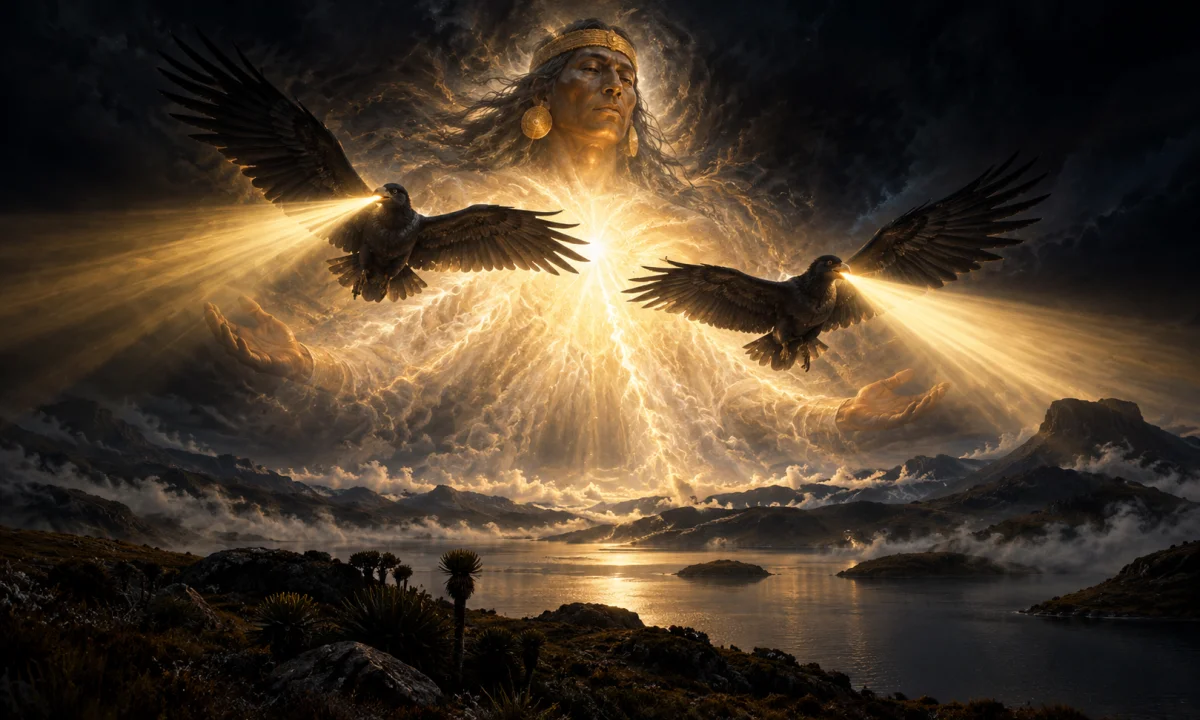
One version describes Chiminigagua as containing or possessing the light and then sending it outward. Other retellings say that the creator released luminous birds, often described as black, which flew through the darkness and emitted light. The details differ between accounts and are sometimes simplified in modern summaries. The bird episode should therefore be presented as a feature of one recorded version or group of versions, not as an uncontested element of every Muisca tradition.
The contrast between darkness and light gives the story a cosmological structure: before the world could be perceived and inhabited, illumination had to be established. Chiminigagua’s role is consequently less that of a warrior or ruler than that of an originating power who makes existence and knowledge possible. The story also places celestial and atmospheric imagery at the centre of creation, reflecting the importance of the sun, sky and cycles of nature in highland agricultural life.
Light, the sun and the moon
Chiminigagua should not simply be identified with Sué, the sun, or Chía, the moon. In accounts that distinguish these beings, Chiminigagua is the creator or source associated with the original light, while Sué and Chía are celestial figures with their own identities and religious significance. The precise relationship among them is not uniform in the sources.
Some retellings make Chiminigagua the source from which the sun and moon, or their light, ultimately derive. Others present the celestial bodies as separate sacred powers within a larger creation. These variations may reflect differences among communities, translation choices or the tendency of chroniclers to organize unfamiliar traditions into a coherent system. It is safer to describe Chiminigagua as connected with the origin of light than to claim that the figure is simply another name for the sun.
This distinction also prevents confusion with solar creator deities from other American traditions. Chiminigagua is not a Muisca equivalent of the Aztec Huitzilopochtli or Tonatiuh, nor should the figure be identified with the Inca Viracocha merely because all have been described in modern writing as creators. Similar functions do not establish historical identity or direct cultural borrowing.
Relationship with Bochica and other Muisca beings
Chiminigagua is sometimes linked with Bochica, the culture hero who appears in colonial accounts as a teacher, lawgiver and bringer of social order. Bochica is also associated in some versions with the draining of a great flood by opening a passage through the mountains, a story connected with the origin of the Tequendama Falls. Certain accounts describe Bochica as acting under the authority of, or as an emissary of, the supreme creator.
That relationship is not fully consistent. Some sources treat Bochica and related names such as Nemqueteba as versions of the same culture hero, while others distinguish them. Chiminigagua and Bochica should not be merged simply because both may be described as beneficent or civilizing figures. Chiminigagua belongs primarily to the beginning of the cosmos and the establishment of light; Bochica’s stories focus more on human society, moral instruction, agriculture, law and the reshaping of the landscape.
Bachué is likewise a distinct figure. In a well-known Muisca origin tradition, she emerges from the waters of a lagoon with a child who later becomes her partner, and together they populate the land. Their descendants become the ancestors of the Muisca. This makes Bachué an ancestral mother and origin figure, not simply another name for Chiminigagua. The existence of several creation and origin narratives suggests that Muisca religious thought did not depend on one single mythic explanation.
Chibchacum, associated in colonial narratives with flooding and the protection or punishment of the people, also has a separate identity. Stories about him belong to a different part of the religious landscape and should not be folded into the account of Chiminigagua’s creation of light.
Religious meaning
Chiminigagua’s importance lies in the figure’s position at the threshold between nonexistence or darkness and an inhabited, visible world. Light can be understood as a symbol of life, order, perception and the possibility of human activity. In an agricultural society dependent on seasonal cycles and environmental knowledge, the establishment of light also carries practical significance: it makes the heavens, land and changing natural conditions available for observation.
The creator’s relative lack of a detailed body or personal biography may indicate that the figure functioned differently from local spirits associated with a particular place or natural force. It would be misleading, however, to turn this observation into a firm theological rule. The colonial records are too fragmentary to determine exactly how ordinary Muisca communities imagined Chiminigagua, how often the figure was invoked in daily ritual or how the figure’s status related to local sacred beings.
Nor is there secure evidence for a single standardized cult devoted exclusively to Chiminigagua. Muisca ritual life included offerings and ceremonies connected with lakes, fertility, leadership, healing, warfare, agriculture and other concerns. The creator’s cosmic role could coexist with devotion to more immediate powers and ancestors. A broad category such as “supreme god” therefore does not capture the full diversity of Muisca religious practice.
Offerings and the danger of simplification
The Muisca are widely associated with offerings of precious materials, including gold objects, emeralds, ceramics and other valuable goods. These offerings are especially connected in popular memory with the story of El Dorado, which refers originally to a ritual involving a ruler covered with gold dust and offerings made at a lake, usually associated with Lake Guatavita. The Spanish transformed this ritual tradition into the legend of a fabulous golden country or king.
There is no sound basis for treating Chiminigagua as the “god of El Dorado” or as the specific recipient of every Muisca offering. The El Dorado tradition belongs to a particular ritual and its later colonial transformation. Muisca offerings had varied purposes and were directed within a wider religious world. Connecting every important Muisca practice to Chiminigagua creates a unified system that the historical evidence does not support.
Colonial interpretation and modern understanding
Spanish writers were interested in finding Indigenous parallels to Christian creation, providence and divine authority. When they described Chiminigagua as a creator or supreme being, they may have preserved an important Muisca idea, but they also framed it through European theological language. The resulting portrait is therefore both valuable and mediated.
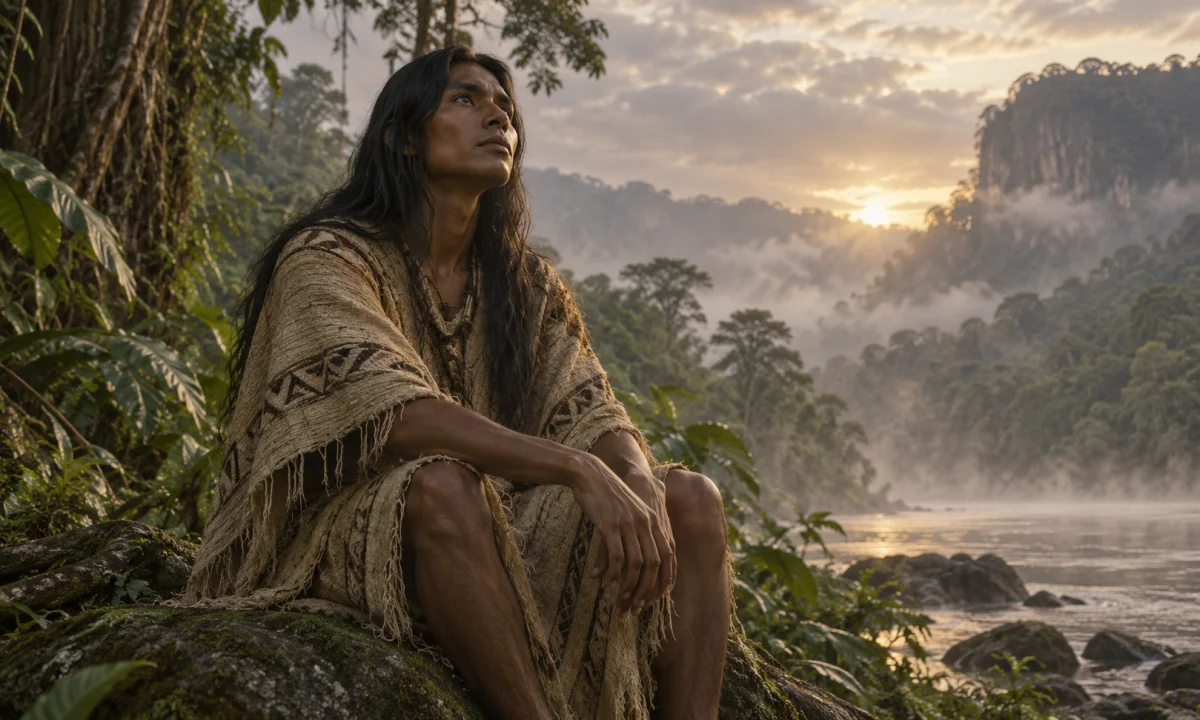
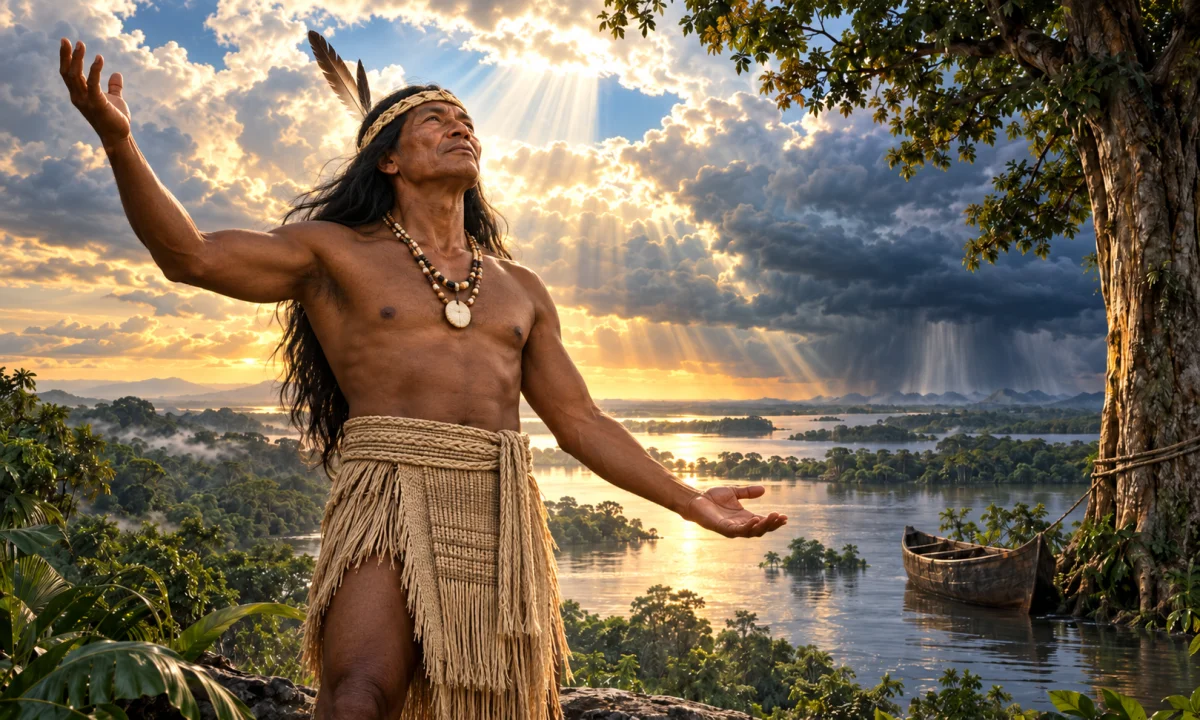
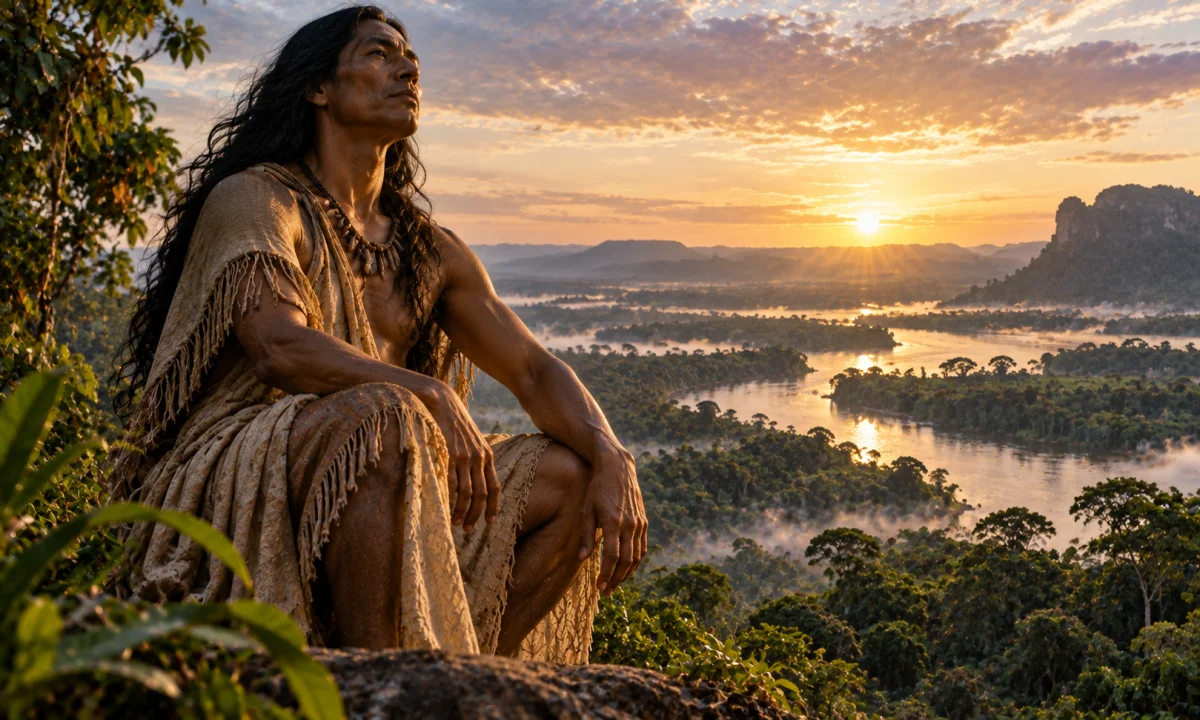
Modern treatments sometimes present Chiminigagua as a clearly defined “Muisca god of light” with a fixed appearance, a precise family and a complete mythology. Much of that detail goes beyond what the historical record securely establishes. There is no widely attested traditional physical image that can serve as a definitive portrait, and dramatic illustrations of a radiant human deity are modern artistic interpretations rather than established descriptions.
Chiminigagua remains relevant as part of the cultural history of the Muisca and of Indigenous traditions in Colombia. Contemporary interest in Muisca heritage may involve re-examining colonial records, restoring attention to sacred landscapes and challenging older portrayals that treated Indigenous religion as primitive or incomplete. Such modern cultural and spiritual work should be distinguished from the limited, sometimes contradictory descriptions preserved by colonial authors.
Chiminigagua in comparison with other creator figures
Many religious traditions contain beings associated with creation, first light or cosmic order. The resemblance between Chiminigagua and other creator figures is a useful point of comparison, but it does not demonstrate that they are versions of the same deity. Chiminigagua belongs specifically to Muisca religious traditions of the Colombian Andes, where the creator’s role is connected with the emergence of light and with a wider network of celestial, ancestral and landscape powers.
The most accurate description is therefore a cautious one: Chiminigagua is a Muisca creator figure, or cosmic source, associated in colonial-era accounts with the origin of light and the formation of the ordered world. The name, stories and relationships vary across sources, and the surviving evidence does not justify assigning the figure a fixed appearance, a fully documented mythology or a simple equivalent in another religion.