WORLD
WORLD
Chibchacum
Chibchacum is a deity of the Muisca, an Indigenous people of the Andean highlands of present-day Colombia. In accounts recorded during the Spanish colonial period, he appears as a powerful protector associated with the people of the Bogotá high plateau, but also as a figure whose anger brought a devastating flood. After the flood, the culture hero Bochica is said to have opened the gorge at Tequendama Falls and imposed a lasting punishment on Chibchacum: he had to carry the earth on his shoulders. When he shifted his burden, the ground trembled.
The story is one of the best-known narratives connected with Muisca religion, although its surviving form comes mainly through colonial authors rather than through an intact pre-colonial Muisca text. Details vary between retellings, and the meaning of Chibchacum's name, role and relationships is not entirely certain. The figure should therefore be understood within the evidence available for Muisca traditions, while avoiding the assumption that later summaries preserve a complete or unchanged Indigenous mythology.
Muisca religious and cultural setting
The Muisca lived chiefly in the highland basins and valleys of the Eastern Cordillera of Colombia. Two important political centres were the territories associated with the zipa around Bogotá and the zaque around Hunza, now Tunja. Their society depended on agriculture, trade, salt production and regional exchange. The landscape of lakes, rivers, mountains, cultivated fields and waterfalls was closely connected with religious practice.
Muisca religion included many sacred places and beings, along with ceremonies involving offerings. Gold objects, emeralds, food and other valuable materials could be deposited in lakes, springs, caves and temples. Gold was not simply regarded as money or decoration. In religious contexts it could represent brilliance, power and transformation, and it formed part of exchanges between humans and the supernatural world.
Colonial reports describe a complex group of deities and culture heroes rather than a single uniform system. Some figures were linked with the sun, the moon, creation, agriculture, water, political authority or particular communities. The names and functions of these beings were sometimes written down by missionaries and administrators who interpreted Muisca beliefs through Christian and European categories. Their accounts are important, but they must be read as mediated records rather than direct transcripts of pre-colonial Muisca theology.
Name and identity
The spelling Chibchacum is common in English-language reference works, but historical and modern publications also use forms such as Chibchacún and other orthographic variants. Colonial writers attempted to represent Muisca words with Spanish spelling, and the original pronunciation cannot always be reconstructed with confidence.
The name has been given several interpretations. Some older explanations connect it with the idea of a staff, support or “báculo” of the Chibcha people. That interpretation fits the later story in which the deity supports the world, but it should not be treated as a certain translation. The exact linguistic analysis remains difficult because the Muisca language is no longer spoken as a community language and the colonial documentation is limited.
“Chibcha” is also a potentially confusing label. It was used historically for the Muisca and, more broadly, in classifications of related languages and peoples of northern South America and Central America. Chibchacum, however, belongs specifically to Muisca traditions of the Colombian Andes. He should not be presented as a general deity shared by every people formerly grouped under the word “Chibcha.”
Role as protector and bringer of disaster
In colonial descriptions, Chibchacum is presented as a powerful guardian of the Muisca people. Some accounts associate him with agriculture, trade and the welfare of ordinary communities. These associations are not identical in every retelling, and they may reflect attempts by European observers to organize diverse local traditions into a pantheon of recognizable “gods.” Nevertheless, the surviving tradition consistently gives him a close relationship with the land and with the fate of the people living on the Bogotá plateau.
His protective role has a troubling counterpart. The most famous narrative says that Chibchacum became angry with the Muisca because of their wrongdoing, disrespect or failure to observe proper conduct. In response, he caused the waters to rise over the plain. Rivers and streams overflowed, and the inhabited and cultivated landscape was threatened by a great flood.
The moral details differ according to the source and later retelling. It is not safe to claim that the story originally had one fixed explanation for the disaster. Colonial writers often reshaped Indigenous narratives in terms of sin, punishment and divine justice, concepts that were central to Christian interpretation. The flood may also preserve a Muisca understanding of the vulnerability of settled life in a landscape shaped by seasonal water, wetlands and rivers.
The flood and Bochica's intervention
The flood story brings Chibchacum into contact with Bochica, one of the most important culture heroes in Muisca tradition. Bochica is described in colonial accounts as a powerful teacher and civilizing figure who brought laws, customs or useful knowledge to the people. He is also associated with the sun and with the restoration of social and environmental order, although the exact description varies.
According to the best-known version, Bochica appeared when the Bogotá plain was overwhelmed. He struck the rocks with a staff or similar instrument and opened a passage through the mountains, allowing the waters to escape. The resulting gorge and waterfall are identified with Tequendama Falls, a dramatic cataract southwest of Bogotá. The story thus connects a sacred narrative with a visible feature of the Colombian landscape.
The account is not a geological explanation in the modern scientific sense. It is a religious narrative about the restoration of balance: destructive water is given an outlet, the inhabited land becomes habitable again, and a disorderly power is restrained. Tequendama Falls consequently carries significance beyond its physical appearance. In Muisca tradition, it could be understood as a place where divine action was marked in the landscape.
After saving the plain, Bochica is said to have punished Chibchacum. Rather than destroying him, he forced him to bear the earth on his shoulders. Whenever Chibchacum moved or adjusted his burden, earthquakes occurred. This explains seismic disturbances through the image of a supernatural bearer struggling beneath the weight of the world.
The punishment also transforms Chibchacum's identity. He is at once an offender, a defeated power and an essential cosmic support. His connection with the land does not disappear; instead, it becomes permanent and burdensome. The deity who once affected rivers and the prosperity of the people is made responsible for holding up the ordered world.
Attributes and symbolism
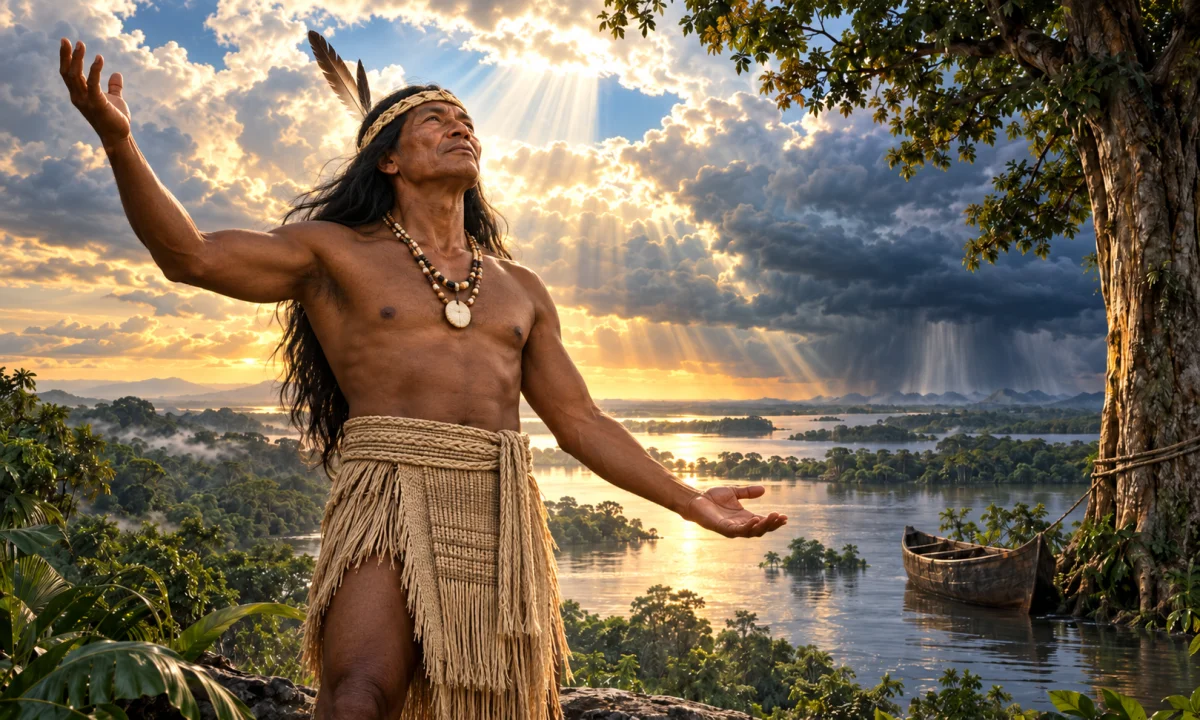
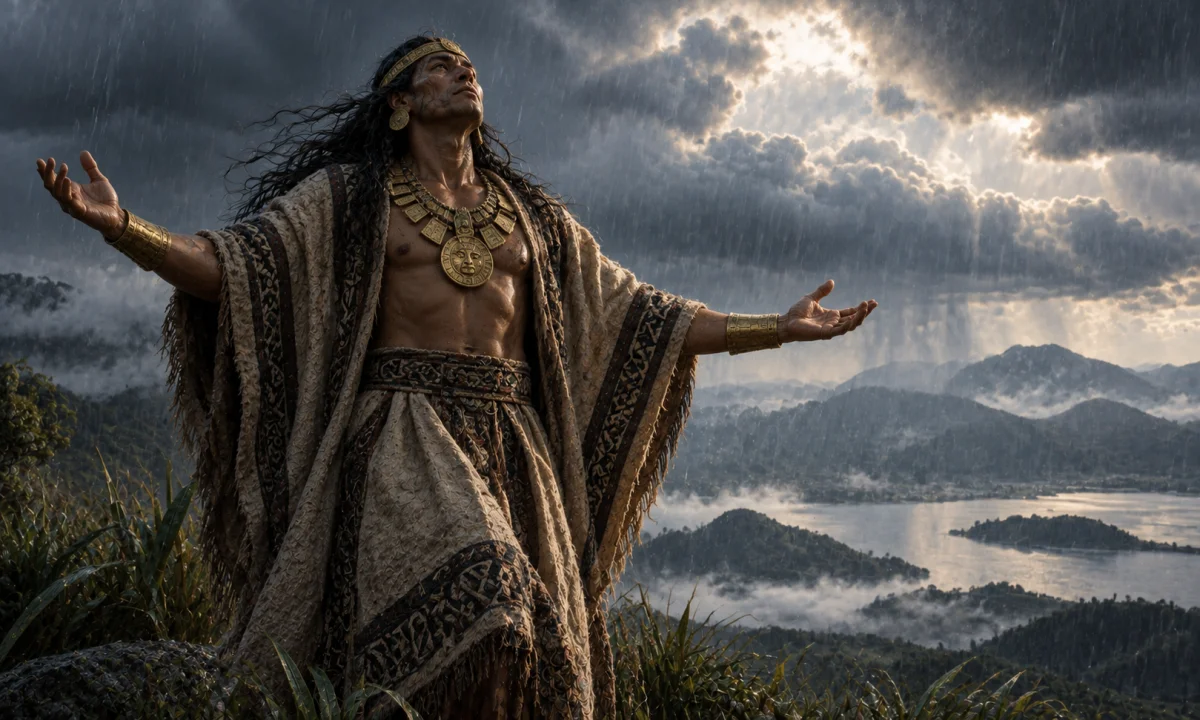
Chibchacum is commonly represented in modern descriptions as a male deity linked with the earth, water and earthquakes. The traditional accounts, however, do not provide a single detailed physical portrait comparable to the standardized images of some figures from ancient Mediterranean or Mesoamerican art. Descriptions of clothing, facial features, weapons or sacred objects are often drawn from modern illustration or generalized ideas about Indigenous gods rather than from secure Muisca evidence.
His most important attribute is therefore not a particular costume but his relationship with support and instability. The earth is imagined as something that can be held, shifted and shaken. This image gives natural events a personal and moral dimension while also expressing the dependence of human society on forces beyond human control.
Water has a similarly ambiguous meaning. Rivers and rain sustain crops and communities, yet uncontrolled water can erase fields, settlements and political boundaries. Chibchacum's flood story reflects this double character. A force that may protect or nourish can also become destructive when the relationship between humans, the land and the sacred order is broken.
The tradition also emphasizes the importance of proper conduct. The Muisca world was not imagined as a collection of unrelated natural events. Human behaviour, ritual obligations, political order and environmental conditions could be connected. The flood and its aftermath express the consequences of imbalance, although the Christian language used by colonial writers may have influenced the way those consequences were recorded.
Sources and historical limits
Most detailed written information about Chibchacum comes from Spanish colonial chronicles, especially accounts produced by missionaries and historians in the seventeenth century. These writers recorded traditions gathered after the Spanish conquest, when Muisca political institutions and religious practices had already been disrupted. Indigenous informants may have preserved important narratives, but the surviving texts present them through translation, selection and editorial interpretation.
There is no known pre-conquest Muisca manuscript that sets out the story of Chibchacum in the form familiar today. This absence does not mean that the tradition was invented by Europeans, but it does mean that the original wording, ritual setting and local variations cannot be recovered with certainty. A colonial account may combine elements from different communities, simplify a specialist religious tradition or assign a single identity to powers that were understood more flexibly.
For this reason, statements about Chibchacum's “domain” should be treated cautiously. Calling him an earth god, earthquake god, flood god or god of commerce can be useful as a brief description, but none of these labels fully captures the evidence. They are modern categories applied to a figure whose roles may have overlapped. His importance lies in the network of relationships among land, water, social order, punishment and cosmic support.
Relationship with other Muisca figures
Chibchacum is most often confused with Bochica because the two appear together in the flood narrative. They are not the same being. Chibchacum is the power responsible for the flood and later bears the earth, while Bochica is the intervening culture hero who opens the passage at Tequendama and imposes the punishment. Their opposition resembles a conflict between destructive disorder and restored order, but the surviving accounts do not establish a single, systematic mythology in which every figure has a fixed place.
Chibchacum should also be distinguished from Bachué, a maternal ancestral figure associated in colonial tradition with the origins of the Muisca, and from figures such as Sué, associated with the sun, and Chía, associated with the moon. These names belong to different strands of Muisca religious tradition. Later popular presentations sometimes arrange them into a neat family tree or pantheon, but the historical evidence does not justify assuming such a fully standardized system.
Nor should Chibchacum be merged with Andean earthquake or mountain beings from other Indigenous traditions. The Andes contain many religious concepts involving mountains, earth supports and subterranean powers, but similarity of function does not prove shared identity. Chibchacum's story is specifically rooted in Muisca cultural geography and in the colonial record of the Bogotá highlands.
Cultural significance and later reception
The narrative of Chibchacum remains significant because it joins sacred history to recognizable places. The flood, Tequendama Falls and the shaking of the earth are not isolated motifs; together they form a Muisca account of how the landscape acquired its present dangers and features. Such stories can preserve relationships to territory even when political structures and religious institutions have been transformed.
Colonial and later writers often used Chibchacum's story to construct a generalized “mythology of the Chibchas.” In doing so, they sometimes treated Muisca traditions as if they formed a neatly organized classical pantheon. Contemporary discussion is more careful about distinguishing the historical Muisca world from the categories imposed by outsiders. It also recognizes that Indigenous traditions can survive in fragments, reinterpretations and local memories rather than only in a single authoritative written version.
In modern popular culture, Chibchacum may appear in illustrated encyclopedias, mythology websites, fantasy writing and games as an earth-bearing or earthquake deity. These representations usually simplify the figure into a visual archetype resembling a world-supporting giant. That image reflects the famous colonial narrative, but it should not be mistaken for a complete traditional portrait or for evidence of a universal Muisca belief system.
The most historically grounded understanding presents Chibchacum as a Muisca figure whose recorded traditions explain the relationship between human conduct, catastrophic water, sacred landscape and the unstable foundations of the world. His story survives through imperfect colonial testimony, but its central images—the flooded Bogotá plain, the opening of Tequendama and the burdened earth-bearer—remain among the most distinctive elements associated with Muisca mythology.