WORLD
WORLD
Chia
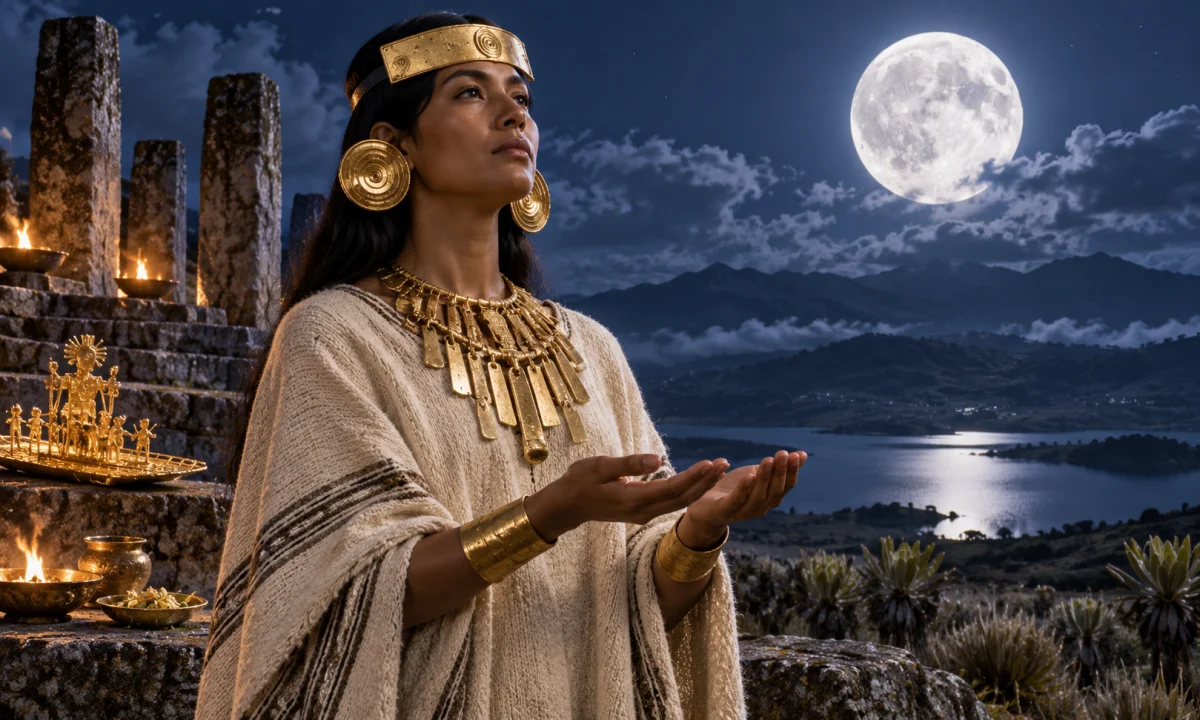
Chía is a lunar figure associated with the Muisca, or Muysca, peoples of the highlands of what is now central Colombia. In most modern descriptions, she is identified as a goddess or personification of the Moon, often placed in relationship with Bochica, the culture hero connected with the Sun. Her character, however, is not preserved in one consistent indigenous text. The surviving accounts were written by Spanish colonial chroniclers, and later retellings frequently combine or confuse Chía with other female figures, especially Huitaca.
Cultural setting
The Muisca lived mainly on the high plateaus and valleys of the Eastern Cordillera of the Andes, including the regions around present-day Bogotá, Tunja, Sogamoso and the sacred Lake Guatavita. Before the Spanish conquest, they formed a network of communities with related languages and religious traditions rather than a single centralized empire in the Inca sense. Their ceremonial life was connected with agriculture, seasonal change, sacred landscapes, ancestors, political authority and the movement of the Sun and Moon.
Much of what is known about Muisca religion comes from descriptions produced after Spanish colonization. Missionaries and colonial officials recorded oral traditions, ceremonies and names of supernatural beings, but they interpreted them through Christian ideas about paganism, morality and divine history. The chroniclers also differed from one another, and their accounts were often written decades after the conquest. As a result, Chía is historically important, but the details of her mythology cannot be reconstructed with complete certainty.
The Muisca observed the heavens closely. The regular movements of the Sun and Moon had practical significance for farming and ritual, while celestial bodies could also be understood as powerful beings or manifestations of sacred order. Chía belongs to this wider religious environment. She should not be treated simply as a direct equivalent of a Greco-Roman moon goddess, because Muisca concepts of divinity, personhood and cosmic power did not necessarily follow European categories.
Name and identity
The name is commonly written Chía, although colonial writers used inconsistent spelling systems for Muisca words. The modern form is also the name of a municipality north of Bogotá. It is often translated or explained as “Moon,” but the precise linguistic history of the word and the relationship between the divine name and the place name are not entirely secure. A shared connection with the Moon is widely accepted in popular and scholarly discussions, but individual colonial spellings do not provide a perfectly uniform record.
Chía is usually classified as a lunar goddess or lunar being. Some accounts treat her as a divine woman with her own personality and relationships; others present her more as the sacred Moon itself. These are not necessarily contradictory in Muisca thought. A celestial body could be both a visible object and a powerful person or presence within a mythic order.
Her association with the night does not automatically make her an evil or destructive deity. European chroniclers sometimes described female supernatural figures in moralizing terms, particularly when they were associated with sexuality, pleasure, disorder or resistance to male authority. Later writers have consequently presented Chía as a dangerous rival of Bochica, but that image may reflect a mixture of distinct traditions and colonial interpretation rather than a single original Muisca conception.
Chía and Bochica
The best-known accounts place Chía in a relationship with Bochica, one of the most prominent figures in Muisca tradition. Bochica is commonly described as an ancient teacher, lawgiver and civilizing hero. He is associated with agriculture, social order and the introduction or restoration of proper customs. In one famous episode, he opens a passage through the mountains at Tequendama, allowing floodwaters to drain from the Bogotá savanna.
Some later summaries describe Chía and Bochica as a cosmic pair: Chía represents the Moon and Bochica the Sun. Their opposition or alternation is then used to explain the division between night and day. This interpretation is attractive because it gives the two figures a clear celestial relationship, but the surviving evidence does not establish one universally accepted Muisca creation story in which they function as a neatly balanced husband-and-wife pair.
In certain versions, Chía is portrayed as Bochica’s wife or companion. She becomes associated with conflict, disobedience or disruptive influence, while Bochica represents order and instruction. In other traditions, however, the rebellious female figure is named Huitaca, not Chía. Huitaca is described in colonial and later retellings as a powerful woman who opposed Bochica’s moral discipline and encouraged pleasure, revelry or sexual freedom. Some accounts say that Bochica transformed Huitaca into an owl or another lunar form; others connect her with the Moon itself.
Because Chía and Huitaca are both female figures linked in later writing with the Moon, night and opposition to Bochica, they have often been merged. It is safer to distinguish them while acknowledging that the records may preserve overlapping traditions. Chía is most consistently identified as the lunar being, whereas Huitaca is more specifically associated in many accounts with defiance of Bochica and with forms of social or sexual disorder. The relationship between the two figures remains uncertain.
Celestial role
Chía’s primary attribute is her connection with the Moon. This association places her within a system of contrasts and rhythms: night and day, darkness and light, concealment and visibility, recurrence and change. The Moon’s phases could have carried significance for agricultural timing, ritual observance and the measurement of time, although the surviving sources do not provide a complete Muisca lunar calendar that can be confidently attributed to Chía herself.
Some modern presentations call Chía a goddess of fertility, childbirth, water or women. These descriptions may arise from broad comparisons between lunar symbolism and themes commonly associated with the Moon in other cultures. They should not be stated as firmly established Muisca attributes unless supported by a specific tradition. The evidence most securely connects Chía with the Moon and with the wider cosmological relationship between lunar and solar powers.
The Moon’s presence over the Muisca highlands would also have made it part of the visible sacred landscape. Muisca religion attached importance to lakes, mountains, caves, rivers and cultivated fields, and celestial powers were not necessarily separate from earthly places. The name Chía continued in the geography of the region, helping preserve a connection between the lunar figure, local memory and the landscape around the northern Bogotá savanna.
Myths and narrative traditions
No single ancient Muisca book sets out Chía’s mythology. The stories associated with her come primarily from colonial records and from oral traditions that were written down after conversion and political conquest. The most common narrative framework is therefore reconstructed rather than directly transmitted in an indigenous written text.
One broad pattern presents the world as ordered through the interaction of major beings such as the creator power Chiminigagua, the solar or civilizing Bochica and the lunar Chía. In simplified modern retellings, Chía’s presence accounts for the Moon and the night, while Bochica’s corresponds to the Sun and the day. These versions may describe the two as spouses, rivals or complementary powers.
Another pattern focuses on moral conflict. A female supernatural figure resists Bochica’s laws, encourages behavior that colonial authors regard as immoral, or contributes to disorder among human beings. Bochica then punishes or transforms her into a celestial or animal form. When this figure is called Chía, the story makes the Moon a transformed woman; when she is called Huitaca, the lunar identification is less consistent. The differences are important because they show that the tradition cannot be reduced to one stable plot.
Chía is also sometimes brought into stories about the great flood of the Bogotá savanna. In popular versions, she or another rebellious figure causes the waters to rise, and Bochica later releases them through the gorge at Tequendama Falls. This dramatic narrative is widely associated with Muisca mythology, but the identity and role of the being responsible for the flood vary across retellings. Chía should not automatically be described as the flood’s sole or original cause.
Relationship with other Muisca beings
Chía belongs to a large and varied sacred world. Chiminigagua is often described by colonial writers as a supreme creative power or source of light, although the exact meaning of this position in precolonial Muisca religion is difficult to determine. Bochica is the principal culture hero in many accounts, while Bachué is the ancestral mother who emerges from Lake Iguaque with a child and becomes the progenitor of the Muisca people. Cuchaviva is associated with the rainbow and is sometimes connected with healing or childbirth in colonial descriptions. Nencatacoa is linked in some sources with festivals, dancing, artisans and communal celebration.
These figures should not be treated as members of a fixed pantheon arranged according to a single authoritative hierarchy. The word “goddess” is useful as a general English description, but it can conceal differences between a creator, an ancestor, a celestial power, a culture hero and a local sacred presence. Chía’s classification as a lunar goddess is conventional and broadly understandable, while her exact theological status in precolonial Muisca thought remains less certain.
Chía and Huitaca: a necessary distinction
Confusion between Chía and Huitaca is especially common. Both appear in accounts shaped by Spanish observers, both can be connected with the Moon or night, and both are sometimes represented as opponents of Bochica. Yet they are not reliably the same figure.
Chía is chiefly the lunar figure and the name most often used for the Moon in Muisca mythology. Huitaca is more often described as a rebellious woman who rejects Bochica’s discipline and embodies pleasure, independence or disorder in accounts influenced by Christian moral categories. Some traditions make Huitaca lunar, owl-like or otherwise transformed, but this does not prove that every story about her originally belonged to Chía.
Modern retellings may combine their names to produce a single “Moon goddess” with all the attributes of both. That synthesis can be useful for storytelling, but it should be identified as a later interpretation rather than presented as an uncontested ancient account. The same caution applies to claims that Chía was specifically a goddess of promiscuity, witchcraft or evil. Those descriptions often reflect the judgments of colonial authors more than securely recoverable Muisca theology.
Religious and cultural significance
Chía is significant because she shows how Muisca sacred traditions connected the heavens with human society and the natural environment. The Moon was not merely a distant object. Its cycles formed part of the temporal world in which crops grew, ceremonies took place and communities understood order and change. A lunar being could therefore carry meanings that were cosmological, agricultural and social at the same time.
Her stories also reveal the difficulties of preserving an indigenous religious tradition through colonial records. Spanish writers frequently reorganized Muisca beliefs according to familiar categories such as god, goddess, devil, idol, sin and punishment. They may have recorded genuine local traditions, but they did so selectively and through translation. The surviving image of Chía is consequently shaped by both Muisca memory and colonial description.
The name remains culturally visible through Chía, the modern town in Cundinamarca, as well as through educational, artistic and heritage representations of Muisca mythology. Contemporary Indigenous and cultural initiatives may use Muisca names and symbols in ways that express identity, historical recovery or respect for ancestral traditions. Such modern uses should not be assumed to reproduce a single unchanged precolonial doctrine.
Later representations
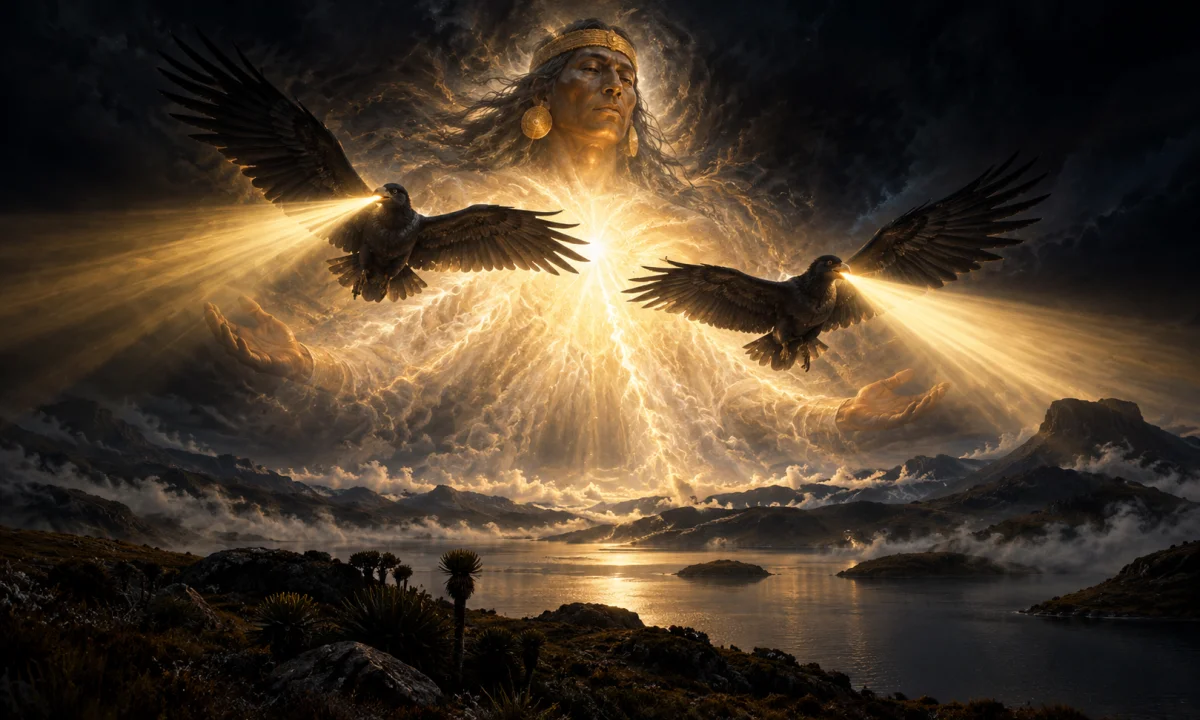
Chía appears in modern books, museum displays, school materials, paintings, tourism narratives and online accounts of Colombian mythology. These representations often give her a striking appearance—such as a woman with a crescent crown, silver clothing or luminous eyes—and may assign her powers over tides, fertility or magic. Such visual details are modern artistic conventions unless they are explicitly tied to a documented traditional source.
In popular culture, Chía is sometimes presented as a complete moon goddess in opposition to a sun god, with a sharply defined personality and mythology. This makes the figure easy to recognize, but it can conceal the uncertainty and variation of the historical record. The most responsible interpretations distinguish the widely attested lunar association from later additions, and they keep Chía separate from Huitaca unless a retelling deliberately explains the fusion.