WORLD
WORLD
Cherruves
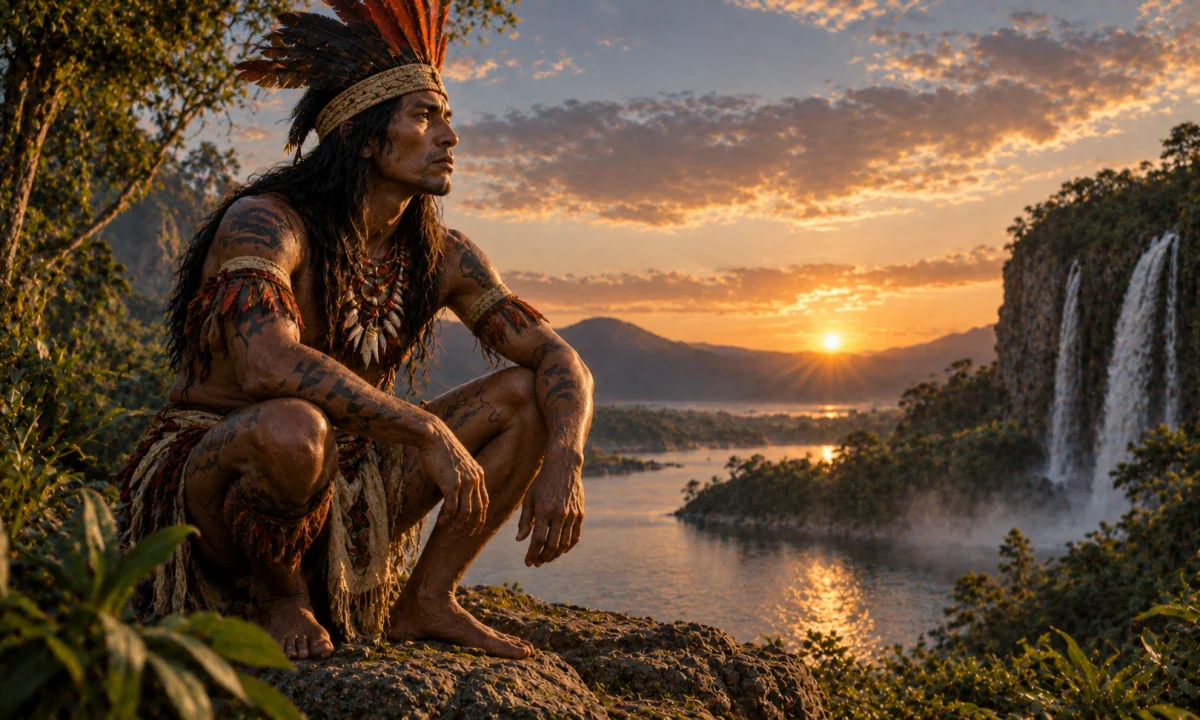
Cherruves is a name used for a fiery supernatural being associated primarily with Mapuche tradition in south-central Chile and adjoining parts of Argentina. The singular form is more commonly written cherufe, cherufé, or cheruvé, while “Cherruves” is often used as an English plural or as a broad name for the being. Accounts differ considerably in spelling, appearance, and behaviour, and there is no single canonical story that defines the figure in the way that a literary myth defines a character.
Origins in Mapuche tradition
The Mapuche are an Indigenous people whose traditional homeland, known as Wallmapu, extends across regions of present-day Chile and Argentina. Mapuche religious knowledge was transmitted primarily through oral tradition, ritual practice, and relationships with the land rather than through one authoritative written mythology. As a result, descriptions of supernatural beings can vary between communities, historical periods, and the outsiders who recorded them.
European and Chilean writers began recording Mapuche beliefs from the colonial period onward. These records are valuable but must be treated carefully. Many were written in Spanish, often by missionaries, travellers, folklorists, or other observers who interpreted Mapuche concepts through Christian or European categories. The spelling cherufe and related forms reflects attempts to represent Mapudungun words using Spanish orthography, not a universally fixed traditional spelling.
In the accounts that use the name, the cherufe is generally connected with fire, volcanic activity, falling stones, and dangerous supernatural power. It is sometimes described as a being that inhabits volcanoes or remote mountains. Other versions portray it as a fiery creature that travels through the sky. These descriptions may represent related strands of local tradition, later folkloric reshaping, or different ways of explaining the same natural phenomena.
Name and classification
The form “Cherruves” should not automatically be treated as the original name of a single, consistently defined creature. English-language retellings sometimes use it as though it were the standard plural of an established monster, but traditional terminology is less uniform. Variants include cherufe, cherufé, cheruvé, cherufo, and other spellings. The pronunciation and precise meaning may also be represented differently in Spanish-language sources.
The being is often classified in modern reference works as a monster, demon, dragon, or volcanic spirit. None of these labels is entirely neutral. “Monster” emphasizes its threatening behaviour; “dragon” reflects its fiery or reptilian descriptions; and “demon” may impose a Christian moral category on a figure from a different religious system. “Spirit” is usually safer, provided that it is understood as a broad English approximation rather than a precise translation of a Mapuche theological term.
Some descriptions present the cherufe as a type of malevolent being, while others focus less on moral identity and more on its connection with destructive forces of nature. It is therefore better understood as a dangerous supernatural presence associated with fire and the earth than as a character with one fixed personality.
Appearance and physical form
Descriptions of the cherufe vary widely. In many popular accounts it has a body of fire, glowing stone, or both. It may be imagined as a giant reptile, serpent, lizard, or dragon-like creature. Some retellings give it wings or describe it as capable of flying, while others emphasize a more amorphous mass of flame and rock.
These images should not be assumed to belong equally to every Mapuche version. Much of the familiar dragon-like appearance comes from later summaries and comparisons with European legendary creatures. A fiery reptile is an effective image for modern storytelling, but the traditional figure is not necessarily a South American equivalent of a medieval European dragon.
Accounts also associate the cherufe with red-hot stones, sparks, smoke, and the glow of volcanic fire. In some versions, it throws or produces burning rocks. In others, the creature itself is compared to a meteor or a stone falling from the heavens. Such descriptions show how oral traditions can combine several observed phenomena—volcanic eruptions, meteorites, lightning, smoke, and fire—without separating them into the scientific categories used today.
Volcanoes, mountains, and fire
The strongest recurring association is with volcanic and mountainous landscapes. Volcanoes have great importance in the geography and spiritual imagination of the southern Andes. They are visible over long distances, capable of sudden violence, and linked with fire, ash, earthquakes, and changes in the land. A supernatural being connected with such places expresses both their danger and their power.
In some retellings, the cherufe lives inside a volcano and emerges when the mountain erupts. In others, its movements or anger are said to cause fiery disturbances. These claims should not be presented as a universal Mapuche explanation of volcanism. Mapuche communities have diverse traditions concerning mountains, spirits, ancestors, and the forces of the landscape. The cherufe is one figure appearing in certain recorded accounts, not a complete explanation of Mapuche religion.
The figure can also be interpreted as a personification of forces that cannot be controlled by human beings. Fire may warm and protect, but it can also destroy homes, forests, and crops. A being made of fire and stone embodies this double character: it is powerful, dangerous, and tied to the living environment rather than merely existing as an enemy in a distant supernatural realm.
Behaviour and supernatural powers
The cherufe is commonly described as aggressive or harmful. It may attack people, threaten settlements, or bring destruction through fire and falling stones. Some popular accounts say that it devours human beings, although this detail is not consistently present in all descriptions and should not be treated as a defining feature of every version.
Its reported powers include:
- creating or controlling fire;
- moving through the air or appearing as a fiery object in the sky;
- living within volcanoes, mountains, or other remote places;
- causing eruptions, showers of burning rock, or other destructive events;
- changing between a solid stone-like form and a fiery or airborne form.
These attributes come from varying folkloric descriptions rather than from a single authoritative narrative. A particular source may describe the cherufe as a giant animal, while another may treat it more like a supernatural projectile or volcanic force. Combining every attribute into one fixed profile can create a modern composite that no individual tradition actually contains.
Stories and narrative patterns
There is no widely recognized epic centred on the cherufe, nor is there a single canonical encounter comparable to the best-known stories of Mapuche culture. Instead, the being tends to appear in brief accounts, descriptions of local beliefs, and later collections of mythology. These accounts often explain why a dangerous place should be feared or why a natural event has a supernatural significance.
A common narrative pattern places the creature in a volcano or high mountain. The cherufe then becomes visible through flames, smoke, glowing rocks, or an eruption. People who approach its dwelling may be endangered, and its appearance serves as a warning against entering a sacred or perilous landscape without proper respect.
Another pattern treats the cherufe as something seen in the sky. A streak of fire or a blazing object descending toward the earth may be interpreted as the movement of a supernatural being. This kind of story does not necessarily distinguish a meteor from a volcanic stone in the modern scientific sense. Both are fiery objects arriving from above, and both can become signs of unusual or dangerous power.
Because the surviving record is fragmentary, it is difficult to determine whether all such accounts refer to one traditional being. Some descriptions may have been influenced by one another after publication, while others may preserve local variations. The safest approach is to identify the shared themes—fire, stone, mountains, and danger—without claiming that every version belongs to one complete mythological system.
Relationship to Mapuche religious ideas
Mapuche religion includes complex relationships among people, ancestors, spiritual beings, sacred places, and the natural world. Mountains, waters, forests, and other features of the landscape can possess spiritual significance. Ritual specialists, especially the machi, have important roles in healing, ceremony, and communication within the religious world, although the precise nature of these roles is broader than any one European category such as “priest” or “shaman.”
The cherufe should not be isolated from this setting and presented simply as a monster waiting in a volcano. Its significance, where the tradition is preserved, lies partly in the relationship between human communities and powerful places. A volcanic mountain is not only a geological formation; it may also be part of a spiritually charged landscape. A dangerous being associated with it can express obligations of caution, respect, and recognition of forces beyond human control.
At the same time, it would be misleading to claim that the cherufe represents all Mapuche ideas about volcanoes or fire. Mapuche traditions include many spiritual beings and categories, and their meanings cannot be reduced to a catalogue of monsters. The surviving descriptions of the cherufe are also shaped by translation and by the interests of non-Mapuche collectors.
Distinction from other Mapuche beings
The cherufe is sometimes confused with other powerful beings in Mapuche mythology, particularly the great serpents Cai Cai Vilu and Trentren Vilu. These figures belong to the well-known story of the conflict between the serpent associated with the sea and the serpent associated with the land. Their struggle explains catastrophic flooding, the raising of mountains, and the transformation of the landscape. They are not simply alternative names for the cherufe.
The cherufe is also distinct from a pillán. In broad descriptions, pillán can refer to powerful spiritual beings, including ancestral or landscape-associated forces, but the word has a wider and more complex range of use than the name of one fiery monster. Some older accounts may have translated or categorized Mapuche beings in ways that blur these distinctions. A cherufe may be connected with a volcanic environment without being identical to every spirit associated with a volcano.
Nor should the cherufe be confused with the ngen, a term often used for beings associated with guardianship or the spiritual ownership of natural places. Interpretations of these categories vary, and translated sources do not always use them consistently. The central point is that a fiery being in a popular list of “Mapuche monsters” does not automatically represent the same religious concept as a guardian spirit, ancestor, or cosmic serpent.
Interpretation and cultural significance
Several interpretations can be applied to the cherufe, but they should be distinguished from direct evidence. As a folkloric figure, it can be read as an explanation for volcanic eruptions, meteors, and other fiery phenomena. As a symbolic figure, it represents the unpredictable power of the earth. As a narrative warning, it marks certain mountains and remote places as dangerous or spiritually significant.
Its association with stone is especially suggestive. Stone is permanent, heavy, and part of the mountain, while fire is active, changing, and destructive. A being that combines both elements embodies the energy of the volcanic landscape: solid earth can suddenly become smoke, flame, and flying fragments. This interpretation is a modern analytical observation, not a universally documented Mapuche doctrine.
The figure also illustrates the problems involved in writing about Indigenous mythology. A short description in a nineteenth- or early twentieth-century collection may be repeated until it appears authoritative, even when its original context is unknown. Spellings may change, separate local traditions may be merged, and European terms such as “demon” or “dragon” may influence the way a being is understood. Responsible accounts therefore preserve uncertainty instead of turning every variation into a fixed attribute.
Modern representation
In contemporary popular culture, the cherufe is often redesigned as a South American dragon or a volcanic reptile. It appears in encyclopaedias of legendary creatures, fantasy fiction, games, illustrations, and online lists of mythological monsters. These versions usually give the creature a standardized body, a set of magical powers, and a clearly defined role as an enemy.
Such adaptations can introduce the name to audiences unfamiliar with Mapuche traditions, but they are not equivalent to the traditional record. A game creature with wings, armour, or a breath weapon belongs to modern fantasy unless those details are specifically supported by a particular historical account. The traditional material is more varied and less neatly organized: the cherufe may be a fiery animal, a volcanic inhabitant, a meteor-like being, or a dangerous presence described through several overlapping images.
The spelling “Cherruves” may therefore be useful as a search term or modern category label, but cherufe and its related forms are closer to the names found in discussions of Mapuche folklore. Any careful treatment should identify the variation, avoid presenting one popular illustration as definitive, and keep the figure connected to the cultural landscape from which the tradition comes.