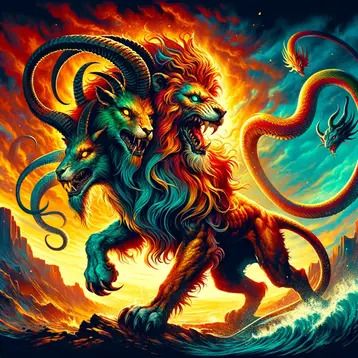
The Chimera is one of the most fascinating creatures in Greek mythology. Often depicted as a monstrous fire-breathing hybrid, the Chimera has captivated the imagination of many throughout the ages. This legendary beast is typically described as having the body and head of a lion, with a goat’s head protruding from its back, and a serpent or dragon for a tail. The Chimera represents a fusion of different animals, which reflects the idea of chaos and the unknown in ancient tales. The story of the Chimera not only highlights the creativity of Greek mythology but also serves as a symbol of the challenges heroes faced in their quests.
Origins of the Chimera
The origins of the Chimera can be traced back to the ancient Greek city of Lycia. According to myth, the creature was born from the union of Typhon and Equidna, two fearsome figures in Greek lore. Typhon was known as the father of monsters, while Echidna was referred to as the mother of all monsters. Their offspring, the Chimera, inherited the traits of its formidable parents, embodying a terrifying amalgamation of different animals. The creature was often associated with destruction and chaos, embodying the fears of the ancient Greeks regarding the natural world and its unpredictability.
 Chione
The Chimera was not only a product of its parents but also a representation of the chaotic forces that existed in the world. In ancient Greek thought, monsters were often seen as manifestations of the dangers that lurked beyond the boundaries of civilization. The Chimera, with its grotesque form and fierce nature, served as a reminder of the wildness of nature and the need for heroes to confront such threats. This idea is evident in the stories surrounding the Chimera and the heroes who sought to defeat it.
The Role of the Chimera in Greek Mythology
The Chimera plays a significant role in various myths, particularly in the tales of heroic figures. One of the most famous stories involving the Chimera is that of Bellerophon, a hero who was tasked with slaying the beast. Bellerophon was a skilled warrior who rode the winged horse Pegasus. This pairing of hero and mythical creature highlights the themes of bravery and the triumph of good over evil in Greek mythology.
Bellerophon’s quest to defeat the Chimera is not just a tale of combat; it symbolizes the struggle between order and chaos. The Chimera, as a creature of chaos, represented the obstacles that heroes must face to restore balance and harmony to the world. Bellerophon’s victory over the Chimera is a testament to the hero’s strength and determination, as well as the belief in the possibility of overcoming great challenges.
 Chloris
Characteristics of the Chimera
The Chimera is often described with a combination of striking and fearsome characteristics. Its lion’s head symbolizes strength and power, while the goat’s head represents stubbornness and ferocity. The serpent or dragon tail adds an element of danger and unpredictability, making the Chimera a truly formidable foe. This combination of traits reflects the complexities of the natural world, where beauty and danger often coexist.
- Lion’s Head: Represents strength and majesty.
- Goat’s Head: Symbolizes stubbornness and aggression.
- Serpent Tail: Adds an element of danger and unpredictability.
The Chimera’s ability to breathe fire further enhances its fearsome reputation. This trait not only makes the creature more terrifying but also symbolizes the destructive forces of nature. In mythology, fire is often associated with both creation and destruction, highlighting the duality of the Chimera as a creature that embodies chaos while also representing the untamed aspects of the world.
Symbolism of the Chimera
The Chimera is rich in symbolism and has been interpreted in various ways throughout history. One of the most prevalent interpretations is that it represents the struggle between good and evil. The Chimera, as a chaotic and destructive force, embodies the challenges that heroes must overcome to achieve their goals. This duality is a central theme in many myths, where heroes face trials that test their strength and resolve.
 Chronos
Additionally, the Chimera can be seen as a representation of the fears and uncertainties that humans face in life. Just as the Chimera is a hybrid of different animals, it symbolizes the complexity of human emotions and experiences. The creature’s terrifying nature reflects the darker aspects of existence, reminding individuals of the chaos that can arise in their lives.
Chimera in Art and Literature
The Chimera has inspired countless works of art and literature throughout history. In ancient Greece, artists often depicted the creature in pottery, sculptures, and mosaics. These representations highlight the Chimera’s fearsome nature and its role in mythology. The visual arts served as a way to convey the stories and themes associated with the Chimera, making it a lasting symbol in Greek culture.
In literature, the Chimera has appeared in various forms, from ancient texts to modern interpretations. One of the most notable mentions is in Homer’s “Iliad,” where the creature is referenced as a symbol of destruction. Additionally, poets and playwrights have drawn inspiration from the Chimera to explore themes of chaos and heroism in their works. The enduring presence of the Chimera in literature reflects its significance in the collective imagination.
The Legacy of the Chimera
The legacy of the Chimera continues to resonate in contemporary culture. The creature has been adapted into various forms of media, including films, video games, and literature. Its hybrid nature and fierce reputation make it a compelling subject for storytelling, often symbolizing the challenges that characters must face in their journeys. The Chimera’s ability to transcend time and culture speaks to its enduring appeal.
Moreover, the Chimera has also found a place in scientific discourse. In modern biology, the term “chimera” is used to describe organisms that contain cells from different zygotes. This scientific concept draws a parallel to the mythical creature, highlighting the intersection of myth and reality. The Chimera serves as a reminder of the complexities of life, both in mythology and in the natural world.
The Chimera is a powerful symbol in Greek mythology, representing chaos, danger, and the struggles faced by heroes. Its hybrid nature and fearsome characteristics make it a compelling figure in ancient tales. Through various interpretations and adaptations, the Chimera has left a lasting impact on art, literature, and even science. As we explore the stories and symbolism surrounding the Chimera, we gain insight into the human experience and the eternal battle between order and chaos.