WORLD
WORLD
Chalchiuhtotolin
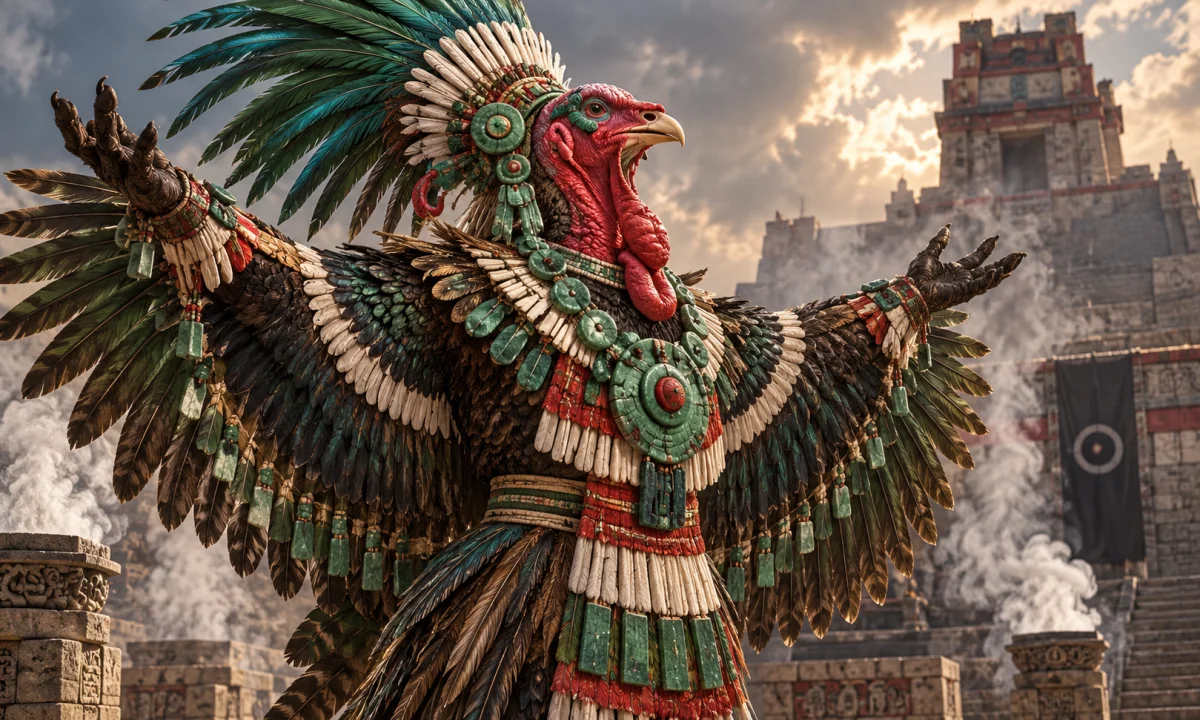
Chalchiuhtotolin is a deity or divine manifestation in Nahua religious tradition, especially the religious world commonly called Aztec. His name is usually translated as “Jade Turkey” or “Precious Turkey.” He is most closely associated with Tezcatlipoca, the powerful god linked with rulership, conflict, fate, sorcery, temptation and punishment. In surviving colonial-era descriptions, Chalchiuhtotolin appears as a terrifying and ambivalent power connected with disease, misfortune, transformation and the ability to overcome or remove affliction.
Name and meaning
Chalchiuhtotolin comes from Nahuatl. The second element, totolin, means “turkey.” The first element is related to chalchihuitl, a word used for precious green stone, especially jade or jade-like materials. “Jade Turkey” is therefore a useful translation, although “Precious Turkey” can better reflect the broader value of chalchihuitl in Mesoamerican thought.
Colonial writers recorded Nahuatl names using Spanish spelling conventions, and modern publications vary in how they represent Nahuatl sounds. Forms such as Chalchiuhtotolin, Chalchihuitotolin and Chalchiutotolin may therefore be encountered. These spellings generally refer to the same traditional figure, not to separate gods. The exact pronunciation used before Spanish colonisation cannot be recovered with complete certainty from every written record.
Religious and cultural setting
Chalchiuhtotolin belongs to the religious environment of central Mexico before and during the early colonial period. “Aztec mythology” is a convenient modern label, but the historical setting was not a single uniform religion. Nahua-speaking communities shared important gods, rituals and concepts while also maintaining local traditions and different emphases. Mexica religious practice, the tradition most often meant by “Aztec religion,” existed within this wider Mesoamerican world.
Knowledge of Chalchiuhtotolin comes mainly from early colonial records produced after the Spanish conquest. Indigenous informants and artists contributed substantially to several of these records, although the information was written down, translated or organised through Christian and European frameworks. Nahuatl texts, painted manuscripts and colonial descriptions preserve valuable evidence, but they do not form a single authoritative mythology comparable to a modern collection of sacred scripture.
The most important descriptions place Chalchiuhtotolin among the manifestations or forms of Tezcatlipoca. This relationship is significant because Tezcatlipoca was not limited to one stable visual appearance or one narrowly defined function. He could appear as a youthful lord, a dangerous sorcerer, a night power, a rival or enemy, and a force that tested human beings. His many names and forms reflect a religious understanding in which a deity could be encountered through different bodies, titles and powers.
Identity and relationship with Tezcatlipoca
Chalchiuhtotolin is sometimes presented in modern reference works as an independent god of disease. The surviving evidence supports a more qualified description. He is certainly treated as a distinct named power, but he is also identified as a form or aspect of Tezcatlipoca. The boundary between “separate deity” and “manifestation of a larger deity” was not necessarily understood in the same rigid way as modern categories suggest.
This connection gives Chalchiuhtotolin a wider significance than the name “turkey god” might imply. Tezcatlipoca was associated with the unstable forces that shaped human life: sudden reversals of fortune, war, political authority, moral failure, illness and death. As Chalchiuhtotolin, that power was represented through an animal form and through the destructive or purifying force of disease.
Descriptions of Tezcatlipoca’s forms often stress his capacity for disguise and transformation. Chalchiuhtotolin therefore belongs to a group of manifestations in which the god’s power is made visible through an apparently specific body. The turkey was not merely an emblem placed beside the deity. It was part of the deity’s presence and identity.
Appearance and animal symbolism
Chalchiuhtotolin is represented or described in turkey form, sometimes with features that connect the bird to precious green stone. The surviving evidence does not provide one universally fixed iconographic design. Painted manuscripts and later reproductions may show differences in colour, body markings, head ornaments and supernatural details. It is safer to speak of a turkey-associated divine form than to claim that every image followed an identical model.
Turkeys were native to Mesoamerica and had practical, economic and ritual importance. They were raised for food, used as offerings and valued for their feathers. Their presence in religious imagery reflects the fact that they were familiar animals within Indigenous society, not exotic creatures imported from another continent. The bird’s association with wealth or preciousness in Chalchiuhtotolin’s name may also evoke valued materials and the elevated status of divine beings.
The greenstone element of the name carries strong Mesoamerican associations. Jade and related green stones were treasured for their colour, durability and connection with life, water, breath and preciousness. A divine “jade” turkey may therefore combine an ordinary, recognisable animal with an image of extraordinary value and supernatural potency. The name does not mean that the deity was simply a literal bird made of jade. It marks the bird as sacred, precious and charged with power.
Disease, danger and healing
Chalchiuhtotolin is most often associated with illness, plague and misfortune. In Nahua religious thought, serious disease was not necessarily understood as a purely natural process separate from divine action. Illness could be connected with the will of gods, the consequences of wrongdoing, ritual imbalance or the unpredictable workings of fate. This did not eliminate practical forms of treatment, herbal knowledge or specialist healing. Instead, physical, social and religious explanations could exist together.
As a manifestation of Tezcatlipoca, Chalchiuhtotolin could send affliction and act as a source of fear. A power capable of causing sickness was also potentially capable of controlling or removing it. This double character is important: he should not be reduced to a simple personification of disease. Divine beings who inflicted suffering could also be approached through ritual, confession, prayer or offerings when people sought relief.
The association with disease also fits Tezcatlipoca’s broader role as a punishing and testing power. Human beings could experience illness as a sign of vulnerability before forces greater than themselves. The deity’s action exposed the limits of wealth, rank and physical strength. In this sense, Chalchiuhtotolin represented not only the presence of sickness but the unsettling reversal of ordinary security.
Descriptions of him as a powerful sorcerer or shape-shifter reinforce this theme. Sorcery in colonial accounts is not always a precise translation of a single Indigenous concept; Spanish authors sometimes used familiar European categories for Nahua ritual specialists and supernatural practices. Nevertheless, the records clearly associate this form of Tezcatlipoca with hidden power, transformation and the ability to affect human bodies and circumstances.
Purification and moral significance
Illness in Nahua religious culture could have moral and ritual dimensions, although it would be misleading to describe every illness as a punishment for personal wrongdoing. Colonial accounts often emphasised sin, confession and divine judgement because Christian ideas shaped the way Indigenous beliefs were recorded. Nahua concepts of pollution, broken obligations, dangerous behaviour and damaged relationships were not identical to Christian sin.
Chalchiuhtotolin can therefore be understood within a wider pattern of danger followed by purification. The deity’s power could expose disorder and force a confrontation with weakness or transgression. Purification did not necessarily mean that the afflicted person was morally bad. It could involve restoring balance, repairing a relationship with a deity or responding appropriately to a crisis.
This pattern resembles the ambivalence found in many Mesoamerican gods. A sacred force might nourish and destroy, protect and punish, or offer prosperity while demanding respect. Such oppositions are not signs of an incoherent mythology. They reflect a religious understanding in which the same powerful being could bring benefits or disasters depending on circumstance, ritual relationship and divine intention.
Stories and surviving traditions
No single surviving epic gives Chalchiuhtotolin a long cycle of adventures comparable to the stories of some better-known figures. The available material is more fragmentary and descriptive. He appears in lists, explanations of divine identities and accounts of the powers attributed to Tezcatlipoca. These records tell more about his nature and associations than about a continuous biography.
This absence of a large narrative cycle should not be taken to mean that he was unimportant. Many Mesoamerican religious figures are known through ritual names, calendar relationships, images or short explanatory passages rather than through extended myths preserved in writing. Indigenous traditions were transmitted through ceremonies, oral teaching, visual signs and community practice, much of which was not recorded or did not survive colonial disruption.
The relationship with Tezcatlipoca is the central interpretive thread. Chalchiuhtotolin is not normally treated as a companion, child or spouse of Tezcatlipoca. He is better understood as one of the forms through which Tezcatlipoca’s power could be recognised. Claims assigning him a detailed family genealogy should be treated cautiously unless they are supported by a particular historical source.
Distinction from similar names and figures
Chalchiuhtotolin should not be confused with Chalchiuhtlicue, the goddess associated with water, rivers, springs and lakes. Their names share the element connected with precious green stone, but they are different figures. Chalchiuhtlicue’s name is commonly translated as “She of the Jade Skirt,” while Chalchiuhtotolin means “Jade Turkey” or “Precious Turkey.” A shared reference to greenstone does not indicate that they are the same deity.
He should also not be merged with Tezcatlipoca’s other forms simply because all of them belong to the same complex of divine identities. The names Yaotl, “Enemy,” and Necoc Yaotl, often translated as “Enemy of Both Sides,” emphasise different aspects of Tezcatlipoca’s character. Chalchiuhtotolin is specifically marked by the turkey form and its associations with preciousness, illness and supernatural transformation.
Nor should the figure be confused with a generic “turkey spirit” from all Indigenous North American traditions. Turkeys were important across a broad geographical area, but the name, religious relationships and evidence for Chalchiuhtotolin belong specifically to Nahua and central Mexican contexts. Similar animal symbolism in another culture does not establish a shared identity.
Historical interpretation
Modern interpretations often describe Chalchiuhtotolin as a god of disease, but that label is only part of the picture. He represents the power of a deity who can enter the world through a striking animal form, bring danger to human beings and participate in the wider cycle of affliction and restoration. His identity is inseparable from the complex character of Tezcatlipoca, whose influence extended across politics, warfare, morality, magic and fate.
The figure also illustrates the difficulty of reconstructing Indigenous religions from colonial documents. Spanish observers sometimes grouped Nahua beings under the word “god,” translated names inconsistently or interpreted rituals through Christian assumptions. Even when a passage is based on Indigenous testimony, its final written form reflects the circumstances of recording. Careful interpretation therefore distinguishes between what the records explicitly say and what later scholars infer from names, images and comparative evidence.
Chalchiuhtotolin’s turkey form is especially significant because it resists the tendency to treat mythological animals as decorative symbols only. In Nahua thought, animals could be manifestations, companions, disguises or embodiments of sacred power. The turkey’s ordinary presence in human life may have made its divine transformation more compelling: a familiar creature could become a sign of illness, hidden force and the unpredictable action of a god.
Modern reception
Chalchiuhtotolin remains relatively obscure outside discussions of Mesoamerican religion, but his memorable name and unusual appearance have attracted modern writers, artists and game designers. Contemporary encyclopedias, fantasy works and digital media may portray him as a monster, a bird-headed warrior or a conventional “demon.” Such representations are creative adaptations rather than direct evidence for pre-Hispanic belief.
Some modern games and occult-themed media include Chalchiuhtotolin among supernatural beings drawn from many religious traditions. These settings commonly give him new statistics, powers, alliances or personalities. They may preserve the turkey imagery or the association with illness while detaching the figure from Tezcatlipoca and from Nahua ideas about ritual danger and purification. Traditional descriptions and modern character designs should therefore be kept distinct.