WORLD
WORLD
Boraro

Boraro is a frightening forest being associated chiefly with Indigenous traditions of the north-western Amazon, especially the cultural region around the Vaupés River in present-day Colombia and Brazil. It is commonly described as a large, hairy humanoid that lives in the forest and threatens people who travel alone. Accounts differ considerably, however. “Boraro” is not always the name of one precisely defined creature, and descriptions found in modern books often combine details from different Indigenous traditions, regional legends and later cryptozoological writing.
Origins and cultural setting
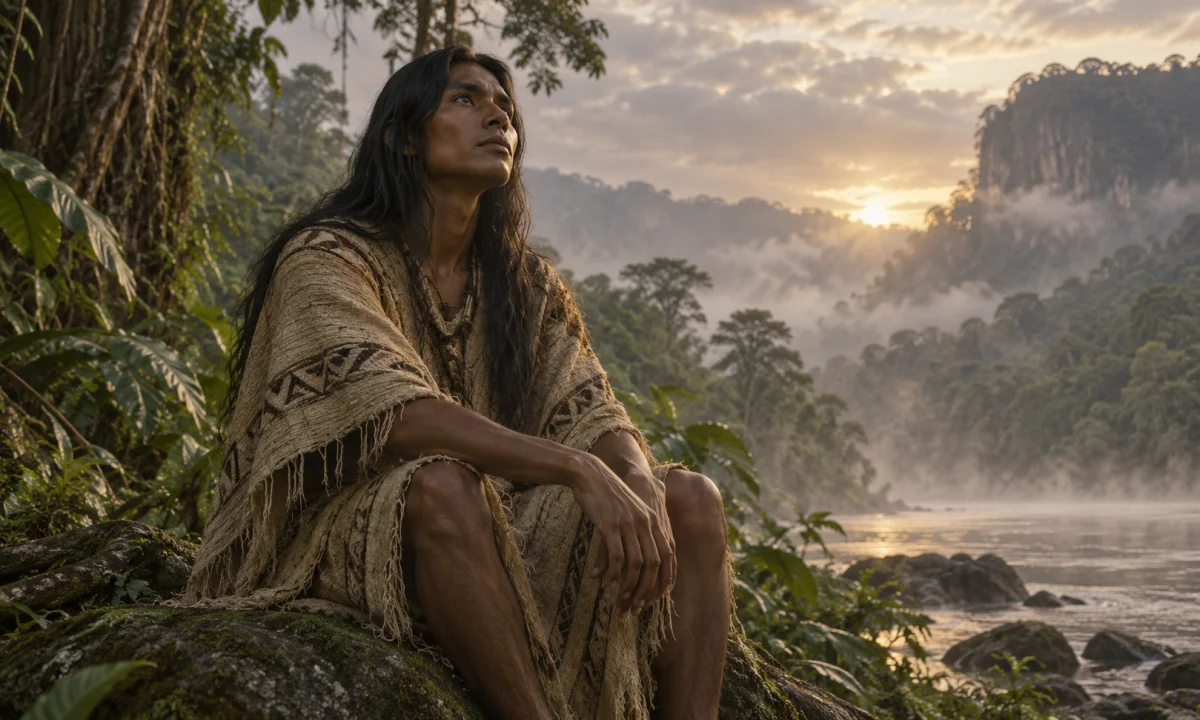
The Boraro is generally connected with the Indigenous peoples of the Vaupés and neighbouring parts of the Amazon basin. This is a culturally diverse region inhabited by, among others, Tukanoan-speaking peoples such as the Tukano, Desana, Barasana, Makuna and Tuyuka, as well as the Kubeo and other communities. These societies have their own languages, histories and ritual systems. A forest being mentioned in one community’s storytelling should not automatically be treated as a belief shared identically by every people in the region.
Knowledge of the Boraro comes through a mixture of oral tradition, local testimony, early ethnographic reporting and later retellings. Many Amazonian narratives were recorded by outsiders using European spelling systems that did not fully represent local languages. As a result, forms such as Boraro, Boraró and Borraro can appear in different accounts. The meaning and pronunciation of the name are not completely uniform across published sources.
Traditional stories from the Amazon often place powerful beings within a living landscape rather than in a separate mythological world. Rivers, animals, trees, ancestral sites and forest beings may all have social, spiritual or moral significance. A being such as the Boraro can therefore function as more than a monster. It may embody the dangers of the forest, warn against careless behaviour, or represent a category of non-human person whose relationship with humans is hostile or unpredictable.
Name and identity
The word Boraro is sometimes translated loosely as “wild man” or “forest man,” but such translations should be treated cautiously. A translated label can give the impression that a term has one fixed meaning across several languages when it may not. The identity of the Boraro is also uncertain because descriptions vary according to the community, language and recorder involved.
Some accounts present the Boraro as a singular supernatural creature. Others treat it more like a class of dangerous forest beings or a people living beyond ordinary human society. In popular writing, these differences are often flattened into a single standard profile: a giant, hairy Amazonian humanoid with reversed feet and a mouth in its abdomen. That profile is recognisable, but it should not be assumed to represent every traditional account.
The Boraro is sometimes compared with the European wild man, the North American Bigfoot or the Himalayan Yeti. Such comparisons can be useful as rough points of reference, but they may also distort the Indigenous context. The Boraro belongs to Amazonian narrative worlds with their own ideas about personhood, dangerous places, animals and spiritual power. It is not simply an Amazonian version of a modern “ape-man” legend.
Appearance
The most familiar descriptions portray the Boraro as extremely tall and covered in dense hair. Its body is often said to be powerful and human-like, but its proportions or anatomy are abnormal. Some versions give it a head that is unusually large, a face without a conventional mouth, or prominent teeth. Others emphasise its strength and ability to move silently through dense vegetation.
One of the best-known features is the direction of its feet. The Boraro is commonly said to have feet turned backwards, so that its tracks appear to lead in the opposite direction from its movement. This motif occurs in stories about several forest beings in different parts of the world, and it is not exclusive to the Boraro. Within Boraro narratives, it serves as a sign that the creature is deceptive and difficult to track.
Another frequently repeated feature is a mouth located on the belly or chest rather than on the face. Some retellings describe the creature as having no ordinary mouth at all, while others say that its mouth opens when it bends over or embraces a victim. This unusual anatomy has become central to the Boraro’s modern image, but the detail is not consistent in all records and may reflect the merging of related or neighbouring traditions.
Accounts also sometimes mention red or glaring eyes, long hair, claws, a foul smell, or a body that resembles a human being seen in darkness. These details are not stable enough to form a universally accepted description. The safest general characterisation is that the Boraro is a frightening, forest-dwelling humanoid whose appearance is deliberately strange and threatening.
Abilities and behaviour
The Boraro is usually portrayed as physically formidable. It may overpower a traveller, seize a person from behind, or crush someone in an embrace. Some stories say that it can imitate human cries or use the sounds of the forest to lure people away from paths and settlements. Other accounts focus less on supernatural powers and more on the danger of encountering an unknown being in a remote environment.
Its reversed feet give it a form of magical concealment. A person following the tracks may believe that the creature has gone one way when it has actually gone in the other direction. In this respect, the Boraro is not merely strong; it is a being associated with confusion, misdirection and the limits of human knowledge.
Some popular descriptions claim that the Boraro drinks blood, eats human flesh or consumes the brains of its victims. Such statements are widespread in modern monster literature, but they should not be presented as a single, securely established feature of traditional belief. Different narratives may describe the being as attacking, abducting, killing or terrifying people without agreeing on what happens afterward.
Several accounts also associate the Boraro with solitary travel. People who enter the forest alone, lose their way, ignore warnings or behave recklessly may be especially vulnerable. This pattern gives the figure a practical as well as supernatural role: it reinforces caution in an environment where disorientation, injury, wild animals, illness and sudden changes in weather can all be serious dangers.
Stories and regional variations
There is no single canonical Boraro story comparable to a fixed written myth with one authoritative sequence of events. The tradition is better understood as a group of related descriptions and narratives that have been recorded unevenly. Storytellers may emphasise the creature’s appearance, its tracks, its attacks or its relationship to the forest, depending on the setting and purpose of the telling.
In some versions, the Boraro appears as an active predator that follows human beings. In others, it remains a distant presence whose tracks, cries or brief glimpse are enough to create fear. A person may encounter the being while hunting, travelling by river, gathering forest products or becoming separated from companions. The narrative tension often comes from uncertainty: the traveller cannot tell whether a sound is human, animal or something belonging to the forest’s hidden population.
Some retellings describe the Boraro as a guardian or inhabitant of places that humans should not enter casually. This does not necessarily make it benevolent. In many traditional cosmologies, a powerful non-human being may defend a territory, punish violations or respond to human actions without fitting neatly into the categories of “good” and “evil.” The forest is not simply an empty wilderness; it is a domain occupied by beings with their own interests.
Details can also change when stories move between languages and audiences. An account collected from an Indigenous narrator, an interpretation made by an early traveller and a twentieth-century popular retelling may all use the same name while presenting different creatures. For that reason, claims about a single set of powers or a universal appearance should be treated with caution.
Cultural meaning
The Boraro can be interpreted as part of a wider Amazonian concern with the boundaries between human society and the forest. The being’s human-like form makes it unsettling: it is close enough to a person to be recognisable, but sufficiently different to signal danger. Hair, unusual feet, unnatural anatomy and strange sounds all mark it as a being outside ordinary human order.
The figure may also express the risks of isolation. Amazonian travel traditionally requires detailed knowledge of rivers, trails, seasons, plants and animal behaviour. A person who loses contact with a group is exposed not only to physical hazards but also to fear and uncertainty. A story about a forest being can preserve practical warnings in memorable form, especially for younger people or inexperienced travellers.
It is important not to reduce the Boraro to a simple “campfire monster.” Indigenous narratives can carry ideas about territory, conduct, relationships with non-human beings and the consequences of ignoring customary knowledge. At the same time, no single interpretation should be imposed on all communities associated with the name. The significance of the figure depends on the tradition in which it occurs.
Distinction from related figures
The Boraro is often confused with other South American forest beings, especially the Mapinguary, Curupira and Caipora. These figures do not have identical origins or characteristics.
- Mapinguary: A powerful forest being associated particularly with Amazonian folklore and Indigenous-influenced Brazilian traditions. Modern descriptions often give it an enormous, hairy body and sometimes a mouth on the abdomen. Because of that unusual feature, Mapinguary accounts are frequently blended with Boraro descriptions. The two should not automatically be treated as the same being.
- Curupira: A well-known Brazilian forest spirit commonly described as a small or child-sized figure with backward-facing feet and vivid hair, often red. The Curupira is strongly associated with protecting animals and the forest, although its behaviour can be dangerous or mischievous. Its reversed feet are one reason it is confused with the Boraro.
- Caipora: A forest being or guardian in Brazilian folklore whose form and character vary by region. It may be portrayed as a human-like figure, a small being or a rider connected with wild animals. The Caipora is not simply another name for the Boraro.
- Bigfoot and the Yeti: These are modern comparison points rather than names from the Boraro tradition. Comparing the Boraro with them can highlight its hairy humanoid appearance, but it encourages a cryptozoological reading that may overlook its cultural and spiritual context.
Historical recording and modern interpretation
Descriptions of the Boraro reached wider audiences through travel writing, ethnographic records and later collections of South American folklore. Early records were valuable in preserving information about local narratives, but they were shaped by translation, the interests of foreign observers and the categories available to European readers. A recorder might describe a being as a “demon,” “devil,” “monster” or “wild man” even when the original tradition did not use those exact concepts.
During the twentieth century, the Boraro was increasingly presented in books and articles about unexplained creatures. In these accounts, it was sometimes treated as evidence for an undiscovered primate living in the Amazon. The reversal of the feet, the abdominal mouth and other supernatural features were occasionally reinterpreted as physical adaptations or signs of an unknown animal. There is no established zoological evidence that the Boraro is a biological species, and the cryptid interpretation remains a modern speculation rather than a demonstrated explanation of the tradition.
Contemporary popular culture may depict the Boraro in documentaries, speculative fiction, online monster catalogues and games. These versions generally emphasise its role as a frightening humanoid predator and may combine it with the Mapinguary, Bigfoot or other creatures. Such adaptations can introduce the name to new audiences, but they are not reliable guides to the beliefs of the Indigenous communities from which related traditions were recorded.
The Boraro is therefore best understood as a variable Amazonian forest being whose name and characteristics have been shaped by oral tradition, translation and later retelling. Its backward tracks, imposing body and uncanny anatomy make it memorable, while its deeper significance lies in the boundary it represents between human safety and the unknown forest.