WORLD
WORLD
Chantico
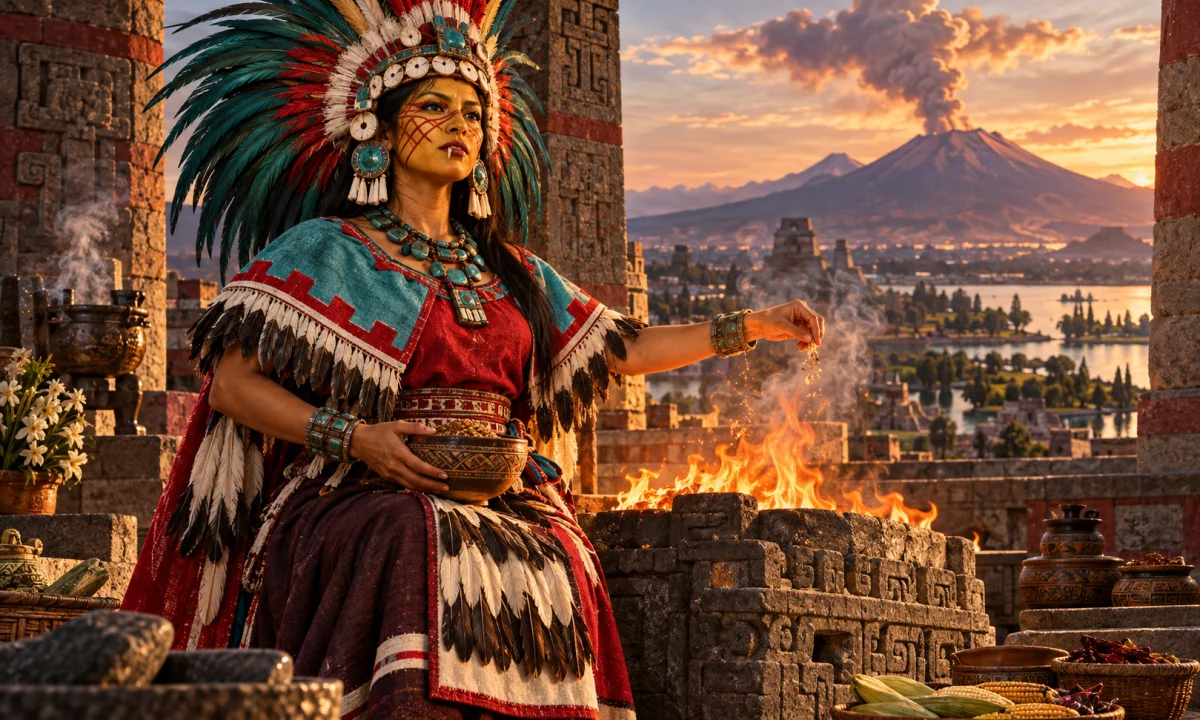
Chantico is a deity associated with the hearth and domestic fire in the religious traditions of the Nahua peoples of central Mexico, including the Mexica (often called Aztecs). Her name is usually connected with the Nahuatl word chantli, “house,” and is commonly interpreted as “she who is in the house” or “she who dwells in the house.” Chantico’s traditional sphere included the fire that sustained household life, but colonial descriptions and later scholarly interpretations also connect her with wealth, precious materials, volcanic fire and the protection of valuable things.
Chantico in Nahua religious culture
Fire was essential to life in ancient central Mexico. It provided warmth, light and cooked food, and it stood at the centre of many household activities. A domestic hearth was therefore more than a practical installation. It was a sacred focus within the home, connected with nourishment, family continuity and the wider religious importance of fire.
Chantico represented this intimate, household aspect of fire. She should not automatically be treated as simply another name for every fire deity in the Mexica pantheon. Nahua religious traditions contained several closely related fire powers, and their boundaries were not always fixed in the way modern categories suggest. Xiuhtecuhtli, “Turquoise Lord” or “Lord of Fire,” was a major male deity of fire, the year and renewal. He was also associated with Huehueteotl, the “Old God,” an ancient fire deity often shown as an elderly figure carrying a brazier on his back. Chantico occupied a more specifically feminine and domestic position in surviving descriptions, although the exact relationship between these figures varies by source.
The importance of the hearth also gave Chantico a connection with the household as a social and religious unit. Her presence could be understood through the continuing maintenance of the fire, the preparation of food and the safeguarding of possessions. In this sense, her significance extended beyond a literal flame. She belonged to a network of ideas involving home, prosperity, danger and the controlled use of powerful natural forces.
Surviving evidence and the problem of interpretation
Knowledge of Chantico comes mainly from records produced after the Spanish conquest. These include the Florentine Codex, compiled in the sixteenth century through Nahuatl and Spanish accounts, as well as illustrated manuscripts such as the Codex Ríos. Other central Mexican pictorial manuscripts may contain images that scholars have associated with Chantico, but identifying deities in pre-Hispanic art is often difficult.
The surviving records do not form a single, perfectly consistent account. They were created in a colonial setting, frequently through collaboration between Indigenous informants, Nahuatl-speaking scribes and European religious authors. Some descriptions preserve valuable information about pre-conquest beliefs, while others reflect translation, selection or interpretation by the people recording them. Images in manuscripts can also be labelled differently by modern researchers.
For that reason, statements about Chantico’s appearance, family relationships and exact powers should be treated with care. It is reasonably secure that she was associated with the hearth and fire. Her connections with precious metals, buried wealth, volcanoes and specific calendrical offices are supported by some traditions or interpretations, but they should not be presented as an entirely uniform doctrine shared by every Nahua community.
Name and identity
The spelling Chantico is the form most familiar in English-language writing. The name is generally analysed in relation to chantli, “house,” together with a locative element. It can therefore be understood as referring to someone who is “in the house” or “within the dwelling.” The interpretation suits her role as a deity of the household hearth.
Colonial sources sometimes present Chantico as a goddess of fire in a broad sense, while other descriptions give her a more specialised role. She may appear as the female counterpart or companion of a major fire deity, but the evidence does not establish a single universally accepted genealogy. Some accounts identify her as the wife of Xiuhtecuhtli; this relationship is important in certain colonial descriptions but should not be assumed to have operated identically throughout Nahua religion.
Chantico is also associated in some accounts with the protection of valuable possessions. This connection may explain her relationship to precious stones, worked metals or wealth held within the home. Fire was necessary for metalworking, and the earth beneath volcanic regions was imagined as a source of powerful and valuable substances. These associations help explain why Chantico could be linked not only to cooking fires but also to subterranean heat, mineral riches and the security of property.
Appearance and iconography
Chantico’s iconography is not completely uniform. Images identified as Chantico often present her as a female figure with strong red or fiery colouring, reflecting her relationship with flame and heat. Red and black can carry several meanings in Mesoamerican visual language, including fire, danger, transformation and the contrast between burning light and darkness. A red body or face should therefore be interpreted as part of a broader symbolic system rather than as a simple portrait convention.
Some representations associated with her include elements that evoke flame, serpents, precious materials or other powerful forces. However, identifying a particular object as uniquely belonging to Chantico can be hazardous. Mesoamerican artists used recurring signs across multiple deities, and the same visual element could have different meanings according to its context. A headdress, facial marking or weapon may indicate a shared attribute, a calendrical role or a connection with another deity rather than proving that the figure is Chantico.
Her possible association with dogs comes from a mythic episode rather than from a general rule that she was normally represented as a canine deity. This distinction matters because Mesoamerican religious art includes several figures with animal attributes, and later summaries sometimes turn a single transformation story into a permanent visual identity.
The story of the forbidden food
One of the best-known stories about Chantico concerns fasting. In colonial accounts, she is said to have eaten roasted fish seasoned with chilli or another pungent red pepper while she was observing a religious fast. The act was treated as a transgression. As punishment, the creator or high deity Tonacatecuhtli transformed her into a dog.
The details differ in translation and in the way modern writers retell the episode. Some summaries refer simply to roasted fish and chilli; others describe the food more generally as seasoned or forbidden food. The central theme, however, is the violation of a sacred restriction and the consequences of breaking a ritual obligation.
The episode does not necessarily portray Chantico as morally evil. In Nahua religious narratives, deities can act in ways that produce disorder, punishment or transformation without fitting the categories of absolute good and evil used in some other religious systems. The story may emphasise the seriousness of fasting and ritual discipline, particularly for beings whose powers affect the household and its food.
The dog transformation also illustrates the fluidity between human, divine and animal forms in Mesoamerican mythology. Transformation could mark disgrace, punishment, concealment or a change of status. It does not mean that Chantico was simply equivalent to a dog deity. Nor does the story provide enough evidence to establish a broad doctrine about dogs and domestic fire.
Fire, food and the household
Chantico’s association with the hearth linked her to one of the most important cycles of ordinary life: raw food becoming edible through fire. Cooking transformed materials and made communal life possible. The hearth was therefore a place of both nourishment and ritual attention.
Her story about forbidden food gains meaning in this context. Food prepared over fire was not religiously neutral. Certain foods could be restricted during fasts, ceremonies or periods of ritual preparation. The same hearth that sustained the family could also become the setting for transgression if rules governing food were ignored.
The household fire was also vulnerable. It could go out, spread destructively or require careful tending. A deity associated with the hearth could consequently embody both protection and danger. Fire was beneficial when controlled but devastating when it escaped its proper limits. Chantico’s character reflects this double nature: she is connected with domestic security, yet the forces represented by fire are never entirely harmless.
Connections with wealth and the earth
Several descriptions connect Chantico with precious objects, wealth or valuable materials. These associations are consistent with the symbolic importance of fire in the production and transformation of metals. Heat releases, reshapes and purifies substances, making the fire of the hearth conceptually related to the heat used by craftspeople.
Her connection with wealth may also have referred to the protection of possessions kept within the home. A household’s stored food, tools, ornaments and other goods were part of its survival and social standing. A divine guardian of the hearth could therefore be understood as a guardian of the material well-being of the household.
Some modern descriptions call Chantico a goddess of volcanoes. This association is plausible within broader Nahua ideas about terrestrial fire and underground heat, but it should be qualified. The surviving evidence does not always separate a domestic fire goddess, a volcanic power and a general deity of fire as clearly as modern classifications do. Volcanic and subterranean associations may reflect interpretation of her fiery nature rather than a universally defined independent office.
Relationship with Xiuhtecuhtli and other fire deities
Chantico is most often discussed alongside Xiuhtecuhtli and Huehueteotl. Xiuhtecuhtli was a prominent deity of fire whose worship had public, political and calendrical dimensions. Huehueteotl, often treated as an ancient form or closely related manifestation of fire, was represented as the aged power at the centre of the world and the household.
Chantico’s feminine identity and domestic emphasis distinguish her from these figures, but the distinctions are not absolute. Nahua religion frequently organised divine powers through complementary relationships, manifestations and overlapping responsibilities. A female deity of the hearth could stand beside a male lord of fire without implying that only one of them truly “owned” fire.
Accounts that describe Chantico as Xiuhtecuhtli’s wife may express one such relationship. Yet a marital connection in a colonial source should not be treated as proof that every community understood the two deities in exactly the same way. Relationships among deities could be theological, symbolic or local, and surviving records do not preserve every regional variation.
Calendrical and ritual associations
Chantico appears in discussions of the ritual calendar and illustrated divinatory manuscripts, although the details of her calendrical status are not always agreed upon. Some identifications assign her a role within the sequence of day or night deities, while others rely on iconographic comparisons between manuscripts. Such claims are valuable but remain dependent on the interpretation of difficult and sometimes damaged sources.
Her presence in calendrical material would fit her broader significance. Fire, household continuity, food and wealth were all subject to cycles of renewal and danger. The calendar did not merely measure time; it helped organise ritual action and assess the character of particular days. A deity connected with the hearth could therefore have importance in determining auspicious or threatening conditions.
It is safer to describe Chantico as a deity with calendrical and ritual associations than to assign her a single fixed position without qualification. Different manuscripts and scholarly readings do not always agree on the identification of figures or on the meaning of individual signs.
Distinguishing Chantico from similar figures
Chantico should not be confused with Chicomecóatl, the important maize goddess. Both can be associated with food and household life, but Chicomecóatl’s principal sphere is maize, agricultural abundance and nourishment through the staple crop. Chantico’s defining association is the fire of the dwelling and the powers connected with it.
She is also distinct from Itzpapalotl, the “Obsidian Butterfly,” a powerful skeletal or warrior-like goddess associated with earth, sacrifice and celestial or calendrical symbolism. Similar colours, claws or sharp imagery in an illustration do not by themselves establish that a figure is Chantico.
Nor should Chantico be merged with Xiuhtecuhtli or Huehueteotl simply because all three are connected with fire. These deities occupy overlapping but not identical positions in the surviving traditions. Chantico’s characteristic emphasis is the domestic hearth, the house and the protection or danger of household resources.
Cultural significance
Chantico reveals how Nahua religion could locate sacred power in ordinary domestic activities. The hearth was a site where food was prepared, family life was maintained and dangerous natural energy was brought under human control. Its significance was simultaneously practical, social and religious.
Her myths also show that deities were not abstract symbols with only one function. Chantico could be a guardian of the home, a power of fire, a figure linked with wealth and a character in a story about fasting and punishment. These aspects are not necessarily contradictions. They express the many consequences of fire: it feeds, transforms, protects, destroys and marks the boundary between order and disorder.
Modern accounts sometimes reduce Chantico to a simple “goddess of the hearth” or expand her into a universal goddess of all fire, volcanoes and riches. Both approaches can obscure the historical evidence. The most responsible description recognises her firmly established connection with the household hearth while acknowledging that her wider attributes and relationships vary across colonial records, pictorial sources and scholarly interpretations.