WORLD
WORLD
Carna
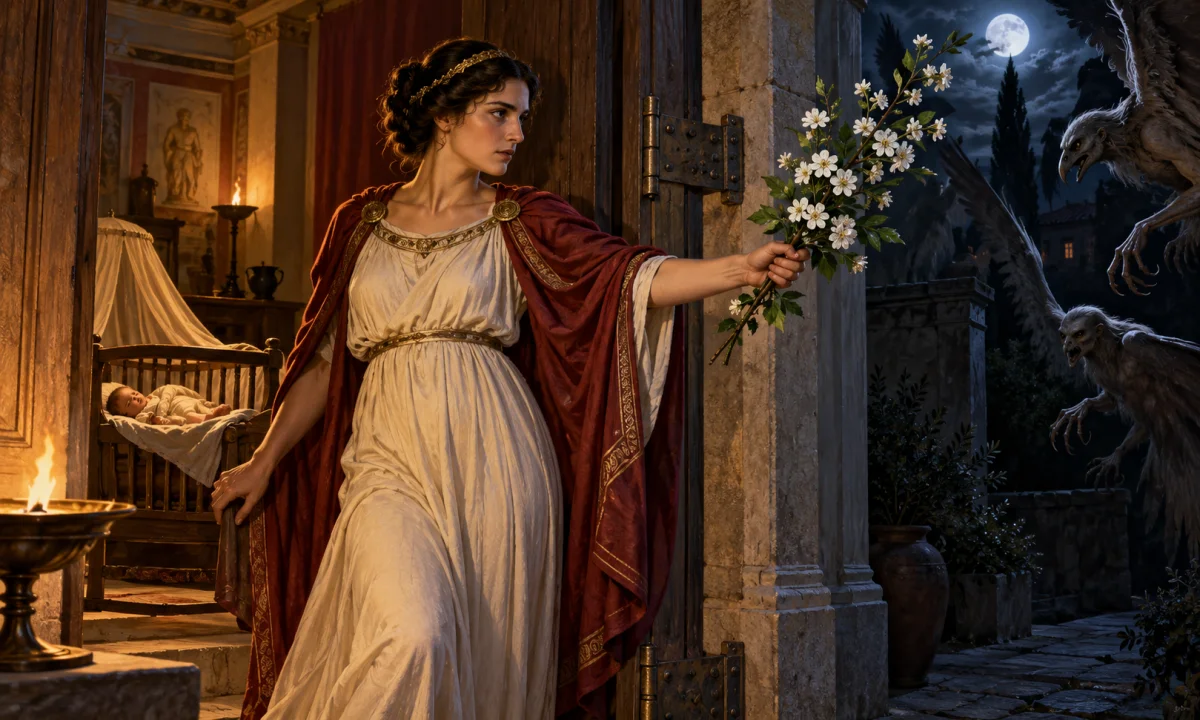
Carna is a minor Roman goddess associated with bodily protection, household boundaries and, in some surviving accounts, door hinges. Her name appears most prominently in the Roman calendar on 1 June, the day of the Kalends of June. The evidence for her worship is limited, and ancient writers do not present a single, fully consistent identity. In Ovid’s account, she is connected with hinges and the protection of infants from dangerous night beings; other interpretations associate her more broadly with the health and preservation of the body.
Origins and religious setting
Carna belongs to the large group of specialised Roman divinities who governed particular places, actions, objects or stages of life. Roman religion included major gods such as Jupiter, Juno and Mars, but it also recognised numerous lesser powers associated with doors, thresholds, childbirth, crops, household tasks and bodily functions. These figures were not necessarily “minor” in the sense of being unimportant to worshippers. A deity responsible for a vulnerable part of daily life could have great practical significance even without a large temple or a prominent public cult.
Carna’s festival fell on 1 June, a significant date in the Roman calendar. The Roman month began with the Kalends, and the first day of June was connected with household observances and seasonal food. The surviving literary evidence links Carna with offerings of beans and pork or bacon. These foods may reflect an old domestic rite rather than the elaborate public sacrifices associated with major state festivals.
The principal surviving account comes from Ovid’s Fasti, a poem describing the Roman calendar and the religious stories attached to its festivals. Ovid wrote during the early Roman Empire, long after many of the traditions he described had developed. His presentation is therefore valuable but not a simple record of an unchanged archaic cult. He combines ritual explanation, etymology, myth and poetic storytelling. Later writers also refer to Carna, but they do not preserve a large independent body of information about her worship.
Name and identity
The relationship between Carna, Cranaë and Cardea is uncertain. Ovid’s narrative presents a nymph named Cranaë, or a figure whose name is closely related to that form, and connects her with the goddess Carna. The same story also explains the name Cardea through the Latin word cardo, meaning a hinge or pivot. As a result, ancient and modern discussions sometimes treat Carna and Cardea as the same goddess, while other accounts distinguish them.
This uncertainty is important because the names do not all have the same apparent meaning. Cardea clearly invites an association with hinges and pivot points, whereas Carna has been connected by some interpreters with caro or carnis, Latin words for flesh or the body. Such linguistic associations may help explain later interpretations, but they do not by themselves prove the original meaning of the goddess’s name.
Ovid’s account is the clearest reason for calling Carna a goddess of hinges. He says that she has power over openings and closures: what is shut can be opened, and what is open can be closed. This function places her at a physical and symbolic boundary. A door hinge is a small mechanism, but it controls access between inside and outside, safety and danger, privacy and exposure. The association may also help explain why Carna could be imagined as a protector of the household and of the body.
Carna and the power of hinges
In Ovid’s story, Carna first appears as a nymph living near a grove associated with Helernus, a place on or near the Tiber. She is described as independent and difficult for would-be lovers to approach. When men attempted to pursue her, she used a deceptive strategy: she would invite them to follow her into a secluded place and then escape while they waited.
Janus, the Roman god of beginnings, transitions, doorways and passages, eventually encounters her. His two faces make concealment difficult, since he can look both forward and backward. The trick that had worked against other suitors does not succeed against him. Ovid presents Janus as overpowering or possessing the nymph, a feature of the myth that reflects the unequal and coercive relationships common in ancient mythology rather than a model of mutual romance.
After this encounter, Janus grants her authority over hinges. In the story’s logic, the grant explains both her divine status and her connection with doors. The narrative also creates a relationship between two figures concerned with transitions: Janus governs beginnings, endings and passages, while Carna governs the mechanism that permits or prevents movement through a doorway.
The myth should not be treated as proof that every Roman regarded Carna primarily as a door goddess. It is an aetiological story, meaning that it explains the origin or meaning of a name, ritual or divine function. Ovid may have shaped older material to fit the literary pattern of his poem. The story confirms that the hinge association was known in his period, but it does not reveal exactly how Carna was understood in every Roman community.
Protection of infants from the striges
Carna is also connected with a darker protective story involving the striges. In Roman literature, the strix or striges are nocturnal, birdlike beings associated with attacks on children and the consumption or draining of blood. They are sometimes translated as screech owls, witches or vampire-like creatures, but none of these modern terms corresponds exactly to the ancient figure. The striges belong to Roman poetic and folkloric imagination, where birds, night spirits and harmful female beings could overlap.
Ovid tells of the infant Proca, a king of Alba Longa in the legendary ancestry that eventually leads to Rome. The child is threatened by striges during the night. Carna intervenes and protects him, using a branch of hawthorn or arbutus in a ritual action around the house. The tale associates her with the safeguarding of a vulnerable child against beings that enter from the darkness.
Details of the episode vary in interpretation because the ancient text is poetic and its ritual language is not always easy to reconstruct. The protective act includes the use of a branch and a substitute offering of animal flesh to distract or satisfy the attacking creatures. The story presents Carna as a guardian who protects the child’s bodily life, not merely as a supernatural gatekeeper.
This episode helps explain why later descriptions of Carna connect her with the vital parts of the body. The heart, lungs and other internal organs were especially vulnerable in ancient medical and religious imagination: they could be injured, weakened by illness or symbolically threatened by hostile forces. Carna’s protection therefore extends from the physical openings of a house to the physical integrity of the person inside it.
Festival, food and ritual meaning
Carna’s festival was observed on 1 June, when beans and pork were traditionally eaten or offered. The combination is often described as beans with bacon or pork, though the precise form of the observance is not fully documented. The rite belongs to the practical, food-centred side of Roman religion. Rather than presenting an abstract theology, it joins a deity with nourishment, household welfare and the preservation of health.
Beans had a complicated place in Roman religious culture. They were ordinary food, but ordinary foods could have ritual importance precisely because they were familiar and nourishing. Pork was likewise a common sacrificial and domestic food. In Carna’s context, the meal may have represented bodily strength and the maintenance of life. It may also have recalled the animal flesh used in the story of the striges.
The date of the festival has encouraged interpretations of Carna as a goddess of seasonal transition. June marked the approach of summer and belonged to a calendar structured around agricultural labour, food supplies and household rhythms. However, the surviving evidence does not establish a complete agricultural theology for Carna. It is safer to say that her observance joined seasonal food with protection of the home and body.
Attributes and symbolism
Carna has no securely established standard appearance. Ancient sources do not provide a canonical image comparable to the familiar representations of Venus, Minerva or Mars. She is therefore best understood through her actions and associations rather than through a fixed visual form.
- Hinges and doors: In Ovid, Carna governs the opening and closing of hinges. This makes her a deity of controlled passage and domestic boundaries.
- Infant protection: Her intervention on behalf of Proca presents her as a guardian of children during the dangerous night.
- The internal body: Later interpretations associate her with the preservation of vital organs and bodily health, although the extent of this role varies by source.
- Hawthorn or a protective branch: The branch used in the story of Proca represents a practical apotropaic object, meaning something used to repel harmful supernatural forces.
- Beans and pork: These foods belong to the ritual and domestic observance associated with her festival.
These attributes create a coherent symbolic pattern without proving that Carna had a single, unified theology. Doors, bodily openings and vulnerable organs all involve boundaries that must be properly guarded. A door that cannot close leaves a house exposed; a body that cannot protect its vital parts is similarly endangered. Carna’s religious significance lies partly in this connection between the household’s outer boundary and the person’s inner life.
Carna, Cardea and related figures
Carna should not automatically be separated from Cardea in every discussion, because ancient evidence itself contributes to the confusion. Some traditions and later reference works identify Cardea as the goddess of hinges, while others use Carna for the same role. Ovid’s account appears to connect the names through the story of the nymph and the Latin word for a hinge. It is therefore reasonable to describe them as closely related or possibly overlapping figures, but not to claim that the distinction is universally settled.
Carna is also different from Carmenta, a Roman goddess associated with childbirth, prophecy and the legendary origins of Rome. The similar names can cause confusion, but the two figures have different traditional roles. Carna is likewise not simply another name for Ceres, the goddess associated with grain and agriculture, or for Bona Dea, a female deity connected with healing, fertility and a restricted female ritual tradition.
The striges connected with Carna should not be confused with later European vampires or with a single standard species of demon. Ancient Roman descriptions contributed to later ideas about night-flying witches and child-threatening monsters, but the modern categories are products of many later traditions. Carna’s role is protective: she confronts such dangers rather than belonging to them.
Interpretation and cultural significance
Carna illustrates how Roman religion could attach divine power to apparently modest details of life. A hinge, a food, a child’s bedroom and the health of internal organs might all become religiously meaningful because each represented a point of vulnerability. The goddess’s importance does not depend on a grand mythological genealogy. It emerges from the practical question of how life is kept secure.
Her stories also show the interaction between literary myth and ritual practice. Ovid links a calendar date, a meal, a divine name, a story about Janus and a tale of supernatural child protection. These elements may not have originated together. The poem brings them into a single interpretive framework, allowing readers to see Carna as both a guardian of hinges and a defender of the body.
Scholarly interpretations therefore tend to remain cautious. Some emphasise her possible connection with flesh and internal organs; others focus on the hinge and threshold symbolism preserved by Ovid. Rather than choosing one function and rejecting the others, it is more accurate to recognise that Carna’s identity was probably fluid. Roman deities could have overlapping powers, and the meaning of a divine name could change as rituals, local traditions and literary explanations developed.
Later reception
Carna has never had the same presence in modern popular culture as Venus, Mars, Jupiter or Medusa. When she appears in modern mythology collections, fantasy writing or discussions of Roman religion, she is usually described as a goddess of hinges, health, household protection or bodily organs. These short descriptions often combine details from Ovid with later interpretations and may present one possibility as though it were universally accepted.
Modern portrayals are most reliable when they distinguish the ancient evidence from creative reconstruction. A depiction of Carna as a guardian of doors, children or bodily boundaries is consistent with surviving tradition, but a fixed appearance, elaborate divine family or detailed set of powers belongs to modern invention unless supported by ancient evidence.