WORLD
WORLD
Ceres
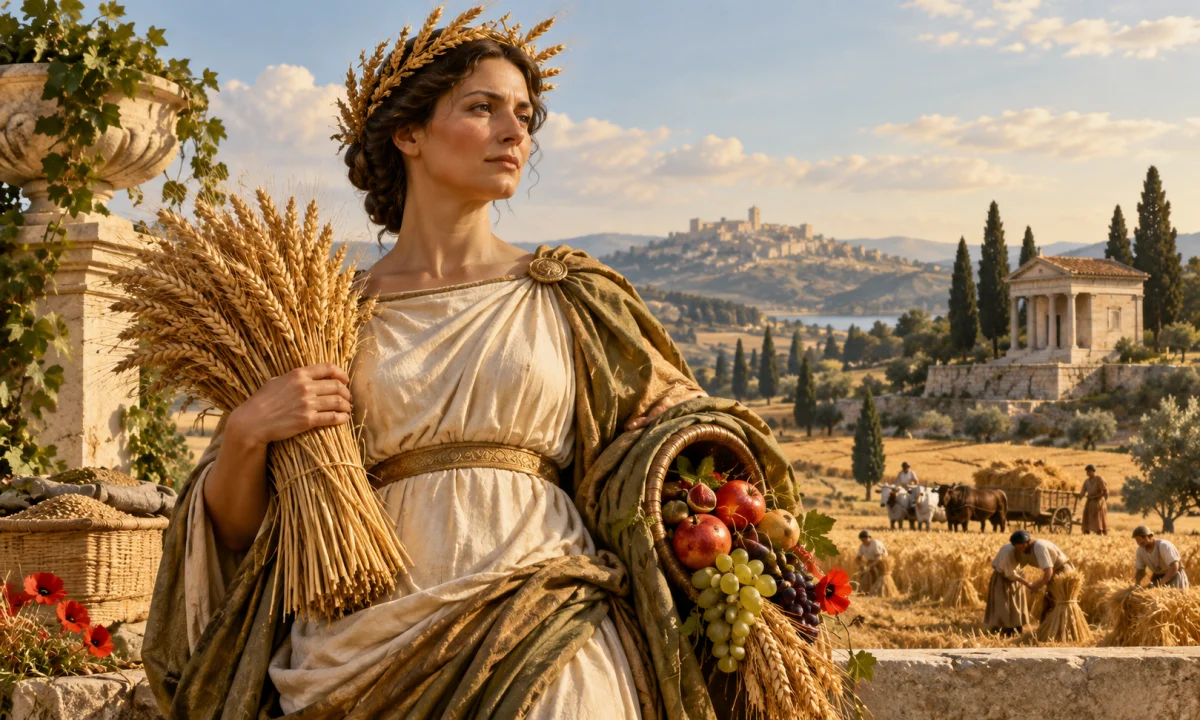
Ceres is the Roman goddess of cultivated grain, agriculture and the nourishment that makes settled life possible. She belongs to the religious traditions of ancient Rome, where farming was both an economic necessity and a sacred activity. Ceres was especially associated with wheat and other grain crops, the work of sowing and harvesting, and the protection of the Roman food supply. In myth and later interpretation, she was identified closely with the Greek goddess Demeter, although Roman worship developed its own institutions, festivals and political associations.
Origins and religious setting
Roman religion did not possess one fixed sacred scripture or a single authoritative version of every myth. Knowledge of Ceres comes from several kinds of evidence, including poetry, philosophical and antiquarian writing, inscriptions, coins, temple remains and descriptions of public festivals. These sources were produced at different times and for different purposes. A poet's story, a state ritual and an inscription do not necessarily preserve identical beliefs.
The worship of Ceres became particularly important in Rome during the early Republic. According to Roman historical tradition, a temple dedicated to Ceres, Liber and Libera was established on the Aventine Hill in 493 BCE, during a period of serious political conflict between the Roman patrician elite and the plebeians. The temple was connected with the plebeian community and became an important religious and political centre. Roman aediles, magistrates closely associated with plebeian institutions, had responsibilities connected with the temple and its administration.
The Aventine foundation also reflects the importance of grain distribution and food security in Roman public life. Ceres was not merely a distant embodiment of nature. Her cult was connected with the practical conditions of survival: preparing fields, storing grain, feeding households and maintaining the urban population. Her association with Liber, a god of wine and male fertility, and Libera, a female deity later identified with Proserpina, expressed a broader concern with agricultural abundance and reproduction.
Roman religion was also shaped by contact with Greek communities in Italy and the wider Mediterranean. Ceres was increasingly understood through comparison with Demeter, especially from the third century BCE onward. This process is often called interpretatio Romana: Roman religious culture identified foreign gods with Roman counterparts, but the result was not always a complete replacement of one tradition by another. Ceres retained specifically Roman associations, particularly her relationship with the plebs, Roman law and the city's grain supply.
The name and identity of Ceres
The Latin name is Ceres, with the genitive form Cereris. Ancient Roman writers connected the name with ideas of growth, producing and bringing forth. Varro and Cicero offered explanations based on Latin words associated with generation or cultivation, but the exact historical etymology remains uncertain. Modern linguistic interpretations have also been debated, so an apparently simple meaning such as “the one who creates” should be treated as an ancient interpretation rather than an established fact.
Ceres was a distinct Roman goddess, not simply a Latin translation of Demeter. The two were closely identified in mythology and art, and many Greek stories were retold with Roman names. Nevertheless, Ceres had a particular place in Roman public religion. Her temple on the Aventine, her connection with plebeian magistrates and the Roman celebration of the Cerealia are features of her Roman identity.
In Latin literature, Ceres could also function as a poetic name for grain or bread. This usage reflects the close relationship between deity and divine gift. When Roman authors invoked Ceres, they might mean the goddess herself, the crops she protected or the food produced through agriculture. The expression “without Ceres and Liber, Venus grows cold,” found in a comedy by Terence, uses Ceres and Liber as symbols of food and wine, without which love and pleasure cannot flourish.
Attributes and symbolism
Ceres was generally represented as a mature, dignified woman rather than as a youthful warrior or a frightening underworld power. Her appearance communicated fertility, abundance and maternal authority. Artists commonly showed her wearing a long robe, sometimes with a veil or a wreath of grain. The exact details varied according to period, medium and artistic convention.
Her most familiar attributes include:
- Grain ears: Wheat and other cereals represented the harvest and the food that sustains human communities.
- A cornucopia: The “horn of plenty” expressed agricultural abundance, although it was also used for many other deities associated with prosperity.
- A torch: The torch became especially important in representations connected with the search for Proserpina.
- A basket or sheaf of grain: These objects emphasized cultivation, harvest and the storage of food.
- A sceptre or throne: Such features presented Ceres as a powerful and venerable goddess rather than merely a personification of a crop.
Ceres represented the productive relationship between land and human labour. Grain does not appear simply because the earth is fertile: fields must be prepared, seed must be planted, crops must be guarded and harvests must be processed. Her symbolism therefore includes both natural growth and the organized agricultural practices on which Roman society depended.
She could also signify the dangers of agricultural dependence. Drought, crop failure, famine and the disruption of grain transport threatened the entire state. Appeals to Ceres thus carried social and political meaning, especially in a densely populated city whose inhabitants relied increasingly on imported grain as Rome expanded.
The story of Proserpina
The best-known myth associated with Ceres is the abduction of her daughter Proserpina by Pluto, the god of the underworld. This story is the Roman form of the Greek myth of Demeter and Persephone. Its most influential Latin literary versions appear in works such as Ovid's Metamorphoses and Fasti, while earlier Greek treatments provided the basic narrative pattern.
Proserpina is gathering flowers when Pluto carries her away to the underworld. In Ovid's version, the precise circumstances and the involvement of other figures vary within the broader mythic tradition. Ceres, unaware of what has happened, searches for her daughter across the world. She carries torches through the darkness and asks gods and humans for news. When she learns that Proserpina has been taken to the underworld, she is devastated and withdraws her gifts from the earth.
As Ceres withholds fertility, crops fail and the human population faces starvation. The crisis affects the gods as well, because sacrifices and offerings can no longer be made. Jupiter eventually intervenes and arranges Proserpina's return, but the girl has eaten food in the underworld, commonly described as pomegranate seeds. Because of this, she cannot remain permanently in the world above.
The resulting arrangement explains the seasonal cycle in mythic terms. Proserpina spends part of the year with her mother and part with Pluto. When she returns, Ceres permits the earth to become fruitful; when she descends again, the land enters a less productive season. The precise length of Proserpina's stay differs among ancient accounts and later retellings, so the familiar modern division of the year should not be treated as a single universally fixed ancient version.
The myth is not only an explanation of seasons. It explores grief, separation, marriage, death, fertility and the limits of divine power. Ceres' search presents her as a mother whose personal loss has consequences for the whole world. Her refusal to nourish the earth turns private mourning into a cosmic and political emergency.
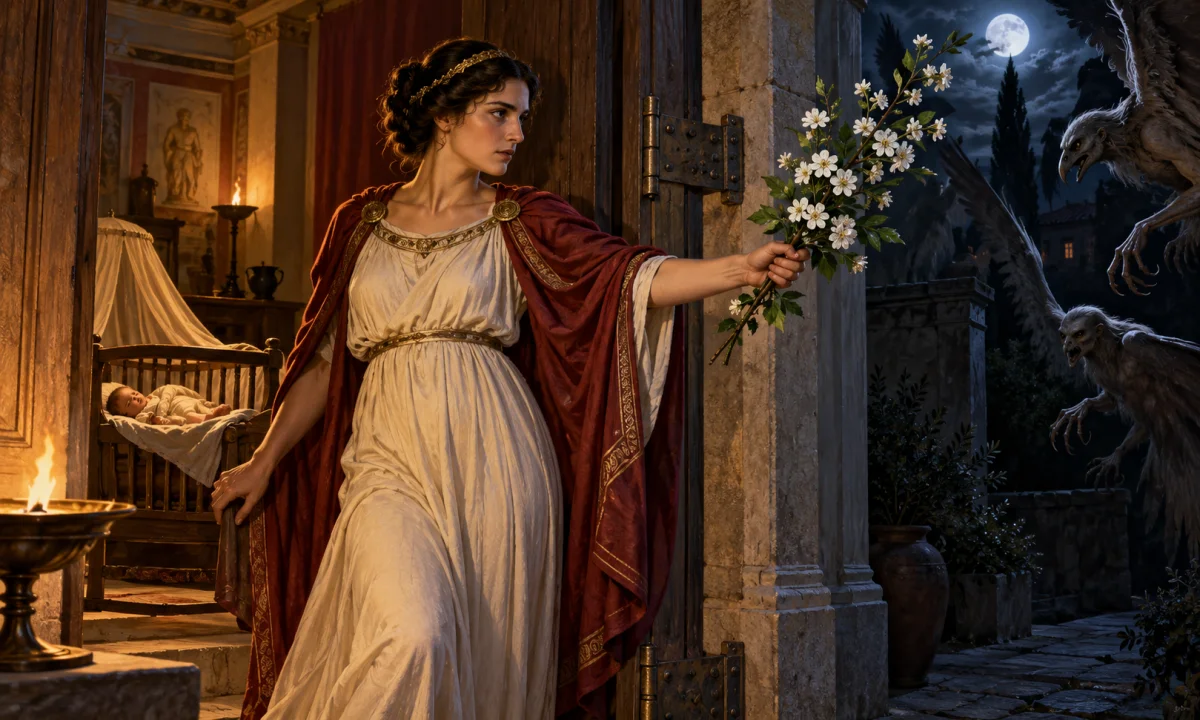
In some accounts, Ceres also encounters the Eleusinian royal household while wandering in search of Proserpina. She attempts to make a human child immortal or divinely protected, but the process is interrupted when the family discovers her identity or misunderstands her actions. These episodes belong primarily to the Demeter tradition and were adapted into Roman literary culture rather than originating as a uniquely Roman story of Ceres.
The Cerealia
The principal Roman festival of Ceres was the Cerealia, celebrated in April. Its main public events traditionally extended over several days, with games and spectacles held in the Circus Maximus. The festival took place during a season important for the growth of crops, although the relationship between the literary myth, the agricultural calendar and the exact ritual schedule was not always straightforward.
Ovid describes a remarkable episode associated with the festival in which foxes were released in the Circus with burning objects attached to their tails. His story explains the rite through a tale of a fox that damaged a grain field and was punished by being burned. This account may preserve an attempt to explain an unusual ritual through narrative. It should not automatically be treated as a complete description of every Cerealia celebration or as proof that the festival was originally designed only to control pests.
The Cerealia combined religious observance with public entertainment. Roman festivals were often communal events in which sacrifice, processions, games and the gathering of citizens overlapped. Ceres could therefore be honoured simultaneously as a divine protector of crops, a guardian of the food supply and a goddess whose festival reinforced Roman civic identity.
Ceres, Proserpina and sacred rites
Ceres' relationship with Proserpina gave her worship a strong connection with the boundary between life and death. Seed disappears beneath the ground before new growth appears, and the descent of Proserpina offered a powerful mythic image for this process. Yet Ceres was not simply a goddess of the underworld. Her primary Roman identity remained connected with agriculture, grain and nourishment.
Roman writers refer to secret or restricted rites of Ceres, sometimes using expressions such as the sacra Cereris. These ceremonies should not be assumed to have been identical to the Greek Eleusinian Mysteries, even though the myths of Demeter and Persephone strongly influenced Roman understanding of Ceres and Proserpina. Some Romans travelled to Eleusis for initiation, while Rome also maintained its own cult practices. The evidence for particular Roman rites is incomplete, and claims about their exact ceremonies or promises must therefore be made cautiously.
In philosophical writing, initiation into the mysteries associated with Demeter and Persephone could be presented as offering hope concerning death and the afterlife. This is evidence for how some ancient authors interpreted such rites, not a complete record of what every initiate believed. The secrecy of mystery cults means that much of their internal practice remains uncertain.
Relationships with other Roman deities
In Roman mythological genealogy, Ceres is usually presented as one of the children of Saturn and Ops, and therefore as the sister of Jupiter, Neptune, Pluto, Juno and Vesta. These family relationships belong to the larger mythic system that Roman writers developed by combining Roman religious figures with Greek-style divine genealogies.
Jupiter is commonly identified as the father of Proserpina, while Pluto is her husband and abductor. In earlier Greek tradition, Demeter's daughter is Persephone and her father is Zeus. Roman poets could preserve the structure of the Greek story while changing the names and placing it within a Roman literary framework.
Ceres should be distinguished from Tellus, the Roman earth goddess, although the two were sometimes worshipped together or compared. Tellus represented the earth as a cosmic and agricultural power, whereas Ceres was more specifically associated with cultivated grain and the nourishment derived from it. She also differed from Ops, a goddess of abundance and agricultural wealth, and from Annona, a later Roman personification of the grain supply or grain provision. These figures could overlap in symbolism without being the same deity.
Ceres was also not identical with Libera. At Rome, Libera was associated with the Aventine temple and later became closely connected with Proserpina, but the names and histories of these figures are not interchangeable in every source. Likewise, Ceres' association with Liber does not make her a goddess of wine: Liber had his own identity and cult, even when the pair represented complementary forms of agricultural abundance.
Historical and cultural significance
Ceres illustrates how Roman religion joined household concerns, agricultural practice and state politics. Grain was essential to Roman life, and its production or importation affected social stability. A goddess of grain could therefore be invoked in matters that were both personal and governmental.
Her Aventine temple has particular significance because it linked religious devotion with the political organization of the plebeians. The association does not mean that Ceres was exclusively a “plebeian goddess” in every period or setting. Romans of different social backgrounds could honour her, and the state cult belonged to the wider religious life of Rome. Nevertheless, the early connection between Ceres, the Aventine and plebeian institutions gave her worship a distinctive civic dimension.
The name of Ceres has survived in modern language. English words such as cereal and cereals ultimately derive from her Latin name through terms relating to grain. The astronomical body Ceres, discovered in the nineteenth century and classified as a dwarf planet, was also named after the goddess. That modern name reflects her traditional association with agriculture; it does not represent an ancient belief about astronomy.
Modern retellings often emphasize Ceres as a universal mother, a symbol of ecological fertility or an archetype of grief and reunion. These interpretations can draw meaningfully on ancient themes, but they are modern readings rather than uniform descriptions of Roman worship. Historically, Ceres was at once a goddess of grain, a protector of nourishment, a participant in Roman civic religion and the Roman counterpart of a Greek mother whose search for her daughter became one of the ancient Mediterranean's most enduring myths.