WORLD
WORLD
Carmenta
Carmenta was a Roman goddess associated with prophecy, childbirth and the legendary beginnings of Rome. Roman tradition also presented her as a prophetess from Arcadia and the mother of Evander, the Greek-speaking ruler who was said to have settled on the future site of Rome before the Trojan arrival of Aeneas. Through Evander, Carmenta became connected with the earliest stories of Rome’s landscape, religious customs and contact with the Greek world.
Identity and name
Carmenta is also known as Carmentis, and ancient authors did not always describe her in exactly the same way. In some accounts she is a goddess; in others she appears as a prophetic woman or nymph who was later honoured as divine. The distinction between a goddess, a culture-heroine and a legendary prophetess was not always sharply maintained in Roman tradition.
Her name is commonly connected with the Latin word carmen, meaning a song, verse, formula or prophetic utterance. The word could refer to poetry, but it could also describe a ritual formula or an inspired declaration. On this interpretation, Carmenta was “the woman of the carmen” or the speaker of sacred words. The connection is plausible and ancient, but the precise origin of her name is uncertain. It should not be treated as proof that every feature of her cult developed from the ordinary meaning of carmen.
Carmenta’s name is also related to the plural term Carmentes, which could refer to prophetic female figures or to the divine powers associated with her. The surviving evidence does not provide one completely consistent account of whether the Carmentes were separate beings, aspects of Carmenta or a wider class of prophetic spirits.
Origins in Roman tradition
Roman writers placed Carmenta within the foundation traditions of Latium. She was usually described as an Arcadian who came to Italy with her son Evander. Evander, whose name means “good man” or “good hero” in Greek, was presented as a civilising ruler who established a settlement called Pallanteum on the Palatine or in its immediate vicinity.
The story belongs to a larger Roman pattern in which the future city was imagined as a meeting place of different peoples. Latin communities, Greek settlers, Arcadians, Etruscans and Trojans all appeared in the legends surrounding Rome’s early history. These accounts were not modern historical records. They were traditional narratives that connected Roman places and institutions with a prestigious and distant past.
Carmenta’s Arcadian identity helped explain the presence of Greek customs and names in the oldest remembered Rome. Her son Evander was associated with the introduction of aspects of Greek culture, although ancient sources differ over exactly what he taught or established. Some later interpretations connect him with writing, religious practices or forms of civilisation, but these details belong to legendary culture history rather than securely documented events.
In Virgil’s Aeneid, Evander receives Aeneas when the Trojan hero arrives in Italy. Evander recounts the older history of the land and shows Aeneas places that will later become important in Rome. Carmenta belongs to this pre-Roman layer of the landscape. Her presence allows Virgil to connect an ancient prophetic tradition with the destined rise of the city.
Carmenta as prophetess
The most distinctive feature of Carmenta is her prophetic authority. She was not simply a goddess of general wisdom. Her role centred on foreknowledge, inspired speech and the ability to disclose events that had not yet happened. Roman stories used her prophecies to link the local past with the future greatness of Rome.
As the mother of Evander, Carmenta could be treated as an ancestral figure in the settlement legend. Her prophetic power gave special authority to her son’s migration and to the choice of the place where he established himself. She was imagined as recognising the importance of the land before Rome became a city.
Virgil calls attention to Carmenta’s prophetic character while describing the sites around the early settlement. Her memory was preserved in a shrine and in the name of the Porta Carmentalis, the Carmental Gate. The gate stood near the foot of the Capitoline area and was traditionally associated with her worship. Its exact archaeological setting and early history are not completely certain, but the name shows that Carmenta was embedded in the topography of Rome.
Prophecy in Roman religion could take several forms. It might involve a person speaking under divine inspiration, the interpretation of signs, or the performance of established ritual procedures. Carmenta represents the first of these forms most clearly: an inspired female voice whose utterances reveal destiny. Her prophetic identity also explains why her name was linked with poetic or sacred speech.
Association with childbirth
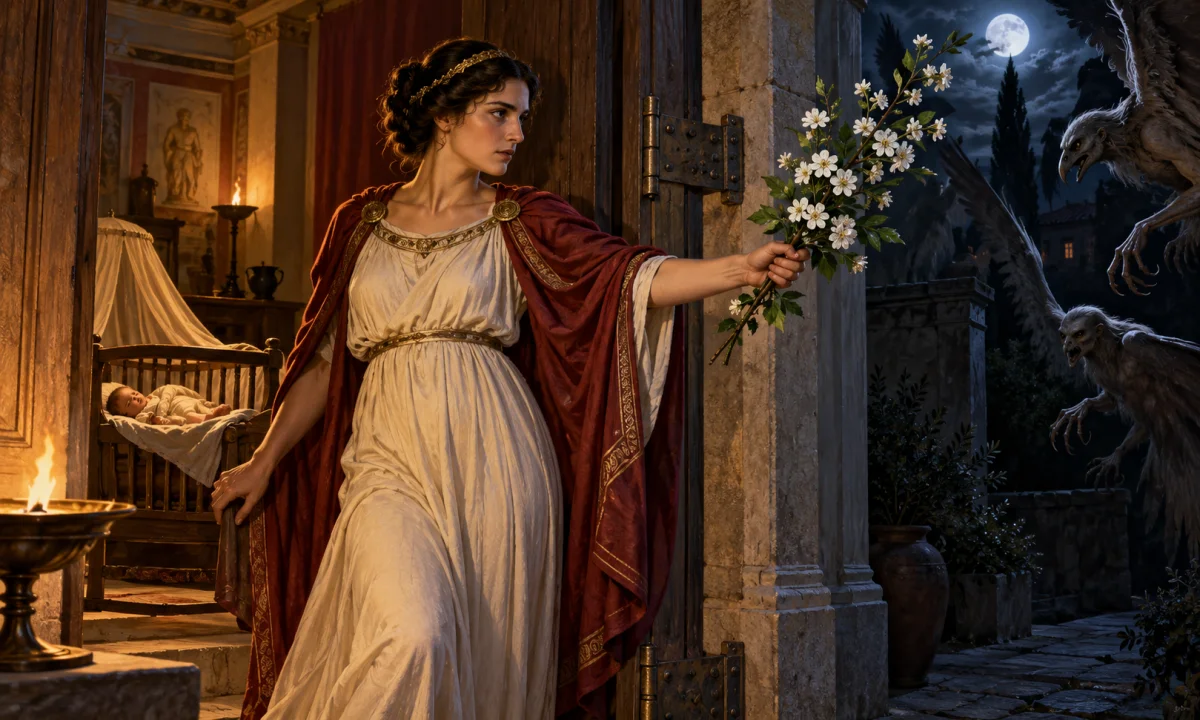
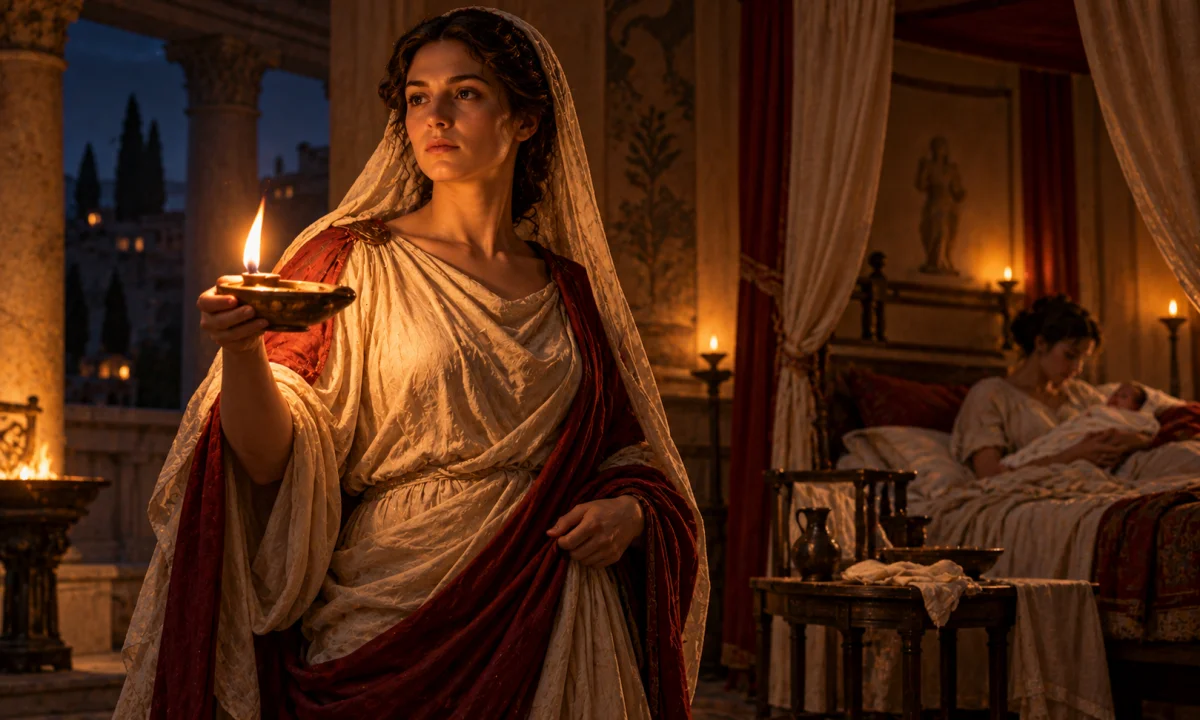
Carmenta was also associated with childbirth and the protection of mothers. This role may appear at first to be separate from prophecy, but Roman religious thought could connect birth with the revelation of a person’s future. The moment of birth marked both physical emergence and entry into the social and religious community.
Her cult was especially important to women, and the Carmentalia, her principal festival, was celebrated in January. Ancient accounts associate the festival with women’s ritual activity and with prayers for safe childbirth. The Carmentalia took place on 11 January and again on 15 January, although the significance of the two dates is not entirely clear from the surviving evidence.
Carmenta’s connection with birth may also reflect the broader Roman importance of female deities who guarded pregnancy, labour and the early stages of life. She should not, however, be reduced to a simple equivalent of every Roman goddess associated with motherhood. Her defining combination was prophecy and birth: she watched over the transition into life while also revealing what the future might hold.
The Carmentalia
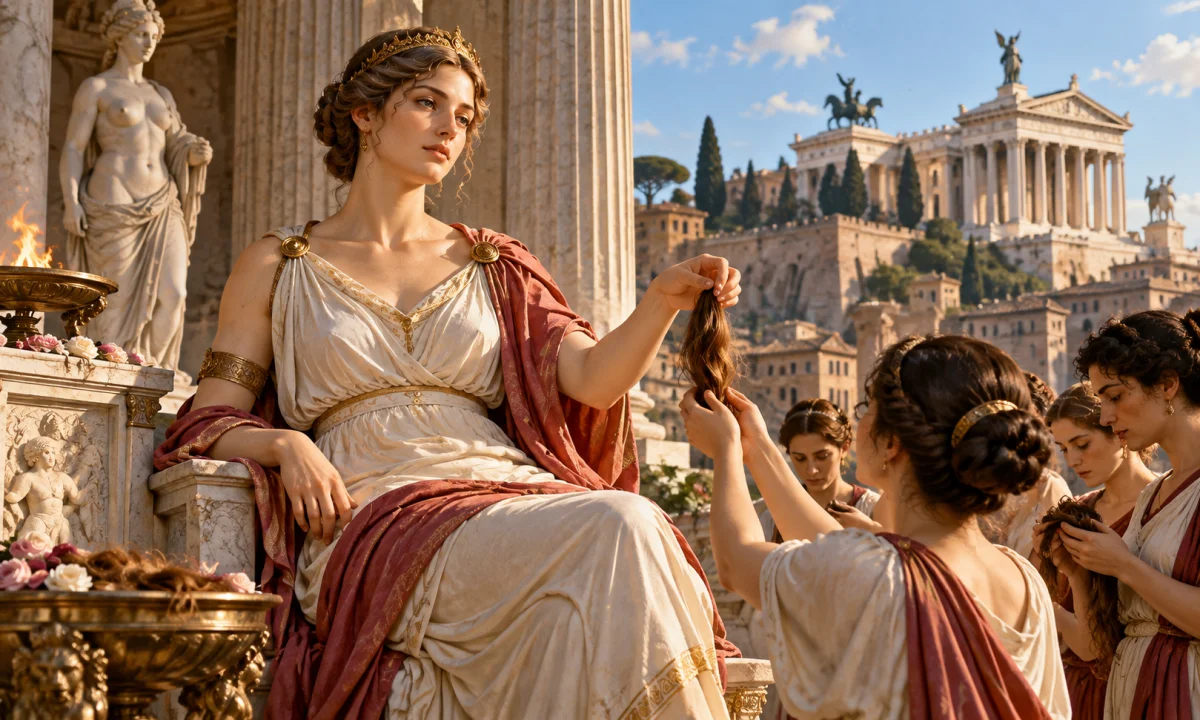
The Carmentalia was a public religious festival centred on Carmenta’s sanctuary and the wider community of women who honoured her. Roman tradition remembered the festival as a women’s celebration, though the details of participation and ritual practice are not fully preserved.
One traditional explanation for the festival involved a conflict between Roman matrons and the authorities. According to the story, women were angered by the loss or restriction of a privilege involving the use of covered vehicles. They withdrew their support from the Carmentalia, and the festival was disrupted. After the privilege was restored, the women resumed the rites. The account functions as an etiological legend: it explains why the festival was linked with women, vehicles and a particular public honour.
The same story appears in different forms in ancient discussions of Roman customs. It should not be treated as a straightforward report of a single historical protest. Roman authors often used stories about women’s collective action to explain the origin of festivals, laws and social privileges. Even when the narrative is legendary, it reflects the recognised public importance of Roman matrons and their religious activities.
Another custom associated with Carmenta’s worship was a prohibition against bringing leather into her sanctuary. Ancient explanations connect this rule with the use of animal hides and leather harnesses, especially in relation to vehicles. The exact reason is uncertain. It may have expressed ritual purity, a symbolic distinction between Carmenta’s sacred space and ordinary transport, or a later attempt to explain an unusual custom whose original meaning was no longer understood.
Postverta and Antevorta
Carmenta was sometimes connected with two figures named Postverta and Antevorta. Their names are usually interpreted as referring to what lies behind and what lies ahead. Postverta could therefore represent the past or events already revealed, while Antevorta represented the future or what was still to come.
Ancient evidence does not present these figures in one completely uniform way. They may have been understood as aspects or attendants of Carmenta, as related prophetic powers, or as names applied to the directions of prophetic knowledge. Later descriptions also associate them with different positions of the unborn child during labour: one with a normal forward presentation and the other with a difficult backward presentation.
Because the evidence is limited, it is safer to describe Postverta and Antevorta as associated figures within Carmenta’s religious tradition rather than confidently calling them her daughters or permanent companions. Their names express a striking feature of her symbolism: Carmenta’s power extends both backward into memory and forward into prediction.
Sanctuaries and Roman topography
Carmenta’s principal shrine was associated with the Porta Carmentalis near the Capitoline Hill. The gate was one of the named entrances in the early Roman landscape, and its traditional location placed Carmenta close to the civic and sacred centre of Rome.
Roman place-names often preserved memories of deities whose original cults had changed or disappeared. A gate named for Carmenta made her part of the city’s physical structure. Travellers passing through it entered a landscape marked by prophetic memory and by the stories of Rome’s earliest inhabitants.
Her shrine also helped connect mythology with ritual practice. Carmenta was not merely a character in the story of Evander. She received offerings, had a festival and was served by a priest known as the flamen Carmentalis. The existence of this priesthood indicates that her worship formed part of the organised public religion of Rome.
Relationship with Evander and Aeneas
Carmenta’s most important mythological relationship is with her son Evander. Their story describes a migration from Arcadia to Italy and presents Carmenta as both mother and prophetic guide. In some traditions, Evander’s father is associated with the god Hermes or Mercury, while other accounts provide different genealogies. These variations show that the story was adapted within both Greek and Roman mythographic traditions.
Carmenta’s connection with Evander also places her before the arrival of Aeneas. When Aeneas reaches Italy in the Aeneid, Evander is already established in the region. Carmenta therefore belongs to an older generation of immigrants and settlers who prepared the ground for the later Trojan foundation story.
She is not the mother of Aeneas, nor should she be confused with Venus, Aeneas’s divine mother. Carmenta belongs to a different strand of Roman origin mythology. Her role is to represent the Arcadian and local prehistory of Rome, while Venus and Aeneas belong to the Trojan ancestry that Roman poets used to connect Rome with the eastern Mediterranean.
Religious and cultural significance
Carmenta brought together several ideas that were important in Roman culture: migration, ancestry, female religious authority, childbirth, prophetic speech and the destiny of Rome. Her legend made the city’s beginnings appear older and more complex than the story of Romulus alone.
Her prophetic role gave sacred meaning to historical memory. The past was not simply a sequence of events; it contained signs of the future city. By honouring Carmenta, Romans could acknowledge a figure who had supposedly recognised the destiny of the land before the political community of Rome existed.
Her association with women’s rites is equally significant. Public Roman religion was not limited to male magistrates and male priests. Women, especially matrons, maintained important rituals and could act collectively in religious matters. The Carmentalia preserved a space in which female experience, childbirth and protection of the household were connected to the fate of the wider community.
Carmenta also illustrates the difficulty of separating mythology from religious classification. A figure might be remembered as a foreign woman, a prophetic nymph, an ancestral mother and a goddess, depending on the author and the purpose of the account. Rather than forcing these descriptions into one rigid biography, it is more accurate to recognise that Roman tradition allowed several overlapping forms of identity.
Distinctions from similar figures
Carmenta is sometimes confused with the Camenae, Roman prophetic or poetic water nymphs. The names may appear related because both traditions involve inspired speech and sacred song, but Carmenta and the Camenae are not simply the same beings. The Camenae formed a group, whereas Carmenta was normally treated as an individual goddess or prophetic heroine.
She should also be distinguished from the Greek Moirai and Roman Parcae, the powers who determine or measure fate. Carmenta predicts and reveals; she is not generally described as one of the beings who allot a person’s lifespan. Likewise, she is not identical with the Greek goddess Gaia, the Roman Juno, or the Roman birth goddess Lucina, even though aspects of their traditions may overlap.
Carmenta is also different from the later literary figure of a generic “Roman sibyl.” Sibyls were prophetic women associated with particular places and prophetic books, while Carmenta belongs to Rome’s own foundation and festival traditions. Ancient authors could compare or connect prophetic figures, but they did not erase the distinctions between them.
Later reception
Carmenta has never had the same continuous popular presence as Jupiter, Venus, Mars or Romulus. Her surviving tradition is preserved mainly through ancient literary discussions of Roman religion, foundation legend and the calendar. As a result, modern depictions are relatively limited and often draw on the general image of a Roman prophetess rather than on a single fixed characterisation.
In modern Pagan and reconstructionist contexts, Carmenta may be honoured as a goddess of prophecy, childbirth, sacred speech and women’s ritual life. Such practices are modern interpretations inspired by ancient evidence; they should not be presented as uninterrupted survivals of Roman worship. Contemporary fiction may also adapt her as a seer or as Evander’s mother, but these creative portrayals belong to modern storytelling rather than to the ancient tradition itself.