WORLD
WORLD
Cahethal
Cahethal is a name found in some modern and esoteric lists of angels associated with the Shem ha-Mephorash, the “explicit name” or “divided name” tradition of Jewish mystical angelology. The name is also written as Cahetel, Cahethel, Cahethel and in several other forms. Among these, Cahetel is the spelling most often used in contemporary occult reference works.
Cahethal is not a prominently named angel in the Hebrew Bible, the New Testament or the Qur’an. Nor is the figure part of the principal angelic hierarchy recognized across mainstream Jewish, Christian or Islamic theology. Its identity belongs chiefly to later Kabbalistic, magical and ceremonial traditions that organize seventy-two angelic names around a particular interpretation of three biblical verses.
Origins in the Shem ha-Mephorash tradition
The traditional setting for Cahethal is the system commonly called the Shem ha-Mephorash. In many later esoteric presentations, seventy-two three-letter combinations are derived from Exodus 14:19–21. In Hebrew, each of those verses contains seventy-two letters. One letter is taken from each verse and combined according to a prescribed arrangement, producing seventy-two triplets. These triplets are then expanded with angelic name endings, usually associated with -el or -iah.
The biblical passage itself describes the Israelites’ escape from Egypt: the angel of God moves behind the Israelite camp, the pillar of cloud changes position, and the sea is divided. It does not list seventy-two individual angels, and it does not name Cahethal. The association between the verses and a catalogue of angelic names is a later mystical development rather than an explicit teaching of Exodus.
The seventy-two-name system took shape through several stages of Jewish mystical and magical interpretation. Medieval Kabbalistic works, practical angelology and later Christian adaptations each contributed to the forms in which the names are now encountered. As the material passed through Hebrew, Latin, French and English sources, spellings and assigned qualities changed. Cahethal should therefore be understood as a figure of later esoteric angelology, not as a universally defined angel from a single ancient scripture.
Name and spelling
The form Cahethal is one of several transliterations used for the eighth name in many modern lists of the seventy-two angels. The more common form Cahetel is often treated as the standard English spelling, while Cahethel and Cahethel reflect different attempts to represent the underlying Hebrew letters.
There is no single pronunciation or universally accepted English transliteration. The initial “C” in these forms reflects conventions used in Western occult literature and does not necessarily indicate an original pronunciation. The exact Hebrew form, its vocalization and its relationship to a meaningful Hebrew phrase are matters of interpretation. Some modern writers provide a translation such as “adored God,” “worshipped God” or a similar expression, but these glosses should not be treated as settled ancient etymologies.
The name is sometimes confused with other angelic names beginning with Ca- or ending in -el. Such similarities are not evidence that the figures are related. In particular, Cahethal should not be merged with Camael, Cassiel, Sachiel or other better-known names from different angelic catalogues.
Place in later angelic catalogues
In the arrangement most often used today, Cahethal is the eighth of the seventy-two angels. This position comes from the order of the triplets derived from Exodus 14:19–21, rather than from a biblical ranking of angels. The number eight is therefore a structural feature of the catalogue, not an indication that Cahethal held a particular rank in ancient Jewish or Christian theology.
Modern occult manuals commonly assign each of the seventy-two names a set of related qualities, a period of influence, a divine name, a verse and sometimes a planetary or zodiacal correspondence. These assignments are not uniform. Different systems may place Cahethal under different dates, degrees, colours, ritual formulas or spiritual functions. Such details belong to particular occult frameworks and should not be presented as universally traditional.
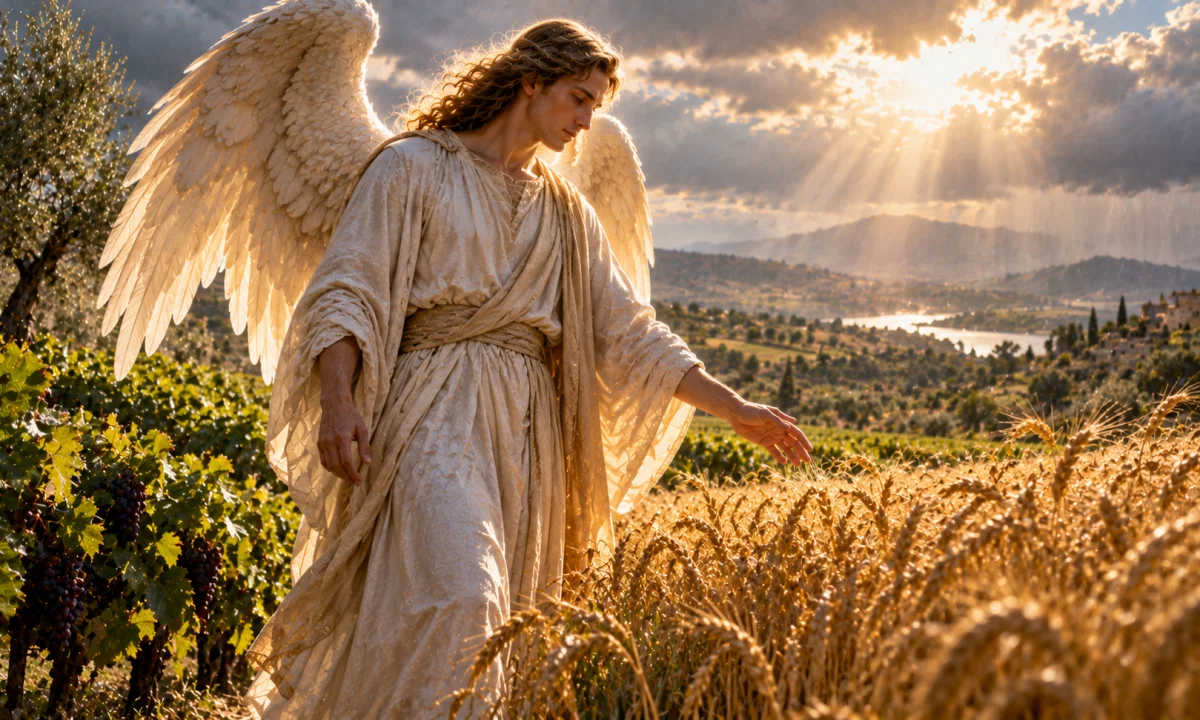
Cahethal is frequently described as an angel of blessing, gratitude and the fruitfulness of the earth. The figure is especially associated in modern lists with agriculture, crops, fertility, productive work and recognition of divine generosity. These themes probably arise from interpretive readings of the angel’s name and from the use of biblical language about harvest and blessing in later devotional or magical texts.
Attributes and symbolic associations
When Cahethal appears in contemporary angelology, the central image is usually that of abundance received through a proper relationship with the divine. The emphasis is not simply on wealth or material success. Rather, the angel is said to represent the blessing that makes work fruitful and the humility required to acknowledge the source of that blessing.
Common attributes assigned to Cahethal include:
- gratitude for the gifts of creation;
- the productivity of fields, gardens and other cultivated land;
- the successful completion of useful work;
- freedom from destructive or misleading influences;
- recognition of divine order in the natural world; and
- the rejection of pride, ingratitude and misuse of prosperity.
Some modern sources describe Cahethal as protecting against harmful spirits or opposing influences. This association is part of later magical classification and should not be confused with a consistent doctrine found in Jewish or Christian scripture. Other lists emphasize the angel’s connection with rain, seasonal growth or the practical prosperity of rural life. Because these attributes vary, it is more accurate to speak of a recurring cluster of agricultural and devotional themes than of a fixed, universally accepted portfolio.
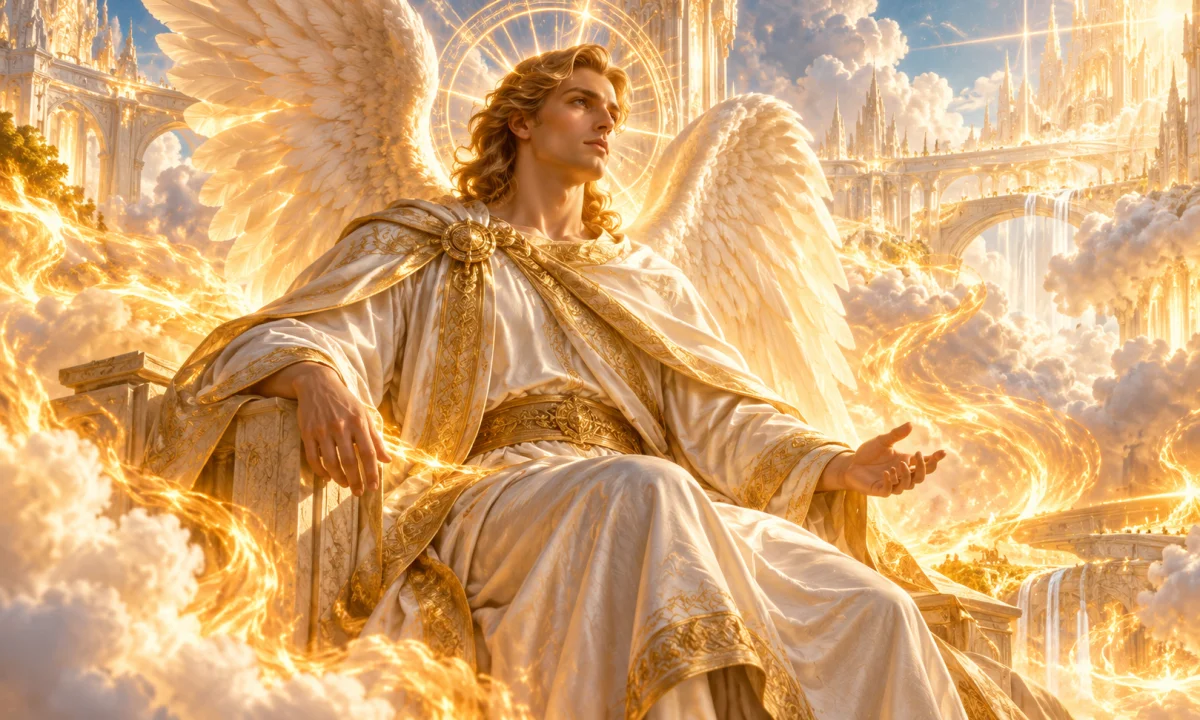
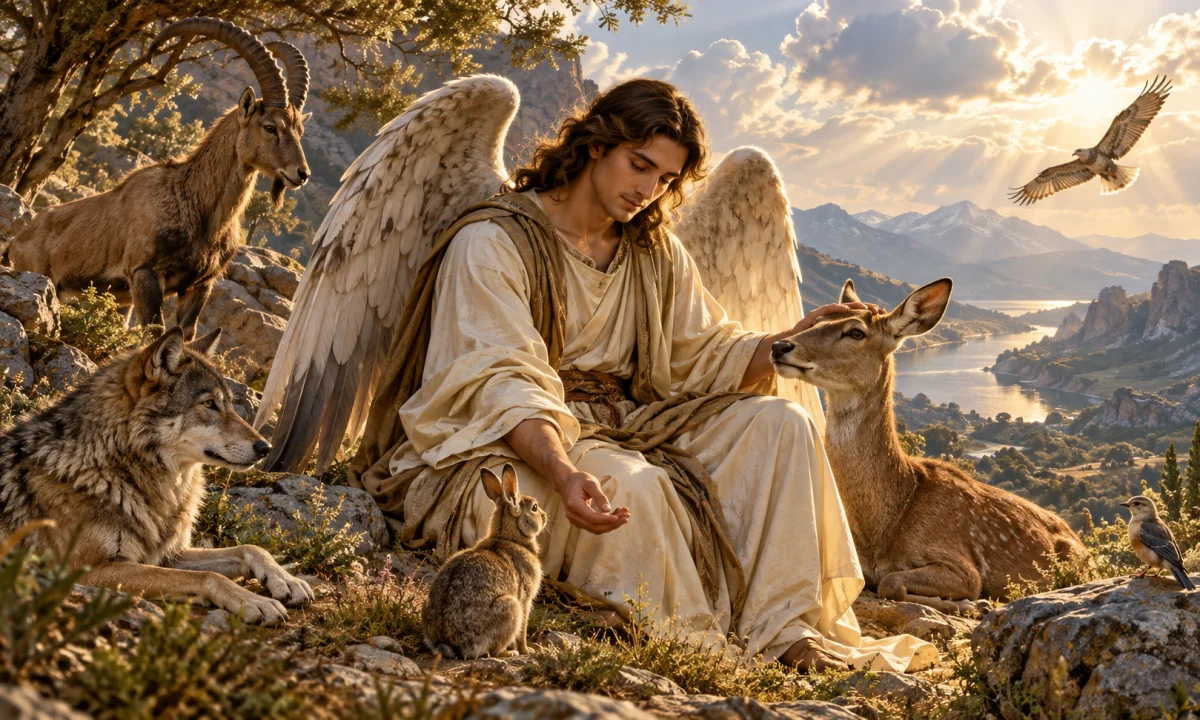
Artistic depictions are also a modern development. Cahethal has no established appearance in the biblical narratives or in a widely shared body of medieval sacred art. Contemporary illustrations may show an angel near cultivated fields, grain, fruit, rain or radiant light, but these images are symbolic inventions rather than descriptions preserved by an ancient tradition. Wings, robes, gender, facial features and colours differ according to the artist or occult system.
Stories and relationships
Cahethal does not possess a developed mythology comparable to the stories of Michael, Gabriel, Raphael or Uriel. There is no widely recognized narrative in which Cahethal acts as a named character, speaks with a prophet or participates in a sequence of legendary events. Its role is primarily catalogical and interpretive: the name occupies a position in a list and receives a set of spiritual meanings.
The most important biblical context connected with the name is the crossing of the Red Sea. Even here, the connection is indirect. The verses used to generate the seventy-two triplets mention the angel of God and the divine presence guiding Israel, but they do not identify that angel as Cahethal. It is therefore inaccurate to describe Cahethal as the angel who divided the sea or as a named companion of Moses.
Likewise, Cahethal should not automatically be identified with the unnamed angel in Exodus, with Michael the archangel or with any of the guardian angels known from other traditions. The seventy-two-name system may draw authority from biblical verses, but its individual names are products of a later interpretive process.
Religious and esoteric significance
Cahethal’s importance lies less in a body of sacred stories than in the way later practitioners used angelic names to express spiritual principles. In this setting, agricultural abundance can symbolize the result of cooperation between human labour and divine blessing. Planting, cultivation and harvest provide a language for discussing patience, discipline, dependence on forces beyond human control and gratitude for the results of work.
This symbolism reflects the wider importance of agriculture in biblical and Near Eastern religious imagination. Grain, fruit, rain and fertile land frequently function as signs of blessing, while drought, failed crops and barren ground can represent disorder, punishment or separation from the divine. The connection of Cahethal with harvest themes is therefore intelligible within a biblical cultural environment, even though the named angel itself belongs to a later system.
In Jewish mystical contexts, the seventy-two combinations may be approached as sacred letter arrangements rather than as a simple list of personal angels. Later Christian occult writers often recast them as individual angelic intelligences with names, virtues and periods of influence. Modern practitioners may use the names in meditation, prayer, visualisation or ceremonial magic. These uses represent different religious and esoteric interpretations, not a single continuous practice shared by all Jewish or Christian communities.
Some contemporary devotional descriptions present Cahethal as an aid for overcoming arrogance and acknowledging the divine origin of prosperity. That moral interpretation is consistent with a recurring religious concern: abundance without gratitude can become pride, while labour without humility can lead to the belief that human beings control nature completely. Whether regarded as a personal angel, a sacred name or a symbolic principle, Cahethal is most often connected with correcting that imbalance.
Calendars, planetary links and other variations
Many modern angel books assign Cahethal a particular five-day period, a set of degrees in the zodiac or a planetary correspondence. These systems are especially common in contemporary Western ceremonial magic and in publications influenced by French occultism. The dates are not consistent across sources, and they should not be mistaken for an ancient liturgical calendar.
Some lists also give Cahethal a specific psalm, biblical verse, colour, incense, metal or angelic ruler. These details depend on the system being followed. A correspondence found in one handbook may be absent from another or may be assigned to a different angel. There is no historical basis for treating every modern table of attributes as part of one unified tradition.
The same caution applies to claims that Cahethal governs a particular type of person according to a birth date. Birth-date angel systems are modern occult arrangements. They can be meaningful within a practitioner’s chosen framework, but they are not established forms of Jewish, Christian or Islamic doctrine.
Distinction from related figures
Cahethal is sometimes presented as though all named angels in Western occult books belong to one ancient hierarchy. They do not. Angelic names have emerged from several overlapping traditions, including biblical scripture, rabbinic literature, apocryphal writings, Christian theological speculation, Islamic tradition, medieval magical texts and modern occult synthesis.
Cahethal is specifically associated with the seventy-two-name tradition in its later forms. It should not be confused with:
- Camael or Kamael, a separate figure in Jewish, Christian and occult angelologies, whose attributes vary considerably between systems;
- Cassiel, a later angelic name often connected with Saturn, solitude or time in Western occultism;
- Sachiel, another name associated in some occult systems with Jupiter, prosperity and authority; or
- Michael, Gabriel and Raphael, angels with substantially broader scriptural, liturgical and religious histories.
Similarity in spelling, the shared ending -el or a common association with divine power does not establish a common origin. The ending -el generally reflects the Hebrew word for God and appears in many angelic names, but it does not make every such name part of the same narrative tradition.
Modern reception
Cahethal has limited visibility in mainstream popular culture. Unlike Michael, Gabriel or Lucifer, the name rarely appears as a major character in film, television, novels or large-scale games. It is more likely to be encountered in online angel directories, occult publications, modern ceremonial practices and spiritual discussions influenced by the seventy-two-name system.
When contemporary writers portray Cahethal as a distinct supernatural character, they are usually expanding a short catalogue entry into a fictional or devotional persona. A story may give the angel a personality, appearance, allies or enemies, but those additions should be distinguished from the older biblical and mystical materials. The established tradition provides a name, a place in a later angelic sequence and a cluster of symbolic associations; it does not provide a detailed biography.
For that reason, the most careful description of Cahethal is as a later esoteric angelic name, commonly linked with blessing, cultivation and gratitude. Its spelling, pronunciation, dates and attributes vary, while its supposed identity as a named angel in ancient scripture is unsupported. Understanding those limits preserves the distinction between biblical text, Jewish mystical interpretation, Western occult classification and modern imaginative use.