WORLD
WORLD
Berith
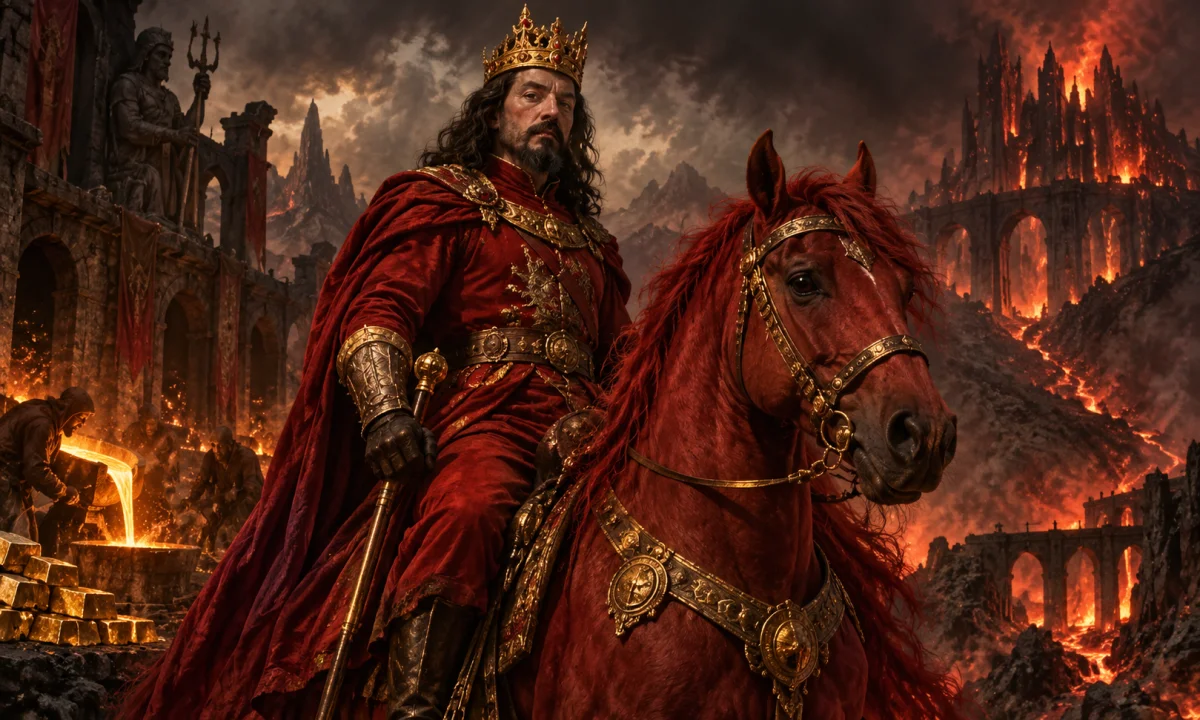
Berith is a demonological figure best known from early modern European grimoires, especially the Pseudomonarchia Daemonum and the Ars Goetia. In those texts he is described as a powerful duke of Hell who appears as a soldier or nobleman riding a red horse. He is associated with the transmutation of metals, the granting of honours, and the revelation of information about the past, present and future. His name is also connected with the older biblical figure Baal-berith, although the relationship between the ancient deity and the later demon is interpretive rather than historically certain.
Origins and cultural setting
The earliest background to the name lies in the Hebrew Bible. The Book of Judges mentions Baal-berith, or “Baal of the covenant,” as a deity worshipped by the Israelites after the death of Gideon. The same narrative refers to the “house of El-berith,” apparently a sanctuary or temple associated with this figure. The biblical account does not describe Baal-berith as a demon in the later Christian sense. It presents him as a foreign or rival god whose worship is condemned within the biblical story.
The Hebrew word berit or berith generally means “covenant,” “agreement” or “treaty.” The compound name Baal-berith can therefore be understood as “Lord of the Covenant,” while El-berith may mean “God of the Covenant.” The precise religious meaning of these names remains debated. They may refer to a deity connected with agreements, oaths or social bonds, but the surviving biblical references are too brief to establish a complete mythology or cult.
In later Jewish and Christian interpretation, pagan gods mentioned in the Hebrew Bible were sometimes reclassified as demons. This was part of a broader process in which the gods of rival religions could be portrayed as deceptive spirits or devils. Baal-berith was consequently incorporated into some demonological traditions, sometimes under the shortened form Berith. That transformation belongs primarily to later religious and occult literature, not to the original biblical material.
The name Berith and related forms
The spelling of the name varies considerably. Forms such as Berith, Beal, Baalberith, Balberith and Bolfry appear in different demonological and occult sources. These variations do not always represent separate beings, and the manuscripts and printed editions of magical texts are not completely consistent.
The connection between Berith and Baal-berith is common in later demonology, but it should not be treated as an established historical identity. The biblical Baal-berith is a deity named in a brief account of ancient Israelite religious conflict. The Berith of the grimoires is a highly individualized spirit with a rank, appearance and set of magical functions. The latter description developed within medieval and early modern Christian demonology, which reorganized many older religious names into systems of infernal hierarchy.
The name has also sometimes been associated with the meaning “covenant” in a symbolic sense. This has encouraged later writers to connect Berith with oaths, agreements, contracts and pacts. However, the major grimoire descriptions do not consistently make him a special patron of contracts. The association is partly a consequence of the name’s biblical and Hebrew background, and partly a product of the wider Christian idea that demons tempt people through binding promises.
Berith in the demonological grimoires
The most influential portrait of Berith appears in texts belonging to the European grimoire tradition. The Pseudomonarchia Daemonum, a sixteenth-century catalogue of demons associated with the writings of Johann Weyer, includes a spirit named Berith. A related description appears in the Ars Goetia, the first section of the Lesser Key of Solomon, a collection that reached its familiar form in the seventeenth century.
In the Ars Goetia, Berith is listed as the twenty-eighth spirit. He is described as a mighty and terrible duke who commands a large number of infernal legions. The number is given as twenty-six in the commonly circulated text. Like many figures in the catalogue, his rank is presented in the language of a royal or military court, reflecting the hierarchical imagination of European demonology rather than evidence of an ancient system of demon worship.
The grimoire says that Berith can answer questions about things past, present and future. He is also credited with giving dignities, or positions of status and honour. Another important power attributed to him is the ability to turn metals into gold. These abilities place him within two familiar areas of ceremonial magic: the acquisition of worldly advancement and the quest for alchemical transformation.
Such descriptions should be understood as features of magical literature. They are not independent historical evidence that a being called Berith was worshipped with these particular powers in the ancient Near East. The red horse, crown and alchemical ability belong to the grimoire portrait and should not automatically be projected backward onto Baal-berith.
Appearance and symbolic imagery
Berith is usually depicted in the grimoires as a striking, martial and aristocratic figure. He appears in red clothing, wears a golden crown, and rides a red horse. In some descriptions, his appearance changes when the conjurer commands him to reveal his true form. The imagery combines the visual language of a military commander, a courtly duke and a fiery infernal spirit.
Red is an important part of his traditional grimoire image. In Christian symbolic language it may suggest blood, violence, war, sin or the fires of Hell. In an alchemical context, red can also evoke the final stage of transformation and the perfection of matter. The colour therefore supports several aspects of Berith’s character: his martial authority, his dangerous nature and his association with the production of gold.
The horse emphasizes movement, command and military power. A mounted figure was a familiar sign of rank in European art and literature, while the crowned head signals authority. These features make Berith resemble a demonic version of a noble cavalry commander rather than a shapeless or purely monstrous spirit. His visual form is part of the grimoire tradition’s tendency to give demons titles, costumes and courtly offices.
Powers and attributed functions
- Alchemical transformation: Berith is said to turn metals into gold. This is one of his most recognizable attributes, although it comes from early modern magical texts rather than ancient descriptions.
- Revelation of knowledge: The grimoires attribute to him the ability to tell the truth about past, present and future events.
- Granting honours: He is associated with dignities, advancement and social distinction, reflecting his status as a duke.
- Infernal command: He is said to rule over twenty-six legions, a detail that places him within the military bureaucracy used by goetic catalogues.
- Dangerous speech: Some versions emphasize that he can answer questions accurately but may deceive the practitioner if proper ritual precautions are not observed. This motif is common in demonological literature, even when the wording varies between editions.
The combination of truth-telling and deception is significant. Grimoires often describe spirits as capable of providing useful knowledge while also warning that the magician must control the encounter through names, seals, prayers and ritual commands. Berith’s reputation therefore reflects the ambivalent nature of occult knowledge: it promises wealth and information but is framed as spiritually hazardous.
Stories and ritual context
Berith does not possess a large cycle of myths comparable to those of figures such as Lucifer, Asmodeus or Lilith. His surviving identity is primarily catalogue-based. He appears in lists of spirits with assigned ranks, powers and visual forms, rather than in extended narrative stories describing his birth, battles or relationships.
The Ars Goetia provides a ritual framework for summoning each spirit, including names, magical signs and instructions for controlling the encounter. Berith’s entry belongs to this practical and classificatory structure. The text treats him as one spirit among many in an infernal hierarchy, and his individuality is expressed through his title, appearance, number of legions and special abilities.
There is no widely established traditional story in which Berith forms a fixed relationship with Solomon, though the Ars Goetia as a whole is presented within a Solomonic framework. The association with King Solomon comes from the legendary idea that Solomon commanded demons and compelled them to reveal hidden knowledge or perform tasks. It does not mean that Berith is described in the Hebrew Bible as one of Solomon’s spirits.
Baal-berith and the problem of identification
Confusion between Berith and Baal-berith is especially common. Baal-berith belongs to the religious world described in Judges, where the name identifies a deity worshipped at Shechem or in its surrounding area. The biblical passage gives only limited information and does not preserve a mythology, image or ritual manual for this god.
Berith in the European grimoires, by contrast, is a duke of Hell with a red horse, a crown and powers over metals and honours. Later Christian writers could treat pagan gods as demons, making an association between the names seem natural. Yet there is no continuous chain of evidence showing that an ancient cult of Baal-berith preserved the exact characteristics later assigned to the grimoire spirit.
It is also important not to confuse Berith with every figure called Baal. Baal was a major Northwest Semitic divine title and name associated with storm, fertility and kingship in various regional traditions. Baal-berith is a specific biblical form, and its meaning is not identical to the general concept of Baal. Nor should Berith be merged with Beelzebub, Baal, Belial or other demons whose names were sometimes connected through Christian polemic or later occult classification.
Interpretation and cultural significance
Berith illustrates how demonological traditions often develop through the reinterpretation of older religious names. A deity condemned as foreign in biblical literature can later be placed within a Christian hierarchy of demons, and a short name can acquire a detailed biography through occult catalogues. This process does not necessarily preserve the original religion. Instead, it reflects the changing concerns of the writers who recorded and classified the figure.
His attributes also reveal the priorities of early modern European occult culture. Gold represented wealth, power and the promise of hidden transformation. Dignities represented access to courts, offices and social influence. Prophecy represented the desire to overcome uncertainty. Berith combines all three ambitions in a single figure, making him a spirit of material advancement and privileged knowledge.
The image of the crowned rider gives these ambitions a political and military form. Berith is not presented as a wild animal spirit or a household goblin. He belongs to an infernal court that imitates earthly institutions: dukes command legions, spirits wear formal clothing, and supernatural powers resemble the privileges of rulers, alchemists and astrologers. This bureaucratic structure is one of the defining imaginative features of European goetic literature.
Later reception
Berith has had a smaller presence in popular culture than more famous demonological figures such as Lucifer, Astaroth or Asmodeus. He nevertheless appears occasionally in modern occult writing, fantasy fiction, role-playing games, horror media and online catalogues of demons. These adaptations commonly preserve the red horse, the crown, the title of duke and the ability to transform metals.
Modern portrayals often expand Berith into a fully developed character with personal motives, alliances or a detailed mythology. Such additions belong to creative reinterpretation rather than to the older sources. The traditional evidence supports a relatively concise grimoire profile: a powerful duke, a red-clad mounted figure, a spirit connected with gold, honours and knowledge, and a name that may have been influenced by the biblical Baal-berith.
For that reason, Berith is best understood as a figure standing at the intersection of biblical polemic, Christian demonology and early modern ceremonial magic. His ancient background is uncertain and fragmentary, while his familiar appearance and powers are products of the later grimoire tradition.