WORLD
WORLD
Asmodeus
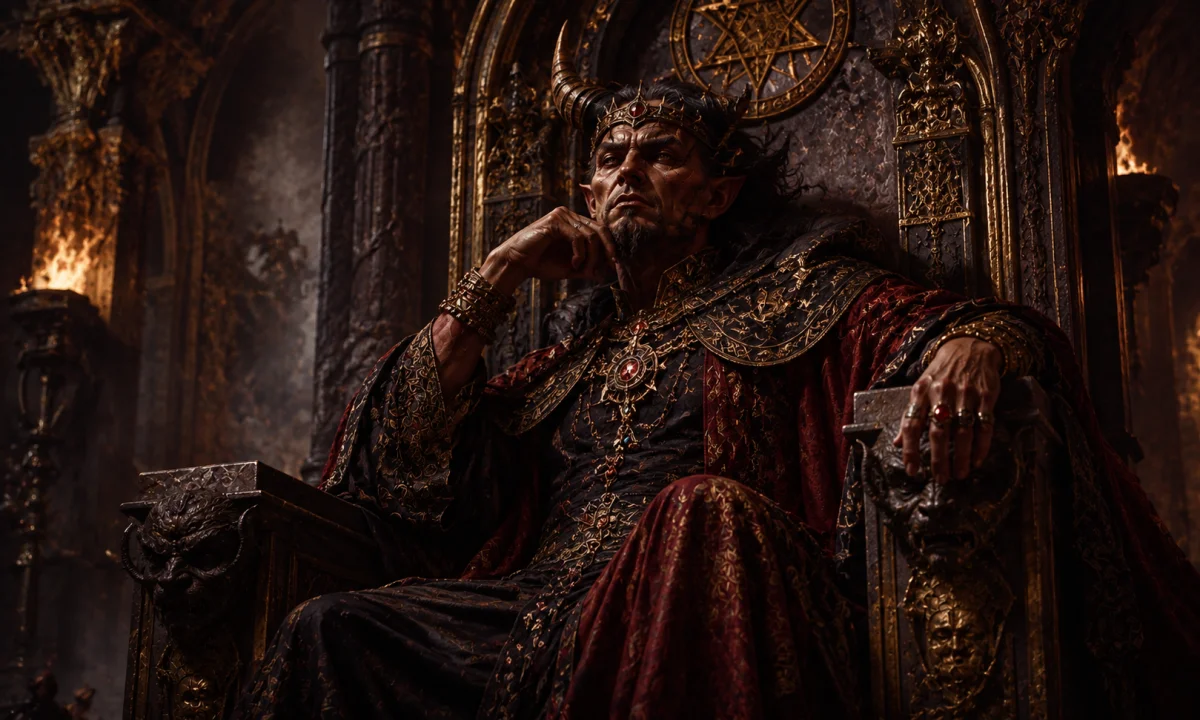
Asmodeus is one of the best-known demonic figures in Jewish, Christian and later Western demonological traditions. His identity is not completely uniform across those traditions. In the Book of Tobit, he is a destructive spirit who kills the husbands of Sarah and is defeated by the archangel Raphael. In rabbinic legend, a related figure named Ashmedai or Asmodai appears as a powerful king of demons who encounters Solomon. Much later, European occult writings classify Asmodeus as a major demon associated especially with lust, luxury and excess.
Origins and cultural setting
The name Asmodeus probably reflects contact between Jewish religious traditions and the older religious world of ancient Iran, although the precise history of the name and figure remains debated. Many scholars connect it with the Avestan being Aeshma daeva, a spirit associated with fury or destructive wrath. The connection is plausible because Jewish communities lived under Persian rule and encountered Iranian religious language, but Asmodeus is not simply identical with Aeshma. The Jewish and Christian traditions developed their own stories, roles and moral meanings around the name.
The earliest substantial surviving narrative about Asmodeus appears in the Book of Tobit, a Jewish work composed during the Second Temple period. The story survives principally in Greek versions, with Aramaic and Hebrew fragments also preserved among the Dead Sea Scrolls. The book is accepted as part of the biblical canon by Roman Catholic and Eastern Orthodox churches, while many Protestant traditions place it among the Apocrypha rather than the Old Testament. It is not included in the Jewish Tanakh.
The story reflects a world in which demons, angels, divine providence and human family life exist within the same religious universe. Asmodeus is not presented as an abstract principle of evil alone. He acts within a specific human tragedy, attacking marriage and preventing Sarah from living a normal married life. His defeat comes not through human strength but through divine instruction delivered by Raphael, an archangel who guides the young Tobias.
The name and its variants
Several forms of the name occur in different languages and periods. These include Asmodeus, Asmodaios, Asmodai, Ashmedai and Ashmodai. The spelling often depends on whether a text is being transmitted through Greek, Latin, Hebrew or Aramaic.
The form Asmodeus is especially familiar from Christian biblical and demonological writing. Ashmedai is common in discussions of rabbinic literature, where the figure appears in the Babylonian Talmud. The forms are generally treated as related, but the characters are not identical in every detail. Their relationship is best understood as a development within overlapping traditions rather than as proof that every story concerns precisely the same being.
The proposed Iranian origin of the name has influenced modern scholarly interpretation. If the connection with Aeshma is correct, the name may originally have carried associations of violent passion or wrath. In later Jewish and Christian contexts, those associations were reshaped. Asmodeus became connected with sexual desire, jealousy, destructive appetite and the disordering of domestic life.
Asmodeus in the Book of Tobit
The central story of Asmodeus occurs in the account of Sarah, the daughter of Raguel. Sarah has married seven men, but each husband dies on the wedding night before the marriage can be consummated. The text attributes these deaths to Asmodeus, who desires Sarah and prevents her husbands from remaining with her.
Sarah is therefore trapped between social disgrace and personal grief. Her situation is so painful that she prays for death, not because she is portrayed as guilty, but because she fears the shame attached to her repeated widowhood. At the same time, the elderly Tobias, father of the young hero Tobias, prays from a different place. The narrative brings their prayers together, establishing the circumstances for the young Tobias to meet Sarah.
When Tobias prepares to marry Sarah, the archangel Raphael instructs him to use the heart and liver of a fish caught during the journey. Tobias burns the organs as instructed, and the smoke drives Asmodeus away. Raphael pursues and binds the demon in an unspecified region of Upper Egypt. The demon's defeat allows Tobias and Sarah to live as husband and wife.
The story gives Asmodeus a specific role as an enemy of marriage and human flourishing. His actions are not described as a general campaign against all humanity. Instead, he is tied to Sarah's household, to sexual jealousy and to the threat of death at the beginning of married life. The fish's organs do not function as a general magical recipe in the text. Their power comes from Raphael's divine instruction, and the episode belongs to the story's particular religious world.
The narrative also differs from later European ideas about exorcism. Tobias does not defeat Asmodeus through his own occult knowledge or by learning the demon's personal name. He follows Raphael's instructions, while Raphael performs the decisive act of binding the demon. The story presents protection as part of divine providence rather than as an independent system of demon magic.
Ashmedai and Solomon in rabbinic tradition
Rabbinic literature gives a related but substantially different picture. In the Babylonian Talmud, especially the account in tractate Gittin, Ashmedai is described as the king of demons. He becomes involved with Solomon, whose building projects and desire for extraordinary assistance lead to a confrontation with the demonic realm.
The Talmudic narrative belongs to a wider cycle of stories about Solomon's wisdom, authority and eventual vulnerability. Solomon is associated with power over demons, and Ashmedai is captured through a combination of planning, a divinely empowered object and the actions of Benayah son of Jehoiada. The details involve a binding device connected with the divine name and a carefully prepared trap. As in many legendary narratives, the story exists in a dense and sometimes contradictory form, and later retellings rearrange its events.
Ashmedai is not merely a monster waiting to be destroyed. He is intelligent, articulate and capable of exposing human weakness. His encounter with Solomon contributes to a broader rabbinic meditation on the limits of royal power. Solomon may command spirits, but he can also be deceived, displaced or humiliated. The demon's presence makes wisdom and authority appear less secure than they first seem.
Some versions and interpretations of the Solomon cycle connect Ashmedai with the construction of the Temple or with Solomon's temporary loss of kingship. These episodes should not be confused with the account in Tobit. The demon who torments Sarah and the demon king who appears in the Talmud are commonly treated as related manifestations of the Asmodeus tradition, but their stories serve different literary and religious purposes.
Attributes and symbolism
Asmodeus has no single universally accepted appearance. In the Book of Tobit, the narrative focuses on his actions and does not provide the elaborate physical description later associated with demons. Rabbinic stories likewise emphasize his speech, intelligence and authority rather than establishing one fixed visual form.
Later demonological manuals give him more distinctive imagery. A famous description portrays Asmodeus with several animal and human features, riding a dragon and carrying a lance or banner. Such images belong to early modern occult classification, not to the biblical or rabbinic accounts. They should not be projected backward as though they were part of the original story of Sarah or the ancient Jewish conception of Ashmedai.
Across the traditions, several themes recur:
- Destructive desire: In Tobit, Asmodeus's desire for Sarah becomes lethal and prevents marriage.
- Disorder within the household: His attacks turn the wedding chamber into a place of fear and death.
- Dangerous intelligence: In rabbinic legend, Ashmedai is a clever speaker whose knowledge can challenge human rulers.
- Excess and appetite: Later Christian and occult traditions broaden his symbolism to include lust, luxury, gambling and uncontrolled pleasure.
- Defeat through higher authority: Raphael defeats him in Tobit, while Solomon's authority and the divine name constrain him in rabbinic legend.
These meanings are not all present in every source. The association with gambling, for example, is particularly prominent in later demonological systems and modern fiction, while the earliest narrative is much more specifically concerned with marriage, death and deliverance.
Asmodeus in Christian demonology
Christian readers inherited Asmodeus chiefly through the Book of Tobit. Because Tobit was treated as Scripture in several major Christian traditions, Asmodeus became a recognized biblical demon rather than a figure known only from folklore. Medieval and early modern Christian writers often interpreted him as a spirit of lust or sexual temptation, extending the implications of his attack on Sarah into a broader moral category.
This development reflects a common pattern in demonological interpretation. A spirit originally associated with a particular story is given a more general function within a hierarchy of vices. Asmodeus came to represent excessive sexual desire, but also the luxurious and self-destructive appetites that accompany it. His name could therefore be connected with sensuality, gluttony, greed or gambling, depending on the writer and classification system.
In the Ars Goetia, a section of the seventeenth-century grimoire known as The Lesser Key of Solomon, Asmoday is presented as a powerful king among demons. The text assigns him a formal rank, a sigil, a method of appearance and particular abilities, including knowledge and influence over certain forms of worldly advantage. These details are part of early modern ceremonial magic, not descriptions found in Tobit or the Talmud.
The Ars Goetia also places Asmoday within a numbered catalogue of spirits. This catalogue should not be mistaken for an ancient Jewish or Christian hierarchy. It belongs to the learned occult culture of early modern Europe, which combined biblical names, medieval demonological ideas, angelic magic and inherited grimoire traditions.
Distinguishing Asmodeus from related figures
Asmodeus is sometimes confused with other beings because names and functions overlap across cultures. The most important distinction concerns Aeshma, the Iranian spirit often proposed as the source of his name. Aeshma belongs to Zoroastrian religious tradition, while Asmodeus belongs to Jewish, Christian and later Western demonological traditions. A possible historical relationship does not make them interchangeable.
Asmodeus should also be distinguished from Samael, another prominent figure in Jewish and later religious literature. Samael can be portrayed as an accuser, angel of death or powerful destructive being, depending on the text. He is not simply another name for Asmodeus, and the two have different narrative histories.
Nor is Asmodeus identical with every unnamed demon associated with lust. Medieval and modern writers sometimes grouped many spirits under broad moral categories, but a classification as a demon of lust does not erase the distinctive features of Asmodeus's own stories. His earliest surviving narrative is specifically tied to Sarah's marriages and to Raphael's intervention.
Interpretation and cultural significance
The story in Tobit can be read as a narrative about the restoration of social and emotional order. Sarah has become associated with death despite being the victim of a supernatural attack. Tobias's marriage to her, made possible through divine guidance, reverses the pattern of repeated loss. Asmodeus represents the force that turns intimacy into danger, while Raphael represents protection, healing and faithful guidance.
The rabbinic Ashmedai stories shift the emphasis from marital danger to the relationship between demonic power and human sovereignty. Ashmedai's intelligence makes him a fitting opponent for Solomon, the archetypal wise king. Yet the demon's presence also unsettles the idea that wisdom can control everything. The king who commands supernatural forces may still be deceived by them.
These traditions reveal differing approaches to the supernatural. Tobit presents a morally ordered universe in which a demon can be defeated through the help of an angel and the fulfillment of divine purpose. Rabbinic legend uses the demon to explore paradox, authority and the fragility of human status. Early modern demonology turns the figure into one member of a structured occult hierarchy. None of these representations should be treated as the single definitive version of Asmodeus.
Later reception and popular culture
Asmodeus remains prominent in modern fantasy, horror, role-playing games and occult-themed fiction. Contemporary works often use him as a prince or king of Hell, a ruler of lust, or a patron of forbidden knowledge. Such portrayals usually draw more heavily on Christian demonology, grimoires and general fantasy conventions than on the narrative of Tobit or the rabbinic account of Ashmedai.
Role-playing games in particular have helped standardize an image of Asmodeus as a powerful infernal monarch. That image is influential in popular culture, but it is a modern adaptation rather than an ancient religious consensus. In traditional sources, his role changes significantly: he is the killer of Sarah's husbands, the demon king who confronts Solomon, or a formally ranked spirit in an early modern magical catalogue.
For that reason, the name Asmodeus carries several layers of meaning. It can refer to a demon in a Jewish deuterocanonical narrative, to Ashmedai in rabbinic legend, to a figure in Christian demonology, or to a modern fictional ruler of Hell. Understanding which tradition is being discussed is essential, because the attributes associated with one layer do not automatically belong to the others.