WORLD
WORLD
Balberith
Balberith is a name associated with demonological literature, but its background reaches back to the ancient Levantine deity called Baal-berith or Ba‘al Berith. The ancient name appears in the Hebrew Bible in connection with Shechem, where it means approximately “Lord of the Covenant.” In later Christian demonology, that local deity was reinterpreted as a demon and appears under forms such as Balberith, Beelberith and Balberit. These names are related, but the ancient god and the later demon should not be treated as identical figures without qualification.
Ancient origins at Shechem
The earliest surviving literary evidence connected with the name comes from the Book of Judges. After the death of Gideon, the Israelites are said to have turned toward the worship of the Baals, and specifically to have made Baal-berith their god. The same narrative refers to money taken from the temple or treasury of Baal-berith at Shechem. A later passage mentions the “house of El-berith,” apparently another title or related designation associated with the same cultic setting.
Shechem was an important city in the central hill country of the ancient southern Levant. It had a long religious and political history and was associated with covenant-making traditions in the Hebrew Bible. The element ba‘al means “lord” or “master,” while berith means “covenant,” “alliance” or “treaty.” Baal-berith can therefore be understood as “Lord of the Covenant” or “Lord of the Treaty.” The title may have described a deity believed to protect agreements, political alliances or sworn obligations.
The biblical references are brief and do not provide a full description of Baal-berith’s appearance, mythology or rituals. They do not say that he was a demon. In their original context, he was a foreign or rival deity whose worship was being condemned by the biblical authors. Later religious interpretation transformed the status of such deities, but that transformation belongs to a different period and theological framework.
Name and identity
The spelling Balberith is a later form of the older name. Other spellings include Beelberith, Beel-Berith, Balberit and forms that retain a separation between the elements, such as Baal Berith. Variations arose through differences in Hebrew, Greek and Latin transliteration, as well as through the copying practices of later writers.
The name can consequently refer to several related but distinct things:
- Baal-berith: the deity mentioned in the Book of Judges and associated with Shechem.
- El-berith: a related or alternative title found in the same biblical narrative, though its exact relationship to Baal-berith is uncertain.
- Balberith or Beelberith: the demonological figure created by later Christian writers through the demonisation and reinterpretation of the older name.
It is not certain that every occurrence of these names in later texts represents exactly the same figure. Some demonological dictionaries and occult compilations repeat information from earlier works, while others alter the spelling, rank or attributes. As a result, Balberith does not have a single universally accepted profile comparable to figures such as Satan, Lucifer or Beelzebub.
From local deity to demon
In Jewish and Christian polemical traditions, the gods of neighbouring peoples were often described as idols, false gods or demons. This did not mean that every ancient deity had a continuous independent cult as a demon. Rather, the change reflected a new religious interpretation: a god once worshipped by another community could be presented as a deceptive or hostile spiritual power.
Balberith belongs to this broader history of demonisation. The ancient deity’s title referred to covenant and alliance, but later Christian demonology could reinterpret the same association negatively. A spirit connected with oaths might become a dangerous power presiding over unlawful agreements, magical pacts or perjury. This development is an example of how names from biblical and pre-Christian religious traditions were absorbed into medieval and early modern catalogues of demons.
The surviving biblical material does not establish a continuous line from the sanctuary of Baal-berith at Shechem to a specific demon named Balberith. The connection is primarily one of name and later interpretation. Historical evidence for an ancient cult and descriptions in Christian demonological books should therefore be kept separate.
Balberith in demonological literature
Balberith is best known from early modern demonological catalogues and later reference works, especially French traditions of demonology. In these sources, he is commonly presented as a demon of high rank or as a powerful official within a diabolical hierarchy. Descriptions vary, but he is frequently associated with contracts, alliances, oaths and agreements.
Some accounts call him a grand pontiff, a master of ceremonies or an authority over compacts. Others describe him as a recorder or keeper of agreements. These titles should not be understood as part of a single ancient mythology. They belong to the administrative language often used by European demonologists, who imagined Hell as a structured court with offices, ranks and specialised powers.
Balberith’s supposed authority over agreements is probably connected to the meaning of Baal-berith’s name. “Lord of the Covenant” could be turned into a demonic title for a being who presides over pacts. In Christian moral thought, however, a pact with a demon was not a sacred covenant in the positive sense. It was generally understood as a corrupt bargain, a temptation or a renunciation of proper religious allegiance.
Some later descriptions also associate Balberith with speech, testimony or the revelation of hidden matters. These details are not stable across the tradition and should not be treated as defining attributes. There is no single authoritative medieval legend that establishes a fixed appearance, set of powers or biography for him.
Appearance and powers
Balberith has no consistently recorded physical form. Unlike certain demons that are repeatedly described as having animal features, multiple heads or a recognisable heraldic shape, Balberith is usually identified by his office and name rather than by a standard appearance.
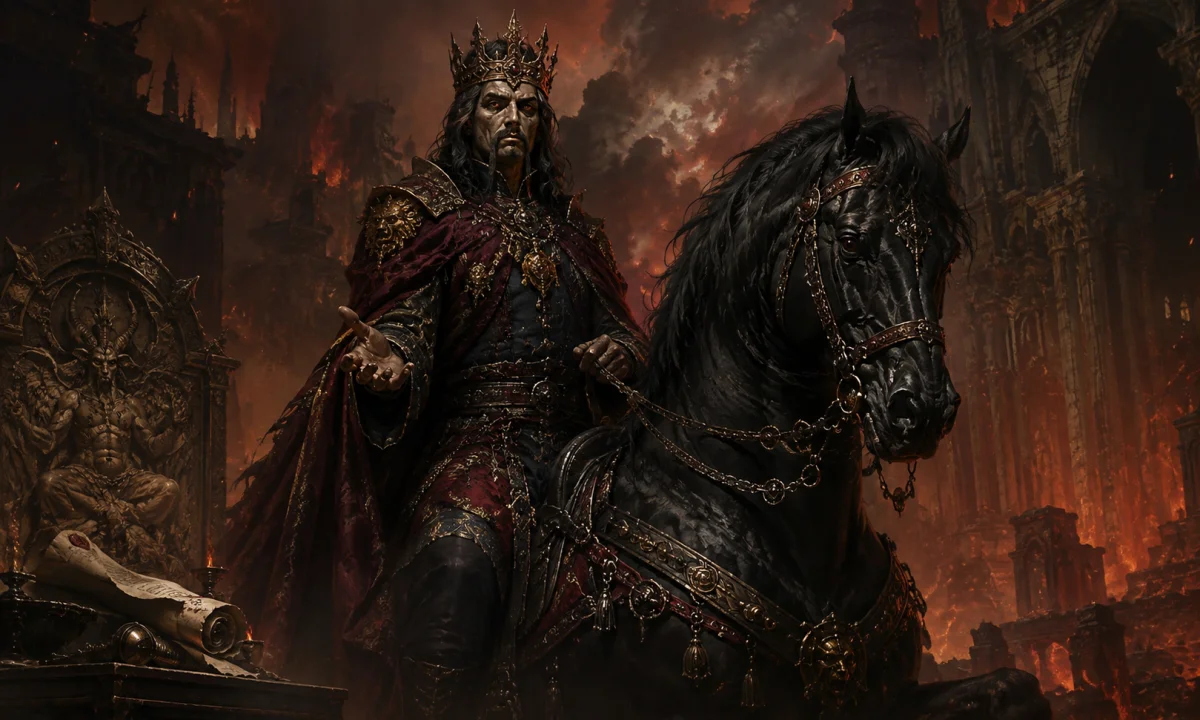
Illustrations in modern occult books may portray him as a crowned spirit, a robed priest, a monstrous official or a shadowy figure holding a document or seal. Such images are artistic interpretations rather than evidence of an established traditional appearance. The idea of a priestly or bureaucratic figure reflects his alleged association with religious office, contracts and formal agreements.
Attributes assigned to Balberith in later demonology commonly include:
- authority over pacts, alliances or sworn agreements;
- involvement in oaths and the consequences of breaking them;
- knowledge of formal or secret arrangements;
- a position of rank within an imagined infernal hierarchy;
- the ability to tempt people through promises, bargains or advantageous contracts.
These characteristics are interpretive additions rather than details preserved from the cult of Baal-berith at Shechem. The biblical passages provide no demonological description of his powers and do not portray him as a supernatural contract-maker in the later occult sense.
Relationships and associated names
Balberith is sometimes linked with Baal because his name contains the title ba‘al, “lord.” This does not automatically mean that he was simply another name for every deity called Baal. In the ancient Levant, ba‘al could function as a divine title and could be combined with a place, function or epithet. Baal-berith may have been a local form or title of a deity worshipped at Shechem, but the limited evidence does not permit a complete reconstruction of his identity.
The name is also occasionally confused with Beelzebub or Beelzebul because of the similar “Beel-” spelling found in some later forms. The similarity is not enough to prove that they are the same figure. Beelzebub has a separate biblical and demonological history, associated with the title “Lord of the Flies” or a related interpretation, whereas Baal-berith is connected with covenant or alliance.
Balberith should likewise not be identified automatically with demons whose names appear in the Ars Goetia, the well-known catalogue of seventy-two spirits. He is not one of the standard spirits listed in that particular text. Occult websites and modern compilations sometimes combine material from several demonological systems, which can produce hybrid profiles not found in any historical source.
Religious and symbolic meaning
The idea behind Balberith is particularly suited to symbolism involving the danger of bargains. A covenant normally establishes trust, obligation and mutual recognition. In demonological interpretation, the same structure can become a trap: a promise that appears beneficial but carries a hidden cost, or a contract that binds a person more completely than expected.
This theme reflects a wider concern in religious literature with improper oaths and forbidden agreements. The problem is not simply that a promise may be broken. It may also be that the agreement was made with an illegitimate power, under deceptive conditions or in exchange for something that should not be surrendered. Balberith’s later identity therefore represents the corrupted form of covenant: a sacred or social bond transformed into a dangerous pact.
His name also illustrates the tension between historical religion and polemical demonology. In the ancient setting, a covenant lord would have been understood by worshippers as a legitimate divine protector. In later Christian writing, the same figure could be recast as an enemy of the true faith. The change tells us as much about the beliefs and priorities of later interpreters as it does about the original cult at Shechem.
Historical evidence and uncertainty
Evidence for Baal-berith is limited. The biblical references confirm that a deity or cult bearing this name was associated with Shechem, but they do not preserve a complete mythology. Archaeological evidence may illuminate the religious environment of ancient Shechem, yet it does not by itself provide a secure biography or iconography for Baal-berith.
The later demon Balberith is even less uniform. His profile comes chiefly from demonological and occult literature rather than from an uninterrupted popular tradition. Writers often classified demons according to moral roles, ranks and offices, and they sometimes borrowed names from biblical passages without preserving the original cultural context. Repeated claims about his exact title, rank or powers may therefore reflect copying between reference works rather than independent evidence.
For that reason, statements that Balberith is definitively “the demon of contracts,” that he has a fixed appearance or that he commands a specific number of spirits should be treated cautiously. Such descriptions may occur in particular modern or early modern compilations, but they are not universal features of the tradition.
Later reception
Balberith has remained a relatively obscure figure compared with more prominent demons. His name appears in encyclopaedic treatments of demonology, occult classifications, fictional bestiaries and modern discussions of infernal names. Writers interested in symbolic magic or religious demonology may use him as a figure representing pacts, legalistic bargains or the dark side of sworn commitment.
Modern fiction sometimes expands Balberith into a powerful prince of Hell, a tempter who offers contracts, or a supernatural bureaucrat who enforces the wording of agreements. These portrayals draw on the later demonological association with covenants, but they are creative adaptations rather than evidence for the ancient religion of Shechem. When Balberith appears in games, novels or other popular media, the fictional character should be distinguished from both Baal-berith and the variable demonological profiles found in historical reference works.