WORLD
WORLD
Beelzebub
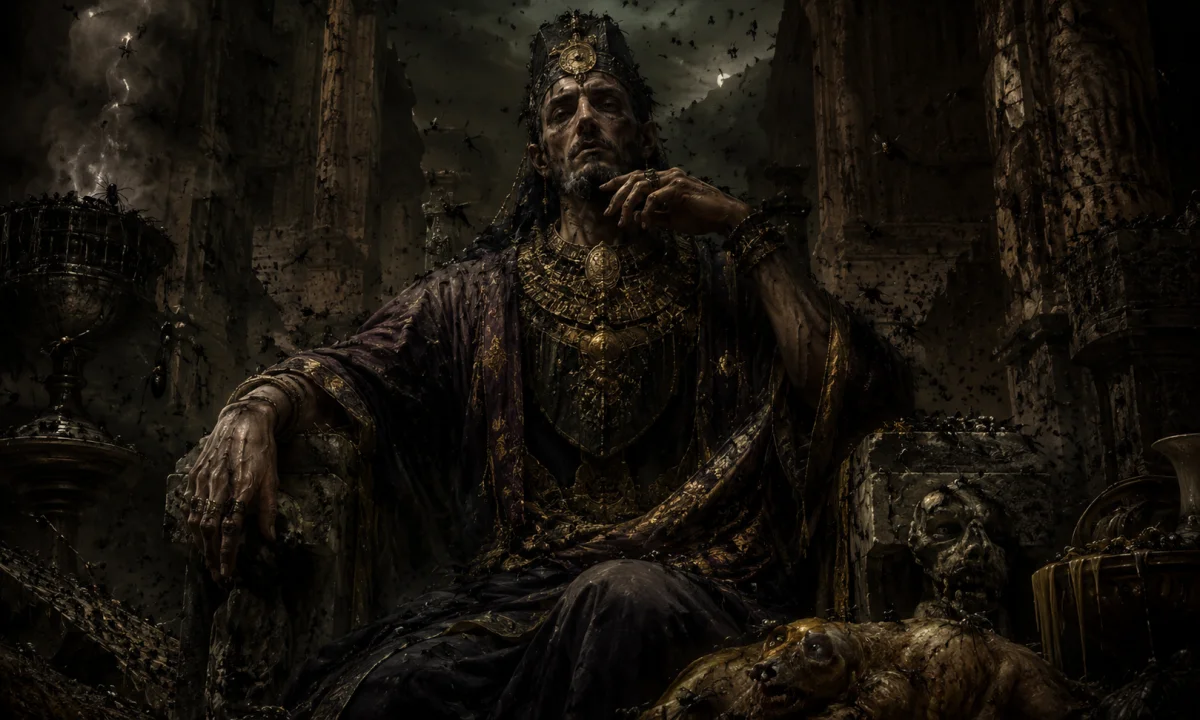
Beelzebub is a name associated with both an ancient deity of the Philistine city of Ekron and, in later Jewish and Christian tradition, a powerful demon. The figure’s identity changed substantially over time. In the Hebrew Bible, the name appears in connection with a foreign god consulted by King Ahaziah of Israel. In the New Testament, a closely related form, Beelzebul, is used as a title for the “ruler of demons.” Medieval Christian demonology expanded that role, while modern fiction often treats Beelzebub as one of Hell’s principal rulers.
Origins in the ancient Near East
The earliest clear biblical reference occurs in the story of Ahaziah, king of Israel, in 2 Kings 1. After suffering an injury, Ahaziah sends messengers to ask whether he will recover from Baal-zebub, described as the god of Ekron. The prophet Elijah condemns the king for seeking an oracle from this deity rather than from the God of Israel. The story presents Baal-zebub as a non-Israelite god associated with a Philistine city, not yet as the supreme demon of later Christian imagination.
Ekron was one of the principal cities traditionally associated with the Philistines. It stood in the southern Levant, in a region shaped by contact among Philistine, Canaanite, Israelite and other ancient Near Eastern cultures. Baal was a common divine title meaning “lord,” and several local gods could be called Baal. The expression Baal-zebub therefore most likely referred to a particular local deity or cult title rather than to a universal figure known throughout the ancient world.
The biblical account is not a neutral description of Ekron’s religion. It is written from an Israelite theological perspective and treats consultation of the foreign god as an act of disloyalty and religious error. The passage preserves the name, but it does not explain the deity’s mythology, appearance, rituals or precise function in Philistine worship.
The meaning and spelling of the name
The name has several forms because it passed through different languages and textual traditions. In Hebrew, the form usually represented in English as Baal-zebub combines Baal, “lord,” with a second element commonly connected with the Hebrew word for “fly” or “flies.” This produces the familiar interpretation “Lord of the Flies.” The title may have referred to a deity believed to control troublesome insects, or it may have been a hostile wordplay created by biblical writers to demean a foreign god.
The exact etymology is disputed. Some scholars have proposed that the original name may have contained a different word related to zebul, meaning something like “exalted dwelling” or “prince.” On this interpretation, a form such as “Baal of the lofty dwelling” or “exalted lord” may have been altered in Israelite usage into a mocking expression involving flies. The surviving evidence does not permit complete certainty about the original Philistine title.
The New Testament generally uses the form Beelzebul, although manuscripts and translations vary. Beelzebub became especially familiar through later Christian and English usage. These forms are closely related, but the variation should not be treated as proof that every historical reference concerns exactly the same conception. Names were transmitted through Hebrew, Aramaic, Greek, Latin and later European languages, and spelling differences reflect that complex history.
Beelzebul in the New Testament
In the Synoptic Gospels, opponents of Jesus accuse him of casting out demons by the power of Beelzebul, whom they call the ruler or prince of demons. The accusation appears in Matthew 10 and 12, Mark 3 and Luke 11, with variations in wording. Jesus answers that a kingdom divided against itself cannot stand: if Satan is driving out Satan, Satan’s dominion is internally divided. The argument is commonly known as the “divided kingdom” saying.
These passages are important because they show the name functioning as a designation for a demonic authority rather than simply for an ancient city-god. In the Gospel setting, Beelzebul is associated with the organization or rule of demons. The texts do not provide a physical description, a biography or a complete hierarchy of Hell. They assume that their audience understands the name as referring to a powerful supernatural opponent.
The relationship between Beelzebul and Satan is not expressed identically in every passage or later tradition. In the Gospel debate, Beelzebul is closely connected with Satan’s realm, and the two names may function in overlapping ways. Later Christian writers often made Beelzebub a high-ranking demon subordinate to Satan, while some traditions treated the names as alternative titles for the same chief adversary. The New Testament itself does not establish the elaborate hierarchy found in later demonological works.
The Gospel use may also reflect a process in which the name of a rival or condemned deity becomes a label for demonic power. Ancient Jewish and Christian writers frequently interpreted the gods of other peoples through their own religious categories. A foreign god could be rejected as an idol, a false power or a demon. Beelzebul’s transformation belongs to this wider history of religious polemic.
From local deity to demonic prince
Beelzebub’s development illustrates how supernatural figures can change when religious cultures encounter one another. In the account of 2 Kings, Baal-zebub is a foreign god with an oracle at Ekron. By the time of the Gospels, Beelzebul has become a name for a demonic ruler. Later Christian interpretation further developed him as one of the leading powers opposed to God.
This change did not occur through one universally accepted doctrine. Different Jewish, Christian and later European sources use the name in different ways. Some treat Beelzebul as a chief demon; some place him below Satan; some use the name as a general synonym for the Devil; and some preserve an association with demons in a more collective or symbolic sense. It is therefore misleading to present a single detailed “official” profile of Beelzebub across all periods.
In Christian demonology, the name was often connected with ideas of corruption, idolatry, temptation and spiritual pollution. The traditional “Lord of the Flies” interpretation encouraged associations with decay, carrion, swarming insects and the uncleanness of death. These associations are largely products of later interpretation and symbolism. The biblical passage about Ekron does not describe Beelzebub as a fly-shaped monster or explicitly identify him with rot and corpses.
Appearance and powers
There is no single ancient description of Beelzebub’s appearance. The Hebrew Bible gives no physical form, and the Gospel passages focus on his supposed authority over demons rather than on his body. Images of a gigantic fly, a winged demon or a horned ruler belong mainly to later artistic, literary and popular traditions.
In religious accounts that identify Beelzebub as a demonic prince, his principal attribute is authority over other demons. He may be portrayed as a tempter, deceiver or patron of false worship. Some later writers connect him with gluttony, pride, filth, disease or the corruption of the senses, but these assignments are not consistent across all demonological systems.
The title “Lord of the Flies” has made insects the most recognizable symbol associated with Beelzebub. A fly may represent nuisance, contamination, decay or the intrusion of disorder into human life. At the same time, this imagery should be distinguished from evidence about the original cult at Ekron. Nothing in the surviving biblical account proves that worshippers represented their god as a fly, or that flies were his exclusive sacred symbol.
Stories and relationships in later tradition
Later Christian writings sometimes place Beelzebub near the top of an infernal hierarchy. He can appear as a prince of Hell, a commander of demons or a major adversary of saints and exorcists. These roles emerge from the broad development of Christian demonology rather than from one continuous ancient biography.
Beelzebub is also connected in some traditions with the broader category of unclean spirits. The New Testament’s language of demons and unclean spirits provided a foundation for later discussions of possession, temptation and exorcism. However, the Gospel accusations against Jesus do not supply a catalogue of Beelzebub’s servants or a description of his kingdom’s administration.
Medieval and early modern demonological texts frequently attempted to classify demons according to rank, function and sin. Beelzebub was sometimes listed among the most powerful infernal beings, but such classifications differed from author to author. The well-known idea that each major demon represents one of the seven deadly sins is not a uniform teaching of early Christianity. It belongs to later systems of moral and occult symbolism, and assignments involving Beelzebub vary.
Stories of saints confronting demons may use names such as Beelzebub to represent a chief spiritual adversary rather than to preserve a distinct ancient myth. In these narratives, the demon’s importance lies in the conflict between holiness and corruption, divine authority and rebellious power. The name can function as a dramatic emblem of demonic resistance even when the story supplies little information about the figure’s origin.
Distinguishing Beelzebub from similar figures
Beelzebub and Satan are closely connected in Christian tradition but are not always identical. Satan is a Hebrew term meaning “adversary” or “accuser” in its earliest biblical contexts, and it later became the proper name of the chief enemy of God in Christian usage. Beelzebul is a separate name with roots in the Baal-zebub tradition. Some later writers merge them, while others make Beelzebub a subordinate ruler.
Beelzebub and Lucifer also belong to different lines of tradition. Lucifer originally means “light-bearer” in Latin and was used in the Latin translation of a passage about the morning star in Isaiah. Later Christian interpretation connected the name with the fall of Satan, especially through readings of Isaiah 14 and other biblical passages. Beelzebub’s history instead begins with Baal-zebub of Ekron and the Gospel title Beelzebul.
Beelzebub and Belial should likewise be kept distinct. Belial began as a Hebrew term associated with worthlessness, wickedness or lawlessness and later became a personal name for a demonic power. Because both names appear in discussions of evil and Hell, later demonological lists sometimes place them together, but their linguistic and textual histories are not the same.
The name Baal itself does not mean “demon.” Baal was a title used for deities in the ancient Levant, and the biblical tradition preserves several references to Baal worship. Beelzebub is one particular name associated with a god of Ekron and its later demonized interpretation. It should not be used as a blanket term for every deity called Baal.
Cultural and religious significance
Beelzebub is significant because his history reveals the interaction of language, religious rivalry and changing concepts of evil. A name connected with a local god was preserved in an Israelite text, reinterpreted in a Jewish and Christian environment, and eventually transformed into one of the most recognizable names in European demonology.
The figure also demonstrates why ancient religious names cannot always be assigned one fixed meaning. “Lord of the Flies” is memorable, but it may represent a polemical reinterpretation rather than the original meaning of the name. Likewise, the image of Beelzebub as a supreme demon is influential, but it belongs primarily to later Christian development rather than to the earliest account from Ekron.
In theological and literary contexts, Beelzebub can symbolize the corruption of worship, the disorder of demonic powers or the degradation suggested by flies and decay. These meanings are interpretive layers built upon the name’s history. They should be distinguished from what the biblical texts directly say and from what can be established about Philistine religion.
Beelzebub in literature and popular culture
Beelzebub became especially prominent in European literature. In John Milton’s Paradise Lost, Beelzebub is a major fallen angel and a leading figure in the infernal council. Milton presents him as a powerful and articulate political figure among the rebel angels, while Satan remains the central leader. This portrayal helped establish Beelzebub as an aristocratic or statesmanlike demon rather than merely an insect-associated spirit.
Later novels, films, games, comics and television programs have used Beelzebub in many different ways. He may appear as a monarch of Hell, a monstrous swarm, a possessed character, a rival to Satan or a symbolic embodiment of gluttony and corruption. These adaptations draw from biblical language, medieval demonology, Miltonic literature and the “Lord of the Flies” image, often combining elements that originated in separate periods.
Modern fictional portrayals should not be mistaken for a single ancient tradition. A fly-like monster, a demon prince with a fixed rank, or a character identified as Satan’s second-in-command may be effective storytelling inventions or later literary conventions. The historically traceable figure begins with the contested name of a deity associated with Ekron and develops through successive religious and cultural reinterpretations.