WORLD
WORLD
Bariel
Bariel is an obscure and uncertain angelic name found in some later angelological and esoteric lists. Unlike Michael, Gabriel, Raphael, or other angels with substantial scriptural and liturgical traditions, Bariel does not have a clearly established identity in the Bible, the Qur’an, or the principal bodies of Jewish and Christian doctrine. The name’s spelling, origin, classification, and supposed functions vary, and some references may reflect transcriptional confusion with other angelic names.
Bariel in religious tradition
Bariel is not a prominent figure in the canonical religious texts of Judaism, Christianity, or Islam. No widely accepted biblical passage presents Bariel as an angel, and the name does not belong to the small group of angels regularly named in scripture. Nor does Bariel have a universally recognized feast, prayer, liturgical office, or theological role in established Christian denominations.
The name is more commonly encountered in later angelology: the study and classification of angels in religious speculation, mystical writing, magical handbooks, and modern compilations. Such sources often preserve long lists of angelic names, many of which were drawn from Hebrew, Aramaic, Greek, Latin, Arabic, or earlier occult traditions. Their status is not uniform. Some names belong to well-developed religious traditions, while others appear only once or in relatively late catalogues.
Bariel belongs to the second, less certain category. References to the name do not form a consistent narrative tradition. There is no agreed account of Bariel’s origin, appearance, rank, companions, or deeds. When a source assigns the angel a specific office, colour, planet, month, virtue, or ritual function, that information should be understood as belonging to that particular system rather than as a universal belief about Bariel.
The name and its uncertain spelling
The ending -el is common in angelic names and generally reflects a connection with the Hebrew word for God, El. It appears in names such as Michael, Gabriel, Raphael, Uriel, and many less familiar names. This ending alone does not establish a figure’s identity or prove that a name comes from a particular biblical or Jewish source.
The first element of Bariel is more difficult to interpret. Different spellings may result from the movement of names between alphabets and languages, from handwritten copying, or from attempts to represent unfamiliar consonants in Latin characters. Forms that look similar are not necessarily variants of the same angel. Without a clear textual chain connecting them, it is safer to treat each name separately.
Some modern lists alter the spelling to Bariel, Barael, Barachiel, or Barchiel. These forms should not automatically be merged. In particular, Barachiel—also written Barchiel or Barakiel in different traditions—is a more recognizable angelic name in some Christian and post-biblical sources. Bariel may sometimes have been shortened from, confused with, or independently associated with such names, but the evidence is not strong enough to make that identification certain.
Surviving sources and the problem of angel lists
Names like Bariel often survive through lists rather than stories. Medieval and early modern writers sometimes arranged angels according to the heavens, planets, zodiacal signs, hours, days, months, directions, virtues, or divine names. These catalogues could combine material from Jewish mystical traditions, Christian angelology, astrology, ceremonial magic, and classical ideas about the cosmos.
A name appearing in one of these catalogues does not necessarily indicate an ancient cult or a widely shared religious belief. It may represent the work of a single compiler, a copying error, a variant transcription, or an attempt to fill a place in a pre-existing scheme. The same angelic name could also receive different attributes in different manuscripts or occult systems.
This is especially important in the case of Bariel. General-purpose lists of angels sometimes provide a short description, such as an association with a celestial sphere or a spiritual quality, but those descriptions are not supported by a stable body of legends. A brief entry in an esoteric catalogue should not be treated as evidence for a complete mythology.
There is also a difference between religious tradition and ceremonial classification. Religious tradition usually includes some combination of scripture, worship, theological interpretation, inherited stories, and communal practice. Ceremonial classification, by contrast, may be a technical arrangement used for ritual or symbolic purposes. Bariel’s surviving profile belongs much more clearly to the latter environment than to mainstream devotional religion.
Identity and classification
Bariel does not possess a stable rank across the sources in which the name appears. It is therefore misleading to describe the figure definitively as an archangel, a throne, a cherub, or a member of another angelic order. The traditional Christian hierarchy associated with writers such as Pseudo-Dionysius was itself a theological system, and obscure names found in later lists cannot automatically be assigned to one of its nine orders.
Nor is there a dependable basis for calling Bariel a guardian angel, healing angel, angel of judgment, or angel of a particular natural force. These descriptions may occur in modern reference material, but they are not consistently attached to the name in a major, continuous tradition.
The most cautious classification is that Bariel is a minor or uncertain angelic name in later esoteric angelology. This wording recognizes that the name has a place in some angelic catalogues without implying that it has the same historical status as angels named in scripture or developed in long-standing religious practice.
Attributes and symbolic associations
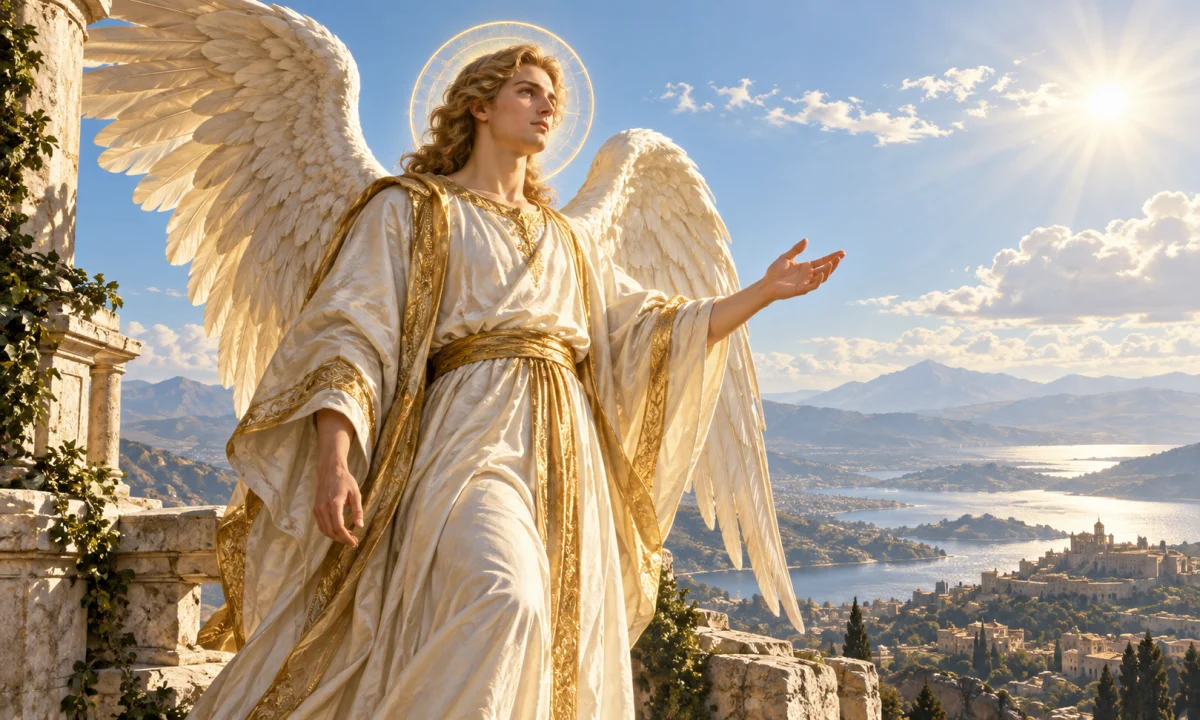
No universally accepted physical appearance is associated with Bariel. There is no standard iconography showing the angel with particular wings, garments, weapons, animals, jewels, or celestial symbols. Images that may appear in modern angel books or online galleries are generally artistic inventions or reconstructions rather than representations preserved by an established devotional tradition.
Likewise, Bariel has no securely documented set of powers. Some occult systems assign obscure angels responsibility for particular times, regions, planets, stars, elements, or spiritual operations. If Bariel is given one of these functions in a specific list, the attribution belongs to that system. It should not be presented as a universally recognized characteristic.
The name can nevertheless be discussed symbolically. Angelic catalogues often express a desire to organize the invisible world into an intelligible structure. A minor name such as Bariel may therefore represent the broader idea that divine or celestial activity extends beyond the few angels named in canonical scripture. In that sense, the figure’s significance lies partly in the history of classification: Bariel shows how religious and occult writers continued to expand, arrange, and interpret the angelic realm.
Bariel and Barachiel
The most likely source of confusion is Barachiel, an angel whose name is more firmly represented in certain later Jewish and Christian traditions. Barachiel is often described in post-biblical angelology as one of the archangels or as an angel associated with blessing. In some Christian traditions, especially those influenced by expanded angelic traditions, Barachiel has a recognizable devotional and iconographic presence.
Barachiel’s name may be written in several ways, including Barchiel and Barakiel. These spellings can make searches and translations difficult. However, similarity in sound is not enough to prove that Bariel is merely an abbreviated form. A source that explicitly equates the names may be following its own interpretive tradition, while another source may list them separately.
Bariel should also be distinguished from other names beginning with Bar- or ending in -el. Angelic nomenclature contains many recurring elements, and scribes or modern writers may produce similar-looking names independently. The absence of a continuous narrative makes it particularly important not to combine figures simply because their names resemble one another.
Relationship to Jewish angelology
Jewish tradition contains a rich and varied angelology, including biblical angels, apocalyptic beings, rabbinic discussions, mystical entities, and names preserved in magical texts. These materials do not form one single catalogue. Different periods and communities used different names and classifications, and some texts are concerned with theology while others are concerned with protection, healing, astrology, or ritual practice.
Bariel should not be presented as a standard figure of Judaism as a whole. The name is not comparable in documentary importance to Michael, Gabriel, or other angels whose roles are rooted in recognized Jewish scripture and interpretation. If Bariel appears in a Jewish-influenced occult list, that demonstrates the diversity of later angelic speculation, but it does not establish a universal Jewish belief in a distinct angel of that name.
The same caution applies to the word angel itself. In Jewish and Christian contexts, angels are generally understood as messengers or servants of God, but their precise nature and hierarchy have been debated. A name included in a magical or mystical system may not have been intended as the name of a personal being in the same sense as an angel appearing in a scriptural narrative.
Relationship to Christian angelology
Christianity inherited the biblical idea of angels and developed it through theological writing, liturgy, visionary literature, popular devotion, and art. A small number of named angels became especially important, while many other names circulated in apocryphal or esoteric material. Church authorities in different periods did not treat every angelic name as equally reliable, and some discouraged the invocation of unnamed or obscure spirits.
Bariel has no broad, standardized place in Christian doctrine. It is not generally included among the universally recognized archangels, and its name is not central to the mainstream teachings of the major Christian churches. Individual occult, mystical, or devotional writers may still have used the name, but such usage should be distinguished from official doctrine and ordinary Christian worship.
This distinction is not meant to dismiss the name. Minor angelic names are valuable evidence for studying how people imagined the celestial world beyond the best-known scriptural figures. They reveal the influence of copying, translation, astrology, ritual practice, and the human desire to give names to unseen aspects of creation.
Interpretation and cultural significance
Bariel’s historical importance lies less in a famous legend than in the questions raised by uncertain angelic names. Who recorded the name? Was it copied accurately? Did the writer inherit it from an older source, adapt it from another language, or create it to complete a symbolic scheme? Without a dependable early context, these questions cannot always be answered.
For researchers and readers, the name illustrates why angelology must be approached comparatively. A modern list may place dozens or hundreds of angels beside one another, but their evidence may range from scripture and ancient religious literature to recent compilations. Treating every entry as equally ancient or equally authoritative creates a misleading picture of religious history.
Bariel can therefore be understood as a figure of the margins of recorded angelology: not necessarily invented by modern culture, but not securely established as an ancient, universally recognized angel either. Its uncertain status is itself part of the subject. The responsible description is not a detailed invented biography, but an account of how the name appears, changes, and becomes attached to different systems of celestial classification.
Modern use of the name
In contemporary occult writing, spiritual websites, fantasy fiction, games, and privately developed angel systems, Bariel may be assigned a personality, appearance, planetary connection, colour, or special power. These adaptations can make the name more familiar, but they should be identified as modern interpretations rather than inherited religious tradition.
Modern authors may also treat Bariel and Barachiel as the same being, or may create an original character from the name alone. Such creative uses are legitimate within fiction and personal spirituality, but they do not resolve the historical uncertainty. A modern profile cannot by itself prove that the same attributes were known in antiquity or the Middle Ages.
The most accurate description of Bariel is therefore a cautious one: an obscure angelic name preserved or repeated in some later esoteric and angelological contexts, with uncertain origins and no consistent, widely recognized mythology. Its spelling and identity should be checked carefully, especially when it appears beside better-attested figures such as Barachiel or Barchiel.