WORLD
WORLD
Arachne
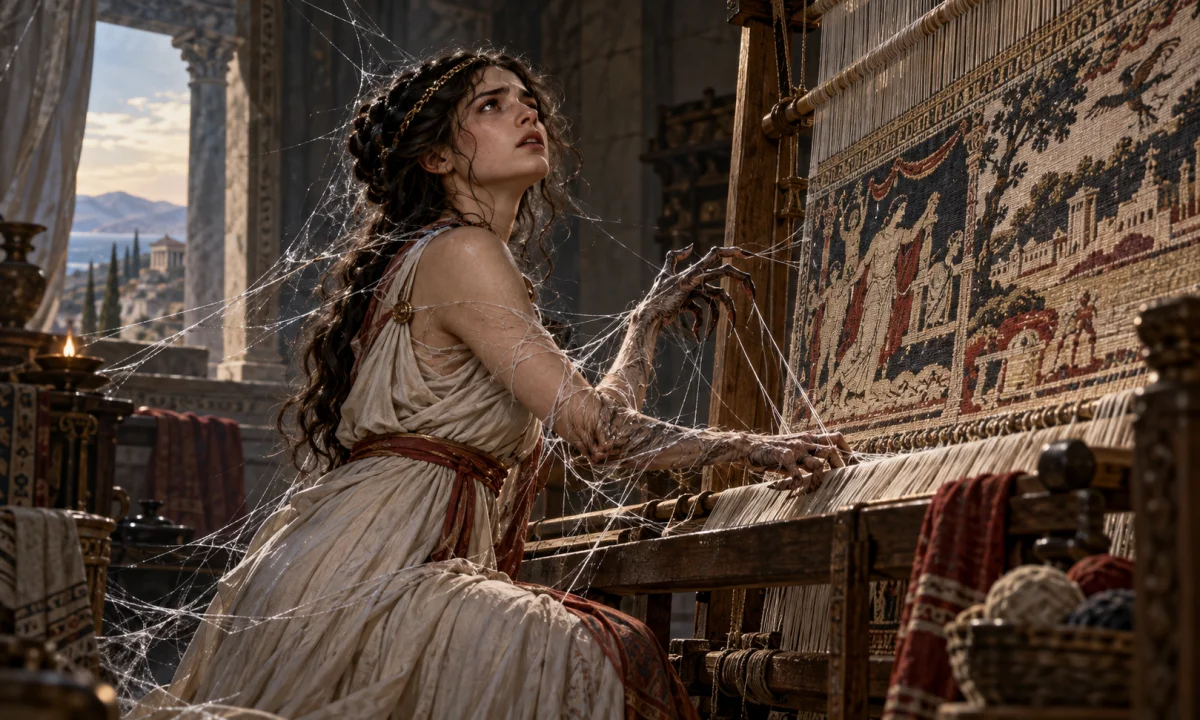
Arachne is a mortal weaver in the best-known Greek myth of artistic rivalry, pride and transformation. According to the account preserved by the Roman poet Ovid, she was so exceptionally skilled that she challenged Minerva—the Roman goddess identified with the Greek Athena—to a weaving contest. Arachne’s work proved technically perfect, but its subject matter offended the goddess. After the contest, Arachne was transformed into a spider, condemned to weave webs for the rest of her existence. Her story is therefore not simply an explanation for spiders: it is also a meditation on artistic excellence, divine power, social status and the dangers of challenging a god.
Origins and surviving tradition
The complete story of Arachne comes principally from Metamorphoses, a Latin poem by the Roman writer Ovid, composed around the beginning of the first century CE. Although Arachne is commonly classified as a figure from Greek mythology, the surviving literary version is Roman and uses the goddess’s Roman name, Minerva. The Greek equivalent is Athena.
No earlier surviving Greek text provides a full narrative of Arachne’s contest with Athena. It is therefore safest to distinguish between the broad cultural background, which is strongly Greek, and the detailed story known today, which depends chiefly on Ovid. The myth may draw on older ideas about Athena’s patronage of weaving and on traditional stories in which mortals suffer after opposing the gods, but the exact pre-Ovidian history of Arachne is uncertain.
Ovid places Arachne in Lydia, a region of western Anatolia that Greek and Roman writers associated with luxury, skilled textile production and ancient cultural traditions. She is described as a Maeonian girl, referring to the old name Maeonia for Lydia. Her father, Idmon, is presented as a dyer of wool from Colophon. Arachne’s social position is not that of a princess or priestess. Her fame comes from her own ability and labour, and this emphasis makes her unusual among figures who challenge a deity.
The setting also reflects the importance of weaving in the ancient Mediterranean world. Textile production was a major form of household labour, and spinning and weaving were strongly associated with women, domestic skill and the management of clothing and wealth. At the same time, elite myths gave weaving a divine dimension. Athena was regarded as a patron of crafts, including textile work, while the Fates were imagined as controlling or measuring the thread of human life. Arachne’s contest therefore places an exceptionally gifted human craftswoman in a field that carries religious and symbolic importance.
Name and identity
The name Arachne comes from the Greek word aráchnē, meaning “spider.” In the myth, the name becomes an explanation for her final form. This is a typical feature of aetiological mythology: a story explains the origin of a natural feature, animal, custom or name through an encounter between mortals and supernatural powers.
Arachne is not originally a spider goddess, an immortal nymph or a member of the Olympian family. She begins as a human being and becomes a spider through metamorphosis. Nor is she one of the Moirai, or Fates, despite the frequent association between weaving and the thread of life. She is also not a daughter, companion or established aspect of Athena. Her relationship with the goddess is one of rivalry between a mortal artisan and a divine patron of crafts.
The myth gives little information about Arachne’s mother, childhood or family beyond her father’s occupation and place of origin. Later retellings sometimes expand her biography, but those additions should not be treated as part of the core classical tradition unless they are clearly identified as later inventions or adaptations.
The challenge to Minerva
Arachne’s reputation spreads because of the extraordinary quality of her work. People come from across the region to admire her textiles. Some visitors even suggest that she must have learned her craft from Minerva herself. Arachne rejects this compliment. She does not want her achievement attributed to divine instruction, and she declares that she is willing to compete directly with the goddess.
Minerva first approaches Arachne in disguise as an old woman. In this form, she advises the young weaver to show proper respect to the goddess and to ask forgiveness for her boast. Arachne refuses to withdraw her challenge. She maintains that she has done nothing wrong and says that Minerva should compete openly if she is truly superior.
The goddess then reveals her identity. Arachne is not intimidated, and the contest begins. Both weavers prepare their looms and work with extraordinary speed and precision. Ovid devotes considerable attention to the visual complexity of the two tapestries, turning the contest into a literary display of artistic description.
The two tapestries
Minerva’s tapestry presents the authority of the gods and the consequences of mortal defiance. At its centre she depicts her own contest with Neptune over the patronage of Athens. Minerva shows the olive tree she created, while Neptune displays the salt-water spring or other manifestation associated with his claim. The gods award the city to Minerva, whose gift is judged more valuable. Around the central scene, she places examples of mortals who have challenged or offended the gods and suffered punishment.
The corners of Minerva’s work contain scenes involving figures such as Rhodope and Haemus, who are transformed into mountains; the Pygmy woman who is changed into a crane after insulting Juno; Antigone, whose pride brings transformation; and Cinyras, who is punished through the destruction of his family. These images reinforce the moral that mortals must recognise divine superiority.
Arachne’s tapestry is equally intricate, but its subject is radically different. Rather than praising the gods, she depicts their deceptions and abuses of power. Her scenes show gods taking animal or human forms in order to approach women, deceive them or carry them away. Among the episodes are Jupiter’s transformations in the stories of Europa, Danaë, Leda and Antiope, as well as other divine seductions and acts of coercion. The exact identification of every scene can vary in translations and interpretations, but the central point is clear: Arachne’s tapestry exposes the vulnerability of mortals before gods who can disguise themselves and escape ordinary limits.
Ovid does not present Arachne’s weaving as clumsy, foolish or technically inferior. On the contrary, the tapestry is described as flawless. The goddess cannot find a defect in its craftsmanship. The conflict arises from its content and from Arachne’s refusal to acknowledge divine authority. This distinction is important: Arachne may be guilty of impiety or provocative pride within the myth’s religious framework, but she is not defeated as an artist.
Punishment and transformation
Minerva reacts violently to Arachne’s work. She tears the tapestry apart, destroys the loom and strikes Arachne. The humiliation and violence cause Arachne to hang herself. Minerva then prevents her death but transforms her into a spider. In Ovid’s telling, Arachne’s body becomes small, her limbs become spider legs and she continues to produce thread, spinning and weaving her web with the skill she possessed as a human.
The transformation has an ambiguous quality. It is certainly a punishment: Arachne loses her human form and is excluded from ordinary human society. Yet the punishment also preserves the central quality that made her remarkable. Her skill does not disappear. The spider continues to weave, suggesting that artistic ability survives even when the artist is degraded or controlled by authority.
The ending can therefore be read in more than one way. In a traditional religious interpretation, the story warns against hubris, the dangerous overstepping of mortal limits. Arachne refuses to respect a goddess and is made into a creature far below her former human status. But the story also leaves the goddess looking threatened by an artwork she cannot surpass. Minerva has the power to punish Arachne, yet the myth does not establish that she has produced the better tapestry. The unequal contest is resolved through divine force rather than artistic argument.
Symbolism and interpretation
One major theme is the conflict between human achievement and divine authority. Arachne’s talent is genuine, and her confidence is not based on empty boasting. She has earned admiration through practice and mastery. The myth asks whether a mortal artist may claim full ownership of an achievement when the gods are believed to govern all human capacities.
The story also examines the relationship between subject matter and power. Minerva’s tapestry presents a world in which divine order is justified and rebellion is punished. Arachne’s tapestry presents the same divine world from the perspective of those harmed by it. Her work calls attention to the violence, deception and sexual coercion hidden beneath stories of divine romance. This does not make Arachne a modern political dissident in any simple sense, but it explains why later readers have found her tapestry especially open to criticism of authority.
Gender and social status are equally important. Arachne is a working craftswoman rather than an aristocratic heroine. Her expertise gives her a form of authority that does not come from birth, marriage or divine favour. The contest places a mortal woman’s independent skill against the power of a goddess who represents both divine sovereignty and an ideal of disciplined craft. Interpretations differ over whether the poem ultimately endorses Minerva’s punishment, exposes its cruelty or does both at once.
The myth is also an example of ekphrasis, a literary description of a work of art. The reader is invited to imagine two tapestries that cannot literally be displayed in the poem. Their contrast creates a debate about art itself: should art praise established order, or should it reveal uncomfortable truths about those who hold power? Ovid’s interest lies not only in the transformation of a woman into a spider but in the tension between artistic representation and political or divine control.
Arachne and Athena
In Greek contexts, Arachne’s opponent is usually called Athena. In Ovid’s Roman poem, she is Minerva. The identification is understandable because Roman Minerva was commonly associated with Greek Athena, especially in later literary and cultural traditions. Nevertheless, the names belong to different religious systems, and the precise character of Athena and Minerva was not identical in every context.
Retellings often simplify the contest into “Arachne versus Athena,” which is acceptable when presenting the myth in a Greek-mythological framework. A historically precise account should note that the surviving full narrative uses Minerva and was written in Latin by a Roman poet. It should also avoid describing Arachne as Athena’s eternal enemy or as a goddess of spiders. Those ideas belong to later simplification, reinterpretation or popular culture rather than to the classical story itself.
Distinctions from similar figures
Arachne should not be confused with Anansi, the West African and Caribbean spider trickster, whose stories belong to different cultural traditions and whose role is often that of a clever cultural hero or storyteller. Nor should she be merged with the Greek Fates, who use spinning and thread as images of destiny but are not transformed human weavers. Arachne is also distinct from Athena herself: Athena is the divine patron of crafts, whereas Arachne is the mortal artisan who challenges her.
The word “arachnid” in modern zoological terminology ultimately reflects the Greek word for spider and therefore preserves a linguistic connection with Arachne’s name. This is an etymological legacy, not evidence that ancient people understood all arachnids through a single religious tradition. In biology, arachnids are a large group of animals including spiders, scorpions, mites and ticks, while Arachne remains a mythological figure.
Later reception
Arachne became an influential symbol of the artist whose excellence brings punishment as well as fame. European writers and artists repeatedly returned to the episode, especially the contrast between the two tapestries. The myth was particularly useful for works concerned with painting, weaving, female creativity and the dangers of competing with established authority.
In modern literature and visual art, Arachne is often reinterpreted more sympathetically than she is in conventional moral retellings. Some adaptations treat her as a victim of divine jealousy, a defender of truth or a figure representing women whose work has been controlled or erased by powerful institutions. Others retain the warning about arrogance and present her transformation as the consequence of refusing to recognise limits. These interpretations are modern readings of the classical narrative rather than evidence that all ancient audiences understood her in the same way.
Contemporary fantasy, comics, games and popular fiction frequently use “Arachne” or spider-like versions of the character. Such adaptations may give her magical powers, a monstrous appearance, a heroic role or a continuing rivalry with Athena. They should be distinguished from Ovid’s Arachne, whose defining features are her human origin, exceptional weaving, critical tapestry and transformation into an ordinary spider-like creature that continues to spin.